WHEN WE WERE in Ahmedabad in November 2025, we saw a superb exhibition at the Kasturbhai Lalbhai Museum. It was housed in a separate, contemporarily designed annex of the museum, the Rahul Mehrotra gallery, within the grounds. This was built on the site of the Lalbhai family’s former tennis court.
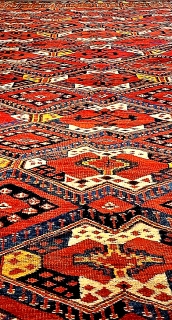
The show we had come to see was called “Bukhara”. It was an exhibition of 19th century traditional textiles from Central Asia, including decorative examples of suzani (needle-crafted hand embroidery using silk or cotton), ikats (weaving using complexly dyed threads), and rugs. The textiles and items (e.g., clothing) made by craftsmen living near to the Silk Routes in Central Asia were magnificently coloured, often with dramatically vivid patterns. On one piece of fabric, decorated with six identical circles, we noticed that one of the circles had a smaller one sewn within it. This, we were told by our guide, was a deliberate imperfection placed to show that only God can create something that is perfect. It might have been deliberately imperfect, but the exhibition was as near perfect as possible.
Since time immemorial, incense sticks have been in use. Here they are burning (for auspicious reasons) at the start of day in a mobile ‘phone shop in Bangalore … for me, this juxtaposition of ancient and modern encapsulates life in modern India.
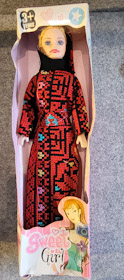
THERE IS A SUPERB exhibition at Cambridge’s Kettles Yard until the end of October 2023. The beautiful exhibits are mainly garments embroidered by Palestinian women before and after 1947. There are also a few other items including Palestinian propaganda posters depicting women wearing embroidered garments. The labels next to the exhibits are full of interesting information. Several of the topics particularly interested me.
Some of the garments were made using scraps of pre-used materials – for example bits of old clothes or even sacking and other packing materials. These old textiles were stitched together to create new clothes. This reminded me of a similar recycling of old materials which I saw at an exhibition of Japanese recycling at London’s Brunei Gallery.
I saw examples of Palestinian dresses which seemed very long. The length of these skirts was for a purpose. The cloth could be raised up to produce pocket like folds in which objects could be carried. These dresses were worn by Bedouins living in the Bethlehem and Jerusalem areas.
There was a widow’s dress. It was dark blue – the colour signifying grieving – and trimmed with red threads, which signified that the wearer was ready to be remarried.
One room was dedicated to embroidery and how the troubled situation in Palestine affected it. In refugee camps, some of the traditional materials were unavailable, and women had to embroider using whatever threads they could get hold of. There were several embroidered dresses adorned with decorations including the Palestinian flag and other patriotic motifs. These were displayed in the same room as the pro-Palestine propaganda posters that show women wearing embroidered garments.
I hope that what I have written gives you something of the flavour of this fascinating exhibition. Despite the intense reactions that discussing the plight of the Palestinians often arouses, the exhibition at Kettles Yard takes a reasonably balanced view of the situation. Its emphasis is on the skills of the Palestinian embroiderers rather than the politics of the part of the world where some of them still reside.
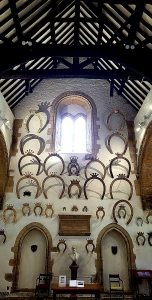
WHEN I WAS a child, I used to enjoy leafing through a book filled with black and white photographs of places in all the counties of England. One of them that stuck in my mind was of a wall covered with large horseshoes. It was only today (the 11th of August 2023) that I saw this wall in ‘real life’. It is in the great hall of Oakham Castle in England’s smallest county – Rutland. The hall, a fine example of Norman architecture, was built between about 1180 and 1190 for one of William the Conqueror’s grandsons – Walkelin de Ferrers. The name ‘Ferrers’ is related to the French word for iron and the English word ‘farrier’, who applies shoes to horse’s hooves.
The Ferrers family held Oakham for about 130 years. It might have been during that time, or certainly by the early 16th century that a curious tradition was established. It was decreed that every peer of the realm who visits Oakham for the first time must donate a horseshoe to the lord of the manor. That tradition is continued even today. Some 245 larger than life horseshoes have been donated to Oakham and many of them can be seen within the great hall. It is likely that others were donated, and subsequently lost. Most of the horseshoes on display bear the names of the donors and the date when they were donated – that is, the year the donor first visited Oakham.
Three of the horseshoes all bear the date 1921, which was when their donors (the future King Edward VIII, the future King George VI, and Princess Mary – daughter of King George V) all visited Rutland as part of a hunting party. Also in 1921, Oakham was visited by Frederick Rudolph Lambart, 10th Earl of Cavan. In 1917, he took command of the British forces in Italy. His horseshoe is mounted on a wooden board. It surrounds a real horseshoe, which had once been worn by an Austrian pony, which he captured after a raid on enemy trenches in Asiago. Another visitor to Oakham was William Edwardes, 3rd Baron of Kensington, after whom Edwardes Square (in Kensington) was named. He visited in 1855. One could continue, but I will not because the biographies of the illustrious donors are too numerous to describe in this short essay.
Another special feature of the great hall is that it is still a working Crown Court. It is used occasionally. Of all the Crown Courts in England, this has remained housed in its original building longer than any others in the country.
Apart from the fascinating great hall, the tiny town of Oakham has many other interesting things to see including a market cross, a fine museum, a gothic parish church, and Oakham School (founded 1584). However, the hall full of horseshoes is by far the most interesting thing to visit. I was pleased to see it even if so many decades have elapsed since I saw a photograph of it during my childhood.
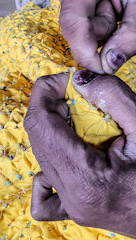
WHILE WANDERING THROUGH the large rambling bazaar in Mandvi, which is in the former Kingdom of Kutch (now part of Gujarat), we came across a workshop where bandhani textiles for clothing were being made.
Making a knot for bandhani dyeing
Bandhani is a method of producing patterned dyed silks and cotton. Put simply, a piece of cloth, already dyed one colour or not at all, is prepared as follows. Parts of the cloth are gathered up to form tight bundles fastened by fine threads. The bundles, which look like small pimples are distributed to form patterns. The tied cloth is then dyed. The dye reaches all parts of the cloth except those enclosed in the tiny bundles. When the bundles are untied the patches of the cloth that had been shielded from the dye remain the original colour. This process can be repeated several times using different dyes to create an interesting pattern.
The shop the looked at, Khatri Ibrahim Siddik & Co, is the oldest bandhani workshop in Mandvi. It has been run by the same family for fifteen generations .
During our recent visit (January 2023), we have come across several businesses that have passed from generation to generation. In Bhuj, the Shivam Daining (sic) restaurant is run by chefs whose great grandfathers, grandfathers, and fathers, have all been cooks to the Maharaos of Kutch. Likewise, there is a bakery in Bhuj with an ancient wood fired stove. This business has passed through at least four generations. Nearby, there is a knife, scissors, and sword maker, who is the fourth or fifth generation of a family, which has been in this trade for over more than a century.
I am certain that there are plenty more examples of families in Kutch specialising in skills that have been passed from one generation to the next. I wonder whether these skills are in the genes, or simply taught by one generation to the next, and so on.
THERE IS A COPY of an icon, originally painted in Constantinople, in Truro Cathedral. This well-executed replica stands near the west end of the chancel. It depicts the Holy Child, Jesus, being held by the Virgin Mary. It exemplifies what we were told several years ago whilst being shown around a collection of icons in the Sicilian town of Piana degli Albanese, whose population is descended from Albanians who fled from the Ottomans in the late 15th century. These folk speak not only Italian but also a dialect of Albanian, known as Arberesh.
The icon in Truro shows the Virgin Mary dressed in dark blue and Jesus dressed in red. Our guide in Piana had shown us that in all the icons, the same thing can be seen. Conventionally, in Byzantine icons, Jesus is almost always dressed in red and the Virgin Mary in blue. The copy of the icon on display in Truro Cathedral is no exception to this tradition.
HAMPSTEAD GARDEN SUBURB (‘HGS’) in north London, where I spent my childhood and early adulthood, is a conservation area containing residential buildings designed in a wide variety of architectural styles. It first buildings were finished in about 1904/5. Despite this, many of the suburb’s houses and blocks of flats were designed to evoke traditional village architecture. Much of HGS contains buildings that do not reflect the modern trends being developed during the early 20th century, However, there are a few exceptions. These include some houses built in the ‘moderne’ form of the Art Deco style, which had its heyday between the two World Wars.
In Lytton Close
A few Art Deco houses can be found in Kingsley Close near the Market Place (see https://adam-yamey-writes.com/2022/02/07/art-deco-in-a-north-london-suburb/), and there is a larger number of them in the area through which the following roads run: Neville Drive, Spencer Drive, Carlyle Close, Holne Chase, Rowan Walk, and Lytton Close. The part of HGS in which these roads run was developed from about 1927 onwards, mainly between 1935 and 1938. So, it is unsurprising that examples of what was then fashionable in architecture can be found in this part of the suburb. According to an informative document (www.hgstrust.org/documents/area-13-holne-chase-norrice-lea.pdf) about this part of HGS:
“… A relatively restricted group of established architects undertook much development such as M. De Metz, G. B. Drury and F. Reekie, Welch, Cachemaille-Day and Lander, and J. Oliphant. H. Meckhonik was a developer/builder and architects in his office may have designed houses attributed to him.”
Most of the Art Deco houses on Spencer Drive and Carlyle Close leading off from it are unexceptional buildings, whose principal Art Deco features are the metal framed windows (made by the Crittall company) with some curved panes of glass. Fitted with any other design of windows, these houses would lose their Art Deco appearances. Number 1, Neville Drive displays more features of the style than the houses in Spencer Drive and Carlyle Close. There is, however, one house on Spencer Drive that is unmistakably ‘moderne’: it is number 28 built in 1934 without reference to tradition. It is an adventurous design compared with the other buildings in the street.
Numbers 13 and 24 Rowan Walk, a pair of almost identical buildings which stand on either side of the northern end of the street, where it meets Linden Lea, stand out from the crowd. They have flat roofs and ‘moderne’ style Crittall Windows. Built in the 1930s, they are cubic in form: unusual rather than elegant.
I have saved the best for last: Lytton Close. This short cul-de-sac is a wonderful ensemble of Art Deco houses with balconies that resemble the deck railings of oceanic liners, flat roofs that serve as sun decks, curved Crittall windows, and glazed towers housing staircases. Built in 1935, they were designed by CG Winburne. I have to admit that although I lived for almost three decades in HGS, and used to walk around it a great deal, somehow I missed seeing Lytton Close (until August 2022) and what is surely one of London’s finer examples of modern domestic architecture constructed between the two world wars. Although most of the Art Deco buildings in HGS are not as spectacular as edifices made in this style in Lytton Close and further afield in, say, Bombay, the employment of this distinctive style injects a little modernity in an area populated with 20th century buildings that attempt to create a village atmosphere typical of earlier times. The architects, who adopted backward-looking styles, did this to create the illusion that dwellers in the HGS would not be living on the doorstep of a big city but instead far away in a rural arcadia.
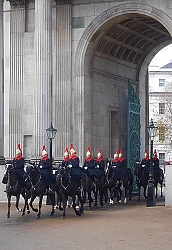
As we approach the end of the year, the pandemic rages on, the weather is appalling, and prospects for post-Brexit UK are not yet looking too bright. But all is not doom and gloom. On Christmas Eve, we went for a walk from Knightsbridge to St James Park. As we reached Hyde Park Corner and the Wellington Arch, an ever present reminder of the days when ‘England ruled the waves’ and a great deal more, we heard the sound of horse’s hooves behind us. We turned to look back at the arch and saw a line of mounted soldiers with shining helmets adorned with red tassels emerging from beneath the arch.as they have been doing several days a week for very many years, if not for several centuries. Seeing this age-old tradition being enacted in front of us reminded me that although much has been disrupted since the covid19 virus began ruling the waves, life goes on.





 yamey
yamey 