One Uber or two at a club in Bangalore

WE NEEDED TO TRAVEL in an Uber cab from Bangalore’s Catholic Club to the Bangalore Club – not far, but we had heavy baggage. A uniformed security guard kindly agreed to book a cab. He was, he told us, from Assam – a member of the large Assamese Bodo community.

Before he ordered the taxi, he looked at us – a European man and an Indian lady, and asked us if we needed one car or two. My wife explained that we are married, and only needed one car.

I believe that the reason the guard asked us how many cars we required was that, coming from a traditional community at the Eastern edge of India, it must have seemed unlikely to him that people from totally different communities, such as my wife and I, would ever become joined in matrimony.

I was struck by his enquiry because when we have travelled in many parts of Gujarat, people have often expressed surprise, and even disbelief, when they learn that a ‘desi’ (Indian) woman has married a ‘gora’ (pale coloured) such as I am. I have described this kind of incredulity in great detail in my book about travelling in India: “The Hitler Lock and Other Tales of India”, which is available from Amazon:
https://www.amazon.co.uk/HITLER-LOCK-OTHER-TALES-INDIA/dp/B0CFM5JNX5/

By road and by rail through rural Gujarat

WE HAD DECIDED TO travel to Mandvi (in Kutch, a part of Gujarat) by taking a train to Gandidham, then going by road the 98 kilometres between there and Mandvi.

The Indore to Gandidham Express arrived 30 minutes late on Ahmedabad Junction’s platform 4. Getting on to our carriage was a veritable scrum. The problem was that people, including us, wanted to board before those alighting at Ahmedabad had reached the carriage entrance. Someone behind us shouted “Hurry up and get inside.” When a passenger who was trying to leave the train replied “We want to get off”, the irritating lout behind us shouted “You should have started getting out quicker.” We struggled along the carriage and found our window seats eventually.

We had reserved seats numbers 73 and 76. A man was sitting in seat 76. When we said it was one of ours, he said that he was occupying his alloted seat, namely seat 77. It took some considerable persuasion before he understood that seat 77 did not have the number ‘76’ above it. This incident reminded me when I used to travel by train in Italy during the 1960s.

Whenever we travelled by intercity trains in Italy long ago, my parents always reserved seats – always in the first class carriages – in advance. Invariably, our reserved seats would be occupied by passengers who should not have been in them. It was o lying after the train conductor had been summoned that the people yielded our seats to us. Moments later, these obstinate people would engage in friendly conversation with us.

Returning to the Indore to Gandidham Express, before it started, vendors selling fruit and bottled water roamed along the platform looking for customers. Meanwhile, a hot tea seller moved along the interior of the train. He and others remained on board during the journey, as did a couple of snack vendors.

Once we got going, the train sped along. There was only one intermediate station where we stopped briefly during the 4 and a 1/2 hour journey. As we traversed the flat plains of Gujarat, we saw many neatly cultivated fields and numerous industrial units of varying sizes. In the area where eastern Kutch begins, we passed vast expanses of land being used as salt pans. Every now and then, we saw conical mounds of grayish white harvested salt.

Many trains passed us, travelling in the opposite direction. Almost all of them were freight trains. The line along which were moving leads to and from the busy port of Kandla on the south coast of Kutch. What little we saw of Gandidham and its outskirts was unattractive.

The air temperature at Gandidham station was well over 30 degrees Celsius and there was little shade. To exit the station, we had to use an escalator. Once again it was a scrum trying board it. Some passengers were too frightened to step on it which made using it even more difficult.

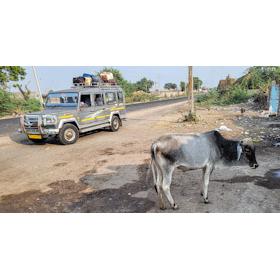
Our host in Mandvi had kindly booked us seats in a shared taxi to travel from Gandidham to Mandvi. This vehicle was like a jeep. It had a front row of seats – sofa like – and behind that there was another similar seating arrangement. Behind that, there was a far less comfortable seating space that accommodated any number of people that could be squeezed in. We were booked into the seating behind the front seats and in front of the rear ‘compartment’.

Although the middle seating had been booked for my wife and me, Lopa invited one of the three passengers who had squeezed in the front seat next to the driver to join us. He turned out to be a friendly chap. He and his friends were returning home from several days of a religious pilgrimage. Our new companion was a trader in rice, sugar, etc. He bought commodities and sold them for export. During our journey, he received a telephone call. He told us that soon after getting home, he had to go to Bombay for some urgent work. He and his business partner would have to drive for 11 hours through the night to reach Bombay from near Mandvi.

Our driver decided not use the 4 lane highway between Gandidham and Mandvi because of heavy traffic. Instead – and it made the journey far more interesting – he took us along a “short cut”, using country roads, some of them minor. This added fascination because we passed through rustic villages. At one of these, we were stopped by an elderly lady standing beside the road. She wanted to go to Mandvi, and was invited on board.

At another place, we stopped and the driver picked up a bundle tied in cloth, which he delivered to someone in another village we passed through later. After about an hour, to my great relief because my mouth was parched, we stopped for about 20 minutes at a stall where snacks and cold drinks were available.

At one point early during our journey, someone in the rear compartment asked our new companion to dial a certain number on his phone. Some conversation in Gujarati ensued. It turned out that there were some labourers travelling in the rear compartment. As they had not yet been paid by their employer, they claimed that they did not have the 300 Rupees needed to pay for the ride. Our friendly sugar trader allowed the employer to electronically transfer the required amount to his account. Our neighbour then suggested that he could electronically transfer that fare money to the driver’s account. However, the driver wanted to be paid in cash, which the trader kindly agreed to do.

Most of the way, the driver used one hand to steer, and the other to hold his mobile phone to his ear. Despite this hazardous practice, there were no scary moments along the way. We arrived at our destination safely, but somewhat cramped.

When we sat inside our host’s air-conditioned large saloon car to drive to his house, it felt as if we had moved from a stone seat into a feather bed. Never before has a modern saloon car felt so comfortable.

Despite moments of discomfort, our rail and road trip was enjoyably interesting. By the end of the journey we felt as if we had been truly travelling – a feeling that air travel often fails to provide.

Come with me in my Ferrari

Fort Kochi (Fort Cochin) is the picturesque, historic part of Kochi – a port on the coast of Kerala in southwest India. Occupied at various different times by the Portuguese, Dutch, and British, this small urban area at the northern tip of an island contains many buildings that recall the town’s former foreign occupiers.

Essentially, the historic town centre consists of a few short streets and some open spaces. Fort Kochi is built on flat terrain, and is a paradise for walkers even in the hot, humid weather that prevails most of the year. As a consequence, the large number of autorickshaw (‘auto’) drivers often seems to outstrip customer demand.

From dawn to after dusk, auto drivers cruise around the town in their empty vehicles, looking for customers. We usually spend at least a week in Fort Kochi every year, especially when the excellent Kochi-Muziris international art biennale is in progress. So, individual auto drivers get to know us as we stroll around. They stop and ask us if we need a ride. We tell them that we are walking. So, when they next see us, optimistically they invite us to take a ride. When we turn them down, they say to us in an understanding way:

“Walking, walking! – always walking.”

Other auto drivers, who either do not recognise us or are trying to tempt other tourists into their cabs, say:

“See my Ferrari. Come and take a ride in my Ferrari.”

This always amuses me because to describe an auto as a Ferrari is rather like describing a pigeon as an eagle.

On the subject of Ferraris, there are some in India. One of them, an eye-catchingly bright yellow, belongs to, or is driven by, a young man who is the late teenaged son of a wealthy family in Bangalore. Because this is not a type of vehicle that could be safely parked in most parts of the city, he can only use it to drive to and from the exclusive Bangalore Club, where he can park it in an area well policed by security guards. At his home, he parks it in the safe compound containing his residence. Given the density of traffic and the daring driving in Bangalore, it is amazing that he feels safe enough to flaunt his precious car on the roads between his home and the Club.

Little green huts

SOUTH OF KENSINGTON Gardens, just west of the Royal Garden Hotel, there is a small green hut with a pitched roof beside Kensington Road. It is one of the thirteen remaining cabmen’s shelters dotted around central London, which were established by the Cabmen’s Shelter Fund (‘CSF’) in 1875 and are still maintained by this organisation. Back in those days, cab drivers could not leave a cab stand whilst they were parked there. This made it difficult for cab drivers to obtain food and drink whilst on duty.

The solution to this problem was devised by the newspaper editor George Armstrong (1836–1907) and Anthony Ashley-Cooper, 7th Earl of Shaftesbury (1801-1885). They conceived the idea of the shelters to provide cabdrivers with refreshment. By law, the shelters had to be no larger a horse and cart, which explains their small size. That way, they did not encroach on the carriageway too much. In the past, these shelters confined themselves to serving cabmen. More recently, members of the public can buy snacks and drinks at these huts, whose attendants are supposed to make a living from their shelters.  Cabmen can eat within a shelter, but others can only use them for take-away refreshments.

Recently, when passing the shelter on Kensington Road, I noticed that there were a couple of menus attached to it. Next to them was a small blackboard on which the following was written in chalk:

“Till Rolls 3 for 2.50 Receipt pads 4 for 2£”

This is stationery for the exclusive use of taxicab drivers. I was pleased to see this because it means that although they are open to the public, they are still of special use to cabdrivers.

I have never sampled anything at a cabmen’s shelter, so have no idea of the quality provided. Years ago, when I was practising dentistry, one of my patients was a taxicab driver. He was a ‘foodie’ and  told me that he knew great quality, reasonably-priced eating places all over London. I cannot recall that amongst the many places he told me about that there were any cabmen’s shelters.

No refusal

TAXI NO RESUSAL[2493]


UBER DRIVERS IN MADRAS are, so I have been told, unaware of a customer’s desired destination when they accept a job. It might be a short ride or even an out of town destination. We discovered a consequence of this earlier this year when we were advised that the most reasonable way to make the three-hour journey from Madras to Pondicherry was to hire an Uber cab.

The first three drivers, who offered us rides, phoned us to ask where we wanted to go. When we told them, they cancelled our rides. On our fourth attempt, an Uber arrived. He was happy to drive us to Pondicherry because, as we found out three hours later, he had a friend he wanted to visit there.

In Bombay, the taxis are nicknamed ‘kali pili’, which refers to their black and yellow body paint colours. Most of the cabbies are argumentative and some of them seem reluctant to work, making complaints like “too much traffic” or “that’s too far”. Eventually, one finds a cab that is willing to carry out one’s wishes, often complaining all the way. Maybe, that is because their metered fares are so reasonable for the passenger. Driving in Bombay’s traffic cannot be too much fun, especially if one is getting paid poorly to do so.

Further south in Bangalore, popular transport for those who prefer to avoid using urban buses include Uber and Ola cabs as well as three-wheeled autorickshaws.

Bangalore’s Ubers and Olas are unreliable.  Often, they accept a ride and minutes before they are about to arrive at the pickup point, they cancel. I imagine that often they get stuck in the city’s slow moving or often static congested traffic and feel they are wasting their time trying to reach their passenger waiting beyond the traffic jam. Whatever the reason, these app-linked car services are not nearly as reliable as they are in Bombay or London.

Autorickshaws (‘tuk tuks’) are the best method for getting through the congested thoroughfares of Bangalore.  Their plucky drivers can take risks with their small vehicles that larger cars are unable to attempt. These manoeuvres are daring and can be hair-raising for the passengers, but they get you to your destination relatively quickly. I love the drivers’ sneaky tactics, but others do not. Once, I was travelling in an autorickshaw with two American ladies on a busy main road in the centre of Bangalore. They shrieked with terror as our vehicle sped adventurously between a bus and a heavy lorry that were rapidly moving close together.

One autorickshaw driver, whose command of English was good, told me that he had been a truck driver before driving the three-wheelers to earn his living. He explained that an autorickshaw driver needs to use all of his six senses and to ‘feel the traffic’ with his body. It is my observation that most drivers of these small fragile vehicles have lightning reflexes and nerves of steel. Yet, as they weave effortlessly and excitingly through the traffic, many of them chatter away on their mobile ‘phones.

Hiring an autorickshaw in Bangalore is always an adventure. The vehicles are fitted with taximeters, which are supposed to determine the fair. They are used occasionally but not often. The driver will start by suggesingt an often outrageous fare, which is the starting point for haggling.  Or, some drivers will agree to use the meter determined fare plus some extra Rupees in addition.

Some autorickshaw drivers without much to do will offer foreigners something like:

“Come with me. I’ll take you anywhere for only 10 Rupees.”

Sounds tempting, does it not? Do not succumb to this unbelievable offer because if you do, you will soon discover the catch. The naive passenger will be invited to visit the driver’s friend’s/cousin’s/brother’s  store, where if you buy something, the driver will be rewarded with something like: school books for his children, or a kilo of rice for his starving family, or a new shirt, etc.

Some autorickshaw drivers will set off for a journey in Bangalore, and then after a few minutes, will ask the passenger whether, on the way, they want to do some shopping at a shop the driver recommends. That is, at a shop that will offer the cabbie a commission or a gift when the passenger makes a purchase. A determined refusal is required to ensure that your journey will not include an unwanted, time-wasting detour for shopping.

On the whole, autorickshaws are a great way of getting around Bangalore.

Calcutta is filled with rugged but battered yellow Ambassador taxis. These are slowly being replaced by newer vehicles with blue and white body paint. One thing they share is the wording “No Refusal” painted on the exterior of their doors. The cab driver, who stops to pick up a passenger, is not supposed to refuse to take you wherever you want. Most of the drivers comply with this.

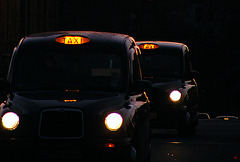
Black Cab taxi drivers in London and other places in the UK are, by law, required to take you anywhere within the area they can legally operate. Like the drivers in Calcutta, the British cabbie is supposed to adhere to the “No Refusal” concept, and often, but by no means always, cabbies comply.

Interesting as all this is, present conditions during the current pandemic mean that not too many cabs are being hailed at the present in London. While the ‘lockdown’ is in force, even in its present slightly diluted form, I feel sorry when I see an empty Black Cab with its ‘For Hire’ sign illuminated cruising the almost empty streets in the hope of finding a customer.

No refusal

UBER DRIVERS IN MADRAS are, so I have been told, unaware of a potential customer’s desired destination when they accept a job. It might be a short ride or even an out of town destination. We discovered a consequence of this when earlier this year we were advised that the most reasonable way to make the three hour journey from Madras to Pondicherry was to hire an Uber.

The first three drivers, who offered us rides, phoned us to ask where we wanted to go. When we told them, they cancelled our rides. On our fourth attempt, an Uber arrived. He was happy to drive us to Pondicherry because, as we found out three hours later, he had a friend he wanted to visit there.

In Bombay, the taxis are nicknamed ‘kali pili’, which refers to their black and yellow body paint colours. Most of the cabbies are argumentative and some if them seem reluctant to work, making complaints like “too much traffic” or “that’s too far”. Eventually, one finds a cab that is willing to carry out one’s wishes, often complaining all the way.

Further south in Bangalore, popular transport for those who avoid urban buses include Uber and Ola cabs as well as three-wheeled autorickshaws.

Bangalore Ubers and Olas are unreliable. Often they accept a ride and minutes before they are about to arrive at the pickup point, they cancel. I imagine that often they get stuck in the city’s slow moving or often static congested traffic and feel they are wasting their time trying to reach their passenger waiting beyond the traffic jam. Whatever the reason, these app connected car services are not nearly as reliable as they are in Bombay or London.

Autorickshaws are the best method for getting through the congested thoroughfares of Bangalore. Their plucky drivers are able to take risks with their small vehicles that larger cars are unable to attempt. These manoeuvres are daring and can be hair-raising for the passengers but they get you to your destination relatively quickly.

Hiring an autorickshaw in Bangalore is always an adventure. The vehicles are fitted with taximeters, which are supposed to determine the fair. They are used occasionally but not often. The driver will suggest an often outrageous fare, which is the starting point for haggling. Or, some drivers will agree to use the meter determined fare plus some extra Rupees in addition.

Some autorickshaw drivers without much to do will often foreigners something like:
“Come with me. I’ll take you anywhere for only 10 Rupees.”
Sounds tempting, does it not? Do not succumb to this unbelievable offer because if you do, you will soon discover the catch. The naive passenger will be invited to visit the driver’s friend’s/cousin’s/brother’s store, where if you buy something, the driver will be rewarded with something like: school books for his children, or a kilo of rice for his starving family, or a new shirt, or …

Some autorickshaw drivers will set off for a journey in Bangalore, and then after a few minutes, will ask the passenger whether, on the way, they want to do some shopping at a shop the driver recommends. A determined refusal is required to ensure that your journey will not include an unwanted detour for shopping.

On the whole, autorickshaws are a great way of getting around Bangalore.

Calcutta is filled with rugged but battered yellow Ambassador taxis. These are slowly being replaced by newer vehicles with blue and white body paint. One thing they share in common is the wording “No Refusal” printed on the exterior of their doors. The cab driver, who stop to pick up a passenger, are not supposed to refuse to take you wherever you want. Most of the drivers comply with this.

Taxi drivers in London and other places in the UK are, by law, required to take you anywhere within the area they are allowed to operate. Like the drivers in Calcutta, the British cabbie is supposed to adhere to the “No Refusal” concept, and often, cabbies, but by no means always, comply.

Interesting as all this is, present conditions during the current pandemic mean that not too many cabs are being hailed at the present.

Picture: Taxis in Calcutta

A narrow escape

IN AUGUST 2011, MY WIFE was invited to attend a Loreto House school reunion in Calcutta (Kolkata). As I had never been to the city before, I accompanied her. While my wife took part in the daily activities with some of her former schoolmates, I explored and fell in love with Calcutta.

Throughout our five day visit to the city, the monsoon rain fell heavily and incessantly. I walked around Calcutta, often wading through filthy water that submerged my feet and lapped around my ankles. This hardly affected my enjoyment of the delightful decaying city, in some respects India’s own distinctive version of old Havana in Cuba.

One day, I visited Jorasanko, the palatial residence of the Tagore family, whose members included not only the Nobel Prize winner Rabindranath but also artists such as Abanindranath and Gaganendranath.

After seeing around the fascinating rooms of Jorasanko, I sploshed through the flooded streets towards the Hooghly River. On my way, I walked along a busy street lined with shops and filled with crowds of people. A steady stream of rickshaws pulled by thin sinewy men and each laden with two or three passengers made its way through the busy throng. The huge wheels of these vehicles keep the passengers high above the water flooding the streets.

I noticed that some shops, often clothes and textile merchants, were giving hot food to some passersby. At one of these shops, I asked about the food distribution. It was explained to me that during Ramadan, it was considered to be a virtuous thing to feed the poor.

Eventually, after crossing a wide road clogged with slow moving heavy traffic, I stepped onto the Howrah Bridge, a gigantic steel bridge, a Meccano lovers dream, which traverses the River Hooghly. It was constructed between 1935 and early 1943.

At first, the bridge crosses over a large market that runs along the riverbank. Then, after a few yards, it is over the water. I walked along the downstream facing pedestrian walkway, dodging many porters carrying heavy and bulky loads on their heads. I took numerous photographs until I was two thirds of the way across the bridge and met a policeman with an ancient rifle slung over his back. Politely, he informed me that photography was forbidden on the bridge. By then, I had sufficient images stored in the memory of my camera.

Once over the river, I headed through the streaming rain and thick crowds to a boat station close to the Howrah railway terminus. My plan was to travel on a river bus downstream to a landing stage not far from Park Street.

I bought a ticket which was printed on very poor quality paper, that had to be kept dry to avoid it falling to pieces. I asked someone on the floating platform at the water’s edge if the boat that was approaching was heading for my planned destination. I received what I believed was an affirmative reply, and then boarded a relatively empty boat with plenty of free seats. We set off.

To my surprise, the boat headed upstream rather than downstream. Soon, we passed beneath the Howrah Bridge. We sailed a long way upstream away from the city centre. The banks of the river were lined with unattractive industrial buildings and these were punctuated by occasional bathing ghats.

I disembarked at the boat’s first stop. Had it not been raining so heavily, I would have exited the boat station to take a look around the area. Instead, I bought another flimsy ticket to return to Howrah. This time, I asked several people at which of the two floating embarkation pontoons I should board the downstream boat. I waited close to the water while a large crowd of fellow passengers gathered behind me. I wanted to be sure of embarking first.

The boat approached where we were all standing. I could see from afar that it was packed to the gills with people. When the boat was about 18 inches away from the pontoon, I felt a great push from behind me and I was catapulted across the water towards the approaching vessel. Luckily, I was able to grab something on the boat and this saved me from falling into the water and being crushed between the boat and the pontoon.

The boat was stuffed with people. I am sure that sardines are less tightly packed in tins. I wanted to try to take a photograph to capture an image of this crowd, but I could not because so great was the pressure exerted by those around me that I was unable to raise my hands from beside my body.

I looked around and noticed there were few life saving flotation items. Had our boat sunk, few on board would have survived.

It was a great relief to disembark at Howrah. I was drenched, somewhat shaken, and hungry. I decided to take a taxi to Flurys in Park Street, a European style tea room that served what I was yearning at that moment: toasted club sandwiches.

I boarded a battered yellow Ambassador taxi in a car park near the railway station. We moved forward into a mass of other similar taxis. The crowded taxis were so close to each other that it felt that they were all welded together. It took almost an hour for my driver to skilfully manoeuvre his taxi a couple of hundred yards on to the bridge.

At last, we arrived at Park Street, where, slightly drier because of sitting for ages in the taxi, I settled down at a table in Flurys. I ordered my sandwich and savoured the peaceful atmosphere in the tea room.

On my third visit to Calcutta at the end of 2019, we visited Flurys but, sadly, we were disappointed to find that its food and service was no longer as good as before. Fortunately, the scruffy Nizams at New Market, which serves parathas stuffed with meat and omelettes, remains as good as it was in 2011 and many years before.

Despite my near escape from severe injury or worse, my enthusiasm for Calcutta and its people continues to grow and grow.

DEATH OF A DRIVER

THE PEAK OF MOUNT KANCHENJUNGA was covered with snow and clearly visible from our bedroom window in Gangtok at 630 am on the 29th November 2019. By 900 am, it was hidden by clouds.
Our taxi driver collected us and we set off for Darjeeling. Although he was born in Sikkim, his parents are from another part of India. Almost 90% of the inhabitants of Sikkim are not Sikkimese and do not enjoy the special privileges afforded to ‘Sikkim Subjects’, people whose ancestors originated in Sikkim. These privileges include owning land and not paying income tax.

The majority of people who now live in Sikkim arrived there after it was absorbed by India in the mid 1970s.

From Gangtok the route is mainly downhill to Rangpo, the border between Sikkim and West Bengal. The winding road follows the River Rani downstream from Ranipool. As we drove along through the wooded valley, our driver told us about ‘D’, one of the two drivers he employs.

‘D’ was the fifth husband of a lady who owns a restaurant and bar. One night, well after midnight when D’s wife had closed her eatery, D decided to give her a driving lesson.

She sat at the wheel, and just before her lesson was to begin, D dashed into the restaurant building to relieve himself. While he was away, she rashly decided to show her husband that she knew how to drive and did not actually need to be taught by him. When he came out, he saw that the car was moving steadily towards the edge of the road and was about to topple over the edge and drop down onto a very steep slope. He ran to save the car and his wife but he and the runaway vehicle toppled off the road and fell down into the darkness below.

D was killed but his wife, who was sitting in the driver’s seat survived unscathed.

Driving without a licence is an imprisonable offence in India. To avoid risking this, her family, D’s in-laws, arrived and placed her dead spouse in the driving seat so as to make the police believe that he, who carried a driver’s licence, was driving the car when the accident occurred.

We were horrified to hear about this event which had occurred less than a fortnight before we set off from Gangtok. It was clear that D’s employer, our driver, was still stunned by what had happened.

Our driver’s careful driving gave us no cause for concern. However, as we neared Darjeeling and had rung our host to give directions for finding his homestay, our journey struck problems.

First of all, our driver told us he had never before driven to Darjeeling and had no idea about its geography. Secondly, we discovered that taxis with Sikkim registration plates, such as ours, were restricted as to where they can drive in Darjeeling. The result was that our driver had to stop at Jorebunglow, quite a few miles outside Darjeeling. We had to wait there until a local taxi driver took us into town. Despite this, the scenic journey between Gangtok and Darjeeling is a joy to experience.

Foolish on foot

Taxi!_240


Years ago, I had friends who lived south of Hampstead Heath in South End Green, near where the writer George Orwell lived during the 1930s. I often visited my friends there and usually stayed with them until long after public transport ceased working late at night – those were the days long before 24 hour bus services. In those days, I was a student with limited means. Taxi and minicab rides to my home in Hampstead Garden Suburb to the north of Hampstead Heath were costly and if used too often would eat too deeply into my meagre funds.

So, often I used to walk through the darkness to my home, a distance of well over 2 miles. Most of this walk was across the wooded stretches of Hampstead Heath. Even back in the 1970s, this vast expanse of urban woodland was far from safe. Murders and attacks were not unknown. My parents and others would have been horrified to learn that I was risking my life to save paying a cab fare. Was I scared? The answer was both yes and no. I was concerned because of the news stories I had read. Yet, on the other hand I was not so afraid.

I felt that anyone encountering me on my nocturnal wandering deep in the secluded heart of Hampstead Heath might have had one of two reactions. Either he or she might have imagined that I was up to no good and possibly on the prowl for victims and would therefore steer clear of me, or that the person  whom I encountered was up to no good. If he or she was ill-intentioned, the person would have still had to be a little bit cautious because I might have turned out to be more than a match for him or her. This reasoning would have done me no good had the person I met been severely evil. 

Fortunately, luck was on my side. I never encountered anyone, innocent or evil, on my nocturnal strolls. However, I would never even dream of making this kind of journey across Hampstead Heath again, and would not advise anyone else to attempt it because London has become more dangerous than it was in the 1970s and before.