With the Mormons

IN JANUARY1995, we drove from Phoenix (Arizona) to San Diego (California) via Yuma (Arizona). Between Yuma and our destination, we traversed the Anza-Borrego Desert east of San Diego. We made a detour to see Box Canyon in that area. After we had finally arrived in San Diego, we had an interesting experience.

Box Canyon

On our way to San Diego, we stopped in the desert at a couple of roadside information signs placed overlooking a rough track in a chasm beneath the road along which we were driving. This was part of the road along which migrants from the eastern part of the USA made their way by foot, on horseback, or in wagons, to the ‘promised’ land of California. According to the sign beside the road, in 1825 Lieutenant Santiago Arguello of the San Diego Presidio (1791-1862), a Spaniard, discovered this pass through the mountains whilst chasing horse thieves. Later, the American frontiersman Kit Carson (1809-1868), the US General Kearny (1794-1848), and gold-seekers, travelled along the route Arguello had discovered. By 1847, a road suitable for wagons had been built through the chasm by members of The Mormon Battalion. Commanded by Lieutenant-Colonel Philip St George Cooke (1809-1895), these hardy men used hand tools to prepare the thoroughfare.

The Mormon Battalion, which existed in the 1840s, was the only US battalion ever to consist solely of members of one particular religious group. All the members were volunteers and they helped to open up the Southwest of what was to become part of the USA. Apart from being involved in various battles, they also constructed the road, whose remnants we saw on our way to San Diego.

Soon after our arrival in San Diego, we stumbled upon a building related to what we had seen at Box Canyon. It was The San Diego Mormon Battalion Historic Site. Having just seen the result of Battalion’s heroic feat of labour, we felt compelled to enter the building. We were greeted amicably and warmly by an Elder, who was immaculately dressed in formal attire. Politely, he asked us if we would like to see the diorama that explained the history of the battalion and its role in opening up the west. We wanted to see this and were led into a room with chairs set out as in an auditorium in front of a large diorama.

The lights were dimmed and then our host explained what was depicted in the diorama as different parts of it were illuminated one after another. He told us the history, the details of which I cannot recall. After the ‘show’ was over, the lights went up and the Elder asked us politely whether we would like to see something else, rather special. We were game for that and he led us into a neighbouring room.

Our host invited us to sit in comfortable chairs in front of a large pair of curtains just like those hiding a theatre’s stage. Then, he pressed a button on the wall and the curtains began to part slowly and silently. They opened to reveal a huge painting in pale shades depicting a religious scene showing Jesus in heaven surrounded by pink clouds and light-skinned angels. Proudly, he informed us:

“This is a genu-wine oil painting all the way from Salt Lake City.”

After we had made politely appreciative remarks, he said to us:

“Now, if you have a moment, I would like to show you something else.”

My wife was against this, but my curiosity was fired up. He led us to another room, which contained glass display cases. They contained metal plates covered with illegible writing. Our host explained:

“Here are the tablets that our founder Joseph Smith discovered back in 1823”

Joseph Smith (1805-1844) was the founder of the Mormon religion. In 1823, so the Mormons believe, an angel directed Smith to a spot where he discovered the gold plates on which the texts of The Book of Mormon were inscribed. Our guide in San Diego was quick to explain that (unlike the oil painting we had just seen) these plates in San Diego were faithful copies of the originals, which after Smith had transcribed them, were re-buried and never seen again.

When I expressed my genuine interest in what we had been shown, the Elder offered to show us even more but my wife, who was beginning to worry that I might be about to be converted to Mormonism, said that we had to leave as we were running out of time. There was no fear of my adopting a new religion, but I was interested to know what further delights were on offer. Our host asked us where we were from, and we told him: London. He said:

“Leave me your address and I can arrange for someone to get in touch with you at home in London.”

My wife said:

“Thank you, give us your address and we can contact you.”

And with that, we exchanged polite farewells with our Elder.

My apparent interest in what we had been shown reminded my wife of her father, whom I grew to know well. Like me, he was interested in a variety of things. Once, he and I attended a trade exhibition in Bangalore (India), where he lived. We approached a stall promoting the sale of concrete beams used for constructing large buildings. Daddy engaged the representatives in conversation, asking many of the sensible questions that builders might well ask. The ‘reps’ answered enthusiastically and informatively. As this proceeded, I began to get worried that Daddy was about to buy a concrete beam for which he had no need at all. Just when he reached the point that both the reps and I expected him to write out a cheque, he shook their hands and thanked them politely before moving on to another stall.  

When we were in San Diego, I had not yet got to know of Daddy’s behaviour as described above and wondered why my wife had become so concerned at the Mormon institution. After years of accompanying my delightful father-in-law to many trade fairs and exhibitions, I now understand the cause for her concern.
Near the shops: a chapel in Kensington

HIGH STREET KENSINGTON is not amongst my favourite London thoroughfares, but streets leading off it take one to places of considerable interest. One of these, Allen Street, offers a view of a building that outshines many of its close neighbours. But, before we reach this short side street, here are a few words about High Street Ken.

Even before the covid19 pandemic, High Street Kensington has been declining in importance as a centre of retailing activity. The retailing boom that made the street into a rival of, for example Oxford and Regents Streets, began in the mid-1860s. Prior to that:

“…most trading and manufacturing activity around Kensington High Street was on a small and local scale. An exception must be made of the Catholic candle-making business owned successively by the Wheble, Kendall, Tucker and Smith families from about 1765 until 1908. Its founder was James Wheble (1729–1801), scion of a prominent recusant family in Winchester. By 1766 at the latest Wheble was based in Kensington, and within a few years occupied miscellaneous properties on the present Barkers site, both in the High Street and on the west side of Young Street, where a warehouse was rated in his name from 1772 onwards.” (https://www.british-history.ac.uk/survey-london/vol42/pp77-98).

This mention of candle making interested me because my great grandfather Franz Ginsberg (1862-1936) established a factory making candles in King Williams Town in South Africa in the 1880s.

From the late 19th century until a few years ago, High Street Ken was a healthily flourishing retail centre. In its heyday, it boasted of three large department stores, Pontings, Barkers, and Derry & Toms. The impressive buildings that housed the latter two still stand and are fine examples of art deco architecture. They are located close to the Underground station, which has been in service since the late 1860s.

In recent years, the advent of on-line shopping, high rents, and the proximity of the Westfield mall at Shepherds Bush (opened 2008), which has good parking, have all conspired to make High Street Ken less appealing to shoppers. Consequently, at any one time a large proportion of shops remain empty awaiting new tenants. Sadly, what was once (especially in the 1960s and ‘70s) a bustling high street with trendy shops like Biba and the ‘funky’ Kensington Market, has become slightly dreary.

Various short streets lead off the south side of the high street. One of them, Young Street, leads to Kensington Square, which is well worth visiting to explore its exciting range of houses dating back to the 18th century and earlier (see https://londonadam.travellerspoint.com/41/). Another road, Allan Street, west of the station, leads south from the high street. This street was a quiet cul-de-sac until 1852 when it was extended southwards. After that date, many more buildings were erected along it including the extensive Wynnstay Gardens, luxurious mansion flats, which was constructed between 1883 and 1885 on a site previously owned by Thomas Newland Allen (1811-1899), who was born at Chalfont St Giles (https://www.captaincooksociety.com/home/detail/chalfont-st-giles-buckinghamshire). A monument to Captain Cook, the explorer, stands on the estate where Allen was born.

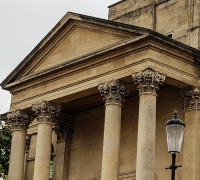
Wynnstay Gardens is not a particularly attractive set of buildings. However, south of it and on the other side of Allen Street, there is a lovely neo-classical building just south of Adam and Eve Mews, which runs along its northern boundary. For many years, I had noticed it from a distance when wandering along High Street Ken, but it was only yesterday that I decided to take a closer look at this church.

Currently called the ‘Kensington United Reformed Church’, it was originally named ‘The Kensington Chapel’. Built in 1854-55 and designed by Andrew Trimen (1810-1868), it replaced the Hornton Street Chapel (north of the High Street), which was built 1794-95 (https://www.british-history.ac.uk/survey-london/vol42/pp386-394#h2-0005). Trimen was a prolific architect and also published a book in 1849, “Church and Chapel Architecture with an account of the Hebrew Church. 1,000 authenticated mouldings”, which was (https://manchestervictorianarchitects.org.uk/architects/andrew-trimen):

“… the first major publication to consider non-conformist architecture.”

The church, clad in ochre coloured Bath stone, and its impressive pillared portico,  is an elegant addition to an otherwise undistinguished street.  Its corner stone recalls that the church replaced the one in Hornton Street and that it was laid by the Reverend John Stoughton on the 26th of June 1854. If you walk along Adam and Eve Mews, you will notice a pair of doors at the east end of the north wall of the church. Above them are the words ‘Lecture Hall’. According to a plan of the original building, this led into a ‘schoolroom’ (built 1856) attached to the east of the church. This was used to accommodate ‘British’ and ‘Sunday’ schools.

John Stoughton officiated first at the Hornton Street Chapel, starting in 1843, and then in the new building in Allen Street until he retired in 1875. His congregation was far from uninteresting as this quote from John Stoughton’s book “Congregationalism in the Court Suburb” (published in 1883) reveals:

“It may be mentioned that Kensington, on many accounts, has long been a favourite place of residence for artists and literary men, and a few of these became some occasional, others regular hearers [i.e. members of the congregation]  … Curious characters at different periods, it may be added would come into the vestry to have a little chat; a gentleman during the Crimean War gravely proposed to the preacher of peace a clever scheme for blowing up Sebastopol; and at another time one of clerical appearance repeated, with extraordinary rapidity, long passages out of the Greek Testament.”

Stoughton was such a popular preacher that by 1871, none of the 1000 sitting places in the chapel would be left unoccupied.

The chapel was damaged by bombing in 1940 and only repaired in 1952-53. Today, the building stands in all its glory and hosts regular religious services for its Congregationalist congregation (it is an autonomous protestant church, which governs its own affairs), but parts of it are now used for non-ecclesiastical purposes. Next time you wander along High Street Ken, make the short detour to see what I consider one of the finer buildings in the area alongside the unusual looking Armenian Church in nearby Iverna Gardens.

An unusual feature

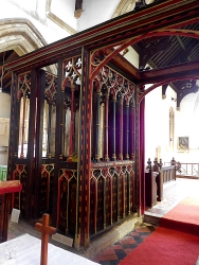
AN ELDERLY LADY WALKING with the help of a walking frame beckoned to us just after we had  walked around the Church of St Mary in the village of Guilden Morden near Royston in Cambridgeshire.  As with so many country churches we have visited since the onset of the covid19 pandemic, we had found that the church was locked up. However, the lady, who had called us over, was holding a large old-fashioned key and asked us whether we would like to see inside the church. I am so glad that we accepted her offer because she pointed out something that is very rarely found in English churches: a double rood screen.

A rood screen is often found in late mediaeval churches. Commonly made of wood and often ornate, the screens separate the nave where the congregation assembles from the chancel where the choir sings and the clergy officiate near to the high altar. The rood screen at St Mary’s in Guilden Morden, whose construction began in the 12th or 13th centuries, consists of two parallel screens on either side of a central passage leading between the chancel and the nave. It is decorated with some paintings of saints and on each side of the passage, there are small enclosures large enough for several congregants to sit during a service.

The lady, who pointed out the special nature of the rood screen, told us that in the past, the lord of one manor sat with family members in the ‘cubicle’ on one side of the central passageway and the lord of another manor sat in the cubicle on the other side. She told us that when she was a small child in the village, she had seen the local aristocrats occupying the rather cramped-looking booths between the parallel screens.

The website www.english-church-architecture.net doubts the church’s claim  that the double-rood screen is an original feature of the church. It quotes the architectural historian Nikolaus Pevsner, who:

“… declared it to be reassembled from the original rood screen and one or more parclose screens, to form “a double rood-screen, i.e. with a kind of pew left and right of a central passageway.  Three designs are represented, two very similar and clearly not too late in the fourteenth century, the third, early Perp.”  In fact, the early Perpendicular work forms the back of the screen and the re-used sections of parclose screens, if that is what they are, appear to have been built up against it on the side towards the nave.”

Whatever its history, neither my wife nor I had ever seen anything quite like that in British churches … and we have visited quite a few of them.

Before leaving the church and the kind old lady, I spotted the baptismal font that looks far older than the church. Our new friend thought it predated the present church. According http://www.british-history.ac.uk, the font’s basin is 12th century and the pillars supporting it are later.

Before we left the church and the lady locked it up, I asked her about the name Guilden Morden. She believed that it might mean something like ‘golden moor’. She was not far off the truth, which is that the name is derived from the Old English ‘Gylden More Dun’, meaning ‘Golden’ (rich or productive) ‘Moor Hill’.

Once again, a trip out of London into the countryside has proved to be not only refreshing but also enjoyable. England, from which we have always travelled abroad during the years before the current pandemic, is proving to be at least as interesting as the many far more exotic destinations we have been enjoying over the years.

The artist and the reformer: Cranach and Luther

IT IS ALWAYS FUN TO MAKE new discoveries. Yesterday, we braved incessant rain and the mist on the motorway to drive to Compton Verney House in Warwickshire, the county where William Shakespeare was born. Our main reason for visiting this lovely 18th century house was to see a special exhibition devoted to the works of the German artist Lucas Cranach the Elder (c 1472-1553). He was born in Kronach in the then predominantly Roman Catholic Holy Roman Empire. He was an extraordinarily successful painter. Also, he was a prosperous businessman: he had his own printing business and was also an apothecary. Cranach painted religious as well as mythological subjects in addition to court (and other) portraits.

Cranach became the court painter for the electors of Saxony in the town of Wittenberg. The electors in Wittenberg were supporters of Martin Luther (1483-1546), a professor of theology (at the University of Wittenberg) who rejected Roman Catholicism and became a ‘father’ of Protestantism. When Luther arrived in Wittenberg in October 1512, Lucas Cranach was already running a prosperous workshop (studio) in the town. Cranach made a portrait (engraving?) of Luther in 1520, which shows the reformer in priest’s garb with his head shaved to create a tonsure. This picture of Luther, when he was still an Augustinian monk, was not on display at Compton Verney. However, one room of the exhibition is dedicated to prints (designed by Lucas) and pamphlets (written by Martin) produced on Cranach’s presses. These works were all produced to promote Luther’s then revolutionary ideas.

Cranach’s courtly patrons in Wittenberg were supporters of Luther and Protestantism. The British historian, an expert on the Reformation, Andrew Pettegree wrote (in “Apollo”, 15th October 2016):

“From the beginning Cranach was a firm and important supporter of the Reformation. This was a relationship of mutual respect, mutual affection and mutual benefit. Cranach provided the Reformation with some of its most memorable images…”

Cranach became one of Luther’s important allies:

“… not merely because of his artistic talents. By this point he was one of Wittenberg’s leading citizens, firmly established among the city’s ruling elite. He would play a crucial role in this regard when Luther was absent from Wittenberg in 1521, and over-enthusiastic supporters, led by Andreas Karlstadt, pressed for radical changes to the order of worship that Luther would not have approved. Cranach, civic leader and artistic entrepreneur, was one of the rocks on which the Wittenberg Reformation was built. He also had the managerial skills and resources to conceive a solution to the problem that might otherwise have stopped the Reformation in its tracks: how to build a mass movement from a small place with extremely limited infrastructure.”

Part of that solution was Cranach’s high-quality printing works that were able to produce large editions of publications either written by Luther or by authors promoting his cause. The exhibition at Compton Verney has several examples of Cranach’s printed pro-Luther propaganda tracts and prints on display.  In one of them, facing pages depict the contrast between Protestantism and Catholicism. For example, an image of the pure Christ rising towards Heaven faces an image of the corrupt Pope burning in Hell. For those not able to read, this was a graphic illustration of Luther’s objections to Catholicism.

In 1521, Luther was excommunicated by Pope Leo X. Four years later, Luther, the erstwhile priest who had taken the vows of celibacy, decided to marry. His bride was Katherine von Bora (1499-1552), a nun who had fled to Wittenberg from a convent near the town of Grimma along with eight other nuns. Luther had undertaken to find them husbands or to find families for them to join so that they could enjoy ‘normal’ lives. At first, Katherine joined the household of Luther’s friend Lucas Cranach (the Elder). Luther tried hard to find her a husband. His friends tried hard to get Luther to marry. In the end, he married Katherine. Lucas Cranach was one of a few close friends who were present when Martin and Katherine took their wedding vows. Luther’s Roman Catholic enemies were quick to claim (according to Richard Marius in his “Martin Luther”) that:

“… all Luther ever wanted was sex, and since he had married a former nun, it seemed he had now lived out yet another of the bawdy stories told of nuns and monks lusting for one another…”

Popular legend of the time predicted that the Antichrist would be born to a monk and a nun, but Erasmus (1466-1536) wrote in connection with this:

“How many thousands of Antichrists had the world already known!”

Katherine and Martin produced six children.  Cranach married Barbara Brengbier. They had several children including Lucas Cranach the Younger (1515-1586), the painter, one of whose works is displayed in the exhibition at Compton Verney. In 1517, Luther stood as a godfather to the last of Cranach’s children. Later, when Luther married, Cranach became godfather to some of his children.

Before visiting Compton Verney, I was already familiar with the fine paintings of Lucas Cranach the Elder, but I had no inkling of Cranach’s close connection with Martin Luther and the promotion of Protestantism. Also, I did not know that Cranach had had other business interests apart from producing works of art. I came away from the splendid exhibition at Compton Verney pleased to have had my eyes opened to an important episode of history about which I was only dimly aware.

Travelling to Compton Verney on a rainy day fulfilled what Mark Twain wrote in his 1869 book “Innocents Abroad”:

“Travel is fatal to prejudice, bigotry and narrow-mindedness, and many of our people need it sorely on these accounts. Broad, wholesome, charitable views of men and things can not be acquired by vegetating in one little corner of the earth all one’s lifetime.”

In other words, travel broadens the mind. Our journey to Compton Verney did, despite inclement weather conditions, did precisely that.

Preaching prejudice

BLOG XMAS St Georges Day_1024


MORE THAN THIRTY YEARS have passed since I spent Christmas very enjoyably with my good friends, ‘X’ and his wife ‘Y’. After breakfast on the morning of Christmas Day, all of us except the housekeeper, who considered that most churches were not sufficiently devout for her to attend, used to set off for the pretty church in the nearby village of ‘H’. Some of the party, including Y, travelled by car but I joined X and some others, who preferred to tramp the mile or so across the countryside that separated the house from the small hill-top church. We occupied more than two complete bench-like pews in the small, crowded edifice.

The service was traditional with Christmas carols. When it came to the singing of “Come all ye faithful”, X sung it loudly in Latin whilst all around him the rest of the congregation were singing it in English. Like him, I was introduced at private school to the Latin version, which commences with the words “Adeste fideles…”. Once, when Y was bemoaning the use of English instead of Latin in church services, someone pointed out to her that unlike the rest of the congregation, she was in no position to complain because she only attended church at Christmas and for christenings, weddings, and funerals.

The Christmas morning service at H, which was held for families with young children, included a sermon. The vicar of H started his sermon something like this:

“Christmas is a happy time of the year for everyone apart from the Jews. However, there is one exception. And that exception is Lord Sieff, the Chairman of the Marks and Spencer’s retailing firm.”

I was horrified by this and sat fuming throughout the rest of the service. When it was over, we shuffled towards the door where the vicar was receiving greetings from those who had attended. One by one people wished him ‘Merry Christmas’ and hoped that he would enjoy his Christmas meal. When I reached him, I refused to shake his outstretched hand. I said:

“Even if I had not been born Jewish, I would have found the beginning of your sermon to be in the worst of taste.”

The cleric did not reply, but Y, who heard me say this, told me afterwards that I had said the right thing.

Writing this many years after that memorable Christmas service, I cannot imagine what was going through the vicar’s head when he composed the sermon. If a man of the church, which encourages brotherly love between all men, can say those words about Lord Sieff and the Jewish people to his congregation and, more recently, a prominent cosmopolitan, expensively educated personality in British politics has characterised black Africans as “‘piccaninnies’ with ‘watermelon smiles’”, gay men as “bumboys”, and women wearing hijab as “looking like letter boxes”,  is it surprising that so many people in Britain harbour prejudice in their hearts, even if they do not always express their feelings openly?

Eye and brain

MEMORIES TRIGGERED BY A PHOTOGRAPH RECENTLY TAKEN NEAR OUR HOME

I first met Catherine during the final year of my BSc in 1973. She was teaching mammalian reproductive physiology. After that, I met her again in 1977 when I began studying dentistry and also attended weekly etching and engraving classes taught by my mother’s cousin Dolf #Rieser. Catherine was another of Dolf’s pupils, and one of his best. I stopped attending these classes on 1982, when I moved to Kent.

Occasionally, I visited Catherine and her husband Brian in a street near where this picture was taken, a street close to our flat.

In about 1994, when Lopa and I had been married a few months, we ‘bumped’ into Catherine in a street quite by chance. We invited her and Brian to dinner. Thus began a close friendship between them and us.

Soon after our daughter was born, we had major building work done in our small flat. Catherine and Brian kindly let us stay at tjeir place for a few weeks.

Catherine employed an elderly lady called Bridie to do ironing several days a week. Bridie and our young daughter fell in love with each other. Catherine suggested that Bridie would probably be a good babysitter for our little one.

Although Bridie was well into her eighties, she was alert and very sprightly. When our daughter was old enough to attend school, Bridie would often collect her and look after her at home until we returned from work.

Bridie was (is??) a committed Roman Catholic. Our daughter, even when a toddler, took a great interest in matters theological. One day, Bridie told our daughter that if you are good in life, then you will go to heaven when you die. To which our daughter, who has an Indian mother, replied:
“Well, us Indians never die, Bridie. We just keep coming back again.”
This indicated an early appreciation of the concept of reincarnation.

Sadly, both Brian and Catherine are no more than memories now. However, whenever we walk in the streets near where they used to live, we remember them vividly. Dolf Rieser left this life long before ourvtwo friends. As for Bridie, we have no idea. If she is still around, she would have passed her hundredth birthday long ago.

Denmark in the tropics

I HAVE WANTED TO VISIT TRANQUEBAR (now called Tharambangadi) since I first heard of the place when I was a teenager in the 1960s. Danish settlers established a fort and their first trading post in India there in 1620. I had already visited the former Danish colony at Serampore (established by 1770) on the River Hooghly, and was keen to see what remains of Tranquebar.

We drove south from Pondicherry for three hours through flat terrain, passing huge rice paddies, negotiating sprawling towns and villages, and crossing numerous rivers and streams.

Tranquebar, a sleepy little place on the wave washed shore of the Bay of Bengal, contains a sizeable collection of buildings constructed by the Danes during their tenure of the town, which finally ended in 1845, when the Danes sold it to the British.

During the Danish era, there were three main churches. One of them built by the seashore was been destroyed by the sea long ago. The Zion Church, the oldest Protestant church in India, was consecrated in 1701. It is now used by the Church of South India. It was founded by a German Bartholomew Ziegenbald (1682-1719). He was educated at the University of Halle, where my great great grandfather received his doctoral degree in the early 19th century, and was sent (with his fellow student Heinrich Plütschau) by the King of Denmark to become the first Lutheran missionary in India.

Ziegenbald was a remarkable man. During the last few years of his life, which were spent in India, he was involved in Lutheran missionary work (countering the activities of Catholic missionaries), literary work, translating the Holy Bible into Tamil, running a printing press, and conducting church services.

The New Jerusalem Church, larger than the nearby Zion and designed with its nave equal in length as its transept, was consecrated in 1717, two years before Ziegenbald died. He was buried in it. The church remains a Lutheran place of worship. Its parish priest, Mr Samson, guided us around its plain interior and told us that about sixty local families worship there regularly. The church is partly surrounded by a small cemetery, some of its gravestones bearing Danish names.

Ziegenbald’s home, now located within the grounds of a school, contains a small museum. The groundfloor contains a portable reed organ, some manuscripts related to Ziegenbald, and two printing presses that were acquired long after Ziegenbald died. One of these presses, made in London in the 19th century, was being demonstrated to a group of Tamil Lutheran visitors.

I watched as Tamil letters were covered with red ink before being covered with a sheet of white paper. The press was then operated manually. When the paper with Tamil letters was removed and shown to the visitors crowding around with cameras poised in readiness, everyone applauded. Then, the demonstration completed, the group sung a hymn in Tamil, praising God for creating such a technological miracle.

The Ziegenbal house museum is currently curated by a German, Jasmine. She encouraged us to see a small bur lovely exhibition of artworks by two German artists from Halle, where Ziegenbald studied long ago. Then, she introduced us to an Indian artist Asma Menon, who is creating a Cabinet of Curiosities similar to a very old one that is kept in Halle and contains objects collected in India long ago. Her creation that will be housed in a cabinet similar to the one in Germany will contain a series of object that captures the ‘essence’ of Germany, as she found it on a recent visit to Halle and other German cities. We spent time talking with Asma and a young volunteer from Germany.

Aaron Hall, next to the former home of Ziegenbald, is named in memory of Reverend C Aaron (1698-1745). A Tamil, he was the first ever non-European to be ordained as a Lutheran pastor. He was ordained in December 1733. He had been baptized earlier by Ziegenbald. Jasmine told us that when Aaron was ordained, there had been massive objections to this back in Germany, but the ordination took place despite these.

The Neemrana “non-hotel” hotel at Tranquebar is housed in the picturesque former British Collector’s Bungalow close to the sea shore. Unfortunately, its restaurant proved to be rather a ‘non-restaurant’: poor food and very poor service. Most of the other diners were late middle-aged Danish tourists nursing cans of Kingfisher beer. Foolishly, I ordered pasta with “aglio olio”. What turned up was penne drowning in an a virulently bright reddish orange coloured sauce that tasted as if it contained tomato ketchup as its main ingredient.

Lunch over, we strolled along the beach passing a monument recording the arrival of Ziegenbald in India. This overlooks a small harbour surrounded by partially ruined stone walls. Men were bathing in its water which was calmer than the sea around it. From where we were walking, we could see row after row of foam crested waves breaking on the shoreline that stretched away to the southern horizon.

The fort built by the Danes under the command of Admiral Ove Gjedde (1594-1660), Fort Dansborg, is still pretty much intact. It contains a small museum with an odd assortment of exhibits – a bit of a jumble. I was intrigued by several fading Maratha paintings and a 12th century Indian stone carving in good condition.

As I stood by the well in the large central open air courtyard of the Fort with the afternoon sun beating down on me at the temperature well in excess of 30 degrees Celsius, I wondered how the Danish settlers and soldiers coped with a climate so different to what they were used to in Denmark. I was able to dive back into our air conditioned taxi after a few minutes in the sun. This option was not available in the centuries when the Danes and Germans spent months and years in Tranquebar. Even the interior of the Fort, with its thick walls, was not greatly cooler than outside.

The Fort is separate from the former British Collector’s Bungalow and the former Danish Governor’s House by a spacious sandy maidan. The Danish Governor’s House neighbours a smaller and more recent edifice named “Danish Indian Cultural Centre”. This contains a library and a small museum. Amongst the exhibits, there are several drawings and paintings by the former Danish Governor Peter Anker (lived 1744-1833; governed 1788-1806). All of his attractive artworks on display are of Indian subjects.

The former Danish Colony of Tranquebar is in Tamil Nadu. About ten kilometres or less the coastal road leading south from Tranquebar leaves the state of Tamil Nadu and enters a part of the Union Territory of Pondicherry separated from the city of that name by over a hundred kilometres of Tamil Nadu. Like Mahe, a tiny part of Pondicherry on the coast of the Arabian Sea and Chandernagore in West Bengal, this southern territory, containing the town of Karaikal, was a French colony. Yanaon, surrounded by Andhra Pradesh, was yet another French colony and is now part of the Union Territory of Pondicherry.

Karaikal became a French colony in 1674 and remained as such until about 1954. At first sight, it looks like a typical, unexceptional modern Tamil urban area with a few decaying old buildings stuck within a mass of architecturally unexceptional buildings. However, our driver, a Tamil named Pierre, drove us to see what little remains of French colonial Karaikal.

The most notable souvenir is the former French Governor’s mansion. Well conserved, the Governor lived on the first floor and his administration used the ground floor. This building, which is well over 200 years old, is now the Collector’s Office of Karaikal. Nearby, there is a French war memorial commemorating those who died in the two World Wars. The monuments single out campaigns in Algeria and Indo-China. Near this, there are a few architectural details that might have existed during the French era, but little else.

Unlike Pondicherry, which has retained its colonial charm and attracts many tourists, there is little to attract the average tourist to Karaikal. I am glad we went there because I find places like this, which hint at their largely forgotten history, very evocative and fascinating.

While I would not reccomend a visit to Karaikal, a few hours or more spent in Tranquebar will be very rewarding both to those interested in history and to lovers of the seaside.

Islands of worship

IN HYDERABAD, BOMBAY, and Calcutta I have seen mosques or large dargahs (mausoleums) located on islands in the middle of roads. Traffic flows on both sides of the places of worship like river water flowing around a rock.

I mentioned this to my wife, who reminded me that London has at least two churches that stand on islands around which traffic flows. Two of them are on the busy Strand: St Clement Danes and St Mary le Strand. This got me thinking about other places where a place of worship stands in a position that forces traffic to move around it. Only one place springs to mind as I write this. There is a small church in a street leading off Syntagma Square in Athens (Greece) that stands on an island in the middle of a street ( or, at least it did when I last visited the city in 1980).

Why are these places of worship on traffic islands? Maybe, the shrines were built before roads were laid out or perhaps a road was widened leaving the holy places stranded in the middle of the enlarged thoroughfare.

Temples and a palace

THE DELWARA JAIN TEMPLE COMPLEX close to Mount Abu opens to tourists at noon. We arrived at about 11 am and our driver, Zakir, suggested we visit the local museum, which turned out to be a handicraft shop.

We were directed upstairs to the fabric department and invited to sit down whilst a salesman told us about the products, which had been made locally, thereby providing employment to about 4500 locals. No obligation to buy, of course! However, we wanted a razzai, a bed quilt like an eiderdown, and after having been shown numerous examples we settled on one. Its price was greater than we were prepared to pay. We were told that the prices were not negotiable. Both the salesman and his manager told us that they could offer us cups of tea or coffee but not reductions in price. We pointed out that as kind as that was, it would only save us about 20 to 40 Rupees.

We had been in the shop, I mean ‘museum’, for almost an hour and I was becoming restless. I think that when the manager noticed this, he felt that there was a real risk that he would lose a sale. He sold us the razzai, having reduced the price by a third.

The Delwara Jain temple complex contains several temples, two of which are well over 600 years old: one dates back to the 11th century AD. Sadly photography is not permitted within the temples. Words cannot do justice to the beautiful intricate stone carvings that adorn these places of worship. Even photographs, if they had been allowed, would only hint at the perfection of the carving and their fine artistry. The precision and sharp definition of this ancient carving done by hand rivals what can be done with the most hi-tech computerised cutting devices. I have never visited the Taj Mahal, but I believe that these temples are even more breathtakingly beautiful than the famous monument at Agra. You will have to see it yourself, and then you will know what I mean.

Mount Abu was the summer resort for the rulers of the princely states of Rajputana, now Rajasthan. Many of them built lavish summer palaces, some of which are now used as ‘heritage’ hotels. Zakir drove us to the Kishangarh House hotel. Kishangarh was a tiny state near Ajmer in Rajasthan. Its population was 91000 in 1901. Its Maharaja built his palace at Mount Abu on sloping ground, which was transformed into terracing and surrounded by terraced gardens. We ate snacks there and were shown the rooms available for hire. Of all the former royal palaces I have seen in India, this looks to be the most comfortable. Even the lowest priced rooms are huge and extremely well appointed.

Zakir dropped us back in town in the town bazaar, as opposed to the touristic market area. There are numerous shops in picturesque winding streets.

Before returning to our hotel for a much needed rest, we bought some socks from a wayside stall. As is expected of customers, we bargained a little. When we agreed on a slightly lower price than the salesman asked initially, he said (in Hindi), maybe hoping to shame us into paying a little more:
“Will you feel better if you buy the socks at the lower price?”
We replied: “much better.”

Hindu reform in Bangalore

IN AN AREA OF BANGALORE FILLED WITH TRADITIONAL HINDU TEMPLES, I STUMBLED ACROSS A CENTRE WHERE A REFORMED VERSION OF THE RELIGION IS PRACTISED.

FINDING SOMEWHERE THAT I HAD NOT NOTICED BEFORE IS OFTEN FASCINATING. I have often been driven past this particular place in central Bangalore at speed. One day, I walked past this compound, located close to RBANM’s Ground, at a leisurely pace and discovered that it contains three buildings arranged around a rectangular garden. The two side buildings are typical old Bangalorean structures with verandahs and monkey-top woodwork as well as other typical traditional architectural ornamentation. The central building facing the street but separated from it by the garden has a simple facade supported by four plain pillars with Doric capitals. A stone embedded in the outer wall of the compound reads “Brahma Mandir 1879”. This compound contains the buildings belonging to the Bangalore Brahmo Samaj.

The Brahmo Samaj is one of the attempts to reform the practise of Hinduism. Founded in about 1828 in Bengal, it was a monotheistic form of Hinduism. The Brahmo Samaj was not the only reforming movement in 19th century India, but, like Arya Samaj, it became one of the better known and enduring attempts to reform Hinduism.

In my recent book “Ideas, Bombs, and Bullets, I have tried to show how the two sets of reformers differ:
The Arya Samaj, in common with the Brahmo Samaj, strove to reform Hinduism, but differed from the Brahmo Samaj in many respects. Members of Arya Samaj had no faith in the goodness of the British Government, whereas the opposite was true for the Brahmo Samaj. Arya Samaj believed in the superiority of Hinduism over other religions, whereas the Brahmo Samaj put Hinduism on the same level as other religions. Another of many differences between the two movements was that Arya Samaj wanted to revive Vedic traditions and to reject modern western culture and philosophy, whereas the Brahmo Samaj accepted western culture and ideas.”

I have yet to stumble across an Arya Samaj place of worship in Bangalore, but I feel sure that there must be at least one in the city. The Brahmo buildings I saw are good examples of beautiful Bangalore architecture, much of which is being callously torn down to make way for ugly new structures.