THE FATEH SAGAR is one of the 4 lakes within the city of Udaipur in Rajasthan. It is man-made, having g first been established by Maharana Fateh Singh of Mewar in the 1680s. Two centuries later, the dam holding the lake was washed away. In 1889, a new dam was built, the lake enlarged,and given its present name. The lake is a little way outside the centre of the city and is surrounded by hills. It is a peaceful place.
At Nehru Park
Electrically powered boats ferry visitors to and from an island in the lake. This island contains the well-maintained Nehru Park, which was established in 1967 and named after Pandit Jawaharlal Nehru.
The small park is beautifully planted with trees and other plants. Various paths criss – cross the island and one runs around its perimeter. The perimeter path is punctuated by circular domed pavilions that provide shade. There is also an elaborate fountain system that was out of action when we visited the park one morning.
Refreshments can be obtaine at a small cafe behind which there is a very clean set of WCs. We spent a very pleasant hour on this small island, and while we were there we spotted some interesting birds which neither of us could identify.
Nehru Park is a lovely refuge: a place to escape from the hustle and bustle of the historic entre of Udaipur.
THERE IS A MAJOR cricket stadium in Kolkata called Eden Gardens. This world renowned sporting venue is adjacent to a far less well-known park: Eden Gardens Park. Established in about 1842, its fame was eclipsed by the opening of the cricket stadium in 1864. The stadium is named after the park.
Lord Auckland, the governor-general of India from 1836-1842, had ordered the construction of this pleasure ground. The garden was named after his sisters, Emily and Fanny Eden.
For a modest entry fee (20 rupees per person) one can enter the park, which contains a bandstand, flower beds, a rather rundown Japanese garden, a lake, a café, and a surprising feature that I will describe shortly. When we visited the park on a Saturday afternoon, there was a discotheque operating in the bandstand. The volume of music coming from the bandstand was excessive and unbearable. A local division of the Kolkata Police Special Department were having a party. Despite the racket, we strolled through the park to the attraction, which makes the park quite distinctive: a pagoda from Burma (Myanmar).
The wooden pagoda, which is in need of a little repairing, stands almost surrounded by the lake. The British brought it in pieces from Prome in Burma in 1854 at the end of the second Anglo-Burmese War (1852-1853), and reconstructed it in the park in 1856. Burmese workers put it together in the park.
Prome is known as ‘Pyay’ in Burmese. Regarding the period when the pagoda was removed to Calcutta, Wikipedia related:
“Called Prome by the British … the city became part of British territory after the Second Anglo-Burmese War in 1853. The town was taken by the British in 1825 during the Battle of Prome and again in 1852, on both occasions with hardly any opposition”. In 1862, the city was almost completely destroyed by fire. So, in a way, it was lucky that the wooden pagoda was saved from this conflagration.
The pagoda is an example of Tazoungs (idol house) architecture. It is surrounded by Burmese stone carvings. The pagoda used to contain a Buddha effigy, but this is no longer to be seen.
Kolkata is full of surprises. The Burmese pagoda is just one of them. I am glad we put up with the background noise in the park because I would have been disappointed not to view this unusual souvenir from Burma.
WHENEVER WE VISIT the Newport Street Gallery in London’s Lambeth district, we pass the entrance to a small garden. Today (19th of June 2024), we decided to enter this little park – a peaceful haven only a few hundred yards south of Lambeth Bridge. It is called Old Paradise Gardens. Irregular in shape, it has one long main path leading from its northern entrance in a southeasterly direction towards its southern entrance, close to a busy railway line. Near the northern entrance, there is a small fenced off area, which is being developed as a community garden in collaboration with the nearby Garden Museum (next door to Lambeth Palace). Not being botanically knowledgeable, I cannot describe the wide variety of plants growing in the Gardens, but I can say that they make for an extremely pleasant green environment.
We saw a few worn, illegible tombstones propped up against one of the garden’s walls. These provide an important clue about the history of the Gardens. The place was:
“…previously a burial ground provided to the parish by the Archbishop of Canterbury in 1703. It was extended in 1816, but by 1853 was full and closed to burial. In 1880 it was decided to convert it into a public garden, which opened in 1884. Gravestones were moved to boundary walls … The recreation ground was extended in 1929 and by the 1970s was largely asphalted. Since re-landscaped, it has grassy mounds, a water feature, with shrubs and spring bulbs planted. In 2013 refurbishment was completed and the park was renamed Old Paradise Gardens. In 2023 a new community garden was introduced in the southeast corner designed by Dan Pearson Studios under the leadership of The Garden Museum nearby.” (https://londongardenstrust.org/conservation/inventory/site-record/?ID=LAM026&sitename=Old+Paradise+Gardens)
When we visited the Gardens at about 11 am today, we saw few other people. Probably, at weekends and after school is over, this delightful little open space becomes busier. It is always lovely to ‘discover’ yet another of London’s numerous green spaces – about 40% of London’s area is occupied by public green spaces.
If you happen to be in need of refreshment whilst visiting the Old Paradise Gardens, head for the elegant café attached to the nearby Garden Museum.
A STEPWELL OR ‘VAV’ (pronounced ‘vaav’) is a well in which users have to descend to the water within it by steps (staircases). The first one I ever saw is a disused vav in the ruins of Vijaynagar in Karnataka. During several trips to Gujarat, we have looked at many other vavs. Some have just one staircase leading to the water in the well, and others have more than one. Because many stepwells are at least partially, if not wholly, subterranean, the structures maintaining their iintegrity are sometimes quite complex – often a series of arches or layers of galleries. Therefore, the architecture of stepwells is varied and often fascinating.
On our second visit to Surat (in early December 2023), we spent a morning looking at two vavs: the Khammavati, and the larger Chatushmukhi. The former is near the railway station, and the latter is a couple of miles away, next to the Gopi Talav (lake).
The Khammavati is about 300 years old. It was established by Kansara a devotee of a goddess of stepwells. It is still used regularly, and is a little difficult to find. To reach it, you have to enter a small, rather rundown looking house. After removing your footwear, you walk through the ground floor room towards a door that leads to a staircase. Its steps lead down to the well. It descends below some brick arches that span the gap between the walls on either side of the steps. Before reaching the water, the steps pass through a chamber containing sculptures of Hindu deities.
The water in the well looked quite clear. A gentleman arrived whilst we were looking at it. After removing a few leaves from the surface of the water, he filled a couple of buckets. He told us that it was “good water”.
The Chausmukhi stepwell
Unlike the Khammavati, the Chatushmukhi vav is no longer used. It was constructed in 1510 AD. Apart from being disused, the structure is in very good condition, which is fortunate because it has an interesting design. The centrally located circular well (now dried up) is approached by four short staircases, each of them is at ninety degrees to its neighbours.
The Chausmukhi vav is beside a circular reservoir, the Gopi Talav. This was first built in about 1610 by Malik Gopi, a wealthy merchant of Surat. By 1673, it had become silted up and of no use as a water source. In 1716, some of its stones were removed to be used in the construction of Surat’s city wall. The Talav lost its former glory. However, in 2015, the city’s corporation restored it, and filled it with water. Today it and the vav form part of a well maintained park – a haven to which one can retreat to escape the noise and bustle of this busy city.
Surat, like Milan in Italy, is a throbbing hub of business and commerce. At first sight, it is, like Milan, not obviously attractive. But on closer examination both cities are studded with historical gems (and in the case of Surat, I am not referring to its famous diamond industry).
THE LAW GARDEN in Ahmedabad was developed into a park in about 1997. Previously, it had been a vast triangular vacant plot in the heart of an affluent residential area. Named after an adjacent college of law, it was an undeveloped, rather disreputable bit of land. In 1997, it was tidied up and turned into what is now a pleasant place for people to relax and ‘take the air’.
Market stalls can be found along the street on one side of the park. After dark, a busy night market springs to life. This existed even before the park was completed.
Many of the stalls sell clothing made using colourful traditional patterned textiles – both embroidered and printed. Several stalls were selling cloths embroidered with small mirrors – work from Kutch.
In addition to clothing, there were hawkers selling toys and balloons. Foodsellers pushed small barrows from which they sold fruit, confectionery, and soft drinks.
This lively market reminded me a little of Fashion Street in Bombay, but it is somewhat smaller and offers less variety. The Law Garden night market is well worth a visit.
PARKS ARE SAID to be a city’s lungs. They are places where one can escape from the noises and fumes mainly created by traffic. On New Year’s Day 2023, we took a walk in Bangalore’s Cubbon Park. Almost as soon as we had entered it, the air seemed cleaner, and we experienced an uplifting sense of serenity.
Cubbon Park was laid out in 1870 under the direction of Major General Richard Sankey, British Chief Engineer of Mysore State. Initially named after Sir John Meade, it was later renamed to honour Sir Mark Cubbon (1775 – 1861), the longest serving Commissioner of Mysore State. The name was changed again in 1927 to Sri Chamarajendra Park, in honour of Sri Chamarajendra Wodeyar (1863–1794), ruler of Mysore State when the park was created. There is a statue of this man in the park. Despite that change of name, the place is still popularly known as Cubbon Park. Even the recently built metro station at the northern edge of the park has that name.
The popular park has plenty of trees that provide shade. Many different species grow in the park, several of them flowering trees. Footpaths cris-cross the park, but visitors do not need to be confined to them. A main road winds its way through the verdant landscape, but this is closed to vehicular traffic on Sundays.
Words are inadequate to convey the joys of Cubbon Park. Only by entering this lovely island of nature in Bangalore’s ocean of urban development can one appreciate the beauty and delightfulness of this city’s important green lung.
These two lemurs live in a cage in Golders Hill Park in northwest London. You can discover more about Golders Green and its wonderful park in my new book: https://www.amazon.co.uk/gp/product/B0BHG873FB/
MOUNT STREET GARDENS in London’s Mayfair was formerly the burial ground of St George’s Church in Hanover Square. Its name derives from Mount Field, where there had been some fortifications during the English Civil War. The burial ground was closed in 1854 for reasons of protecting public health. St George’s Church moved its burials to a location on Bayswater Road, St Georges Fields, which is described in my book “Beyond Marylebone and Mayfair: Exploring West London”. In 1889-90, part of the land in which the former burial garden was located became developed as the slender park known as Mount Street Gardens (‘MSG’- not to be confused with a certain food additive). Small as it is and almost entirely enclosed by nearby buildings, it is a lovely, peaceful open space with plenty of trees and other plants.
The garden is literally filled with wooden benches. Unlike in other London parks where there is often plenty of space between neighbouring benches, there are no gaps more than a few inches between the neighbouring benches in MSG. The ends of neighbouring benches almost touch each other. The result is that MSG contains an enormous number of benches given its small area. And they are much appreciated by the people who come into the park and rest upon them.
Each bench bears a memorial plaque. Many of these memorials commemorate people from the USA, who have enjoyed experiencing the MSG. And most of these having touching messages written on them. Here are just a few examples: “For my children Philippa and Richard, young Americans who may one day come to know this place. Richard L Feigen. 8th August 1987”; “Seymour Augenbraun – a New Yorker and artist for whom this spot in London is his oasis of beauty. From his wife Arlene and family on July 15th 1986”; “To honour a dear brother and sister Ira and Nancy Koger of Jacksonville Florida”; “This seat was given by Leonora Hornblow, an American, who loves this quiet garden”; “In memory of Frances Reiley Bochroch, a Philadelphia lady who found these gardens a pleasant pace”; and “In loving memory of Joe Bleich (1910-1990). An American who could not find a park like this in New York City,”
There are plenty of other similar memorials to Americans on the benches. All of them interested me, but one of them particularly stood out: “To commemorate Alfred Clark, pioneer of the development of the gramophone. A friend of Britain, who lived in Mount Street”. Clark (1873-1950) was a pioneer in both cinematography and sound recording. Eventually, he became Chairman of EMI. A keen collector of antique ceramics, he donated some of his pieces to London’s British Museum.
Not all of the benches are memorials to Americans. There are others to Brits and people from other countries, but the Americans outnumber the rest. Had it not been for the extraordinarily large number of benches in this tiny gem of a park, I doubt that my eye would have been drawn to the commemorative plaques, but having seen the one in memory of Joe Bleich, who was unable to find a park like it in NYC, I was drawn to examine many of the others.
THE RIVER BRENT is a major tributary of London’s River Thames. It has two main sources: one, which feeds into Dollis Brook, is west of Barnet; the other, which feeds into Mutton Brook, is near East Finchley. As a child, Mutton Brook figured amongst the places where I used to play with my friends. It flows through Hampstead Garden Suburb (‘HGS’) where I lived during the first three decades of my life. In those far-off days, I had no idea that the then rather malodorous, winding Mutton Brook flowed into the Thames. Mutton and Dollis Brooks merge to become the Brent near Golders Green. The Brent flows through northwest and then west London to reach its junction with the Thames at Brenford, an interesting place, rich in history, described in my book “Beyond Marylebone and Mayfair: Exploring West London”.
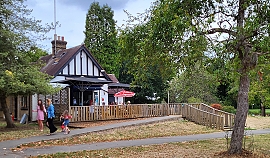
The cafe in Pitshanger Park
On its way to the Thames, the Brent skirts another garden suburb, Brentham Garden Suburb (‘BGS’), which, like HGS, was an attempt to create a leafy residential Utopia. They were built at roughly the same time. The northern edge of BGS borders Pitshanger Park, through which the Brent winds its way towards the Thames. The name of the park derives from the Putelshanger or Pitshanger family, who occupied the area in the 13th century. The manor occupied the area between Hanger Hill and the Brent. Until 1908, when it was demolished, the manor house (and its antecedents), known as ‘Pitshanger farmhouse’, occupied a plot on the present Meadvale Road, which runs along the northern edge of BGS. This building was completely different to Pizhanger Manor near Ealing Broadway, which was built by John Soane (and is described in my book).
Pitshanger Park is laid out on what used to be part of the grounds of Pitshanger farmhouse. BGS was built on another part of that same estate. The park is adjacent to Ealing Golf Course. Both were already in existence by 1912. The Brent also runs through the golf course. While we were visiting the park, we watched two men leaning over the bank of the river, rather ineffectually attempting to recover a ball from the weeds growing beside the water.
The park consists mainly of spacious grassy meadows that are bordered to the north by dense bushes and trees lining the bank of the Brent. Amenities offered in the park include, tennis courts, outdoor exercising equipment, and an attractive children’s play area. Housed in a small building with fake half-timbering, there is a small café with a terrace on which there are tables and chairs. The ‘caf’ offers hot and cold drinks and a few snacks. Its staff are pleasant, and the washrooms were clean.
While Pitshanger Park cannot be classed as one of London’s more exceptional open spaces, it is a wonderful amenity for residents in the area, just as was (and still is), the public gardens in HGS through which Mutton Brook flows.





 yamey
yamey 