THERE ARE MANY stepwells in India. For those, who have never seen any of them, a stepwell is, putting it simply, an enclosure built around a deep well. Its walls have sets of staircases, often geometrically arranged with landings at regular intervals. The steps allow people to access the water, whose level varies according to the season. In rainy periods, the water level is high, but in other periods, it is far below ground level, and people use the steps to reach the it.
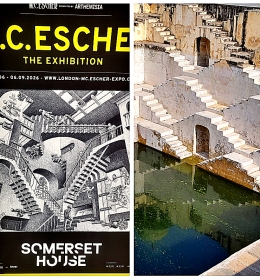
Whenever I see a stepwell, and I have seen many of them during travels in India, I think of the creations – optical illusions – of the Dutch graphic artist MC Escher (1898-1972). He produced images in two dimensions of subjects that cannot possibly exist in three dimensions. Several of his pictures include interconnecting staircases, which unlike those seen in stepwells, could not be constructed in three dimensional reality.
As far as I can establish, Escher never travelled to India. I always wonder if Escher’s staircase images were influenced by having seen drawings or photographs of stepwells in the Indian Subcontinent. It would be interesting to know if he did see pictures of these interesting water sources.
A STEPWELL OR ‘VAV’ (pronounced ‘vaav’) is a well in which users have to descend to the water within it by steps (staircases). The first one I ever saw is a disused vav in the ruins of Vijaynagar in Karnataka. During several trips to Gujarat, we have looked at many other vavs. Some have just one staircase leading to the water in the well, and others have more than one. Because many stepwells are at least partially, if not wholly, subterranean, the structures maintaining their iintegrity are sometimes quite complex – often a series of arches or layers of galleries. Therefore, the architecture of stepwells is varied and often fascinating.
On our second visit to Surat (in early December 2023), we spent a morning looking at two vavs: the Khammavati, and the larger Chatushmukhi. The former is near the railway station, and the latter is a couple of miles away, next to the Gopi Talav (lake).
The Khammavati is about 300 years old. It was established by Kansara a devotee of a goddess of stepwells. It is still used regularly, and is a little difficult to find. To reach it, you have to enter a small, rather rundown looking house. After removing your footwear, you walk through the ground floor room towards a door that leads to a staircase. Its steps lead down to the well. It descends below some brick arches that span the gap between the walls on either side of the steps. Before reaching the water, the steps pass through a chamber containing sculptures of Hindu deities.
The water in the well looked quite clear. A gentleman arrived whilst we were looking at it. After removing a few leaves from the surface of the water, he filled a couple of buckets. He told us that it was “good water”.
The Chausmukhi stepwell
Unlike the Khammavati, the Chatushmukhi vav is no longer used. It was constructed in 1510 AD. Apart from being disused, the structure is in very good condition, which is fortunate because it has an interesting design. The centrally located circular well (now dried up) is approached by four short staircases, each of them is at ninety degrees to its neighbours.
The Chausmukhi vav is beside a circular reservoir, the Gopi Talav. This was first built in about 1610 by Malik Gopi, a wealthy merchant of Surat. By 1673, it had become silted up and of no use as a water source. In 1716, some of its stones were removed to be used in the construction of Surat’s city wall. The Talav lost its former glory. However, in 2015, the city’s corporation restored it, and filled it with water. Today it and the vav form part of a well maintained park – a haven to which one can retreat to escape the noise and bustle of this busy city.
Surat, like Milan in Italy, is a throbbing hub of business and commerce. At first sight, it is, like Milan, not obviously attractive. But on closer examination both cities are studded with historical gems (and in the case of Surat, I am not referring to its famous diamond industry).


 yamey
yamey 