AT INDIAN WEDDINGS, money is often gifted to the happy couple, usually amounts of rupees ending in 1 (eg 51, 101, 501, 1001, etc). Today (26 December 2025), by chance, we found ourselves in a part of the city of Indore, Sarafa Bazaar, where jewellery and things for use in weddings are sold.
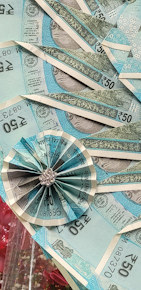
Amongst the numerous shops, we found several that were selling items we had not seen before. They are decoratively made bouquets of genuine Indian banknotes. These are assembled geometrically around colourful decorative ornaments, and, in some cases, flowers.
When we asked a shopkeeper what purpose these amazing, attractive arrays of banknotes served, he said that they were for what sounded like the ‘dulhan’ (bride in Hindi). The prices of these bouquets is the sum of the banknotes contained within them and the ornamentation, as well as the labour costs.
While writing this short piece, I found out that these banknotes bouquets or currency garlands can also be presented to bridegrooms.
I do not know how widespread is the practice of presenting banknotes arranged decoratively. So far, I have only seen it in Indore.
Between late 2024 and early 2025, we spent 88 days travelling 4000 miles through India. I have published an account of this fascinating odyssey in my book, “88 DAYS IN INDIA: A JOURNEY OF MEMORY AND DISCOVERY”, which is available from Amazon (https://www.amazon.co.uk/dp/B0FKTFBFM2). Here is a very brief excerpt from the book. It describes what happened when we were sitting in a cathedral in the formerly French colony of Pondicherry.
HERE IS THE EXCERPT:
“We sat inside the spacious cathedral’s cool interior within reach of the draught coming from a fan attached to one of the pillars supporting the long nave’s high, barrel-vaulted ceiling. As we were relaxing in the cooling breeze, a small group of Indians entered, and went to the front pews, where they knelt and prayed in front of the high altar. Amongst them was a young couple dressed in their finest. Each of them had lavish flower garlands (malas) around their necks. As they walked away from the front of the church towards where we were seated, we asked them if they had just married. They told us that that was the case. They had been married in another church and wanted to pray in the cathedral. These friendly people invited us to join them in the church’s sunlit entrance while photographs were being taken of them, of us, and of us with them. They asked us for our blessing.
Opposite the cathedral on a corner plot, we entered a large bookstore. Tables covered the floor. They were laden with books, mostly new, but not arranged in any obvious order. Along one side of this vast hall, there were ...“
END OF EXCERPT
Read my book, and enjoy discovering the wonders of India without leaving home!
Subhas Chandra Bose (1897-1945) is probably the most famous Indian to have spent time in Nazi Germany. Less well-known is Ayi Ganpat Tendulkar (1904-1975), who spent much longer in Germany than his illustrious compatriot. While studying in Paris, he married Sasha Alexandra Passini in about 1924. Soon after this, the marriage ended, and Tendulkar began studying in Berlin. He married one of his professor’s daughters – Eva Schubring. In 1933, after Hitler had come to power and Tendulkar had divorced again, he began a close relationship with the screenwriter Thea Von Harbou (1888-1954). Thea had just divorced her second husband, the great film director Fritz Lang (1890-1976) – one of my favourite film directors. The relationship between Tendulkar and Von Harbou was very close, and had Hitler’s racial laws (against marriages between ‘Aryans’ and others) not been enacted, there is a good chance that they would have married.
Tendulkar returned to India just as WW2 broke out. There, he met and fell in love with Indumati Gunaji (died 2006). From the start, her family were against the relationship, and Indumati ran away from home to live with Tendulkar. Both were followers of Mahatma Gandhi – she more than he. Soon, Tendulkar, who had published anti-British articles in Berlin and elsewhere and was under suspicion because of his long stay in Germany, was imprisoned by the British. Meanwhile, Indumathi helped the villagers where she lived. Her life was not easy, and she missed Tendulkar greatly.
Eventually, Indumathi and her family, who were concerned about her and her romantic attachment to Tendulkar, became reconciled to some extent. Her father, a Gandhian, suggested that they ask Mahatma Gandhi what he thought of the relationship. His reactions to the situation were far from simple, as is revealed in the pages of “In the Shadow of Freedom” by Laxmi Tendulkar Dhaul – the daughter of Indumathi and Tendulkar.
Ms Dhaul’s well-researched book is a fascinating read. It covers the extraordinary lives and relationships between Tendulkar, Indumathi, and Thea Von Harbou, both in Germany and in India – before and after independence. Despite some unfortunate errors missed by the proofreader, this is an un-put-downable book. It opened my eyes to the interesting subject of Indians living in Nazi Germany as well as Gandhi’s rather intriguing views on the purpose of marriage.
MANY INDIANS STRIVE to gain a Master of Business Administration (‘MBA’) degree. I can say little or nothing about the merits of this academic qualification, but know many friends who have been awarded it.
A long time ago, soon after we married in Bangalore, we attended an engagement party held for one of our friends. During the evening, the priest who would eventually officiate at the marriage gave a speech. He spoke in English with a strong South Indian accent. He introduced the couple as follows: “These two dear people are well-matched. He has a yem bee yay. And she has a yem bee yay…” Just in case you did not make sense of that, ‘yem bee yay’, it is the way that many Bangaloreans would pronounce ‘MBA ‘.
This distant memory of our friends’ engagement party was prompted by noticing a tea shop on Bangalore’s St Marks Road. It is named “MBA CHAI WALA”. Above the name are the words “India’s Most Iconic Chai Wala”. As we were in a hurry on our last day in Bangalore, we had neither the chance to sample a cup of tea nor to discover whether the place had anything to do with the MBA degree. On our next trip to Bangalore, I will investigate and get back to you.
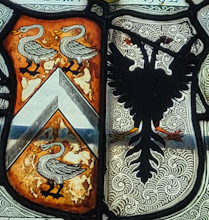
THE GREAT HALL of Lytes Cary Manor House in Somerset has some stained glass windows decorated with crests relating to the Lyte family, who owned the property between the 15th and 18th centuries. One of the crests caught my eye because the crest contains a double-headed eagle. This is a symbol that began to interest me in my teens when I first became fascinated by the Balkans. The double-headed eagle figures on the flags of Albania and some of its neighbours. The earliest known use of this peculiar creature is on seals used to secure goods in Babylon during the 3rd century BC.
The crest at Lytes Cary Manor is a combination of the Lyte family crest and that of the Worth family, which incorporates the two headed bird.
In 1592, Thomas Lyte (c1568-1638) married Frances Worth (1580-1615) who was born in Charlton Mackrell in Somerset. Thus, the double-headed eagle of the Worth family became joined with the three swans of the Lyte family crest. This marriage which was celebrated so long ago, is recorded in glass on a window of the Great Hall at Lytes Cary.
Why the Worths employed the double-headed eagle on their crest is something I would like to know, and will investigate. The double-headed eagle appears on British crests less frequently than other heraldic creatures. Possibly, andI am only guessing, it relates to the fact that a son of King John, Richard, Duke of Cornwall (1209-1272) was appointed King of The Germans, that was a senior position in the Holy Roman Empire. The symbol of that empire was the double-headed eagle.
BEFORE WE MARRIED in 1993, many of our kind friends wanted to give us wedding presents. A large proportion of them wanted to choose gifts from a ‘wedding list’. For those who are unfamiliar with this kind of list, let me explain. A ‘wedding list’ is a list of items, usually available from a shop chosen by the bride and groom, from which those wishing to give wedding presents can choose. As the items are bought, the shop removes them from the list so that the likelihood of duplicate purchases is reduced.
We were a little reluctant at first, but people insisted that it would be helpful if we compiled a wedding list. We chose to have our list at a shop that we both enjoy visiting: Liberty on Great Marlborough Street, very close to Regent Street.
Above an entrance to Liberty shop
From the outside, Liberty looks like an extremely well-preserved example of Tudor architecture, too good to be true. It is not because it was completed in 1924.
Liberty was founded by Arthur Lasenby Liberty (1843-1917), son of a draper. In 1875, he opened his own shop on Regent Street. According to the Liberty website (www.libertylondon.com), he wanted:
“… a London emporium laden with luxuries and fabrics from distant lands, his dream was to metaphorically dock a ship in the city streets. To this day, a voyage of discovery awaits on the good ship Liberty, with history hidden amongst six floors of cutting-edge design, unexpected edits and beautiful wares from the world’s greatest craftspeople. In 1875, Arthur borrowed £2,000 from his future father-in-law and took a building on Regent Street, London with just three dedicated staff and plenty of ambition.”
By the time that Liberty opened his shop, the British public was fascinated by Japan and other parts of Asia. In 1885, he brought 42 villagers from India and set up a temporary ‘living village’ of artisans in the shop.
The website added:
“Liberty’s collection of ornaments, fabric and objets d’art from around the world proved irresistible to a society intoxicated at the time by Japan and the East and Liberty effected social change in interior design and dress, so much so that the Art Nouveau period in Italy is called ‘Liberty Style’.”
Liberty died before his new shop was completed. Designed by Edwin T Hall and his son Edwin S Hall, it was built in the Tudor Revival style that achieved great popularity in the 1920s. Not only is the shop’s exterior in the Tudor Revival style, but also its interior. A great dela of wood was used in the construction as the shop’s website revealed:
“… the builders Messrs Higgs & Hill were given a lump sum of £198,000 to construct it, which they did from the timbers of two ancient ‘three-decker’ battle ships. Records show more than 24,000 cubic feet of ships timbers were used including their decks now being the shop flooring: The HMS Impregnable – built from 3040 100-year-old oaks from the New Forest – and the HMS Hindustan, which measured the length and height of our Liberty building.”
Even if you do not wish to purchase anything from our long out-of-date wedding list, a visit to Liberty is rewarding not only to see the wonderful range of beautiful products on sale but also to narvel at the building and its many finely crafted decorative features.
BULL HOUSE STANDS on the High Street immediately beneath the remain of the castle that dominates the Sussex town of Lewes near Brighton. Its neighbour is an older, half-timbered edifice that now houses The Fifteenth Century Bookshop, a supplier of second-hand books, which was unfortunately closed when we passed it on a Sunday morning.
In the year 1768, the owner of Bull House, a tobacconist named Samuel Ollive, and his wife Esther, took in a lodger, who had arrived in the town. This man was an excise officer aged about 31. His name was Thomas (‘Tom’) Paine (1737-1809). 1n 1771, Paine, already a widower, married Elizabeth Ollive, daughter of Samuel and Esther. At of that time, he became involved in the Ollive’s tobacco business as well as the administrative affairs of the town of Lewes. A year later, as part of a campaign to improve the remuneration of excise officers, he published a pamphlet. “The Case of the Officers of Excise”. Tom enjoyed lively discussions and debates at the town’s ‘Headstrong Club’, which met at the White Hart Inn on the High Street. This hostelry can still be seen today.
The year 1774 found Tom in trouble. He had been accused of being absent without permission from his position as excise officer. Also, his marriage failed, and he separated from his wife Elizabeth. To avoid a spell in a debtors’ prison, he sold all his possessions. He left Lewes and went to London, where he was introduced to the revolutionary Benjamin Franklin (1706-1790), who recommended that Tom should emigrate to North America. Tom set sail from England and arrived in Philadelphia in November 1774.
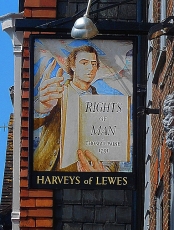
The pamphlet that Paine wrote in Lewes was followed by many more published writings. Amongst these is his best known, “The Rights of Man”, published in 1791, in London, England, where Tom had returned in 1787. This work is described in a guidebook to Lewes as “…the bible of English-speaking radicals.” Whether Tom ever returned to Lewes after his first excursion to what is now the USA, I do not know. If it ever occurred, it is not mentioned in my guidebook, and I have not found any reference to it.
OUR DETAILED ROAD atlas – yes, we are still using one of these in preference to ‘GPS’ – marks ‘churches of interest’. One of these is at Little Dunmow in Essex and was labelled ‘priory church’. As we were nearby, we made a small detour to the tiny village of Little Dunmow and found the superb gothic structure standing near some small modern dwellings. As is frequently the case, the church was locked up, but someone suggested that if we asked the lady who lived in one of the nearby houses, she would most likely open it for us. We knocked on her front door and a neighbour looked into her back garden, only to discover that she was not at home. Another of her neighbours suggested that she might be out walking her dog. We saw several ladies out walking with their dogs, and the third one we asked happened to be the one with the key to the church. She opened the church for us, and we had a good look around its interior.
The Flitch Chair at Little Dunmow, Essex
The church of St Mary in Little Dunmow is all that remains of what was once a huge priory church. In fact, it is what was once the Lady Chapel on the south side of the chancel. The rest of the church and the Augustinian Priory, to which it was attached, was demolished in the 16th century following the passing of the Suppression of Religious Houses Act 1535 during the reign of King Henry VIII. Some of the great area that was once occupied by the priory and its large church now contains the village’s extensive cemetery.
The north wall of the existing church was the south arcade of the chancel of the former priory church. The arches through which one could have passed from the Lady Chapel into the now demolished church have been filled in with masonry, but the original supports of the arches remain intact. The south wall of the current parish church has four large gothic windows and on the eastern wall another, which allow a great deal of light to suffuse the church. Probably, these date from 1360 when the chapel was, according the architectural historian Nikolaus Pevsner writing in his Essex volume of “The Buildings of England”, opulently remodelled. The red brick bell tower at the western end of the edifice was added in 1872 and Pevsner describes it as being “… a silly NW turret.”
The church’s well-lit interior has a wonderfully spacious feel beneath its ceiling lined with simple dark timber beams. Apart from enjoying the place in its entirety, several features attracted my interest. Two alabaster effigies, a man and his wife lying down with carved animals at their feet, commemorate Walter Fitzwalter (died 1432) and his wife Elizabeth (née Chideock, died 1464). Walter was the grandson of Robert Fitzwalter (1247-1346), First Baron Fitzwalter. And, more interestingly, Robert’s father, Robert Fitzwalter (died 1235), feudal baron of Little Dunmow, was one of the barons who opposed King John and made sure that he adhered to what was contained in the Magna Carta, which he signed in 1215. A modern plaque on the eastern wall of the church honours his memory.
The pair of effigies are located next to the north wall of the church, west of an alabaster effigy of a now unknown woman, also located next to the wall. Information in the church suggests that she might have been the mother of Walter Fitzwalter, or Matilda, the daughter of Robert, the Third Baron, or even Maid Marion of Robin Hood fame.
Another curious feature within the church is a wooden chair with carvings made in the 15th century, using wood with 13th century carvings. This, the Dunmow Flitch Chair, is a unique piece of furniture. Its seat is wide enough to comfortably seat two adults. It was used during the so-called ‘Flitch Trials”, which still take place in Great Dunmow every four years:
“The ancient Flitch of bacon custom rewarded a couple who had been married in church and remained ‘unregreted’ for a year and a day, with a flitch of bacon. The claimants had to swear an oath kneeling on two sharp pointed stones in the churchyard. They were then carried through the village to be acclaimed.” (www.magnacartabarons.info/index.php/the-towns-and-villages/little-dunmow-essex/)
A flitch of bacon is a side of bacon (half a pig cut lengthwise). The trials were held at the priory church in Little Dunmow until 1750, and were later revived in the 19th century following the publishing in 1854 of “The Flitch of Bacon”, a novel written by William Harrison Ainsworth (1805-1882). In the preface to his story, the author hints at the origin of the tradition:
“”Among the jocular tenures of England, none have been more talked of than the Bacon of Dunmow.” So says Grose, and truly. The Dunmow Flitch has passed into a proverb. It is referred to by Chaucer in a manner which proves that allusion to it was as intelligible in his day as it would be in our own. The origin of the memorable Custom, hitherto enveloped in some obscurity, will have found fully explained in the course of this veracious history. Instituted by a Fitzwalter in the early part of the Thirteenth Century, the Custom continued in force till the middle of the Eighteenth—the date of the following Tale.”
According to the novel, the couple attempting to win the flitch of bacon had to came to the priory church at Little Dunmow, where they were subjected to a trial with witnesses, jury, and judges, to assess whether their marriage had been without blemish for a year and a day. On arrival at the priory church, Ainsworth related, the couple:
“… kneel down on the self-same spot, and on the self-same stones, where, more than four centuries ago, Reginald Fitzwalter and his wife knelt when they craved a blessing from the good prior. Benedicite! fond pair! Ye deserve holy priest’s blessing as well as those who have knelt there before you. Bow down your gentle heads as the reverend man bends over you, and murmurs a prayer for your welfare. All who hear him breathe a heartfelt response. Now ye may look up. He is about to recite the Oath, and ye must pronounce it after him. The Oath is uttered.”
Having been awarded the flitch, we learn that:
“All is not over yet. Ye have to be placed in the antique chair, and, according to usage, borne on men’s shoulders round the boundaries of the old Priory, which in the days of your predecessors stood hereabouts. And see! the chair is brought out for you. It is decked with rich though faded tapestry, woven with armorial bearings, which ye must know well, since they are your own, and with a device, which each of you may apply to the other—Toujours Fidèle.”
Well, our road atlas marked the church at Little Dunmow as being “of interest”, and having visited it, we can assure you that it is of very great interest.
A ROW OF HOUSEBOATS is moored alongside the bank of the River Thames that runs past Cheyne Walk in London’s Chelsea. The floating dwellings are faced by Lindsey House, one of the oldest buildings in the Royal Borough of Kensington and Chelsea. Built in 1674 by Robert Bertie, 3rd Earl of Lindsey (1630-1701) on land that was once part of Thomas More’s riverside garden, it was remodelled by Count Nicolaus Zinzendorf (1700-1760) for London’s Moravian community in 1750. Five years later, the edifice was divided into separate dwellings. Today, they are numbered 96 to 101 Cheyne Walk. The American artist James McNeill Whistler (1834-1903) lived in number 96, and the engineers Sir Marc Isambard Brunel (1769-1849) and his son Isambard Kingdom Brunel (1806-1859) lived in number 98. My friends Kit and Sheridan lived in a ground floor flat in number 100.
Lindsey House, Chelsea, London
I first met Kit and Sheridan during one of our annual family holidays to Venice. Kit, who was a colleague of my father at the London School of Economics, and her husband Sheridan used to stay in the Pensione Seguso that was next door to the Pensione La Calcina, where John Ruskin (1819-1900) once stayed, and we always stayed in Venice. During one of our holidays when we stopped on the Fondamente Zattere to talk with Kit and Sheridan in Venice, they asked me whether I liked classical music. When I told them that I did, they said that they would invite me to their musical evenings held some Saturdays in their home. I attended quite a few of these during the second half of the 1960s.
On arrival at 100 Cheyne Walk, Kit used to welcome the guests by offering us coloured sugar-coated almonds, which she described as ‘stones of Venice’, an illusion to Ruskin’s book about Venice (“The Stones of Venice”), where the almonds had been purchased. After discarding coats, all of the guests, twenty to thirty in number, had to find somewhere to sit in the large, low-ceilinged living room. I was always directed by Kit to the same seat. She used to want me to sit next to the telephone. She always told me:
“If it rings during the music, dear, lift the receiver and say: ‘Sorry, we are having a party. Please ring again tomorrow’”
It never did ring, but I used to sit nervously in anticipation of having to perform my important duty.
Sheridan was a fine ‘cellist, who knew many professional musicians, all of them quite famous. He used to invite several musicians, anything from two to four, to perform a couple of chamber works with him. Kit knew what was to be performed at each soirée, but the invited musicians were not told until they arrived (at the same time as the audience). Without prior rehearsal, Kit and his musical guests performed chamber works, often by Brahms and Beethoven, beautifully and, except for Sheridan, from ‘scratch’. The acoustics of the 17th (or 18th) century living room were perfect for the music performed. These wonderful evenings engendered my enduring love of the chamber music of Brahms. During the music, Kit sat a few feet away from Sheridan on his right. Her eyes never wandered from him and she always smiled sweetly as he played. Whenever we saw them in Venice, they were always walking hand-in-hand like two lovers.
I believe that Kit and Sheridan married late in life. Sheridan told me once that he was pleased when he married, because as a married man he was able to perform a service, for which only married people were eligible at the time. He was at last able to become a marriage guidance counsellor.
Sheridan told me once that there was a lot of planning before putting on each musical evening. He ensured that none of his guest musicians ever played the same piece together more than once. Also, he tried to make sure that nobody in the audience ever heard the same combinations of pieces more than once. He did this by recording who had played what and who had heard what in a set of notebooks.
Two works were played at each soirée. During the interval, everyone stood up, many relieved to get off the not always comfortable seating provided. Kit served glasses of red wine and crackers with pieces of cheese that contained cumin seeds. Every soirée, the same refreshments were provided.
A few of the musicians that I can remember hearing playing with Sheridan included the violinist Maria Lidka (1914-2013) and her son, a ‘cellist; individual players from the Amadeus Quartet; and once the pianist Louis Kentner (1905-1987). At the end of the evening when Kentner had played, Kit asked him to give me a lift part of the way back to north west London. He agreed, but as we drove together, I had a distinct feeling that this famous pianist was not at all keen about giving me a lift and said not a word to me during the short journey.
As Sheridan grew older, he became increasingly frail and began looking gaunt. During the last few concerts I attended, I noticed that he covered his hands with woollen fingerless gloves. Maybe, he had a circulation problem. Sheridan died in 1991. Kit lived on another seven years. I believe that the last time I spoke to her was just after I married in late 1993, but she showed little interest in my news.
Whereas back in the 1960s, when I used to attend the musical evenings at Lindsey House, one could walk from the street to the front door, today this is impossible without being able to unlock a gate leading into the grounds of the house. Currently owned by the National Trust and rented to tenants, Lindsey House is rarely opened to the public. Fortunately, we did once manage to attend one of these openings, but all seemed to have changed since I last listened to chamber music being played close to the river.
WE MARRIED TWICE. That is to say that Lopa and I had a civil marriage in a registry office in October 1993 in London’s Chelsea Town Hall and then a religious marriage in mid-January 1994 in my in-law’s garden in Koramangala, a district south of central Bangalore. Both ceremonies were memorable and meaningful but the one in Bangalore was more colourful, and far lengthier than that in London.
Between November 2019 and the end of February 2020, we were in India. Just before leaving for India in November 2019, we celebrated our English anniversary with our daughter at a French restaurant in London, the Poule au Pot, where one can enjoy typical classic French cuisine in a dimly lit but pleasant environment.
Mid-January 2020 found us near the port of Mandvi in Kutch, formerly an independent princely state, a largely arid, desert region, now part of the Indian State of Gujarat. We were staying with Lopa’s cousin and his wife in their lovely remote and spacious 150-year old farm house, which has been in his family for several generations. Informed of our anniversary, they decided to treat us to dinner at a nearby resort close to the sea. After the meal, we walked to the car under a star-filled clear sky and returned home. There, we sat on the veranda and enjoyed a dessert that Lopa’s cousin’s wife, an accomplished cook, had made specially for us.
A year later, a few days ago, we celebrated our ‘Indian’ anniversary in London. Interestingly, the temperature in wintry London was higher than it was when we were in Kutch (at night), but there was far less sunshine. This year, in the midst of strict ‘lockdown’ conditions necessitated by the covid19 pandemic, we celebrated alone, and not at a restaurant. We had a celebratory cup of coffee outdoors and enjoyed a good home-cooked meal prefaced by gin and tonics. Had we been in India as we often are in January, but not in Gujarat, which is teetotal, we would most probably also have celebrated with ‘g and t’ but sitting outside under the stars on a warm evening in southern India.
Little did we know when we were enjoying ourselves in Kutch last January, that a year later, the idea of visiting India, let alone leaving London, would be out of the question. Well, as my late father used to say, rather annoyingly when misfortune struck:






 yamey
yamey 