
Every year until I was 17, I used to accompany my parents to Venice. There, we stayed at the Pensione La Calcina in the Zattere district. This accommodation, where the nineteenth century cultural guru John Ruskin (1819-1900) used to stay, was next to the large Giudecca Canal. And each time we stayed there, we met other regular visitors, whom we got to know quite well …
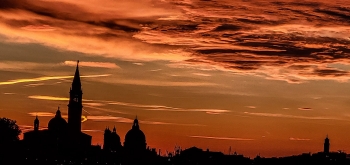
We always took demi-pension at the Calcina – room, breakfast (such as it was), and one main meal. Usually, we ate lunch there and had our evening meals elsewhere. The dining room was L-shaped. Most of the clientele sat in the long and larger part of the dining room but regular guests, such as us, sat in the shorter section at right angles to its longer section. There were 5 tables in this part. Our family occupied a table at the end of it and next to a window that looked out towards the Giudecca Canal from which we could watch its gently undulating waves glistening and glinting in the bright midday sun.
Every summer, we dined with the same guests who, like us, stayed at the Calcina year after year. Each party occupied the same table each year. Behind and next to us, there were two elderly Russian men. They were, my mother once explained, ‘Whites’ not ‘Reds’ – they had fled the Bolshevik Revolution in 1917. Although she was not sure, she felt that they were homosexuals. They never said much at lunch except once when one of them expressed the opinion that the paintings in the Accademia Gallery had been ruined by cleaning. He thought that the old masters had looked far better before the restorers had removed layers of yellowing varnish to reveal the bright colours had been hidden beneath them.
Each of two tables facing each other and close to ours were occupied by two Polish composers and their respective wives. One of these musicians was named Horowitz. He was not related to the famous pianist as far as I know. The other was named Tansman. I did not realise it at the time, but he was none other than the composer Alexander Tansman (1897-1986). Although he might not be as well known to the public as some of his contemporaries, he was, and still is, highly regarded by musical cognoscenti. The two composers spent much of their lunchtimes glaring at each other. They appeared to disagree about most things except one. And that was the appalling quality of the food that used to be served in the Calcina. As soon as the main course arrived at table, everyone in the regulars’ section of the dining room looked at each other, raising their eyebrows knowingly.
The food was served to the regulars by a friendly waiter, who was at the Calcina year after year. Along with the ladies, the owner Ms Scolozzi and her manager, Miss Steiner, he was a permanent fixture at the pensione. I often felt that he sympathised with us. I am sure that he knew that what he was serving was probably unenjoyable, but that was his job. At the end of lunch, fruit would be served. This always included grapes, which he pronounced as ‘greeps’.
There was one more regular who lunched with us. A well-built elderly American, he remained an enigma for years. He beamed at us in a friendly way, but said nothing during our meals. It was not until one morning in the early 1970s that we learned more about him. For some reason we left the Calcina later than usual: at 11 o’clock instead of the usual 10 or half-past. We were standing waiting outside the pensione when my mother noticed a gondola draped with green cloths pulling up at the corner where the nearby small side canal, which ran alongside the Pensione Seguso, next door to La Calcina, met the much larger Giudecca Canal. The gondolier, a young man, was dressed in green livery that matched the drapes on his highly polished black boat.
Soon after this gondola had moored, we noticed our elderly American fellow diner emerging from the main entrance of the Calcina. He headed straight for the recently arrived gondola, and then boarded it. Next, he sat down, and then started reading a newspaper whilst the gondolier began to row him across the Giudecca Canal. We watched his gondola crossing the water, before it disappeared into one of the small canals that traversed the Giudecca Island before reaching the lagoon. We were fascinated and intrigued. After he disappeared, we began our morning’s activity.
My mother was never shy when she needed to know something. So, after lunch that day, she stopped our mysterious American lunch neighbour and asked him about the gondola and its liveried oarsman. He explained that every day, he was ferried out into the lagoon in the gondola. When he reached the lagoon, he took over the oar and rowed around the waters of the lagoon for an hour before handing the oar back to the gondolier, who then rowed him back to the Calcina in time for lunch. Remarkable as it was that a non-Venetian could row a gondola competently, what he told us next was even more amazing.
Mr Milliken, as he identified himself, was, as my father – a keen amateur art historian – was most excited to learn, none other than the director of the well-respected Cleveland Art Museum in the USA. The liveried gondolier, whom we had observed, was the grandson of his late mother’s personal gondolier. She used to accompany Mr Millikan on his annual visits to Venice before WW2, and employed her own gondolier during her stays.
Later that day, we asked Miss Steiner about Milliken. She told us that he visited the Calcina every year on the anniversary of either the birth or the death of his mother – I cannot remember which. He occupied the room in which she used to stay. It would be furnished exactly as it was when she was alive, and was kept decked with fresh flowers – not the plastic ones that adorned so many Italian hotels. We were most interested to learn this, but I did not think about it much until years later when I looked up Milliken on the internet and discovered that he had published a book about Venice called “Unfamiliar Venice”. I obtained a copy of this from a second-hand bookseller. It is a beautifully written and illustrated book, clearly the work of one who knew the city intimately. However, nowhere except in his dedicatory words does he make any reference to his own very personal connection with the place. He wrote: “To my mother, ‘The lady who loved Venice,’ and Bernard Berenson, who encouraged me to write these impressions.” The biographical note on the book’s endpaper added that Milliken had spent several months in Venice each year since 1921, when he was aged 32, but not during WW2. In his autobiography, “Born under the Sign of Libra”, I discovered that his mother’s gondolier was a member of the Fabris family. I also learnt that his mother, like mine, had a fear of small boats, but made an exception of the gondola.
We were not yet on speaking terms with our fellow diner Mr Milliken in 1960 when the Olympic Games were held in Rome during the height of summer. However, he and the other regular lunch diners including my father used to crowd around the Calcina’s only TV set after lunch during the Games. It was a small black and white receiver situated in the sitting room that adjoined the dining room. All the diners from the regulars’ section used to cluster around it to check on the latest Olympic results. Each time one of the Soviet Bloc countries won a medal, everyone booed. When a non-Soviet Bloc nation won, it was usually West Germany or the USA, they cheered. One thing apart from the awful food served in the pensione united those who sat near us at lunch in the Calcina, and that was a dislike of Communism. This was hardly surprising as the regulars included Russian émigrés, Poles, and an American; and the Games were being held during the height of the so-called Cold War.
A few years before my last visit to Venice with my parents, I met a couple who were destined to play a prominent role in my social life during the late 1960s and the early 1970s.
One evening whilst we were standing in front of the Calcina, my father greeted an elderly lady who was walking hand in hand with an equally elderly, but taller, man. It was touching to see them as they were clearly very much in love. The woman was a colleague of my father at the London School of Economics (‘LSE’). Her name was Kit Russell, and she was until her retirement in 1973 an academic member of the School’s Department of Social Administration. Her husband Sheridan was an almoner by profession. They used to stay at the Seguso which was next door to the Calcina. After that first encounter, we used to bump into them often whenever we visited Venice. As far as I know, the Russells were not part of my parents’ social circle; I had never heard of them before we met them in Venice.
One evening in Venice before August 1970 that is when I was still a secondary school student, Kit asked me whether I enjoyed listening to classical music. When I answered affirmatively, she said that she would be sure to invite me to one of the musical evenings that she and Sheridan held at their home. So it was that I turned up one Saturday evening at the Russell’s ground floor flat in Lindsey House in Cheyne Walk close to the River Thames. It dated back to the 17th century, but the ground floor flat occupied by the Russels resulted from an 18th century modification of the building. Separated from the river only by its front garden and a street, it is now maintained by the National Trust.
I attended many musical evenings at the Russell’s place. They all followed the same pattern, but always differed in detail. On arrival at the flat, the 30 or so guests would mingle and help themselves to what Kit called the ‘Stones of Venice’. These were almonds covered by a sugary coating that was coloured to make them resemble washed pebbles. The Russells used to buy them in bulk when they visited Venice. When everyone including the guest musicians had arrived, the audience would sit on a variety of objects ranging from sofas to cushions on the floor. After my first musical soirée, Kit used to ask me to sit on a chair near the windowsill upon which the telephone was perched. My job was to answer the telephone should it ring during the music, and I was to say: “We are having a party. Please ring again tomorrow,” and then to replace the receiver quickly. Fortunately, I never ever had to do this because it never rang.
When we were all seated, Sheridan, an accomplished ‘cello player, would introduce the guest musicians. Most of them were well-known professional players. Maria Lidka (1914-2013), a highly accomplished violinist who had fled from Nazi Germany, appeared frequently at these soirées. One evening, the famous pianist Louis Kentner (1905-1987) joined Sheridan’s ensemble. Kit persuaded him to give me a lift part of the way home in his car. He did so, but very reluctantly.
In addition to Sheridan, there would be up to 5 other musicians, but more usually 2 or 3. They were usually string players and pianists, but on one occasion there was a clarinettist. It was at this party that I first heard the beautiful clarinet quintet by Brahms. Sheridan explained to me that the members of his ensembles were different for each soirée. No musician would ever be invited to play with the same group of musicians more than once. And also none of his guest musicians would play the same composition more than once. Further, the Russells varied the composition of the audience so that everyone had a chance to meet someone new.
The guest musicians had no idea what they would be asked to play until they arrived. Sheridan had rehearsed the pieces in advance, but his musician guests had not. They played each work either from memory or by sight-reading. The performances were truly impromptu, but that did not matter because all the players were of the highest calibre. Kit and Sheridan made sure that none of the audience, many of whom were regular attendees, ever heard the same pieces more than once. Apart from being highly enjoyable, each of the soirées was a masterpiece of planning.
Once, Maria Lidka’s son, the then young ‘cellist Marius May, was invited to play for us. All went well for a while until suddenly one of his instrument’s strings snapped noisily. It sounded like a gunshot. Marius had to stop playing. One of his fingers had begun to swell horribly having just been assaulted by the broken string. Fortunately, this did not put an end to his promising career as a professional musician.
The lights were turned down and, if it was summer, the curtains were drawn. Then, the first piece of the evening was performed. The Russell’s living room was the perfect setting for chamber music, much of which had been written soon before or just after the room had been built. Its acoustics were second to none. Sheridan always played with his back to the audience. Kit used to sit a short distance away from his right hand, beaming lovingly at him. I will never forget her sweet smile and her obvious care and affection for him. As he grew older, Sheridan used to wear gloves even during the performance. He would remove them only when he had to play. During the intervals in which he was counting bars without playing, he used to slip his aging shaky hands back into his gloves. I used to be saddened seeing my elderly friend having to do this.
During the interval that followed the first piece of music, we were allowed to mingle whilst we enjoyed the refreshments that Kit brought out from her kitchen. These were always the same: savoury biscuits upon which there were small pieces of a yellow hard cheese that was studded with caraway seeds. Glasses of red wine were served with this snack. After the interval, the second piece of the evening was performed. When that was over, we all bade farewell to our hosts and went our own ways. I used to love attending these evening chamber concerts. It was wonderful hearing Brahms, Beethoven, and Mozart, performed in such a perfect environment.
Sheridan, who was born in 1900, married Kit when he was 57. He told me once during an interval at one of his soirées that marrying her allowed him to do something that he had always wanted to do, but was unable to do so as a bachelor. And that was to become a marriage guidance councillor.
The encounters described above are amongst my fond memories of Venice – a place I still enjoy visiting. And had it not been for meeting Kit and Sheridan on a warm summer night in Venice, I might never have been able to experience the magical musical occasions at their home in London.


