A remarkable queen in central India

Over the centuries, there have been many notable female leaders. These include Hatshepsut, Cleopatra, Boadicea (Boudica), Joan of Arc, Elizabeth I, Catherine the Great, Queen Victoria, the Rani of Jhansi, and Indira Gandhi … to name but a few.

During a recent trip to Madhya Pradesh, a state in Central India, we stayed in the small town called Maheshwar, which had a famous resident, a queen called Ahilyabai. I must admit I had never heard of her until we visited the town, and this is not good because she was at least as remarkable as, if not more amazing than any of the women I listed above.
Ahilyabai was born in 1725 in the village of Chaundi, now in Maharashtra. Her father, Mankoji Sindhia (Shinde), a scion of the Dhangar family, was the Patil (village headman). Although it was at a time when women were not allowed to go to school, Ahilyabai’s father taught her to read and write. When the Maratha ruler of Malwa (now part of Madhya Pradesh), Malhar Rao Holkar (lived 1693-1766), was travelling to Pune in 1733, he spotted Ahilyabai and was so impressed by her that he arranged for her to be married to his 10-year-old son Khanderao Holkar (1723-1754). Her husband, who admired Ahilyabai, fought in many battles, and was killed at the Fort of Khumber in 1754. As was the tradition of those times, Ahilyabai wanted to commit sati by throwing herself on Khanderao’s flaming funeral pyre, but Malhar Rao stopped her.

From 1754 onwards, he trained her in military matters and administrative skills. Soon, she became competent in both, and successfully carried out several military operations against enemies of the Holkars. When Mahar Rao died, his successor was Ahilyabai’s 21-year-old son, Male Rao Holkar (1745-1767), who went insane, and died a year after he came to the throne. The writer, John Malcolm (1769-1833), who lived in India between 1783 and 1831 and knew people close to the Holkars, and wrote about them in his “Memoir Of Central India Including Malwa Vol.1” (published in 1824) included descriptions of Male Rao’s madness, such as:

It was a common usage with him to place scorpions in clothes and slippers that he gave them; he also put these venomous reptiles in pots filled with rupees, which he invited the holy mendicants to take; and, when their eager cupidity caused them to be stung, his joy was as excessive …”

Unwilling to adopt an heir, Ahilyabai wrote to the Peshwa (senior official of the Marathas), petitioning him to appoint her as ruler of Malwa. He sent her a letter, appointing her. Immediately after this, she appointed Tukoji Holkar (1723-1797), the great nephew of her father-in-law, Mahar Rao, as commander of her army and to manage Malwa’s military affairs. This allowed her to concentrate on administering Malwa and other Holkar estates.  Until her death, Ahilyabai and Tukoji worked together harmoniously. After she died, he became the ruler of Malwa, and was known as Tukoji Rao I Holkar. John Malcom met people who remembered Ahilyabai, and they told him she was a good ruler:

Her first principle of government appears to have been moderate assessment, and an almost sacred respect for the native rights of village officers and proprietors of lands. She heard every complaint in person; and although she continually referred causes to courts of equity and arbitration, and to her ministers, for settlement, she was always accessible: and so strong was her sense of duty, on all points connected with the distribution of justice, that she is represented as not only patient, but unwearied in the investigation of the most insignificant causes, when appeals were made to her decision.”

During her reign, Ahilyabai did much to make Indore into a prosperous and beautiful city, but shifted her capital to Maheshwar. She did much work to improve the roads and forts in Malwa, as well as making many religious endowments (including mandirs, dharamshalas, tanks, bathing ghats, etc) in the kingdom. A man, Baramul Dada, who knew Ahilyabai well, related to Malcolm that:

“… she rose one hour before daybreak to say her morning prayers, and perform the customary ceremonies. She then heard the sacred volumes of her faith read for a fixed period, distributed alms, and gave food, in person, to a number of Brahmins. Her own breakfast was then brought, which was always of vegetable diet; for, although the rules of her tribe did not require it, she had forsworn animal food. After breakfast she again went to prayers, and then took a short repose; after rising from which, and dressing herself, she went about two o’clock to her Durbar, or court, where she usually remained till six in the evening; and when two or three hours had been devoted to religious exercises and a frugal repast, business recommenced about nine o’clock, and continued until eleven, at which hour she retired to rest.”

Her good works in connection with her religion extended well beyond the boundaries of Malwa. Using inherited Holkar money, rather than public funds, she ordered the construction of religious edifices in places including Varanasi, Kashi, Gaya, Somnath, Ayodhya, Mathura, Hardwar, Kanchi, Avanti, Dwarka, Badrinarayan, Rameshwar and Jaganathpuri. Ahilyabai. After shifting her capital to Maheshwar, she did much to improve the place. 

During her life as queen and after her death, Ahilyabai’s reputation was legendary, and remains so. In what was once Malwa (and elsewhere), she is regarded as a saint.  It is worth noting that Ahilyabai was not the only female Maratha ruler. Earlier, Tarabai Bhonsle (1675-1751) was the regent of the Maratha Empire from 1700 until 1708. Undoubtedly,

Ahilyabai was one of the most remarkable women in India’s long history. Indore’s airport, where we landed, is now named after her. To digress slightly, when we were in Bombay, we saw a statue of her – a bust – close to the city’s busy Churchgate train station. It is in a prominent place, but  market stalls and vegetation around it make it difficult to view her properly.
Saved from the funeral pyre: an airport is named after this remarkable queen

AHILYABAI HOLKAR WAS born in 1725. She married Khanderao Holkar (1723-1754), the only son of Malhar Rao (1693-1766),  the founder of the kingdom of Indore.


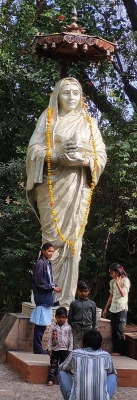
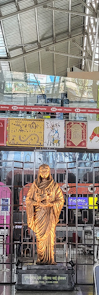
Statue of Ahilyabai Holkar at Indore airport

When Khanderao was killed in battle, his devastated wife wanted to commit sati: to throw herself onto his funeral pyre. However, her father-in-law and the subjects of the kingdom successfully persuaded her not to commit suicide. Following that, her father-in-law trained Ahilyabai in military matters. Khanderao’s only son, Malhar’s successor, Male Rao Holkar, ruled from 1766-1767. After his brief reign, cut short by illness, Ahilyabai became ruler of the Kingdom of Indore, which was part of the Maratha Empire.


Ahilyabai was one of the world’s most remarkable queens. As Wikipedia summarised:

“She is renowned for good governance, social welfare, and humanitarian work along with religious, educational, and cultural advancements. She contributed to the growth of Indian architecture through the commission of various temples, Ghats, and Dharmshalas. Ahilyabai’s Matha, or charitable endowments, spread across India.”


As a result, she is now revered as a saint. Apart from her philanthropic activities, she was also involved with military matters (in 1765, she commanded the artillery during an attack near Gwalior), and transferring her capital from Indore to the holy town of Maheshwar.  As if this were not sufficient,  she also transformed Indore into a modern city where commerce and industry were encouraged.


In view of the above, it is very apt that Indore’s airport bears her name. It is called Devi Ahilya Bai Holkar Airport. We flew from it to Bombay. A statue of Ahilyabai greets passengers as they arrive in the hall with the airline check-in desks.

  The airport is smallish, but lovely. The departure lounges are spacious and airy, and there is a good variety of refreshment counters. Some of the walls of the airport have fine examples of art in the style practised by the tribal Gond people. Compared with many other airports I have used, that serving Indore is one of the most pleasant. Ahilyabai would have been pleased to have this place named in her honour.

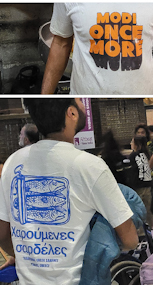
The writing is on the shirt, not on the wall

RECENTLY I  SAW two eye-catching T-shirts. One that was seen in Indore, speaks for itself.

Top shirt seen in Indore, bottom one in Bombay

The other, spotted while waiting for our luggage at Terminal 2 in Bombay Airport, might look Greek to you, and indeed it is. The rear of the shirt reads when translated into Latin script ‘karimenes sardeles’, and beneath it, written in Latin script “Traditional Greek sardines, Pyrgos, Greece”. This refers to a brand of sardines from Pyrgos on the Greek Aegean island of Santorini.

I asked the man wearing this shirt whether he had got it in Greece. He said that he had bought it at a branch of H&M in India. I asked him what the Greek words on his shirt meant. He had no idea, neither had he ever heard of sardines. Well, I had no idea that this shirt was a best-selling item sold at H&M.

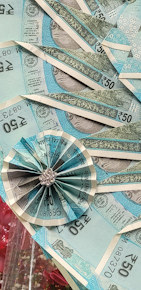
Bouquets of banknotes for brides and grooms in Indore

AT INDIAN WEDDINGS, money is often gifted to the happy couple, usually amounts of rupees ending in 1 (eg 51, 101, 501, 1001, etc). Today (26 December 2025), by chance, we found ourselves in a part of the city of Indore, Sarafa Bazaar, where jewellery and things for use in weddings are sold.


Amongst the numerous shops, we found several that were selling items we had not seen before.  They are decoratively made bouquets of genuine Indian banknotes. These are assembled geometrically around colourful decorative ornaments, and, in some cases, flowers.


When we asked a shopkeeper what purpose these amazing, attractive arrays of banknotes served, he said that they were for what sounded like the ‘dulhan’ (bride in Hindi). The prices of these bouquets is the sum of the banknotes contained within them and the ornamentation, as well as the labour costs.


While writing this short piece, I  found out that these banknotes bouquets or currency garlands can also be presented to bridegrooms.


I do not know how widespread is the practice of presenting banknotes arranged decoratively. So far,  I have only seen it in Indore.

The only road in Indore named after a British man

A ROAD IN INDORE NAMED AFTER A BRITISHER

A STATUE OF of Robert North Collie Hamilton (1802–1887) who was British Resident of Indore during the first war of independence in 1857, stands within the garden of the Lalbagh Palace in Indore.

According to a website about the city’s Lalbagh Palace (www.freepressjournal.in/pbd-indore/hamilton-road-only-road-of-indore-named-after-britisher) :

“In the year 1857, a group of freedom fighters gathered at Hamilton Road to protest against the Britishers. On the same day Hamilton was going on leave and his acting officer Sir Henry Marion Durand had taken charge. Sir Durand, angry at the protestors, ordered British army to attack them. When Hamilton came to know this he cancelled his sanctioned leave and ordered the army to not to attack”

The Hamilton stands close to a statue of Queen Victoria.

Because of Hamilton’s actions, he is remembered in Indore not only by the statue but also the city contains a short road named after him. It is the only road in Indore named after a British person.

The cemetery where Roman Catholics in Indore are buried

THE CITY OF Indore has a population of about 3.1 to 3.5 million. Of these, about 17750 are Roman Catholics. Indore is a diocese in the Ecclesiastical province of Bhopal. The diocese was established in 1952, having formerly been Mission Sui Iuris of Indore established in 1931. There are well over 12 Catholic churches in Indore.


It so happens that the hotel where we are staying in Indore (in December 2025) is a few hundred yards away from the Kanchanbagh Roman Catholic cemetery, which we took a look at today.


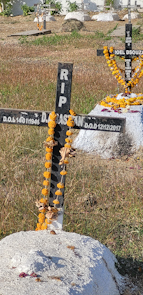
Flower garlands on graves

The older graves are raised mounds not too dissimilar from Sephardic gravestones. However, each grave is surmounted by a cross. What interested me was that on many graves there were fresh flowers. There is nothing surprising about this except that many of the flowers are ‘malas’ (garlands) such as are commonly found draped around Hindu effigies and shrines.


At the far end of the cemetery there is a large hall in which funeral masses are held. There is a bas-relief depicting the Last Supper at the altar within the hall.


On one side of the hall, there are the newer graves. These consist of flat rectangular slabs on which names are listed. These are the names and dates of the people buried beneath a slab. The idea is that several people will be interred beneath each slab, and their names recorded on it. No doubt, the new system is designed to make efficient use of the burial ground. I wondered about this because there seemed to be plenty of unused land in the graveyard.


I am pleased that we entered the cemetery because seeing it made me become aware of the surprisingly large number of Roman Catholics in Indore.

HAPPY NEW YEAR TO ALL OF MY READERS

I HOPE THAT 2026 WILL BRING YOU CONTENTMENT, GOOD HEALTH  AND PROSPERITY