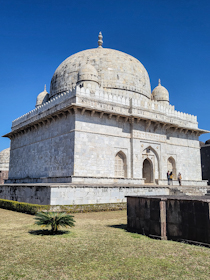
As it is difficult to judge a book by its cover, here is a brief excerpt from my latest book “Road to Heaven – a passage through India”. It describes what we saw at one of the ruined gateways to Mandu in Madhya Pradesh.
Mandu is a huge hill fort at about 2400 feet above sea level, and 1200 feet above the surrounding plains. This irregularly shaped, undulating plateau extends from east to west for between approximately 3.7 and 5 miles, and from north to south, it measures 3 to 3.7 miles. Deep ravines cut into the steep, and in places vertiginous, cliff-like, slopes sweep almost vertically down to the plains below,
Here is the excerpt:
Our journey continued along a rough track that ended abruptly and without a warning sign at the edge of a high cliff that dropped down precipitously to the plain far below. The view from the cliff edge was spectacular. We could see a couple of lakes or reservoirs amongst the fields and trees, but the horizon was obscured by haze. To our left, there were the impressive, crenellated walls of the hill fort and one of its seven gateways. We had reached the fortress-like stone Tarapur Gate at the southwest corner of the plateau. A staircase leads up from it to a walkway that runs along the remains of the high walls. Near the bottom of this, an old stone roadway, now in a parlous condition, made two right-angle turns before passing beneath an arch and continuing as a rocky track that wound its way down to the plains below, clinging precariously to the steep slope of the drop at the edge of the plateau. Of this path, Yazdani wrote:
“…the fall of the hill beyond the outer arch of the gate is very precipitous, and although there are traces of a paved path descending to the plains, it is very difficult to believe that heavy artillery or chariots could be brought up this way, for the garrison could easily have crushed them by rolling down heavy stones. History, however, records that the Fort was invaded several times from this direction…”
While we were looking around, a straggling parade of farm animals, many cows and goats, made its way quietly through the gateway, and down the rocky track. They were accompanied by a couple of herders. The right-angle turns in the gateway were probably designed to make it easier for those guarding it to control entry to the hill fort. Apart from the farmers and their animals, we were the only people at the Tarapur Gate. It was in a part of Mandu which felt more remote than the rest of the hill fort.
After leaving the gateway, we drove through a hamlet where I noticed a man seated on the ground, weaving a cane basket. Further on, we passed women in saris carrying bundles of straw on their heads. We drove northwards through luscious countryside, passing many country folk chatting and working outside their simple homes. Then, after passing the Jami Masjid in Mandu village, we reached …
[ My book is available as a paperback from Amazon:
Over the centuries, there have been many notable female leaders. These include Hatshepsut, Cleopatra, Boadicea (Boudica), Joan of Arc, Elizabeth I, Catherine the Great, Queen Victoria, the Rani of Jhansi, and Indira Gandhi … to name but a few.
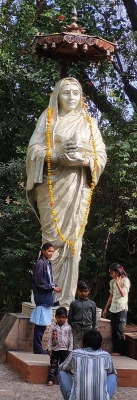
During a recent trip to Madhya Pradesh, a state in Central India, we stayed in the small town called Maheshwar, which had a famous resident, a queen called Ahilyabai. I must admit I had never heard of her until we visited the town, and this is not good because she was at least as remarkable as, if not more amazing than any of the women I listed above.
Ahilyabai was born in 1725 in the village of Chaundi, now in Maharashtra. Her father, Mankoji Sindhia (Shinde), a scion of the Dhangar family, was the Patil (village headman). Although it was at a time when women were not allowed to go to school, Ahilyabai’s father taught her to read and write. When the Maratha ruler of Malwa (now part of Madhya Pradesh), Malhar Rao Holkar (lived 1693-1766), was travelling to Pune in 1733, he spotted Ahilyabai and was so impressed by her that he arranged for her to be married to his 10-year-old son Khanderao Holkar (1723-1754). Her husband, who admired Ahilyabai, fought in many battles, and was killed at the Fort of Khumber in 1754. As was the tradition of those times, Ahilyabai wanted to commit sati by throwing herself on Khanderao’s flaming funeral pyre, but Malhar Rao stopped her.
From 1754 onwards, he trained her in military matters and administrative skills. Soon, she became competent in both, and successfully carried out several military operations against enemies of the Holkars. When Mahar Rao died, his successor was Ahilyabai’s 21-year-old son, Male Rao Holkar (1745-1767), who went insane, and died a year after he came to the throne. The writer, John Malcolm (1769-1833), who lived in India between 1783 and 1831 and knew people close to the Holkars, and wrote about them in his “Memoir Of Central India Including Malwa Vol.1” (published in 1824) included descriptions of Male Rao’s madness, such as:
“It was a common usage with him to place scorpions in clothes and slippers that he gave them; he also put these venomous reptiles in pots filled with rupees, which he invited the holy mendicants to take; and, when their eager cupidity caused them to be stung, his joy was as excessive …”
Unwilling to adopt an heir, Ahilyabai wrote to the Peshwa (senior official of the Marathas), petitioning him to appoint her as ruler of Malwa. He sent her a letter, appointing her. Immediately after this, she appointed Tukoji Holkar (1723-1797), the great nephew of her father-in-law, Mahar Rao, as commander of her army and to manage Malwa’s military affairs. This allowed her to concentrate on administering Malwa and other Holkar estates. Until her death, Ahilyabai and Tukoji worked together harmoniously. After she died, he became the ruler of Malwa, and was known as Tukoji Rao I Holkar. John Malcom met people who remembered Ahilyabai, and they told him she was a good ruler:
“Her first principle of government appears to have been moderate assessment, and an almost sacred respect for the native rights of village officers and proprietors of lands. She heard every complaint in person; and although she continually referred causes to courts of equity and arbitration, and to her ministers, for settlement, she was always accessible: and so strong was her sense of duty, on all points connected with the distribution of justice, that she is represented as not only patient, but unwearied in the investigation of the most insignificant causes, when appeals were made to her decision.”
During her reign, Ahilyabai did much to make Indore into a prosperous and beautiful city, but shifted her capital to Maheshwar. She did much work to improve the roads and forts in Malwa, as well as making many religious endowments (including mandirs, dharamshalas, tanks, bathing ghats, etc) in the kingdom. A man, Baramul Dada, who knew Ahilyabai well, related to Malcolm that:
“… she rose one hour before daybreak to say her morning prayers, and perform the customary ceremonies. She then heard the sacred volumes of her faith read for a fixed period, distributed alms, and gave food, in person, to a number of Brahmins. Her own breakfast was then brought, which was always of vegetable diet; for, although the rules of her tribe did not require it, she had forsworn animal food. After breakfast she again went to prayers, and then took a short repose; after rising from which, and dressing herself, she went about two o’clock to her Durbar, or court, where she usually remained till six in the evening; and when two or three hours had been devoted to religious exercises and a frugal repast, business recommenced about nine o’clock, and continued until eleven, at which hour she retired to rest.”
Her good works in connection with her religion extended well beyond the boundaries of Malwa. Using inherited Holkar money, rather than public funds, she ordered the construction of religious edifices in places including Varanasi, Kashi, Gaya, Somnath, Ayodhya, Mathura, Hardwar, Kanchi, Avanti, Dwarka, Badrinarayan, Rameshwar and Jaganathpuri. Ahilyabai. After shifting her capital to Maheshwar, she did much to improve the place.
During her life as queen and after her death, Ahilyabai’s reputation was legendary, and remains so. In what was once Malwa (and elsewhere), she is regarded as a saint. It is worth noting that Ahilyabai was not the only female Maratha ruler. Earlier, Tarabai Bhonsle (1675-1751) was the regent of the Maratha Empire from 1700 until 1708. Undoubtedly,
Ahilyabai was one of the most remarkable women in India’s long history. Indore’s airport, where we landed, is now named after her. To digress slightly, when we were in Bombay, we saw a statue of her – a bust – close to the city’s busy Churchgate train station. It is in a prominent place, but market stalls and vegetation around it make it difficult to view her properly.
Here is another extract – a ‘taster’ – from my forthcoming book “ROAD TO HEAVEN – a passage through India”, which has reached the final editing stage. This sample relates to Maheshwar in Madhya Pradesh, a state in central India
+ + + + + + +
Maheshwar is a 58-mile drive south of Indore, a journey that took us about 2 ½ hours. Much of the way was through hilly countryside. In places the road goes through rock faced cuttings. Every now and then we saw distant high peaks, that looked bluish in the heat haze. During our journey, we passed pedestrians carrying bags and bedding rolls on their backs. These people walking in the hot sunshine were pilgrims, about whom I will tell you more soon. Occasionally, we had to slow down when we met flocks of goats and herds of cattle being led along the road – a common sight on country roads, including motorways, in India.
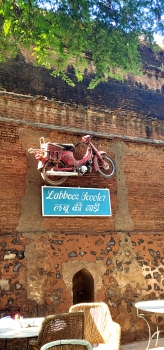
When we arrived in Maheshwar, our driver had difficulty both navigating and negotiating the maze of narrow, winding lanes in the lower, newer districts of the small town. Eventually, we drove up the steep, straight road leading to the main gateway in the walls that surround Maheshwar Fort. Traffic is not generally allowed into the heart of the fort, but as our accommodation, at Laboo’z Café and Lodge, was in the traffic-restricted zone, a barrier was lifted to allow us through. Nestling within a corner of the fort’s walls, Laboo’z is an attractive café with outdoor tables and chairs. An old motorbike is attached high up on the tall stone wall facing the seating area. Below it, there is a sign that reads: “Labooz’s Scooter”. The cafe was established in 2002 by Richard Holkar, a scion of the Holkar family that once ruled the Kingdom of Indore. Richard is the son of Yeshwant Rao Holkar II (reigned 1926-1948), who commissioned, and had built, a Modernist style palace in Indore, which was designed by the German architect Eckhart Muthesius (1904-1989).The palace, Manik Bagh, still exists. Stripped of its Modernist furnishings and sculptures by Constantin Brancusi, it now houses governmental offices. When Richard and his half-sister were children, they used to be ferried around Maheshwar on the bike now adorning the cafe. The driver who took them on the motorbike was tall (‘lambu’ in Hindustani). Over the years, he became known affectionately by the nickname ‘Labboo’. The scooter on the wall commemorates him.
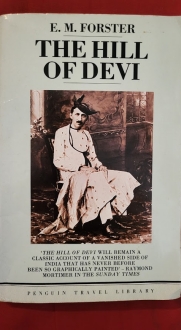
SOON AFTER READING “A Passage to India” by EM Forster (1879-1970), published in 1924, I read this author’s “The Hill of Devi”, first published in 1953. Forster made two visits to the Princely State of Dewas Senior, which ins in what is now Madhya Pradesh, not far from Indore and Ujjain. His first visit was in 1912, and the second in 1921. During the second visit, he spent several months as private secretary to the Maharajah of Dewas Senior.
“The Hill of Devi” consists mostly of letters that Forster wrote from India to his mother and other people. In them, he described the typical often extraordinary events he experienced in Dewas Senior. He also describes the people whom he met and with whom he worked including the friendly but indecisive Maharajah. The letters, interspersed with commentary, provide a view of what life was like in a relatively unimportant kingdom within British India.
The letters were all written before Forster published his “A passage to India”. In his book “The Hill of Devi”, Forster noted that he had begun “A Passage…” before staying in India in 1921, and tried to finish it while staying in Dewas Senior, but was unable to do so. He completed it after his return to England. The letters published in his “The Hill of Devi” contain much material that he later incorporated into hs “A Passage …”.
I enjoyed reading the collection of letters. Because they were letters often written in haste and, originally not for a public audience, they have an immediacy even though they are not the finest works of the author. Nevertheless, they were most interesting because recently I have visited the region in which Dewas Senior is located, and stayed in places that must have formerly been similar to that about which Forster wrote.
AT INDIAN WEDDINGS, money is often gifted to the happy couple, usually amounts of rupees ending in 1 (eg 51, 101, 501, 1001, etc). Today (26 December 2025), by chance, we found ourselves in a part of the city of Indore, Sarafa Bazaar, where jewellery and things for use in weddings are sold.
Amongst the numerous shops, we found several that were selling items we had not seen before. They are decoratively made bouquets of genuine Indian banknotes. These are assembled geometrically around colourful decorative ornaments, and, in some cases, flowers.
When we asked a shopkeeper what purpose these amazing, attractive arrays of banknotes served, he said that they were for what sounded like the ‘dulhan’ (bride in Hindi). The prices of these bouquets is the sum of the banknotes contained within them and the ornamentation, as well as the labour costs.
While writing this short piece, I found out that these banknotes bouquets or currency garlands can also be presented to bridegrooms.
I do not know how widespread is the practice of presenting banknotes arranged decoratively. So far, I have only seen it in Indore.
I AM OVER HALFWAY through reading “A Passage to India” by EM Forster (1879-1970). In this exciting novel, which contains the author’s acute observations about the minutiae of India as it was before Independence and to a large degree after, Dr Aziz, an Indian, ill-advised (in my opinion) accompanies two English ladies to the Marabar Caves (a fictional name). Trouble ensues, and Dr Aziz is arrested. I will not give away the rest of what I have read so far, but will mention some caves in Mandu (Madhya Pradesh), which we visited on Christmas Day 2025.
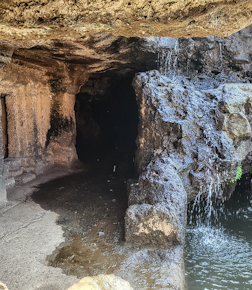
The caves are close to the scant remains of Mandu’s Lohani Gate. Easy to enter, they were excavated and converted into chambers or cells where Hindu priests or yogi might once have resided. Archaeological evidence suggests that the caves were excavated and modified in the eleventh or twelfth century. They predate all of the other archaeological sites in Mandu.
Fortunately, our visit to these caves was less eventful and sinister as is described in Forster’s excellent story. In fact, the Lohani Caves are delightful, and considering how close they are to Mandu’s most visited places, they are ignored by most tourists.
Now, I must leave you and get back to my tattered copy of “A Passage to India”.
PS: by “minutiae” I include Forster’s detailed description of the behaviour of Indian squirrels and the Echo Point at Mandu, which we saw recently, as well as the curious echo effects at the Gol Gumbaz in Bijapur, which I have experienced.
WHEN ARSLAN KHAN was appointed Sultan of the Malwa Sultanate (now part of Madhya Pradesh) in 1406, he became known as Hoshang Shah. He ruled until his death in 1435.
Hoshang’s body lies within a splendid, white marble mausoleum in Mandu. It has one large central dome and 4 smaller domes, one at each corner of the square edifice. As soon as I saw this marvellous building, I thought of the Taj Mahal, which I have seen in many photographs.
Hoshang Shah’s mausoleum was constructed in the fifteenth century, long before the Taj Mahal. A tablet within Hoshang’s mausoleum has an inscription that records the visit of 4 of Shah Jahan’s architects in 1659. They came to pay homage to the builders of the tomb. One of the four was Ustad Hamid, who was closely involved in the construction of the Taj Mahal in Agra (completed in 1653). This illustrates the high esteem that Hoshang’s mausoleum inspired.
I wonder whether those builders saw Hoshang’s mausoleum before designing the Taj Mahal.
A STATUE OF of Robert North Collie Hamilton (1802–1887) who was British Resident of Indore during the first war of independence in 1857, stands within the garden of the Lalbagh Palace in Indore.
According to a website about the city’s Lalbagh Palace (www.freepressjournal.in/pbd-indore/hamilton-road-only-road-of-indore-named-after-britisher) :
“In the year 1857, a group of freedom fighters gathered at Hamilton Road to protest against the Britishers. On the same day Hamilton was going on leave and his acting officer Sir Henry Marion Durand had taken charge. Sir Durand, angry at the protestors, ordered British army to attack them. When Hamilton came to know this he cancelled his sanctioned leave and ordered the army to not to attack”
The Hamilton stands close to a statue of Queen Victoria.
Because of Hamilton’s actions, he is remembered in Indore not only by the statue but also the city contains a short road named after him. It is the only road in Indore named after a British person.