Fading letters on a wall:
Memories evoked
Of times long ago
Picture taken in the midst of the area of London where the annual Notting Hill Carnival takes place

Fading letters on a wall:
Memories evoked
Of times long ago
Picture taken in the midst of the area of London where the annual Notting Hill Carnival takes place

Recently, I was walking along the South Bank close to London’s National Theatre when I saw two friends approaching each other. One said to the other:
“Hello, tourist!”
The other replied:
“I am a tourist everyday.”
This got me thinking that I am also a tourist every day. Since I retired in September 2017, my time is more or less my own. However, I do not sit at home bemoaning the fact that I have no work to do. On the contrary, I love my freedom to do what I wish.
Almost every day, when not travelling abroad or to some other part of the UK, I visit somewhere in London. It may be local or more distant, it does not matter where. Wherever I go, I discover something new, something that either did not exist before because it is newly built or opened or something that has been around for ages, which I have never noticed before.
London is so rich in experiences and sights that even a person like me, who has lived there for over 60 years, can always find novelty when stepping out of the house. Every time I leave home, I enjoy and appreciate London. Every day, I become a tourist in my own city.

Venice is a special place in many ways. This meeting place of oriental and occidental art is bathed in light of a special quality. Maybe this is due to the fact that there is so much water reflecting the daylight and thereby increasing its intensity. Maybe, it is something else, but whatever it is, part of the beauty of Venice is its lovely light.
Artists have long been attracted to portraying Venice. Canaletto portrayed the city almost photographically in his paintings. Guardi captures the city brilliantly by using an almost impressionistic technique. Ruskin captured the beauty of the Venetian architecture scholarly yet attractively. Other artists such as Manet, Monet, Moran, and Turner have also portrayed some of the ‘essence’ of Venice’s attractiveness.
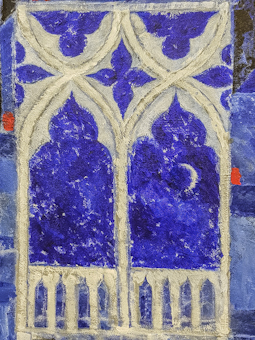
Yesterday, I visited an exhibition of new paintings inspired by Venice by the British contemporary artist Joe Tilson (born 1928). Each of his deceptively simple canvases capture several aspects of what makes Venice attractive for me. Architectural details, coloured patterning like tiles or brickwork, and moonlit skies conspire to evoke the special light an appearance of Venice. His painting is both simple and subtle, and above all visually satisfying.
The exhibition is at Marlborough Fine Art, 6 Albermarle Street, London W1S 4BY until 18th May 2019

Once again, London’s Kew Gardens is hosting an exhibition of glass sculptures by Dale Chihuly (born 1941). The amazingly crafted glass artworks of often quite complex design have been placed both in the open-air and inside some of Kew’s lovely old glass-houses.
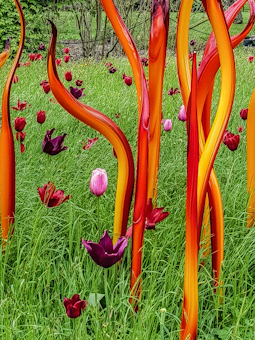
The curvy tubes with pointed ends shown in my photograph have been tastefully planted in a grassy field dotted with tulips. In the Temperate House, a large glass mobile has been suspended from the ceiling and smaller objects mingle with the plants. Wherever you look, you will find glass artefacts in intimate contact with the plants growing around them. In the Water-Lily House, large glass sulptures evoking the flowers of water-lillies mingle with the real plants whose fronds float on the water.
As time passes and the plants grow more, some of Chihuly’s colourful glass objects will become harder to find. The plant-like forms of many of the artworks mix with the plants to provide in some cases a stark contrast or in others they almost blend with the plants around them.
It is well worth visiting Kew whilst these sculptures are on display. However much I like the glass artworks, the stars of the show are for me the plants themselves (rather than the sculptures). This highlights how difficult it is for man to compete with nature on the aesthetic playing field.
The Chihuly works are on display at Kew Gardens until the 27th October 2019

The first fly of this year flew into my room just after the short warm spell we had in London over the Easter weekend. It was not the first fly that I have seen this year because the first couple of months of this year I spent in India. However, the fly in question, which arrived in late April, was the first fly that has tried to annoy me in London.
Although its buzzing and endless fly-passes can become annoying, there is another sensation that seeing and hearing the insect evokes in me. It reminds me of summer, a season I love. So, despite it annoying me, seeing this first plump fly also makes me joyful and gives me the feeling that warm, long bright days are not far off in London.

When I was a child, I spent a great deal of time with my aunt and her children. They lived a few minute’s walk from our family home and I enjoyed spending time with them. Often, my sister and I used to spend a whole day at my aunt’s house, sometimes over night especially when my parents were away on a trip.
My aunt fed us. Sometimes she made us fried eggs. Then, I was a very fussy eater. In those far-off days, I only liked the white part of the fried egg, not the central yellow bit. One of my cousins only liked the central yellow part, but disliked the white surrounding it. My aunt was an extremely down-to-earth individual, laden with more than a fair share of common sense. Her solution to the fried egg situation was that after making the fried egg, she used to carefully dissect the yoke portion of the finished product and serve it to my cousin. I was given the white portion of the egg with a neat hole in it where the yellow had been.
Today, many decades later, I am not keen on any part of a fried egg and do not eat eggs prepared in this way. I much prefer omelettes and hard-boiled eggs. However, I do enjoy making them for other people, The challenge is to avoid breaking the yoke.

This evening, I attended a performance of A Musical Offering by JS Bach (opus BWV 1079) at the Royal College of Music in Kensington. Each of the sections of this work was introduced by the conductor, Joe Parks, who explained what was musically interesting about them.
The whole piece is based on a theme composed by King Frederick II of Prussia. He gave it to Bach on the 7th of May 1747, and challenged the composer to do something interesting with it. A Musical Offering is what Bach did with the King’s theme. I am no musician, so can hardly explain the compositional procedures with which Bach exploited the King’s somewhat dull theme. For example, in one of the sections improvisations on the theme are played with musicians simultaneously playing the modified theme both forwards and in reverse. In another section, the theme is improvised in a range of different keys. In brief, this piece by Bach is both intriguing and challenging for musicians. Although this aspect of the music is lost on me, my enjoyment of the work was not impaired.
What fascinates me is that a piece of music so full of compositional twists and turns is a delight to hear. Bach has not only satisfied his desires to hone his compositinal technique in this piece, but also he has created a work that is highly satisfying to the listener.
Great music like great paintings reach into the the inner subconscious of the listener or viewer and thereby evoke an almost visceral sensation of joy. It does not matter that the music is full of compositional magic or the painting might be impressionistic or abstract because the great artist knows how to produce a work that reaches those hidden parts of the body that evoke feelings we call emotion. Without doubt, A Musical Offering did that for me.

High above the clouds
A climate protester flies,
Changing the climate
This was inspired by an article in the Daily Mail newspaper (see: https://www.dailymail.co.uk/news/article-6938095/Dame-Emma-jets-5-400-miles-green-is.html), which reported:
“Emma Thompson arrived at Marble Arch yesterday afternoon to support climate change protesters and urged others to join their numbers.
What she might not have mentioned to them is that she had just flown back to Heathrow Airport from Los Angeles the day before.”

While I was engaged to my wife, she suggested that I join her at her health club and try some of its facilities.
The first time I went, I decided to go swimming. After swimming two lengths very slowly, I managed to climb out of the pool, exhausted and breathless.
For the next visit, my wife-to-be suggested that I try a session in the sauna. She thought it would do me good and would not be particularly exhausting. I removed most of my clothes and sat alone in the poorly-lit sauna room. After a few minutes I began feeling cold, and started shivering. Fed up with this miserable experience, I left the sauna, and got dressed. The sauna had not been switched on!
Undismayed by this, I decided to give the sauna another try a week later. This time it was switched on, and steaming hot. Because my first visit had been so boring, I decided to take a magazine into the sauna to read to pass the time. I took my place on a bench alongside some very muscular men and opened my copy of a glossy BBC clasical music magazine. Within minutes, the glue holding my magazine together melted. Numerous pages covered with fascinating information about classical music floated gently downward on to the floor of the sauna, Sheepishly, I recovered some of them, and then hurried out of the sauna.
“Why not try the exercise cycles next time? ” my wife asked. “Good idea,” I replied reluctantly. So, a week later, I sat in the saddle of an exercise bike. My wife was seated on a neighbouring cycle pedalling away while reading a book resting on the handle bars. The third cycle in the room was being pedalled furiously by a man lstening to his Sony Walkman through a pair of headphones. Meanwhile, I was just trying to move my cycle’s pedal … completely unsucessfully. After a few minutes, I abandoned the cycle, and after that I have never bothered with health clubs again.
“That’s a pity,” you might think.
But, maybe not, as I will explain.
When I was practising as a dentist, quite a few patients, often young men, used to limp when they walked into my surgery. Almost everyone of them had injured knees or tendons whilst playing football or running, or trying to keep ‘fit’. When I saw them, I thought how lucky I was that I did not become addicted to ‘keeping fit’.

Sometime during the summer in the early to mid-1980s, when I was living in Kent, two young people came to stay with me from land-locked Hungary. Because travelling opportunities were limited and money was short in the Communist country, people did not travel abroad as much as people in Western Europe. My two guests had never seen the sea, except in photos and on the TV or cinema screen.
One evening, I drove my guests to the Kent coast to see the sea. We parked by a beach. As soon as we had stopped, the two lads leapt out of my car and ran into the sea fully clothed. That is how excited they were to see real waves and the sea.
After experiencing the sea, they asked me about ‘fish and chips’, which their English teacher in Budapest had mentioned. We walked to a nearby fish and chips shop and placed an order. When the fillets of fish arrived wrapped in crisp golden batter, my friends looked at them, wondering whether or not they had been served pieces of fish. They had never seen fish prepared like this before.
Fish prepared, fried and covered with batter, as it is served in British fish and chip shops is actually not a dish of British origin. According to that mine of knowledge Wikipedia, it was the Sephardic Jews, who settled in the UK from the 16th century onwards, who introduced fish prepared this way. Alexis Soyer (1810-58), the famous 19th century chef wrote in his A shilling cookery for the people, published in 1854:
“There is another excellent way of frying fish, which is constantly in use by the children of Israel … In some families … they dip the fish, first in flour, then in egg, and fry in oil“, which is more or less what happens in a fish and chips shop.
This leads me to the real subject of the article: a reccommendation. There are many highly-rated fish and chips shops (‘chippies’) in the British Isles. The ‘Fryers Delight’ is one of them. This unpretensious shop, whose decor seems unaltered since the day it opened back in in 1958, serves excellent fish with superb chips cut in the shop’s kitchen, all fried in beef dripping. I have eaten there twice, and look forward to my next visit. The staff are friendly, and the prices are very reasonable and the food is good value for money.
The FRYERS DELIGHT, which is open from noon to 10pm every day except Sunday is located at:
19 Theobalds Rd, Holborn, London WC1X 8SL