
With strings attached


During my wanderings through India, I have often noticed trees with thin threads tied around their trunks. These are peepal trees with heart-shaped leaves. They are held to be sacred by devout Hindus. Women wrap threads around the trunks in the hope that their prayers will be answered satisfactorily.

On at least one occasion, and this was in an Islamic mausoleum (dargah) in Baroda (Gujarat), I have seen threads tied around pillars within the dargah. Some of these threads had bangles attached to them. We were told by the guardian of the dargah, that Muslim women tie these threads, hoping that their wishes will be fulfilled.

Statues of Christ, the Madonna, and saints in churches in India are often draped with flower garlands. This is done more likely to honour the persons depicted in the statues than to have wishes granted. I have not yet seen any examples of threads tied in churches like I have seen in Hindu and Muslim shrines in India.

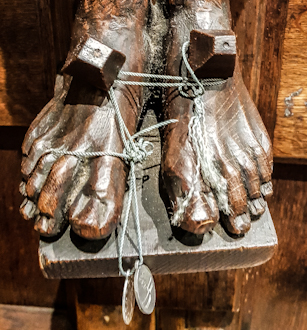
Yesterday, I visited St John the Baptist Church (Church of England) in Holland Road, Shepherds Bush, London. At the entrance to this magnificent Victorian Gothic building, there is a wooden crucifix. I was surprised to see that it had something that made me think of India. Two threads, each bearing a small metal medallion with some prayerful words on them, were wrapped around the heads of the nails penetrating Christ’s feet. I have never seen anything like this in a church in the UK. Is this a chance finding or the beginning of a new trend?

How sad is that?

I was visiting Christie’s auction house in London to view some modern art being displayed prior to an auction.

Seated by a large painting by David Hockney, there was a well dressed man looking at his mobile phone.

A decorous young lady sauntered up to him and said in a French accent:

“Do you follow me on Instagram?”.

The man looked up and said:

“No. Who are you?”

How sad is that?

A myth


Recently, I renewed my Reader’s Card at the British Library, currently housed in superb premises on Euston Road, next door to the Victorian Gothic St Pancras railway station. This building was opened by Queen Elizabeth II in about 1998. Prior to this, the library’s Reading Room was a huge circular structure in the heart of the British Museum.

When our daughter was at primary school, she was taught about the Ancient Egyptians  including a female Pharaoh called Hatshepsut. One Saturday, I took our daughter to the British Museum in the hope of finding an image of the pharaoh in the Egyptian Galleries. After a desultory search, we gave up and walked acoss the the lovely covered Great Court, created relatively recently. The central circular structure within it contains the unused but well-preserved round Reading Room, which was designed by Sidney Smirke and opened in 1857, the year of the First Indian War of Independence. 

We entered the old Reading Room and I asked the attendant sitting there:

“Where exactly did Karl Marx used to sit when he used the library?”

“It’s a myth, sir,” replied the attendant, “He did not have a particular place because it has always been the library’s policy that places can not be reserved from day to day.”

I was a bit disappointed with his reply, but had to accept it.

When we got home, my wife asked our child how we had got on. She replied:

“You know Mummy. Daddy asked about his friend at the big old library?”

My wife asked which friend. Our daughter replied:

“I don’t know, but the man said he was a myth really.”


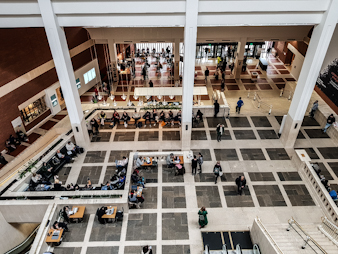
Picture shows foyer of current British Library in Euston Road


Saved by a coffin

Old people

Before I began studying at Highgate School (in North London) in 1965, joining the Combined Cadet Force (‘CCF’) was compulsory. The CCF was military training for teenagers, who were dressed in full military uniforms. The school was well-equipped for CCF training, having an assault course, a shooting range, a fully-equipped armory, and several members of staff who had been, or still were, high ranking military officials. 

Fortunately for me, joining the CCF became voluntary just after I joined the school. The CCF trained on Tuesday afternoons. Those, incuding me, who had opted out of the CCF, had to do something worthy instead of military training.

For a while I was enrolled in ‘Digweed’, a squad of pupils who helped with gardening in the school’s numerous properties. I was assigned to the garden of one of the boarding houses. I could not tell a wanted plant from a weed, and was therefore quite useless. We used to be given cups of tea halfway through the afternoon. It was tea with milk, which I detested in those days. So, my only useful contribution to Digweed was watering plants with the contents of my tea cup.

After a spell of Digweed, I was asked to visit a home for elderly people every Tuesday afternoon. My task was to chat with them. People who know me now will not believe how shy I was when I became a visitor to the home, but I was. The elderly folk living at the home used to sit in high backed chairs arranged around the walls of a large room. I was supposed to talk with them. I tried, but almost all of them were too far gone to respond. These Tuesday afternoon visits were dreary and depressing, as well as being pointless.

There was one old lady, who was very chatty and friendly. However, she was not present every time that I visited. She told me that whenever she could, she would run away from the home, but would always be found and brought back.

One Tuesday, I rang the doorbell of the home. One of the staff opened the front door, but prevented me from entering. Behind her, I saw a coffin resting on a trolley in the hallway. “Best you don’t come in today,” the staff member whispered to me. I know it sounds wrong, but I was really pleased that the coffin had spared me yet another afternoon of misery with those poor distressed gentlefolk.

A North London idyll

Highgate Wood in late February

Trees with bare branches will soon bear leaves.

The sun shines through the cool, clear morning air.

Shadows  of tree trunks fall across the gravelly path, along which a man walks his dog.

A mother wheels her baby in a pushchair. 

And a jogger lopes past me, panting wheezily. 

An occasional bus passes by a signboard on the barely used pavement. It invites customers to take refreshment in a sylvan café.

It is Monday morning, and most people are at work.

A suburban idyll.


Espresso in Ealing

Until a couple of years ago, I considered that the very best coffee served in London could only be found in a few coffee bars, all of which were Italian (e.g. Bar Italia, Lina Stores, and The Algerian Coffee House in Soho; the Portobello Garden Café in Portobello Road), Portuguese (e.g. Lisboa Café in Golborne Road and Madeira Star in Lambeth), or Spanish (e.g. Brindisa near Borough Market). I still consider all of these as good choices for excellent coffee, but need to add another to my list.

A Polish born receptionist working at the dental practice where I used to practise dentistry, suggested that a restaurant in Ealing called ‘Sowa’ (means ‘owl’ in Polish) served good Polish food. We visited this place, but were not impressed by the food. Much better Polish food can be obtained at Café Maja in POSK, the Polish Centre in King Street, Hammersmith.

The well-appointed restaurant at Sowa adjoins a café, which is part of the same establishment. Unlike the restaurant that fails to shine, the café is magnificent. The coffee served here in all forms (espresso, cappuccino, latte, etc.) is at least as good as that we have drunk in the best of the Italian, Portuguese, and Spanish coffee houses in London. Having visited Sowa too many times to remember, I can safely say that the high quality of its coffee never wavers. 

Sowa’s café also offers a mouth-watering range of highly tempting pastries and cakes. It seems in general that the Polish have a magical touch when it comes to making these delightful accompaniments to coffee.

So, if you are in Ealing, ignore every other café, and head for Sowa.

PS: Next door to Sowa, there is a lovely Polish delicatessen that offers a wide range of salamis, hams, and other cooked meats, as well as other Polish food items.

Sowa: 33 High St, London W5 5DB

NB: I have no interest financial or otherwise in Sowa. I am simply a content customer!


Liverpool

When I was doing experimental work in a physiology laboratory in London during the early 1970s, a new technician joined us. She was a lovely young girl from Liverpool. The job suited her perfectly and she was a great worker, full of cheer.

After two weeks, she announced that she was leaving us and returning to Liverpool. When asked why, she said: “I love working with you all, but nobody talks to each other on the bus. Back home in Liverpool everyone chats on the bus.”

Several decades later, I visited the lovely city of Liverpool. As soon as I was able, I took several rides on the city’s buses. On not one of these journeys did any of my fellow passengers chat to me nor to anyone else. I was so disappointed: I had been looking forward to speaking with the loquacious Liverpudlians, whom our technician had missed when she spent two weeks working with us in London.

A precocious child

Sometimes it pays to keep your mouth shut at the dental surgery.

In the 1950s and early ’60s, our family dentist was a kindly German Jewish refugee called Dr Samuels. In those days, I learned later while I was studying dentistry, sugar used to be an ingredient of toothpaste made for use by children. I doubt that my mother provided us with children’s toothpaste, which she would have regarded as being gimmicky.

Dr Samuels had a very upmarket practice in London’s St John’s Wood. His waiting room floor was covered with thick pile oriental carpets and the reading matter was glossy journals such as Country Life.

The surgery, where Dr Samuels performed his dentistry, was old-fashioned. Instruments were kept on display in glass fronted metal cabinets. His x-ray machine looked antiquated even to my young, inexperienced eyes. So, did most of his other equipment, much of it made by the German Siemens company. One of my uncles, also a patient of Dr Samuels, once asked him if a museum might be interested in displaying this historic looking dental equipment. Samuels answer was that it was not quite old enough for a museum.

Dr Samuels drilled teeth with a cord driven dental handpiece. He told us that he had an air driven high speed dental drill, but he did not like it because it cut too fast in his opinion. So, having fillings in his surgery was quite a noisy and bumpy experience.

Dr Samuels was a gentle, kindly man, like a benevolent grandfather. He never frightened me.

At the end of an appointment, he used to reward me with a boiled sweet. I looked forward to receiving these. However, one day when I was about 8 or 9 years old and he offered me the sweet, I said to Dr Samuels: “No thank you. Sweets are filled with sugar and bad for my teeth.”

The price I paid for my precociousness was that he never again offered me a sweet at the end of my appointments with him. I should have kept my mouth shut and graciously accepted his kind but unhealthy gift.

View of palms

I am not certain when I first saw palm trees. Maybe, it was when I was three years old. Then, my parents took me for a holiday in South Africa, where they were born.

Some of the first palm trees that I remember seeing are still growing in a small garden next to the entrance of St John’s Wood Underground station near Lord’s Cricket Ground in London. We used to visit St John’s Wood regularly when I was a child because our family dentist, Dr Samuels – a refugee from Nazi Germany, had his surgery opposite the station.

My first view of palm trees growing en-masse was from the air on an early morning in late December 1993. Our plane was landing at the airport in Colombo, Sri Lanka. We were travelling via Colombo to Bangalore in India. A week or so after seeing this vast plantation of palms, my wife and I were married during a colourful Hindu ceremony.

Although I have seen many, many palm trees since then, I still find them beautiful and exotic.

Some know, others don’t

I know it is not a good idea to make generalisations, but it is quite fun to do so occasionally. So, here goes! This time, I am going to generalise about taxi drivers’ knowledge in London, Bombay, Bangalore, and Ahmedabad.

The drivers of London’s characteristic black (usually) cabs are only allowed to work when they have “The Knowledge”. That is, they have passed an examination that requires the candidate to have a very detailed knowledge of the streets of London. A London cabbie only very rarely does not know the way.

London’s minicab and Uber drivers do not have to be tested on The Knowledge, but they are usually very adept at using GPS systems.

In Bombay, there is a huge number of yellow and black cabs. In my experience, the drivers usually know their way around the city. Some of them raise all kinds of objection s before they give in to your wish to hire them, but once aboard they will take you where you want without requiring navigational assistance.

I find the best way to get around Bangalore is to travel in an autorickshaw. Their drivers often know the way, and if they do not, they will ask fellow autorickshaw drivers, who can point them in the right direction. Uber and it’s competitor Ola exist in Bangalore, but their drivers, often from out of town, are often clueless about the city’s geography and find GPS hard to understand.

It is our experience with autorickshaw drivers in Ahmedabad that prompted me to write this blog. We have made many trips in their vehicles. An enormous proportion of the drivers will tell you that they know how to reach a place, but in reality they have no clue. They will not admit their ignorance and are often reluctant to stop and ask for directions from bystanders.

One driver in Ahmedabad, who was completely lost, got annoyed with us, his customers, and said: “Why are you going somewhere if you don’t know how to get there? I should leave you here, and you can find your own way.”

I did say that I would be generalizing. In all fairness, I must record that some of the autorickshaw drivers in Ahmedabad have been very knowledgeable about their city, but these have been in the minority.

So, when you visit the truly wonderful city of Ahmedabad, you will find it helpful to be able to access Google maps on your mobile phone while travelling around.