Eye and brain

MEMORIES TRIGGERED BY A PHOTOGRAPH RECENTLY TAKEN NEAR OUR HOME

I first met Catherine during the final year of my BSc in 1973. She was teaching mammalian reproductive physiology. After that, I met her again in 1977 when I began studying dentistry and also attended weekly etching and engraving classes taught by my mother’s cousin Dolf #Rieser. Catherine was another of Dolf’s pupils, and one of his best. I stopped attending these classes on 1982, when I moved to Kent.

Occasionally, I visited Catherine and her husband Brian in a street near where this picture was taken, a street close to our flat.

In about 1994, when Lopa and I had been married a few months, we ‘bumped’ into Catherine in a street quite by chance. We invited her and Brian to dinner. Thus began a close friendship between them and us.

Soon after our daughter was born, we had major building work done in our small flat. Catherine and Brian kindly let us stay at tjeir place for a few weeks.

Catherine employed an elderly lady called Bridie to do ironing several days a week. Bridie and our young daughter fell in love with each other. Catherine suggested that Bridie would probably be a good babysitter for our little one.

Although Bridie was well into her eighties, she was alert and very sprightly. When our daughter was old enough to attend school, Bridie would often collect her and look after her at home until we returned from work.

Bridie was (is??) a committed Roman Catholic. Our daughter, even when a toddler, took a great interest in matters theological. One day, Bridie told our daughter that if you are good in life, then you will go to heaven when you die. To which our daughter, who has an Indian mother, replied:
“Well, us Indians never die, Bridie. We just keep coming back again.”
This indicated an early appreciation of the concept of reincarnation.

Sadly, both Brian and Catherine are no more than memories now. However, whenever we walk in the streets near where they used to live, we remember them vividly. Dolf Rieser left this life long before ourvtwo friends. As for Bridie, we have no idea. If she is still around, she would have passed her hundredth birthday long ago.

The leaning tree

LATE 18 leaf

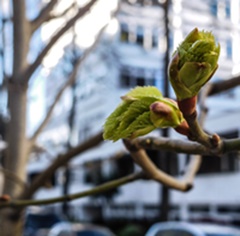
“A PICTURE IS WORTH A THOUSAND WORDS” It is not known exactly when this well-known sentence was first used, but an article in Wikipedia suggests that one of the first times it appeared in print was in an advertisement for a Texan newspaper, the “San Antonio Light”, in 1918. I do not know whether I can write a thousand words to put the attached picture in context, so you will have to make do with what I am able muster.

Just over a year ago, my wife and I were ‘wintering’ in India. We left our daughter looking after our flat in Kensington. One day, she sent us a message informing us that one of the old trees in our street had toppled over in the middle of the night.

The tree that fell always looked precarious as its trunk leaned over the road at quite a sharp angle, making it tricky to park a car next to it. A neighbour told us that it had done so for well over a century. His evidence was that the very same tree can be seen leaning over the road in an old photograph of our street taken about 150 years ago. So, the tree was not inherently unstable.

Many years ago, while walking through woods with my old PhD supervisor (and by then a close friend), he pointed out the variety of shapes and inclinations of the tree trunks around us. He wondered how a tree ‘knew’ how to grow in various directions whilst maintaining a centre of gravity that stopped it toppling over. Clearly, our late lamented leaning tree ‘knew what it was doing as it had been leaning seemingly precariously for at least a century and a half.

After we returned from India, there was a bare patch where the tree had stood for so long. A neighbour, who makes it his business to find out in detail what happens in our small street told us what befell our tree. The local council decided to move the position of the curb and so to widen the pavement around the tree, the idea being to narrow the road at that point and thereby prevent parking next to the tree.

Unfortunately, the workmen assigned to carry out this job managed to cut through part of the tree’s root system. This destabilised the tree, which then fell over across the street. While falling, the tree damaged a first-floor balustrade and terrace on a building across the street. Luckily, there were no human casualties.

For some months, the site of the fallen tree remained treeless. Then, a small tree with a slender trunk, a sapling, was planted by the council. Day by day, we watched it producing leaves. These changed colour in the autumn, looked sickly, and fell off, leaving a sad looking spindly tree. Then, we spent another winter in India.

When we returned in late February this year (2020), the young tree was still standing and still looking lifeless. As the weeks passed, we were very pleased to see buds forming on its slender branches. These buds have grown in size and are, at last, unfurling to reveal the tiny leaves seen in the photograph.

It is pleasing to see that even in these troubled times, nature has something positive to lift our spirits.

Well, I have reached about 580 words, not quite a thousand. However, as the saying goes, I hope my photo is worth at least a thousand words and is something to enjoy.

Watching

It gives me great pleasure and sense of wellbeing watching the ducks, moorhens, geese, swans, seagulls, and other fowl, swimming in or sitting close to the water bodies on London’s parks.

Sometimes, I have spotted rarer birds such as herons, cormorants, and pelicans (in St James Park). Golders Hill Park in northwest London used to have flamingos. I do not know if they are still there.

I often wonder what the birds think about the humans, who come to visit them, that is if they think at all. Are we good company for them or simply an occasional source of welcome food waste?

It does not matter to me whether or not they think, so long as they are there to give us all a pleasurable experience and that they are enjoying life in an avian kind of way.

Divided but unified

CZECH BLOG

Notting Hill Gate, not to be confused with ‘Notting Hill’ as in the Hugh Grant film, on the western edge of central London is not lacking in mediochre modern architecture, mostly constructed in the 1960s and 1970s. One building stands out as being aesthetically a cut above the rest. This is the former Czechoslovak Centre, the Embassy of Czechoslovakia, a fine (if that is an appropriate adjective) example of ‘Brutalist’ concrete architecture.

The Centre was built between 1965 and 1970, and was designed by “…Šrámek, Stephansplatz and Jan Bočan, from the Atelier Beta Prague Project Institute, were the architects of the embassy, working in cooperation with British architect Robert Matthew and based in his office” (see HERE for detail). The building won an architectural award from RIBA in 1971. Unlike many buildings built at te same time, the Czechoslovak Centre building has not suffered from ageing. It stll looks in great condition.

In 1993, Czechoslovakia ceased to exist. It split into the Czech Republic and the Republic of Slovakia. Despite this, the Czechoslovak Centre building continued to have diplomati cfunctions. The building was divided into a Czech Embassy and a Slovak Embassy.

Before and after the separation of the two parts of what was once Czechoslovakia, I was a member of  the Dvorak Society, an English organisation for promoting interest in music from  the Czech and Slovak lands. The Czechoslovak, and then later the Czech and Slovak embassies used to host occasional congenial recitals of music for the Dvorak Society.

On one occasion after 1993, my wife and I attended a recital at the Slovak Embassy. After the music was over, we were treated to delicious food and Slovakian wine. The ambassador mingled amongst the guests. My wife asked him how the Czechs and Slovaks were coping with sharing the same building. Smiling, he replied:

We have to cope well because we have to share the central heating and hot water system that was installed to serve the building when it was a single embassy.”

Dress code and literature

Many of the smarter social clubs in India have rules about how one should be attired when visiting them. The same is true for ‘elite’ clubs in London.

DRESS CODE

For example, at the Ootacamund (‘Ooty’) Club in southern India men cannot think oof having a drink at the bar if they are not wearing a formal suit and tie. And, at the Bangalore Club, men can where sandals in the Club House providing the sandals have a back strap. Even worse, at the same club the wearing of smart Indian national outfits is frowned upon if not forbidden. This is surely a hangover from the days when the club only admitted ‘white’ Europeans and a few high-ranking Indian military personel.

Once, I was staying at the Kodaikanal Club in Tamil Nadu state. Dress rules were extremely casual there. Many guests wore shorts and sandals even in the bar and dining room. One day, I entered the club’s small library, and the librarian promptly asked me to leave. I was wearing sandals (with backstraps). Apparently, in the library gentlemen are required to wear formal lace-up shoes.  I cannot say why this was required unless the Kodaikanal holds literature in high esteem, and wants it to be respected by library users who have taken the trouble not to be dressed casually.