Exhibitionism then and now

THE DIORAMA IN REGENTS Park is no more. However, the building on Park Square East (number 18), a protected edifice which housed it, still bears the word ‘Diorama’ prominently displayed. Designed by Morgan and Pugin, architects, and opened in 1823, this former London attraction, a mere 700 yards away from Madame Tussauds, a current attraction, was described in “Mogg’s New Picture of London and Visitor’s Guide to its Sights, 1844”

(quoted in www.victorianlondon.org/entertainment/diorama.htm) as follows:

“The Diorama, in Park Square, Regent’s Park, long an object of wonder and delight in Paris, was first opened in London, September 29, 1823. This is a very extraordinary and beautiful exhibition; it consists of two pictures that are alternately brought into view by a very ingenious mechanical contrivance; the interior resembling a theatre, consisting of one tier of boxes and a pit, being made to revolve upon a centre with the spectators, thus gradually withdraws one picture and introduces the other to the view. A judicious introduction of the light, and other contrivances, give increased effect to pictures beautifully painted, which, by a concentration of talent, completes an illusion that with perfect justice may be pronounced ‘the acme of art’.”

In 1844, the place was open from 10 am to 4 pm and the admission charge was steep for that era, two shillings (10p in today’s currency). The technology employed to create the show was invented by the Frenchmen Louis Daguerre (1757-1851), of photography fame, and Charles M Bouton (1781-1853). John Timbs in his “Curiosities of London” (published 1867) provided more details of the Diorama:

“The Diorama consisted of two pictures, eighty feet in length and forty feet in height, painted in solid and in transparency, arranged so as to exhibit changes of light and shade, and a variety of natural phenomena; the spectators being kept in comparative darkness, while the picture received a concentrated light from a ground-glass roof. The contrivance was partly optical, partly mechanical; and consisted in placing the pictures within the building so constructed, that the saloon containing the spectators revolved at intervals, and brought in succession the two distinct scenes into the field of view, without the necessity of the spectators removing from their seats; while the scenery itself remained stationary, and the light was distributed by transparent and movable blinds-some placed behind the picture, for intercepting and changing the colour of the rays of light, which passed through the semi-transparent parts. Similar blinds, above and in front of the picture were movable by cords, so as to distribute or direct the rays of light. The revolving motion given to the saloon was an arc of about 73º; and while the spectators were thus passing round, no person was permitted to go in or out. The revolution of the saloon was effected by means of a sector, or portion of a wheel, with teeth which worked in a series of wheels and pinions; one man, by turning a winch, moved the whole. The space between the saloon and each of the two pictures was occupied on either side by a partition, forming a kind of avenue, proportioned in width to the size of the picture. Without such a precaution, the eye of the spectator, being thirty or forty feet distant from the canvas, would, by anything intervening, have been estranged from the object.”

Although the Diorama was successful from a cultural viewpoint it was not commercially viable. By 1850, it had been sold. In 1852, the politician and engineer Sir Morton Peto (1809-1889) bought the building, and it was turned into a Baptist chapel (www.british-history.ac.uk/old-new-london/vol5/pp262-286). More recently, its interior has been modernised and converted to be used for various purposes.

The former Diorama faces the south east corner of Regents Park, the English Garden, where once a year this area briefly becomes host to a contemporary cultural event: The Frieze Sculpture show. Various commercial galleries display works of art from their collections in the open air in this part of the public park. It is a show that we enjoy visiting and this year, 2020, was the third year running that we have attended.

This year, the show runs from the 5th to the 18th of October, a shorter time than in previous years because of the covid19 pandemic. Realistically, it could have been held for far longer given that it is in the open air and crowding is unlikely. The 2020 exhibition comprises 12 artworks selected by curator Clare Lilley (Director of Programme, Yorkshire Sculpture Park). The artists whose works can be seen are as follows: David Altmejd, Fabio Lattanzi Antinori, Gianpietro Carlesso, Eric Fischl, Patrick Goddard, Lubaina Himid, Kalliopi Lemos, Richard Long, Sarah Lucas, Gavin Turk, Rebecca Warren and Arne Quinze. Of these, I had heard of some of them and already seen some of their art.

Without attempting to describe the artworks, all of them were visually intriguing, well-executed, and most of them evoked light-hearted feelings to a greater or lesser extent. The visitors who were looking at them seemed to be enjoying what they were seeing. Both children and adults were having fun. A lot of selfies were being taken, especially next to the sculptures that featured free standing doorways by Lubaini Himid and another by Gavin Turk. Fabio Lattanzi Antinori’s “viewing room” also attracted many people. This simple electronic sculpture flashed up a series of ridiculous but amusing messages such as “Culture is £1.28” and “Raju is £0”, which together formed a curious critique of today’s cultural values. An artwork which was somewhat macabre and delightfully weird was a collection of latex rubber animal heads scattered around in the grass. Each head also incorporated a mirror. This collection, entitled “Humans-Animals-Monsters (2020)” was created by Patrick Goddard. So, when a viewer looks at one of the heads, he or she not only sees the animal or monster but also his or her own reflection.  One sculpture, which I liked but my wife and daughter did not, was a tower of twisted torn metal sheets created by Arne Quinze. One work, which I did not particularly like, but was popular with small children was a sculpture depicting an oversize sandwich, created by Sarah Lucas.  The other six artworks, although not insignificant visually, attracted me less than those I have just described.

In brief, although a far cry from the long-lost Diorama, the outdoor Frieze Sculpture show is great fun and worth visiting if you can. Interesting artworks are displayed in a lovely environment. Some of them seem in harmony with nature and others deliberately clash with it. I must confess that I have a great fondness for outdoor displays of sculpture. Maybe, this derives from my childhood when my mother used to create sculptural works and displayed some of them in the garden of our home in northwest London. Recently, apart from seeing the sculptures at Regents Park, I have enjoyed seeing artworks displayed outdoors at Salisbury Cathedral, Compton Verney House (in Warwickshire), and at Henry Moore’s former home near Much Hadham.

PS: If you cannot get to Regents Park, the exhibition is on-line for a while at: https://viewingroom.frieze.com/viewing-room/

See a short video made by me at the exhibition by clicking here:https://youtu.be/Hg1IfB4jR9U

Pelicans in the park

I HAVE BEEN FORTUNATE to have lived in parts of London close to large green open spaces. When I was at secondary school in Highgate (north London), I could walk there from my home in Hampstead Garden Suburb, hardly needing to walk along streets. It was a short distance from my house to the grassy Hampstead Heath Extension. From there, I crossed a road to enter the wooded part of Hampstead Heath through which I walked to the Spaniards Inn. Then a few hundred yards of pavement followed before I entered the pleasant landscaped grounds of Kenwood House. Walking through this lovely park brought me to within a few hundred yards of my senior school.

When I was a student at University College London (‘UCL’), I was able to walk there through green areas most of the way from my family home. By walking the length of Hampstead Heath Extension, and then strolling southwards across the eastern part of Hampstead Heath, I reached South End Green. From there, I had to tramp the streets towards Primrose Hill, where once again my feet were on grass instead of paving stones. Primrose Hill led straight to Regents Park and from that splendid open space, it was a short walk along pavements to UCL.

Since marrying over 27 years ago, we have lived close to the northwest corner of Kensington Gardens. We are about three to four minutes’ walk away from the gardens depending on whether the pedestrian traffic lights are in our favour or not. We can traverse Kensington Gardens, passing close to the so-called Round Pond and then reaching The Serpentine Lake, where maybe one might stop for a coffee at the café by the Lido on the Serpentine. From there, it is not a long distance to the southeast corner of Hyde Park, which is next to Hyde Park Corner, a small green space ringed by busy roads. After crossing Hyde Park Corner, maybe having walked beneath Wellington Arch, which is surmounted by a metal quadriga, one road needs traversing before entering Green Park, which lives up to its name with its expanses of lawn and rows of mature trees. If you wish, you can walk along the northern fringe of Green Park to reach the eastern third of Piccadilly, and then you have arrived in the heart of the West End hardly having stepped upon the pavements lining busy streets.

After walking east through Green Park, one reaches the Mall and the front of Buckingham Palace. Cross the Mall and then you are in St James Park. By crossing this beautiful green space, you will soon reach Parliament Square and beyond it the Thames and the South Bank area.

Let us linger awhile in St James Park. The feature that endears me to this London Park is the St James Park Lake and its rich assortment of waterfowl. The park was established by King Henry VII on marshland watered by the now no longer visible Tyburn River, which runs in underground conduits. The lake, probably designed by the French landscape designer André Mollet (d. before 16 June 1665), began life as a canal dug for King Charles II. The king used it for swimming in the summer and for skating when it froze in the winter (a rare occurrence nowadays, thanks to the so-called ‘global warming’ that many believe is occurring).

There is a pedestrian bridge across the water, two islands, and a fountain, in the lake. A wide variety of ducks, swans, geese, herons, cormorants (or shags), and other birds congregate in and around the water. This is nothing peculiar. You can see the same in The Round Pond, the Serpentine Lake, and many other water bodies that are dotted liberally across Greater London. However, St James Park offers one kind of bird that you will not find anywhere else in London except at the Zoo. The park is home to a small population of pelicans. These creatures are often hard to see as they usually perch on the islands in the lake, but yesterday, the 11th of October 2020, at least three of them were walking fearlessly (it seemed) along the edge of the lake close to admiring visitors including my wife and me.

In 1664, during the reign (1660-1685) of King Charles II of England, Scotland and Ireland, pelicans were first introduced into St James Park. These distinctive long billed birds, which symbolise the Passion of Jesus and the Eucharist in Christian symbolism, were gifts of the Russian Ambassador, who knew that the king appreciated exotic waterfowl. Charles was presented with two grey or Dalmatian pelicans (Pelicanus crispus). Sadly, they did not breed successfully, and the park needed to be replenished with new specimens occasionally. An article in the online version of “Country Life” (www.countrylife.co.uk/out-and-about/dogs/st-jamess-park-pelicans-sparked-cold-war-stand-off-russia-usa-171954), published in January 2018, reveals:

“The Russian Embassy’s custom of occasionally presenting new pelicans continued during and after the Soviet era and other organisations – such as the City of Prague in 2013 – have also added to the birds’ numbers.”

However, a diplomatic incident erupted in the 1960s, when:

“… London’s Royal Parks accepted some American pelicans for the lake in St James’s Park … According to Foreign Office tradition, the presence of the American pelicans resulted from a Cold War rivalry between the American and Soviet Embassies. One day, a newly accredited US Ambassador called on the Foreign Secretary, whose office overlooks the lake. He noticed the pelicans and was informed about their history and origin.

Determined not to be upstaged by the Soviet Ambassador, his opposite number announced that he, too, would be presenting some pelicans – American ones – to grace the lake, an offer that the Royal Parks management accepted gratefully.

When the American pelicans duly arrived, they were, predictably, not friendly to their Russian counterparts. Indeed, rather mysteriously, they failed to flourish and seemed miserable. The US Embassy suspected the Soviet Embassy of harming the American pelicans – which the Russians denied – and relations between the embassies became glacial.”

That incident is something that we did not see recorded on any of the numerous informative signs placed near the perimeter of the lake.

Londoners are most fortunate to have so many green spaces often within easy walking distance from their homes. Many other great cities of the world do have significantly large public green spaces, for example Central Park in New York, Cubbon Park in Bangalore, the Bois de Boulogne in Paris, and Kalemegdan in Belgrade, but few have so many as liberally distributed across their areas as does London. Being within walking distance of both Kensington Gardens and Holland Park during our recent severe month’s long ‘lockdown’ helped raise our spirits during this bleak period. Not only was the walking we did good for our spirits, but it gradually increased the distance that we can walk comfortably before becoming physically fatigued. Even when eventually the pandemic of covid19 dies down, we might well think twice about taking public transport now that we know how pleasant it is to walk instead.

PS: If you wish, you can watch the pelicans feeding in the lake on:  http://www.ipernity.com/doc/adam/50409682

The story of a bookshop

THE BIOGRAPHY OF STANLEY Spencer, which I ordered online, was too large to fit through the letter flap on our front door. So, as is usual in such situations, the postman left a red and white postcard informing me that I could collect my oversized parcel from the local post office. Until October 2019, undelivered packages could be collected from a busy post office in Queensway. Since then, and throughout the 2020 ‘lockdown’, post can be collected from a new and much improved centre on nearby Westbourne Grove.

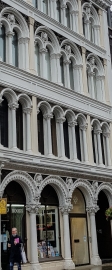
Much of the architecture on the stretch of Westbourne Grove between Chepstow Road and Queensway is unremarkable. An exception is number 26, which houses the Al Saqi bookstore. This elegant establishment specialises in selling (and publishing) books about the Middle East and North Africa. In 1978, two friends, André Gaspard and Mai Ghoussoub, left war-torn Lebanon to settle in London. They founded the Al Saqi book shop because:

“They yearned to recreate something of the heady intellectual freedom of pre-war Beirut, and to supply a then-untapped market for English and Arabic books on the Middle East and North Africa.” (https://saqibooks.com/about/history/).

They began publishing as ‘Al Saqi’ in 1983 and have been selling books, including some banned in certain countries, for well over thirty years.

Interesting as the bookshop might well be, its premises catch the eye and intrigue the passer-by. As the “Arab Weekly” wrote in December 2015 (https://thearabweekly.com/al-saqi-not-your-average-london-bookstore), the shop is;

“Not your average London Bookstore … London – Al-Saqi bookshop is housed in a conspicuous building in London’s Bayswater district. With colonnades and arches topped by 11 staring busts, its architecture recalls ruins that are found across Europe, North Africa and the Middle East.”

It was the shop’s exuberant and unusual façade that has often caught my attention.

It was not Al Saqi who designed the façade of the building housing it. After he had spoken with a customer in Arabic, I asked a learned looking man, who was working in the shop, about the history of the building in which it is housed. He had no idea.

The architectural historian and his co-author Bridget Cherry mention the building in “The Buildings of England, London 3: North West”. They wrote that the highlights of Westbourne Grove include:

“… No. 26 built as an ‘Athenaeum’, 1861, by A Billing, stuccoed with columns and a good deal of sculpture (musical angels, busts of Milton, Shakespeare, etc.)”

A Billing was Arthur Billing (1824-1896), whose career included construction of, and restoration of, many churches in London and south-east England. Most dictionaries define an Athenaeum as an institution for the promotion of literary or scientific learning. a library or reading room.

Another source (https://historicengland.org.uk/listing/the-list/list-entry/1066120) describes Saqi’s home as having once been a “… Theatre … built as a Shakespearean theatre”, but does not refer to it as an Athenaeum.  Just as I was beginning to despair of discovering whether number 26 was originally an Athenaeum or a theatre, or both, I stumbled across an informative website (https://archiseek.com/2013/vestbourne-athenom-westbourne-grove-b-wswater/). It describes the building as having been originally named ‘Westbourne Hall’ and quotes an article published in an issue of “The Building News” dated 31st of May 1861.

From the article, we learn that the newly built Westbourne Hall was attached to the Bayswater Athenaeum, which was on nearby Havelock Terrace (which, strangely, does not appear on a detailed map published in the late 1860s). From the detailed description of the façade of Westbourne Hall, it is certain that the premises of the bookshop are in the former Westbourne Hall, not the Athenaeum. The gaslit auditorium, equipped with lights installed by Mr G Reed, “the eminent gasfitter of Westbourne Grove”, had raked seats with “carved ends”. There was a gallery above the entrance end of the hall. The hall was equipped with what was then a “new patented system” of heating and cooling designed to keep the audience comfortable. The article added:

“When the new reading rooms, refreshment and committee rooms, and other offices are completed, the business of the Athenaeum will be removed into them, and look out upon Westbourne-Grove.”

So, it appears that The Athenaeum moved into Westbourne Hall. The article also gives an idea of the place’s original intention. It was to provide a place where the “respectable population” of the area could hear worthy events such as Shakespeare being read by:

“… a silver voiced popular preacher …Lectures on the Holy Land, Revelations, and Negro Slavery, an evening with amatory Thomas Moore …”

Another issue of “The Building News” (see  https://archiseek.com/2013/vestbourne-athenom-westbourne-grove-b-wswater/) gives a very full description of the building’s remarkable exuberant façade.

The subsequent history of the Westbourne Hall is found on an informative website (www.british-history.ac.uk/vch/middx/vol9/pp221-226). Here, slightly edited by me, is what is written:

“Westbourne hall in Westbourne Grove could hold 400 people for lectures and entertainments in 1860, when its lessee opened adjoining premises in Havelock Terrace as Bayswater Athenaeum and Literary Institution.  An ornate four-storeyed building with a hall for 1,000, designed by A. Billing, was built on the site of the first hall in 1861 and licensed for music alone by T. E. Whibley in 1863.  The Athenaeum, although welcomed for its educational value, had become the Athenaeum divan by 1865 and may have closed soon afterwards.  Westbourne hall continued to be used for concerts, plays, and public meetings until 1875 or later …”

A playbill preserved in the National Archives (https://discovery.nationalarchives.gov.uk/details/r/6497ee39-a6e5-4a92-9acc-551fda7680ed) gives a flavour of what was on offer at Westbourne Hall:

“Wednesday July 1st 1868.

‘Benefit and last appearance of Miss Lydia Howard, the Baby Actress, when she will sustain her characters of Katherine! in “The Taming of the Shrew”, Falstaff! in “King Henry the Fourth”, Prince Arthur! in “King John” and Matilda Mowbray! Hector Mowbray!! Foppington Mowbray!!! Cobbleton Mowbray!!!! in The Four Mowbrays’. Also appearing: Miss Hazelwood and Mr J S Fitzpatrick Paddington”

That must have been a memorable evening. According to Anne Varty in her book “Children and Theatre in Victorian Britain”, Lydia, who was not yet five years old, ‘retired’ from the stage in 1869. Child actors and actresses were popular in Victorian times. As for the other ‘stars’ of that evening in Westbourne Grove, I have not yet found anything about them. “The Four Mowbrays” was a one-act farce by John Poole (c 1786-1872), first performed in the late 1820s.

So, there you have it more or less: the story behind the building where books on Middle Eastern and North African subjects are on sale. It is appropriate that this former Athenaeum/ theatre is still being used for cultural purposes. I am curious to know whether there is anything remaining of the Westbourne Hall’s former auditorium. Part of the building is now used by the HBA (Hirsch Bedner Associates) Gallery. A photograph of this organization’s premises looks like the space being used might well have been part of the auditorium (see https://foursquare.com/v/hba-the-gallery/5151a5e1e4b0cbcf6b5f4568). So, all is not lost.

Meeting the professor

AMONGST THE COURSES on offer in the third year in the Physiology Department at University  College London Lon, there was one with the mysterious title of ‘Connective Tissue’. I went to see our tutor Dr Roger Woledge, a specialist in muscle physiology, and asked him about this. He told me that it had been on offer for years, but no one had ever asked to take it. He suggested that I enrol in it so that it would be held for the first time ever, and at the very least he would discover what was on offer. I agreed, and he sent me to the office of Prof Robert Harkness to let him know that I was interested in finding out about his course.

As soon as I entered Robert’s cluttered office, I knew that I would enjoy studying whatever was on offer. There was barely any, if any, free space on the Prof’s huge desk. The walls of the office were crowded with books, runs of journals, pictures, old engravings, and even framed cartoons. There was a small paper notice stuck on the glass door of one cupboard. It was typical of Robert’s sense of humour and his take on common sense.

 His rotating office chair looked antique, rather like something you might expect to see in a bank manager’s office in the old Wild West. There was a glass fronted wooden cabinet filled with books and other objects. On the floor, there was a variety of things including polished wooden microscope cases. I was asked to close the door behind me quickly because he told me that his life would not have been worth living if the new black kitten, which had just emerged from a cupboard, was allowed to escape from the office. He and his wife, Margaret. would be taking it home that evening.

I imagine that Robert must have told me something about his Connective Tissue course whilst I stroked his affectionate young cat, but I do not remember what. All I can recall is that by the end of our brief but friendly interview, I had been enrolled on his course. When I reported this to Dr Woledge, he was delighted. The course was not to be held until well into the academic year, and, by the time it commenced, its participants included G Clough, who is now a professor at a major University, an MSc. Student, and me.

Some months later as I neared the date of graduation, I began investigating the possibility of starting a PhD and began visiting various people who were potential supervisors. While I was walking beside the iron railings enclosing the gardens of Lincolns Inn Fields after just having had two interviews that I had not enjoyed, I had a revelatory moment. It dawned on me that however prestigious a laboratory or potential doctoral supervisor might be, I would have to get on with him or her as well as his or her team of co-workers. I would be spending at least 3 years in their company. It was important, at least for me, that I should feel at ease with whomever I was to collaborate. If I did not, as I had just felt during the recent interviews, I knew that I would not be able to flourish as a doctoral student. Since that day, I have always asked myself whether I would feel comfortable working with whoever was interviewing me when applying for a post. Only once, I did not follow this rule, and then I ended up in a job that did not suit me at all.

On the next day, I visited Robert Harkness in his office.  As I entered and surveyed his undoubtedly individual office, I decided that whatever project that he had to offer would suit me as it would give me the chance to work in the genial company of Robert, Margaret, and their friendly team. He told me that he would be able to get hold of a Medical research Council (‘MRC’) grant for me, providing that I thought of an interesting topic related to connective tissue. He was not going to tell me what to research – I had to make that decision.

Then all of a sudden, he opened one of the leather-bound volumes that contained reprints of his published papers, and showed me a graph published in a paper that he had written for the prestigious Journal of Physiology. I forget what the graph illustrated but recall that it was divided into sections by several vertical dotted lines. He explained to me that he always had a great deal of trouble from the editors of the Journal. They were forever returning the manuscripts of the paper that he submitted to them, wanting him to make minor modifications and thus delaying publication.  He asked me to examine the vertical lines with a magnifying glass, and then I saw that they were made up of dots and dashes, which looked like Morse code. He asked me whether I was able to decipher Morse code. I told him that I could not. Gleefully, he translated the dots and dashes which he had drawn on the published graph and revealed that they spelt out the words ‘drat those flies’ repeatedly along the length of the lines. They had not been noticed by the journal’s fussy editors and were Robert’s revenge for their pernickety interferences.

Not only did I complete my PhD under the supervision of Prof Harkness, but also, I established a close relationship with him and his family. This friendship with the family, which my wife and I value greatly, has endured long since the deaths of the Prof and his wife.

Peel Street and paintings

WALKING ALONG A SHORT street in London’s Kensington recently, I observed things that I had never noticed before and was reminded of Tony ‘M’. When I was a student of dentistry at the University College Hospital Dental School, I first met Tony in the third year. In that year, we began to learn how to make crowns (‘caps’) for our patients. Instead of sending the work out to be done by technicians, we students had to learn the nitty gritty of fabricating crowns, mostly gold ones. We were assigned to one of three or four technician tutors. I was assigned to Tony’s group. Why visiting Peel Street in Kensington sparked me to think of Tony will be revealed later.

Peel Street in Notting Hill Gate lies in land that used to be known as ‘The Racks’. It was part of the extensive estate of Campden House, which was owned by the Phillimore family. In the early 19th century, the land was bought by John Punter and William Ward, who divided the land between them in 1823 after having agreed to lay out two roads: Peel Str and Campden Str. Peel Street lay in Punter’s share of the area. Although Punter retained several plots along Peel Street, the rest were sold to a variety of different people. Nearer the eastern end of the street several buildings were demolished between 1865 and 1875 during the construction of what is now the Circle Line. Though the tracks are underground, there are no buildings built above them. If you look through the gap on the north side of the road, you can see the rear of a brick building which fronts on Edge Street. Near the top of this place, some bricks have been made to project slightly and to spell the name ‘LESLIE’. The rear part of this L-shaped building is currently occupied by ‘The Spanish Education Office’. This building was flying Spanish and  EU flags. I have no idea about the significance of ‘Leslie’.

One of the houses on the south side of Peel Street used to be a pub. It still bears the lettering ‘Peel Arms’. It was probably in existence by 1889, but today it is a private dwelling. The pub’s clientele were probably mostly workers who toiled in the gravel pits that abounded in the neighbourhood. The pub is not far from the six-storey Camden Houses, brick-built blocks of flats erected in 1877-8 for labourers, some of whom might well have drunk at the Peel Arms. The blocks contain 125 separate flats. The entrances to the blocks have art nouveau features. The building were designed by the architect Edwyn Evans Cronk (1846-1919) for the National Dwellings Society Ltd. Cronk was born in Sevenoaks (Kent) and died in Redcliffe Square in South Kensington.

At the western end of Peel Street, there is another pub, The Windsor Castle. Unlike the Peel Arms, this is a working establishment, now popular with the locals, most of whom are not poorly paid labourers. It was originally built in about 1826 and then remodelled in 1933. The pub contains much of its original late Georgian building fabric and is a Grade II listed place. Although I have passed it often, I have never entered it or its reputedly fine garden. At the Eastern end of Peel Street, there is a wine bar, The Kensington Wine Rooms. When we were getting married, back in 1993, the premises were occupied by a branch of the Café Rouge restaurant chain. We held a pre-wedding dinner there. The premises now housing the wine bar once housed a pub, The Macaulay Arms.  It was listed as being in existence in the 1868 edition of “Allen’s West London Street Directory”. Thus, residents of Peel Street were only a few steps from three ‘drinking holes’.

The directory ( https://www.gutenberg.org/files/58160/58160-h/58160-h.htm) lists the residents of Peel Street in 1868 as follows:

“1 Upfold George, sweep/ 2 Arnold F., carpenter/ 3 Miles Frederick, painter/ 23 Mansell H., painter/ 26 Redman J., marine stores/ 28 Redman J., beer retailer/ 37 Taylor W., gardener/ 46 Lucas Wm. Grocer/ 53 Hobbs Mrs. general shop/ 55 Horskins Thos. Baker/ 63 Pollett —, bootmaker/ Harris W., greengrocer/ 67 Smart M., The George Brewery/ 69 Dunnett Mrs. dressmaker/ 77 Elson George, oilman/ 80 Evans H., gardener/ 82 Atwood Mrs, dressmaker/ 83 Salmon —, bootmaker”

Most of the inhabitants appear to have been tradesmen, merchants, and craftsmen, rather than labourers. This is probably because the list was compiled before the Campden Houses were built to house manual labourers and their families. Incidentally, there is still a greengrocer on Peel Street. Jack and Jessie’s excellent shop is opposite the Kensington Wine Rooms.

Peel Cottage stands almost at the corner of Peel Street and Campden Hill Road. It is next to number 118 Campden Hill Road (aka ‘West House’), a building on the corner of Peel street designed for the artist George Henry Boughton (1803-1905) in the late 1870s by Richard Norman Shaw (1831-1912). New Scotland Yard and Lowther Lodge (home of the Royal Geographical Society on Kensington Gore) were amongst the many other buildings designed by Shaw. Another artist, the landscape painter Matthew Ridley Corbet (1850-1902) lived at number 80 Peel Street, where once lived the gardener, H Evans.  

The entrance to Peel Cottage, which is dwarfed by its neighbours, is partially covered with ivy. It was seeing the blue, circular commemorative plaque on the wall next to its entrance that reminded me of my former teacher Tony M. The plaque informs the passer-by that the artist Sir William Russell Flint (1880-1969) lived in Peel Cottage from 1925 until his death. This brings me back to Tony M, about whom you must have thought I had forgotten already.

As a dental student, I spent many hours with Tony M as I struggled to make decent gold crowns that would fit my patients’ teeth in the conservation clinics of the Dental School. Each encounter with Tony involved a trip to the canteen in the school’s basement. Tony was unable to function without a fresh cup of the school’s barely mediocre coffee. Over cups of coffee, Tony used to encourage us when the clinical teachers made our lives miserable, help with our technical work, and chat. During one of our sessions together, Tony, knowing that art interested me, suggested that I visit Cottrell’s showrooms in nearby Charlotte Street (numbers 15-17) to see the fine collection of paintings that hung on its walls. Cottrell’s were an important supplier of dental equipment and materials. Today, although it has retained its original Victorian frontage, it is the premises of the Charlotte Street Hotel.

Dutifully and because I was curious, I visited Cottrell’s showroom and looked at the framed watercolours hanging on the walls of the two ground floor showrooms. The paintings were all works of the inhabitant of Peel Cottage, William Russell Flint.

Flint was born in Edinburgh. He studied at Daniel Stewart’s College and then Edinburgh Institution. Between 1900 and 1902, he worked as a medical illustrator in London. Later, he produced illustrations for books and “The Illustrated London News”. He was elected President of the Royal Society of Painters in Watercolours (now the Royal Watercolour Society, of which my wife’s cousin, Varsha Bhatia, is a member), a position he held from 1936 until 1956. He was knighted in 1947. Flint produced many well-executed, delicately tinted water-colour paintings. He often visited Spain, where he made plenty of images that often included sensuous portrayals of women in various stages of undress. It was some of these titillating paintings that Tony had sent me to see on the walls of Cottrell’s showroom.

It was in the late 1970s or early 1980s (before 1982, when I qualified) that Tony M encouraged me to pay a visit to Cottrell’s in Charlotte Street to widen my knowledge of the world of art. Many years have passed since then, but a memory of that brief glimpse of Flint’s paintings lingers in the back of my mind. Visiting Peel Street and seeing Flint’s home brought that all back to the forefront of my memory.

Between Mortimer Market and Iraq

MANY LONDONERS WILL HAVE walked past Mortimer Market without knowing it exists. Yet, I used to visit it every working day for about five years. It played an important role in my life and greatly affected my career. How it did, I will reveal later.

Mortimer Market lies a few feet east of Tottenham Court Road (‘TCR’) between Capper and University Streets. Immediately to its east, runs Huntley Street that is parallel to TCR. I used to enter Mortimer Market through a short, covered passageway leading off TCR. Vehicles can enter the Market via Capper Street.

Mortimer Market before 1949
Mortimer Market before 1949 when this photo was published

Until 1886, Capper Street was known as ‘Pancras Street’. This street has existed for over 300 years. Its history is outlined in some detail on an interesting website (https://regencyredingote.wordpress.com/). Before it was laid out, the land on which it runs was part of Capper Farm, which was in existence by 1693. The farmer, Christopher Capper, whose widow died in 1739, kept cattle. Members of his family, his daughters, kept the farm going until at least 1768. After his death, the family moved to crop growing in preference to rearing cattle. In 1756, the Duke of Grafton constructed the Euston Road that ran along the northern boundary of the Capper’s farm. At first, the Capper sisters raised an objection to it, saying that the dust raised by traffic along the new road would spoil their crops. The Duke and the sisters eventually came to some agreement. By 1770, the Capper sisters gave up their farm. It was then bought by Hans Winthrop Mortimer (1734-1807), who merits an entry in Wikipedia and on the History of Parliament website (www.historyofparliamentonline.org/volume/1754-1790/member/mortimer-hans-winthrop-1734-1807 ).

Mortimer was a property speculator and a Member of Parliament between 1775 and 1790. In the 1774 General Election, he was defeated by Sir Thomas Rumbold (1736-1791), who served as British Governor of Madras between 1777 and 1780. Rumbold became well-known for being corrupt. His misdeeds included what was effectively the theft of a precious ring from the Nawab of Arcot (Muhammad Ali Khan Wallajah, who reigned 1749-1795). Rumbold’s corruption preceded his stay in India. This involved, amongst other things, bribery during the election he contested against Mortimer. After a court case against Rumbold, Mortimer was awarded £11,000 in damages in 1776 and also gained the parliamentary seat that Rumbold had tried to win by cheating (bribery). It is a sign of the East India Company’s wobbly ethics that a man as corrupt as Rumbold was appointed the Governor of Madras so soon after losing his case of corruption.

Mortimer spent a great deal of money acquiring property in Shaftesbury, his constituency and also in London.  

The land, which Mortimer bought that had been the Capper’s farm, became known as ‘The Mortimer Estate’. Some of this estate was later sold and became the site of University College (‘UC’) London, which established in 1826. Mortimer Market began to be built on the western part of the estate in 1795. Old maps of the area show that in the 19th century Mortimer Market was like a piazza containing two parallel rows of small shops. This can be seen in a photograph published in 1949 and reproduced on a British history website ( www.british-history.ac.uk/survey-london/vol21/pt3/plate-27).

By 1963, the shops in Mortimer Market had been demolished. In that year, a purpose-built structure standing where the rows of shops had once stood was opened as University College Hospital Dental School (‘UCHDS’). It was this architecturally undistinguished building that I used to visit during the clinical years (1977-1982) of my studies of dentistry. The building is so non-descript that it does not get even a tiny mention in Pevsner’s detailed guide to the buildings of north London.  Prior to 1914, what was to become UCHDS was known as the National Dental Hospital, founded in 1861 and located at 187-191 Great Portland Street (see: https://ezitis.myzen.co.uk/uchdental.html). In 1894, the establishment relocated to 59 Devonshire Street. Twenty years later, it amalgamated with University College Hospital. From 1963 until its closure in 1991, 9 years after I qualified as a dentist, UCHDS was housed in Mortimer Market.  The former dental school building still stands and looks very much like I remember it, but now it houses a centre for the treatment of sexually transmitted diseases.

As mentioned earlier, I used to reach the entrance of the dental school by way of the passageway from Tottenham Court Road. However, the hospital could be reached via the network of underground passageways that linked various building of the hospital both with each other and UCL itself. To the right of the passageway if you face it from TCR, there used to be the premises of the Iraqi Cultural Centre. I went in there several times. On one occasion, I mentioned to one of the friendly men who worked in their shopfront office that I am fascinated by folk music from all over the world. He told me to wait and within a few minutes he returned and presented me with an album containing two LPs of recordings of Iraqi folk music. For years after this, I enjoyed listening to them.

During several of my brief lunchtime visits to the Iraqi Cultural Centre near Mortimer Market, I noticed something strange in it. Men would suddenly appear from what seemed like nowhere, maybe from doors hidden in the shop’s internal walls. When Saddam Hussein’s regime (1979-2003) began to attract western military attention, I remembered these curious appearances, and wondered whether there was something other that cultural promotion going on in this place so near my dental school. My suspicions have been confirmed: according to the writer Said K Aburish (born in Palestine in 1935), writing in 2004:

“Years ago Saddam Hussein used the Iraqi cultural centre in Tottenham Court Road to conduct intelligence against dissident Iraqis and to eliminate political opponents.”

Also, The Guardian newspaper noted on the 30th of April 2002:

“The Iraqi government also used some of the students on its scholarships as spies, and set up a London surveillance network based at a “cultural centre” on Tottenham Court Road. There were sporadic assassination attempts against dissidents: in 1995 Latif Yahia, a defector previously employed by the Iraqi government as the official double of Saddam’s brother, alleged that he had been attacked with knives by five men speaking Arabic while stuck in traffic on the capital’s Edgware Road.”

My time studying in Mortimer was quite exciting but not as much as what must have been going on nearby in the cultural centre.  Thinking back to my years of study, we had some lectures given us by a young Iraqi dentist, who was working on his PhD – something to do with denture fixatives. He seemed very pleasant, but now I wonder… 

While I was studying at UCHDS, I had wanted to write about the history of Mortimer Market. In those days before the Internet, although I looked at several books in UCL’s very well-stocked library, I did not find anything about the story behind this little-known part of London. So, what you have just read is what I was hoping to write more than 38 years ago.

Pleasure Gardens then and now

BATTERSEA PARK IS but a very few miles (only three!) from where we live in London, yet it is a place that until now we have hardly ever visited. Maybe, this is because it is across the River Thames on its south bank. To those who live on the north side of the Thames, anything across the Thames seems extremely far away and almost in another country. That sounds ridiculous, but it is the case. The river is like a psychological barrier to us ‘northerners’, but it is well worth crossing it. We parked our car in Chelsea close to the Albert Bridge, an elegant structure built in the early 1870s. A short stroll across the bridge brings you to Battersea Park, which stretches along the south bank of the Thames to Chelsea Bridge, which is downstream from the Albert Bridge.

Before 1858, when the park was opened, the land on which it now stands was marshland reclaimed from the Thames and used by market gardeners. Prior to the opening of the park, the area was a popular location for duels. The Duke of Wellington challenged the Duke of Winchilsea in this area in 1829.

The name Battersea is derived from the Anglo-Saxon name ‘Badrices īeg’, meaning ‘Badric’s Island’. In the Domesday Book, it was called ‘Patricesy’. Gradually, the name evolved into its present form. The park was laid out between 1846 and 1854 by the architect Sir James Pennethorne (1801-1871), but when it opened in 1858, the year that Chelsea Bridge was completed, it differed somewhat from his original plans. In 1889, the year when the Eiffel Tower opened in Paris, the park came under the control of London County Council (‘LCC’). Moving forwards to 1951, the year of the Festival of Britain, much of which took place near Waterloo Station on what is now called the South Bank, Battersea park was used to stage a part of the festival known as the ‘Pleasure Gardens’.

You can read much about the Pleasure Gardens on an interesting and informative illustrated website at https://alondoninheritance.com/eventsandceremonies/the-festival-of-britain-pleasure-gardens-battersea-park/ . In contrast to the rest of the Festival, the aim of the Pleasure Gardens:

“… was to balance the other events and add an element of fun to an otherwise mainly serious festival.”

Unlike other parts of the great event, the Pleasure gardens allowed commercial sponsorship. This was because the cost of these gardens was greatly in excess of what the government could afford. The Pleasure Gardens’ attractions included: a shopping area, ‘The Parade’; the Grand Vista with its fountains, arcades, towers, eating areas, and firework displays; a miniature passenger-carrying railway with two stations (Oyster Creek and Far Tottering); a fun fair; lawns and flower gardens; a dance pavilion; specially designated areas for children’s performances such as ‘Punch and Judy’; and a zoo. It must have been quite a wondrous place and a great relief for many people who had suffered hardships during WW2 and just after it. Many of the structures in the Pleasure Gardens were designed by well-known artists of the time including, to mention a few, John Piper, Osbert Lancaster, and Hugh Casson.

The former Pleasure Gardens were on the north side of Battersea Park close to the river. Little remains of what must have been a wonderful sight. The Children’s Zoo flourishes. It is the descendant of the zoo created in 1951. It nearly closed in 2003, but was rescued by Carol and Roger Heap, a couple intensely interested in wildlife education and conservation. Their son Ed is involved with the zoo’s management and his wife Claire is the zoo’s resident vet. I have yet to see the zoo, which we did not visit recently on account of the rain.

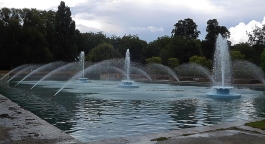
Hardly anything remains of the other parts of the Pleasure Gardens. The funfair that was opened in 1951 continued to operate until the early 1970s when an accident involving the Big Dipper occurred on the 30th of May 1972 hastened the fairground’s demise. What little remains of the Pleasure Gardens today has been conserved well by Wandsworth Council. This includes, The Parade (a tree-lined avenue running inside the park parallel to the riverbank), the Fountain Lake, and a few remnants of the Grand Vista. The prominent Peace Pagoda (erected 1985) with its gold coloured Buddha stands where once the Mermaid Fountain (sponsored by Lockheed Hydraulic Brakes) stood.

We visited Battersea Park on a grey weekday when few other people were in the park. The remnants of the Pleasure Gardens, where many people once congregated to have fun, was eerily empty, almost surrealist in appearance. Next year, it will be 70 years since the Festival of Britain. Being optimistic, it would be nice to imagine that maybe the pandemic will have subsided significantly, and we might be able to celebrate again, possibly with an element of ‘socialdistancing’ as one of the ‘attractions’.

An ancient wood

AN ANCIENT WOOD IS one that is at least 400 years old and has probably been in existence since time immemorial. Several of these ‘prehistoric’ woods have survived the spread of London over the centuries. Often, they are islands of wildness in a sea of suburbia, as is the case of Coldfall Wood near East Finchley and Muswell Hill in North London. We visited it on a damp afternoon when the trees were dripping with rainfall. This heightened the sense that we were strolling through a landscape little changed from the time when London had not extended so far into what was mostly untamed countryside.

Coldfall Wood was originally named ‘Colefall’, a word possibly derived from the Old English words ‘cole’ and ‘gefeall’, probably used to describe a place where charcoal was burnt. It is named that way in a document dated 1599 and on an Ordnance Survey map published as late as 1877. In 1599, there was a murder in the wood. This was not an uncommon event in Finchley, whose common land (which included Coldfall Wood) was the haunt of highwaymen and other miscreants for many centuries, and especially during the 18th. The wood made history in the world of geology in 1835 when (according to an article that can be found at http://www.locallocalhistory.co.uk/gd/gdpage04.htm):

“…At a spot in Coldfall Wood, just beneath the vegetable soil, an eminent London geologist, Mr. N. T Wetherell, of Highgate, discovered a strange accumulation of fossil remains, consisting of miscellaneous rocks, shells, teeth of fish, and bones of saurians of extinct species, evidently brought hither by some unknown agency from the formations of various northern areas of England.”

The importance of this discovery led to the suggestion that:

“… the southern lowlands of England, as well as the mountains of Wales and the northern counties, showed traces of their former occupation by glaciers, and perhaps a glacial sea.”

However, this idea mooted in the 19th century has been challenged. It is now thought unlikely that Muswell Hill was once submerged beneath a glacial sea (although the glaciers did reach the area).

The present Coldfall Wood, which is a reduced version of what it was before the mid-19th century, is a deformed square in plan, its southern border, which is bounded by Creighton Avenue, being longer than its northern one. In the past, the wood extended southwards and reached the road now called ‘Fortis Green’ that existed from the early 19th century. Incidentally, the settlement of Fortis Green was in existence by the 16th century.  The wood slopes downhill from its southern and western edges. At its southwest corner, it is just over 300 feet above sea level and at its north eastern corner, it is at least 60 feet lower.

Distinct footpaths both circumnavigate and traverse the wood. Because of the density of the trees, the buildings surrounding the wood are mostly hidden and the 14-hectare (35 acre) woodland feels much larger than it is. Every now and then, the footpaths cross small footbridges. These structures traverse often barely perceptible beds of streams, many of which were waterless on the August afternoon of our visit. In the lower reaches of the wood, the streams were filled with water. At the lowest corner of the wood, there is a wetland area traversed by an elevated wooden walkway. The water that flows down the slopes of Coldfall Wood disappears underground at the lowest (north east) corner of the woodland.

East Finchley, in which Coldfall Wood is located, is a watershed for two of London’s rivers, both tributaries of the Thames. From the western slopes of East Finchley, water runs into the River Brent whose mouth is at Brentford in West London. Water from the eastern slopes heads eastwards towards the River Lea whose waters flow into the Thames in London’s East End. I believe that this is the case for the water from the streams in Coldfall Wood.

I believe that I might have visited Coldfall Woods once before while visiting a dear friend, sometime in the late 1970s. Neither then nor a few days ago, when I made my second visit there, did I have even the slightest inkling of its history and geological significance. As we still have good friends who live close to it, it is likely that my next visit to Coldfall Wood will be in much less than forty years’ time.

Russian in Russell Square

RUSSELL SQUARE IN London’s Bloomsbury was laid out in 1804 following the demolition of Bedford House. Russell was the surname of the Dukes and Earls of Bedford. Its garden is a pleasant place to relax and contains fountains as well as a lovely café where Italian food is available. The garden was redesigned in 200-2001 by Camden Council, but retains features of the layout of the original garden created by Humphrey Repton (1752-1818) in about 1801.  Visitors to the square cannot but help noticing a huge, flamboyant hotel facing its eastern side. This is the Kimpton Fitzroy Hotel, which was known as the ‘Russell Hotel’ until 2018.

The hotel faced with terracotta coloured stone, which bears the date 1898 on its exuberant façade, was opened in 1900. It was designed by Charles Fitzroy Doll (1850-1929), who designed the dining room on the ill-fated liner, ‘The Titanic’. His design for the building was inspired by the Château de Madrid near Paris (France). The hotel is a remarkably eye-catching building covered with decorative features. A terrace framed by arches and slender pillars runs around the first floor of the edifice. This terrace is decorated by a series of roundish three-dimensional bas-relief coats-of-arms that are best seen with either binoculars or through the zoom lens of a camera. These have caught my eye on many occasions as some of them contain crests that include the mythical/heraldic double-headed eagle, a ‘creature’ that interests me greatly.

The coats-of-arms are of countries that existed in 1898. The double-headed eagle crests contain images of St George slaying a dragon. This suggests to me that these crests represent Imperial Russia rather than Austria-Hungary.  I was able to identify some of the other crests, such as those of the Kingdom of Italy, Portugal, USA, and France. Some of the others represent countries that I am not able to identify.

In 1994, the hotel hosted a meeting that led to the formation of the Russell Group of research universities. More recently, in late 2011, I attended a reunion dinner of alumni of the now defunct University College Hospital Dental School. It was the thirtieth anniversary of my class’s graduation. My memories of the hotel’s interior were of somewhat gloomy but impressive public rooms with much dark marble or similar stonework. The food served at the costly (overpriced) reunion dinner was unremarkable. What struck me was how much some of my fellow students, who were younger than me, had aged. What did not stroke me until some years after that evening was that the exterior of the building which I had entered was studded with double-headed eagles.

Unlike flags that can be easily removed or changed according to what happens to countries, the bas-relief crests on the hotel cannot be changed so easily without damaging the buildings structure. So the Kimpton Fitzroy, once the Russell, bears a curious history of nations some of which have changed considerably since 1898. What amuses me is that the Russian double-headed eagle, which gave way to the hammer and sickle in 1917, survived the Russian Revolution and is now Russia’s symbol once more. It is lucky that the hotel’s management did not attempt to remove it.

A fountain with a history

I LOVE WALKING IN LONDON because there is so much to see. Even when walking along a street that is familiar to me, a route that I have tramped many hundreds of times before, I see things that I have never noticed before. These are details that have been staring me in the face for years, but which I have unconsciously chosen to ignore. Then, I notice them and wonder why it has taken me so long to do so. During the strict phase of the covid-19 ‘lockdown’ when our walks have had to be confined to our neighbourhood, the number of interesting hitherto unnoticed details that I have ‘discovered’ for the first time has been enormous. Today for the first time, I walked along a road in Kensington, one which until now I have only driven, or been driven, along.

BLOG F1

Marloes Road runs south from Wright’s Lane (which links it with High Street Kensington) to the busy Cromwell Road.  It joins the latter a few yards west of a large branch of Sainsbury’s supermarket chain. This non-descript temple of retailing stands on the site of the long-since demolished West London Air Terminal, which was operational between 1957 and 1974. It served British European Airways passengers, who checked-in there before travelling by bus to Heathrow Airport. Today, there is no sign of, or memorial to, the building, which had six storeys above the terminal concourse.

On the west side of Marloes Road, I spotted a Victorian drinking fountain embedded in the wall of a building. This now non-functional water source bears the date 1893 and a plaque that reads:

“Lord from thy blessed throne

The griefs of earth look upon

God Bless the Poor

Teach them true liberty

Make them from strong drink free

Let their homes happy be

God Bless the Poor”

This was erected near the gates to St Mary Abbots Workhouse in February 1894 by the Church of England Temperance Society, no doubt to encourage the thirsty to reach for water rather than ale or gin. Constructed mainly with white Portland stone, the fountain was designed by the long-lived architect T Philips Figgis (1858-1948). His other works include two with which I am familiar. One of these is the domed Kennington Underground Station on the Northern Line. The other, which I have never entered but have often seen, is St Ninians (Presbyterian) Church in Golders Green. Its name has always intrigued me. I have yet to meet someone named Ninian. Built in 1911, soon after Golders Green began growing in earnest, the church has been re-named as Shree Swaminarayan Hindu Temple and was used as a Hindu temple between 1982 and 2013. The same sect of Hinduism was responsible for erecting the spectacular Shree Swaminarayan Mandir in Neasden, close to a well-known temple of commerce, IKEA on the North Circular Road,

As for the St Mary Abbots Workhouse to which the fountain designed by Figgis was attached, this has an interesting history. From about 1726, Kensington had a parish workhouse. This was located on Gloucester Road just south of Kensington Gore, the eastern continuation of High Street Kensington. In 1849, this was replaced by a new building on Marloes Road (which was then a part of Wrights Lane). This was under the care of the Kensington parish of St Mary Abbot. The workhouse, constructed in Marloes Road to the designs of Thomas Allom (1804-1872) in a combination of Jacobean and Elizabethan styles, must have been an impressive sight to behold.

Between 1871 and 1992, the former workhouse became part of St Mary Abbot’s Hospital. The hospital was one of four that closed when the newly built Chelsea and Westminster Hospital opened on Fulham Road in 1993. The site occupied by the former hospital and its predecessor, the workhouse, is now part of Kensington Green, an upmarket gated community protected by high security. Part of the palace-like edifice designed by Allom remains standing, but I could not see it from Marloes Road because it is surrounded by other buildings.

I would not have come across of any this information had I not spotted the well-conserved drinking fountain whilst casually strolling along Marloes Road. I took photographs of it just in case it proved interesting, which, certainly, it has turned out to be. Thus, a disused water source has given rise to a fount of historical knowledge.