KENSINGTON GARDENS CONTAINS numerous works of art, one of which is a large piece by Henry Moore (1898-1986), a sculptor who is highly regarded by many people. It is a large irregularly shaped arch made of travertine, which stands overlooking the Long Water, the part of the Serpentine lake within the confines of Kensington Gardens. Presented by the artist to the park in 1980, its shape is based on that of an animal bone. I am not wild about Moore’s works, but this piece looks wonderful in its setting on the eastern bank of the Long Water.
Today, 19th of May 2021, whilst walking in Kensington Gardens I saw a heron standing on the western bank of the Long Water almost framed by the Moore arch. After circumnavigating the lake, we reached the point on the eastern shore where the sculpture stands. Through the archway you can see the eastern façade of Kensington Palace. Along the line that connects the palace and the sculpture, you can see another sculpture, “Physical Energy” by George Frederick Watts (1817-1904). The three items on this axis form a kind of timeline: the 18th century palace, the 19th century sculpture by Watts, and the 20th century sculpture by Moore.
I have walked past the Moore sculpture too many times to count, but it was only today that I saw a heron perched on top of it. I have seen geese and pigeons perched on it in the past, but this was the first time I saw a heron using it as a doubtless superb vantage point to survey its surroundings. Apart from the fact that I find herons beautiful, its close association with the sculpture struck a certain curious chord in my mind. Maybe, it was something to do with the fact that the words ‘heron’ and ‘henry’ share so many letters in common (3 out of 5). Whatever the reason, it was pleasing to see nature and art intimately in touch with each other.
SOME OF LIFE’S PLEASURES are seasonal. Such is the case for the explosion of colour that can be seen in the Isabella Plantation in London’s Richmond Park. During late April and most of May, the azaleas and rhododendrons in the Isabella burst into flower. These alongside many other flowering plants, including seas of bluebells, provide a sumptuous banquet of colour for the visitors’ eyes. It is not so much the immense number of flowers that provides so much joy but the way the shrubs and other plants have been planted that creates a visual experience that easily rivals the best of fireworks displays. Even if I were able to express myself better in writing, words cannot possibly recreate the experience of seeing the Isabella Plantation in full bloom. Although I am keen on photography, I feel that even good photographs of the place can only hint at the impact of seeing the flora in real life. In brief, if you can, you must try to visit the plantation when the blooms are at their most magnificent.
The Plantation is in the southwest part of Richmond Park, not far from both the Robin Hood and Kingston Gates. The latter is open to motor traffic currently (May 2021). Richmond Park was a royal deer park, a hunting ground, established by the 14th century when it was part of the Manor of Sheen (https://historicengland.org.uk/listing/the-list/list-entry/1000828). King Henry VII was particularly fond of the park, which he named ‘Richmond’ after his earldom in Yorkshire (Richmond is a town in that county). He also had a palace built there, of which precious little remains because by the Restoration of the Monarchy in 1660, it was already dilapidated and was never rebuilt. In its heyday, it was one of the few places fitted with a flushing lavatory. This was installed by Queen Elizabeth I’s godson, Sir John Harington (baptised 1560- died 1612; https://en.wikipedia.org/wiki/John_Harington_(writer)).
The history of public access to the park is of interest (www.trpg.org.uk/perch/resources/newsletter-005.pdf). Between 1637 when King Charles I enclosed the park and the 1730s when Robert Walpole forbade it, there was pedestrian access to the park. In 1758, a certain John Lewis (1713-1792) won a court case that re-established the right of some public access to the paths and roadways within the park. By the mid-19th century, the public could drive their carriages through it. Today, its roadways are popular both with cyclists and motorists.
The history of the Isabella Plantation is detailed on the website of The Royal Parks (www.royalparks.org.uk/), from which I obtained the following information. By the 17th century, the waterlogged area in the south west corner of Richmond Park was known as ‘The Sleyt’, a sleyt being a word for boggy ground or an open space between woods and banks. The area where the Plantation is today was marked as ‘Isabella Slade’ on maps published by 1771. The name Isabella either referred to a lady with that name, or, more likely, it was a corruption of the word ‘isabel’, which as far back as the 15th century meant ‘dingy’ or ‘greyish yellow’, which is the colour of the soil in the area of the park where the Plantation is located.
A Deputy Park Ranger, Henry Addington, Lord Sidmouth (1757-1844), fenced off an area of 42 acres of the Isabella Slade in 1831, planted various kinds of trees for timber, and gave the land its present name, ‘Isabella Plantation’. Sidmouth, a Tory politician, was briefly Prime Minister at the beginning of the 19th century, lived in the White Lodge of Richmond Park from 1801 until his death (https://whitelodgetimeline.royalballetschool.org.uk/1800/item/161/). He had been given it as a residence by King George III, who appointed himself the park’s Ranger and Sidmouth his Deputy. Currently, the White Lodge houses The Royal Ballet school.
Getting back to the Plantation as we see it today, it was created chiefly by the work of the Park Superintendent, George Thomson, done between 1951 and 1971. The Royal Parks website explains that:
“The present garden of clearings, ponds and streams was established from the 1950s onwards. It is largely the work of George Thomson, the park superintendent from 1951-1971. Along with his head gardener, Wally Miller, he removed Rhododendron ponticum from large areas and replaced it with other rhododendron species. They established evergreen Kurume Azaleas around the Still Pond and planted other exotic shrub and tree species.”
The Plantation has three ponds, of which the Still Pond is the most spectacular. Surrounded by azaleas and Rhododendrons, its waters are still, that is they are mirror-like. The flowers of the shrubs surrounding the water are reflected in the water, producing a delightful and dramatic visual effect. The other ponds, Peg’s Pond, and one named after Thomson, have their own charms but lack the drama of the Still Pond. Streams and rivulets lined with ferns and other plants flows across the Plantation. The longest stream was dug in 1960 and includes Peg’s Pond.
So far, we have visited the Isabella Plantation three times. Twice, we saw it in its full floral glory and once a few months before the flowering began. Timing is important if you want to enjoy the full floral impact. So, get there in late April or during the first few weeks of May in order to best experience the forms, colours, and fragrances of this beautiful collection of flowering shrubs.
A FRIEND INVITED us to dine one evening at the exclusive Mosimann’s Club in West Halkin Street in London’s elegant Belgravia district. As it was dark when we arrived and I was too busy chatting with our host, I failed to notice the exterior of the establishment. Years later, I noticed that the narrow façade of this fancy eatery, named ‘The Belfry’, is that of a Victorian gothic church with a slender spire.
The church was being used by the Presbyterians in 1866, so wrote Edward Walford in the 1880s. The website of The London Metropolitan Archives catalogue reveals more:
“…a chapel was built on Lower George Street, called the Ranelagh Chapel. In 1845, on the death of the Methodist minister, the church joined the English Presbyterian Church and was renamed Ranelagh Presbyterian Church. The lease on the Lower George Street chapel expired in 1866 and the church merged with a Presbyterian Mission in West Halkin Street, Belgrave Square. The name Belgrave Presbyterian Church was adopted. The church was rebuilt in 1881. In 1923 the church moved to premises in Emperor’s Gate, Kensington.”
The former church is an unusual structure in that the end facing the entrance is considerably wider than the façade. As to when it was originally built, I am uncertain. Nikolaus Pevsner, the architectural historian, does not give it a mention in his extremely detailed guide to the buildings of the City of Westminster in which it is located. However, he does mention the chapel’s neighbour, to the left of it as you face the façade. Far more attractive than the chapel is the façade of its neighbour which is decorated in a neoclassical style. It has two porticos supported by pillars with Doric capitals. This building was built in about 1830.
Today, the Doric pillars flank entrances to a branch of Waitrose food stores. This shop also has an entrance on the street parallel to West Halkin Street, Motcombe Street. Thus, two temples of food stand side by side. If you cannot afford to dine in the former church, then you can console yourself and appease your appetite by acquiring something edible in Waitrose by stepping between the Doric pillars. In case you are wondering what we ate at Mosimann’s, I am afraid I cannot recall as it was so long ago, but I do remember enjoying it.
BEFORE THE ADVENT of railways, transportation of goods across England (as well as Wales and Scotland) was heavily dependent on an extensive canal system constructed mostly in the 18th and early 19th centuries. Freight was carried along these canals in the holds of long narrow barges, more correctly known known as ‘narrow boats’. They had to be narrow enough to negotiate some of the narrower canals that formed part of the canal network. Prior to the development of steam and other kinds of engines, and even for some years after these became available, the narrow boats were towed by horses. These creatures walked along paths known as ‘towpaths’ that run along one or other side of a canal, except when a canal passed through a tunnel. In the tunnels there were no towpaths, and the boats were propelled by the feet of men lying either above the load on the boat or sometimes on planks projecting from the sides of the vessel, a process known as ‘legging’. The boatmen’s feet literally walked along the tunnel walls, thus moving the boat. Meanwhile, the towing horses walked over the hill through which the tunnel passed. All of this interesting but becomes even more so if you can experience a trip on a canal in a narrow boat.
Several companies offer canal trips between Little Venice (near London’s Paddington) and Camden Lock, east of it. We chose to travel on “Jason”, a narrow boat built in 1906 and one of the last of its era, which is still in use. “Jason” has been little modified compared to others that ply the route along the Regents Canal, a branch of the Grand Union Canal system. “Jason”, which was originally horse-drawn, has been fitted with a diesel engine that occupies part of the small rear located cabin that was once the home to a boatman and his family. Passengers sit in the long, narrow freight hold of the boat under an awning that was added when “Jason” was converted from a freight carrier to a tourist vessel, which has been doing the tours since 1951. Unlike most of the other tourist boats, there are no windows separating passengers from the exterior. This provides for great viewing along the route without the hindrance of sometimes not too clean glass, which might be encountered in other vessels.
The tour starts from a landing stage next to Blomfield Road, close to the cast-iron bridge that carries Westbourne Terrace Road over the Paddington Arm of the Grand Union Canal. At the other end of the trip, passengers disembark or embark next to the popular (not with me) and rather ‘tacky’ Camden Lock Market. The cruise between the two landing stages takes 45 minutes and is highly enjoyable. Travelling eastwards from Little Venice, we were given an extremely clear and intelligent commentary by a lady called Sarah. Various things she told us made a strong impression on me.
The Regents Canal that links Paddington Basin to Limehouse Basin in east London, where it leads to other canals, used to carry a wide range of goods, from coal to cocoa. The waterway passes under both rail and road bridges. Many of the latter have curved arches over the canal; are made of stone; and look older than the rail bridges, most of which have rectangular arches with roofs consisting of metal plates screwed together. Over the years, the tow ropes drawing the narrow boats have cut grooves or notches in the corners of the bridges next to the towpath. Some of the bridges have been protected from this damage by iron brackets placed so that the ropes passed over these instead of the masonry of the bridge. These metal protectors, which were easily replaceable, can now be seen to be notched where the ropes have abraded them.
“Jason”, like most other narrow boats, has a flat bottom and a shallow draught. This is because the water most of the canal system is quite shallow, usually not more than 6 feet deep. The bottom of “Jason” is made of wood (probably elm) and iron, a combination known as a ‘composite’ construction. Few narrow boats with this kind of construction exist today.
The most fascinating thing that Sarah told us related to the history of Lord’s Cricket Ground. In 1787, Thomas Lord (1755-1832), a professional cricket player, opened his first cricket ground in what is now Dorset Square (close to Baker Street Underground station). In 1809, Lord shifted his cricket ground to another location because the rent at his Dorset Square site became too high. The new location was on some disused ground just south of the present Lord’s Cricket Ground. It was where today the Regents Canal emerges from the eastern end of the 272-yard-long Maida Hill Tunnel. Let me explain.
In 1813, Parliament altered the route of the proposed Regents Canal so that it passed right through Mr Lord’s recently relocated cricket ground (www.lords.org/lords/our-history/timeline). Mr Lord was unhappy about this and was not prepared to give up his ground without first going to court. According to our guide, Lord struck a deal with the government. He agreed to move to a new site providing he was given all the earth that was excavated during the construction of the Maida Hill Tunnel. He used the vast amount of excavated earth to lay out the ground on which the present Lord’s Cricket pitches are now located.
Concerning construction, Sarah told us that not only had the tunnels been dug by hand, but also the entire canal system. Most of the manual workers were Irish and were known as ‘navigational engineers’, or ‘navvies’ for short. The base of the Regents Canal is lined with compressed clay to make it watertight, a difficult process when the canal was built.
The cruise between Little Venice and Camden passes through a variety of landscapes, ranging from disused industrial to almost bucolic. The canal passes through the northern edge of Regents Park, where it is lined with trees and parkland. In this stretch of the canal, it is difficult to believe one is in the middle of a huge metropolis and not in the deep countryside. The waterway also passes through the London Zoo. On one side, if you are lucky, you can catch glimpses of African hunting dogs and the occasional warthog in their cages overlooking the canal. Opposite them on the northern bank of the canal is Lord Snowdon’s aviary, now devoid of birds and awaiting a new purpose.
The 45-minute cruise provides an enchanting view of several districts of London. The commentary provided by Sarah and what she pointed out along the route helps recreate in one’s mind the golden age of canal transport. We enjoyed the cruise in both directions and hope that many others will take advantage of the special experience that it provides. For booking details and other practical information, consult “Jason’s” website: www.jasons.co.uk/the-tour
DESPITE THE RAIN, we decided to walk along the path by the River Thames, proceeding upstream from Hammersmith. I had done this before, but never ventured beyond (i.e., upstream) the attractive church of St Nicholas, Chiswick, in whose graveyard you can find the funerary monument to the painter, William Hogarth (1697-1764), whose former home is nearby, and another to the Italian patriot, Ugo Foscolo (1778-1827). After walking along a riverside pathway that passes several recent, moderately attractive, but probably immoderately priced, housing estates, we reached Chiswick Pier at Corney Reach, whose name commemorates the now demolished Corney House, where Queen Elizabeth I was once entertained by the Earl of Bedford, who owned the place (www.chiswickw4.com/default.asp?section=info&page=conhistory29.htm).
Several lovely old houseboats are moored next to the pier. Near the jetty there is a noticeboard explaining the history of each of these vessels. Soon after this, the riverside path enters Dukes Meadow. Up to Barnes Bridge, which is a combined rail and pedestrian crossing over the river, the meadows form a grassy promenade running parallel to the Thames. Beyond the bridge, the meadows widen out and extend to Great Chertsey Road that crosses Chiswick Bridge.
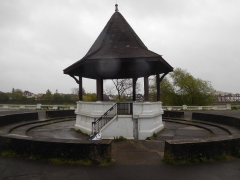
The bandstand at Dukes Meadow
The history of Dukes Meadow is recorded in a detailed essay by Gillian Clegg (https://brentfordandchiswicklhs.org.uk/dukes-meadows-the-threats-to-its-rural-survival/), from which I have extracted most of the following. In the past, the Meadow were low lying farmland and orchards prone to occasional flooding. The land was owned by the Dukes of Devonshire and cultivated by the Jessop family, then later farmed by John Smith of Grove Farm. Incidentally, one of the Dukes, William, the 5th Duke of Devonshire (1748-1811), who had owned nearby Chiswick House in the 18th century. He had both enlarged the house (in 1788) and extended its grounds. At one time, the grounds of Chiswick House must have neighboured the Dukes Meadow. Ms Clegg noted that it was miraculous that the meadows survived as such considering the plans that were proposed for making use of it during the early 20th century.
Two plans were conceived for the ‘development’ of Dukes Meadow. The first was a housing scheme that was to be named ‘Burlingwick’. Clegg wrote:
“On 19 April 1902 The Times newspaper reported that ‘an influential body of capitalists’ had negotiated successfully with the Duke of Devonshire for 330 acres of land for a building plan to be called Burlingwick. The promoter, manager and developer of this scheme was Jonathan Carr, the developer of Bedford Park.”
Had this gone ahead, it would have created housing for up to 400,000 people and 330 acres of green land would have been lost to bricks and mortar. Fortunately, for reasons that are not now too clear the scheme was abandoned in about 1906.
1914 saw the next threat to the Meadows. The Brentford Gas Company planned to cover 80 acres of the Meadow with a huge gasworks. The people of Chiswick and other areas raised strong objections. The London “Times” of 6th February 1914 published its doubts about the scheme, which it said went against all the principles of good town planning, suggesting:
“…that land ripe for building – such as the Chiswick orchard farm – near the heart of the metropolis should be utilized for parks and garden settlement.”
The plan was scrapped, but what the “Times” had alluded to was later realised, but in a then novel way.
In 1923, the local council bought 200 acres of land from the then Duke of Devonshire. The land was to be used as a public recreation area complete with a riverside promenade, a bandstand, and a children’s area with paddling pools. All of this cost the council much money. To recoup some of what they had spent, they made an agreement with the Riverside Sand and Ballast Group. As Ms Clegg explained, the company:
“…was allowed to extract at least five acres every year in exchange for £1,500 an acre.”
The extraction of gravel proceeded from 1924 until 1937 and caused considerable damage to the area. Ms Clegg explained that when the land was finally returned to the council in 1948:
“The gravel pits were filled in, mainly with rubbish brought from inner London, and the area re-landscaped. Dukes Meadows has been described as one of the earliest and most impressive examples of restoration.”
Today, the promenade remains but I saw neither a children’s play area nor paddling pools, which still exist. The bandstand, which stands within a sunken circle lined with steps on which the audience can sit has a hexagonal tiled roof supported by six plain pillars. It is flanked on two sides by spacious shelters, also with tiled roofs. All their roofs are designed so that the angle (or degree) of pitch reduces noticeably about two thirds of the way from the top. Judging by their appearance, I would guess that these structures were built back in the early 1920s. This is confirmed by their appearance in a photograph taken during those years. Also visible in this picture are the unusual, twisted railings, looking like sugar-candy, running alongside the water, and supported by concrete posts with rounded tops. These are still in place today as are their concrete supports which bear simple decorative patterns. Some balustrading can be seen lining the waterfront near the bandstand (see quote below).
Part of the promenade leading towards Barnes Bridge from the Chiswick end of the Meadow is arranged in the form of two long steps. I have no idea why, but maybe they were once used by spectators watching boat races on the river. An article written in 1924 describes the popularity the Meadow with people watching the annual university boat race (http://dmtrust.dukesmeadowspark.com/newriversidepleasaunce.html):
“…in fact so many thousands of people availed themselves of this vantage point last Saturday week at the small admission fee charged by the Council, that over £1,000 net was raised towards the promenade project.”
However, currently a line of bushes obscures sight of the river and the suburb of Barnes across it from these steps. A planning document produced in November 1923 (http://dmtrust.dukesmeadowspark.com/ariversideboulevard.html) sheds a little light on these steps:
“The Scheme, which received the first prize and was submitted by MR A. V. Elliot, of Chiswick, is reproduced on this page. It shows a series of terraces with a plateau of turf, showing seats and rustic shrubberies at intervals, and with a central feature of a bandstand and stone balustrading including a flight of steps and a causeway admitting to the river at all states of the tide.”
We enjoyed our stroll along the Dukes Meadow promenade even though the sky was grey, trees were dripping, and raindrops were falling intermittently. On our way back along the Thames Path to Hammersmith, we stopped at a charming Italian eatery and delicatessen on Chiswick Mall. The place, which is run by Sicilians, is called Mari Deli & Dining, and merits a visit to enjoy a good espresso, at the very least.
SIXTY-NINE YEARS ago on the 8th of May 1952, a lecturer in economics at the London School of Economics was sitting anxiously in the ante-chamber of an operating theatre in the Royal Free Hospital, which was at that time in London’s Grays Inn Road. It is now part of the Eastman Dental Hospital, the post-graduate dental school of University College London, where I have attended courses.
The lecturer looked up from what he was trying to read to distract himself when the gloved surgeon came out of the operating theatre, and talking to himself, but loud enough to be heard, said:
“Shall I use the Simpsons or the Kiellands?”
He was referring to forceps used to deliver babies. My father, who thought that the question had been addressed to him, replied:
“I am sorry I can’t help you with that. I am only an economist.”
The surgeon gave him a withering look, and returned to the operating theatre, where the economist’s wife was lying, deeply anaesthetised. In the end, the surgeon decided to deliver the baby with a Caesarian section.
That baby was me. The economist was my father. That I am writing this today is at the very least a minor miracle, as I will explain.
Back in the early 1950s, one did not argue with medical practitioners; they always knew best. My mother had informed her physician when I had been conceived, but he did not believe what she had said. I can imagine the doctor thinking: “what would she know? Only a woman.” So, when my mother did not give birth when she expected, at about nine months after conception, the doctor told her to be patient as he thought she had another month to go
After I had been ‘in utero’ for ten months, my mother began getting worryingly ill. Eventually, those who claimed to know best admitted her to hospital and I was delivered. Both my mother and me had developed symptoms of toxaemia. It was touch and go as to whether we would both survive, but we did.
Because I had been inside the womb for a month longer than I should have, I was born with several problems. One of these was a cerebral haematoma, which I hope has resolved itself by now. Years later, my mother told the school that I should not play rugby for fear of disturbing this. The other thing was that my neck was bent over to one side; I had a torticollis. The medics told my mother that it was incurable and that she should get used to the idea that I would just have to live with the distortion.
If I am not misrepresenting my late mother, I am certain that she would not have been happy living with a distorted child. She was a sculptor and decided that the doctors were wrong about being certain that my neck condition was incurable. Every day, she stretched my neck gently and gradually it began to grow in the normal way. I am incredibly grateful that she did this.
Getting back to my first days on earth, I had to spend the first fortnight in an incubator. In those far-off days, visiting babies in incubators was limited if it was allowed at all. My mother was exhausted after the traumatic birth and, given that she would not have been able to see me much whilst I was in the incubator, she and my father took a holiday in Cornwall. I only learnt about this a few years ago, Had I known about it when I was younger, who knows but I might have had a rejection complex. My behaviour might be considered unusual at times, but I feel it would be unfair to blame that on my spell in the incubator in London while my parents relaxed in Cornwall.
Well, there you have it: the story of the first few days of my life. Of course, I cannot remember any of it, but what I have told you was related to me by people who were around at the time.
PERCY BYSSHE SHELLEY (1792-1822), the poet, was a friend of the literary critic and essayist James Henry Leigh Hunt (1784-1859), who lived at various times in Hampstead, north London. Shelley’s poetry and other writing attracted the attention of radical thinkers including, for example, Karl Marx, who wrote:
“The real difference between Byron and Shelley is this: those who understand them and love them rejoice that Byron died at 36, because if he had lived he would have become a reactionary bourgeois. They grieve that Shelley died at 29, because he was essentially a revolutionist and he would always have been one of the advanced guard of socialism.” (https://www.marxists.org/archive/eleanor-marx/1888/04/shelley-socialism.htm)
Hunt, who knew him well, wrote of the poet:
“Shelley was not only anxious for the good of mankind in general. We have seen what he proposed on the subject of Reform in Parliament, and he was always very desirous of the national welfare.”
I mention this about Shelley because it chimes with what is to follow.
The Vale of Health, Hampstead, north London
A few months ago, I acquired a copy of Leigh Hunt’s wordy but fascinating autobiography. After being released from a spell in prison in 1815 having libelled the Prince Regent, the future King George IV, Hunt moved to the Vale of Health in Hampstead. Shelley often used to visit Hunt there, sometimes staying at his home for several days. Hunt wrote that Shelley:
“… delighted in the natural broken ground, and in the fresh air of the place … Here also he swam his paper boats on the ponds, and delighted to play with my children…”
Hunt was returning to his home in the Vale of Health one evening after having been to the opera when he heard a woman shrieking and a man’s voice coming from within his house. The woman’s voice was that of a lady, whom Shelley had found lying:
“… near the top of the hill, in fits. It was a fierce winter night, with snow upon the ground; and winter loses nothing of its fierceness in Hampstead. My friend, always the promptest and the most pitying on these occasions, knocked on the first house he could reach, in order to have the woman taken in.”
Shelley’s request was turned down. Hunt continued:
“The poor woman was in convulsions; her son, a young man, lamenting over her. At last my friend sees a carriage driving up to a house at a little distance. The knock is given; the warm door opens; servants and lights pour forth…”
And Shelley asks for help employing the voice:
“… which anybody might recognise for that of the highest gentleman as well as of an interesting individual …”
He relates his story to the elderly gentleman emerging from his carriage and asks whether he will go and see the distressed female. The passenger replies:
“No, sir; there’s no necessity for that sort of thing, depend on it. Impostors swarm everywhere: the thing cannot be done; sir, your conduct is extraordinary.”
To which Shelley replied to the astonishment of the man who refused to provide assistance:
“Sir, I am very sorry to say that your conduct is not extraordinary; and if my own seems to amaze you, I will tell you something that will amaze you a little more, and I hope will frighten you. It is such men as you who madden the spirits and the patience of the poor and wretched; and if ever a convulsion comes in this country (which is very probable), recollect what I tell you: – you will have your house, that you refuse to put the miserable woman into, burnt over your head.”
By ‘convulsion’ Shelley meant revolution, something that England did not suffer as had France or later Russia and elsewhere. Leigh’s reporting of what Shelley said may help to show that whatever Marx saw in his writings was in harmony with his own ideas.
As for the poor woman, she was:
“… brought to our house, which was at some distance, and down a bleak path (it was in the Vale of Health); and Shelley and her son were obliged to hold her till the doctor could arrive.”
In case you are wondering how the woman got into such a sad state, Hunt informs us:
“It appeared that she had been attending this son in London, on a criminal charge made against him, the agitation of which had thrown her into fits on her return. The doctor said that she would have perished, had she laid there a short time longer.”
Now, I am no reader of poetry. I find that I enjoy it more if it is read to me. Further, I must confess that I am unfamiliar with Shelley’s works, but this story related by Hunt, has begun to endear the poet to me. Shelley not only met Hunt in Hampstead but also in Italy on the 1st of July 1822, where they, along with Lord Byron, made plans to start a new journal “The Liberal”. On the 8th of July, Shelley died at sea when the boat he was travelling in sunk.
THE TOWER OF BABEL greeted anyone who climbed the staircase at my childhood home in Hampstead Garden Suburb. Well, actually it was a large engraving of the tower as imagined by Dolf Rieser (1898-1983). Dolf, who was born in King Williams Town in South Africa, was related to my mother’s grandmother Hedwig Ginsberg (née Rieser). My mother and Dolf were cousins. Even though they lived not far from us in north London, I saw little of Dolf and his family until about 1976 when I began studying dentistry. It was then that my uncle Sven, married to my mother’s sister, and his daughter told me that they were about to join the printmaking classes that Dolf held in his studio above his home in Sumatra Road, West Hampstead. As I liked drawing and painting, I signed up as well. The three of us attended the weekly evening classes that Dolf held on Tuesdays. Out of a class of on average six to eight students, three of us and the teacher were all closely related.
At the top of the stairs leading to the studio, there was a small colourful image created by the artist who is now very famous. It was a gift to Dolf given by the artist when both were living in Paris in the 1920s and 1930s. Dolf, who had studied biology in Switzerland and was awarded a PhD in 1922 (https://dolfrieser.com/), began studying art in Munich in 1923, and then moved to Paris to study print-making in Atelier 17, the studio of the great surrealist painter and etcher Stanley Hayter (1901-1988) and the engraver Jozef Hecht (1891-1951).
In the compulsory half hour tea breaks during the classes, we used to sit with Dolf whilst he regaled us with tales about his life in Paris during the 1920s and 1930s. Every winter, he used to go to Switzerland to ski. He used to enter the railway station carrying his wooden skis, and Parisians would stop him to ask what they were. For, in those days, it might surprise you to learn, the average Frenchman was unfamiliar with skiing. Dolf used to visit the Café Les Deux Magots in the Saint-Germain-des-Prés district of Paris, where he would enjoy the company of other artists. He told us that he often saw Pablo Picasso there, sitting at one of the tables. Dolf said that being a junior and relatively unknown artist at the time, he had to sit at a table near to Picasso’s, which was reserved for the ‘upper echelon’ of the artists community in the city. I cannot recall all that he told us, but much of it was both informative and highly entertaining, if not always entirely suitable for polite company. One bit of French that I learned from him during these entertaining intervals in the class was ‘poule de luxe’, which you can look up for yourself.
Dolf’s lofty studio had several large tables where we worked on our copper and zinc plates. At one end of the studio there was a raised platform, a gallery, on which there was a couch or bed. The tables were surrounded with a great assortment of stuff, both works of art by Dolf and the plethora of materials and equipment need to make prints, not only on paper but also on plastic and silk, techniques he developed. There was a table with large shallow trays containing nitric acid in which plates of zinc prepared for etching were bathed. The acid in the trays was of variable concentration, unknown even to Dolf, who used to periodically chuck in unmeasured dollops of concentrated acid from brown glass Winchester bottles whenever he felt (rather than knowing for sure) it might be necessary. Often, he did not tell us when he was about to strengthen the liquid. This could prove difficult if someone were trying to make small delicate adjustments to his or her zinc plate. Occasionally, one or other of us would shout, dismayed:
“Oh, Dolf, you didn’t say you were adding acid. Now, see: the acid has eaten deeper than I was expecting.”
But the ever-ingenious Dolf usually always had a way of remedying what looked to be disastrous at first sight. Today, I doubt that the studio would have passed health and safety rules. There were no extractor fans above the acid baths to remove the toxic fumes emitted when a plate was in the acid. This did not bother any of us.
One end of the studio near the acid baths was dominated by a large, hand operated printing press. The etched or engraved plate was placed on a soft woollen cloth, after having been inked up. A sheet of damp paper was placed over the plate, and this was covered by another cloth. Then, Dolf or one of us turned the large wheel that drove the plate between a pair of metal rollers that applied high pressure to the dampened paper, driving it into the ink-filled grooves on the etched or hand-engraved plates. When Dolf turned the large wheel, always moving his body rhythmically, he often used to say in Swiss German:
This referred to a slightly lewd joke he often told us. It went like this. Two Swiss peasants come to Zurich, where they decided to employ the services of a prostitute for the first time in their lives. To save money, they agreed that only one of them should pay for the experience. When the chosen one had finished with the prostitute, he joined his friend, who asked him how it was. The other fellow replied that it was quite pleasant, adding: “Aber die Bewegung is immer die glierchen.”
Printing was always a messy business. To remove the ink from one’s hands, we used a petroleum-based jelly often used by motor mechanics, which Dolf kept in his studio. Removing the ink from one’s hands was easier than removing the lacquer that was painted on to zinc plates to prevent acid from reaching parts that were not to be etched. To explain, a zinc plate is covered with lacquer, which is then removed with tools of varying sharpness to expose parts of the plates which the artist requires to be etched. This is of course an oversimplification. Dolf who was very inventive showed us many other techniques for producing etched plates. It is likely that his early training in science helped him to develop interesting new ways in printmaking. Dolf maintained an interest in science, as is exemplified by his book “Art and Science”, published in 1972. Its opening words are:
“Art and science are generally considered totally different disciplines. The aim of this book is to draw attention to some of the qualities they share.”
Dolf was a superb teacher. Although the students in our classes were of mixed ability, he brought out the best in each and every one of us. I found that he was particularly good on critiquing composition. The compositions and ideas embodied in his own creations were mostly superb. He used to look at one’s work, immediately understand what we were trying to achieve, and to nudge us gently and constructively in such a way that we ended up with what we were hoping to produce and express.
Once, he held an exhibition of our, his students’, work in his studio and asked us to invite our friends. At the end of the evening, Dolf had sold several of his own prints, but none of us managed to sell any that we had created. Dolf told us off, saying that none of us had worked hard enough, if at all, on getting our friends to buy our works.
After Dolf’s wife died, he continued the classes, but used to be reluctant to see us leave at the end of the evening. I liked Dolf so much that I was always sad when the classes came to an end. However, after he became a widower, we used to follow the classes by walking with him to a Turkish restaurant nearby in Willesden, where we all enjoyed a late supper with him.
The last time I saw Dolf was when he was lying in a hospital bed near the end of his life. Even in hospital, he was in reasonably high spirits, telling his visitors stories and jokes. His house in Sumatra Road still stands. I do not know whether his wonderful studio is still being used to create works of art, but it is with Dolf and his students that I will remember it.
Finally, having read the above, I hope that you will not get the wrong idea when I invite you to “come up and see my etchings”. Many years ago, a young lady did accept this invitation when I made it; she is now my wife.
THE PAINTER GEORGE ROMNEY (1734-1802) moved to Hampstead in north London for health reasons near the end of the 18th century. His home on Holly Hill, originally named ‘Prospect House’ because of the views over London that could be seen from it, still stands today, even thouh it has been altered since Romney occupied it. During 1792, he made frequent visits to Hampstead and the following year he decided to move to the suburbs north of London. In June of that year, he took lodgings at a place he called ‘Pineapple Place’ near Kilburn. Dissatisfied with his Kilburn abode, and having been persuaded that it would be better to buy an existing building rather than to build from scratch, he bought the house on Holly Hill, an old house and its stables, in 1796. It is this building that bears a plaque commemorating his residence there. The Holly Hill house contained his studio, which was completed after the artist had spent £500 on alterations to his new home. While the alterations were being carried out, Romney lived in a building called The Mount on Heath Street, so the informative historian Barratt reveals in Volume 2 of his encyclopaedic history of Hampstead.
Romney’s house in Hampstead, London
The works that Romney had paid for resulted in the creation of:
“…strange new studio and dwelling-house … an odd and whimsical structure in which there was nothing like domestic arrangements. It had a very extensive picture and statue gallery …”
Barratt continues:
“At last Romney got rid of the builders and decorators, and all his town treasures —paintings, casts, statues, canvases, and what not—scores of cart-loads of them—were deposited in the new house and gallery, and the painter began to think that his higher aims were about to be attained.”
But this was not to be. His health failed and in January 1799, he shut up his Hampstead abode and travelled to Kendal. He returned to Holly Hill briefly but returned to Kendal after the 28th of April. He died in Kendal. His house in Hampstead was sold and by 1808, it contained ‘Assembly Rooms’ and three years later it became home to ‘The Constitutional Club’. Barratt revealed that the rooms in Romney’s house were:
“…For sixty years these rooms were practically the Town Hall of Hampstead and the centre of the town’s municipal life. The Hampstead Literary and Scientific Society, formed about 1833, met here, and many learned men at its invitation gave lectures in the rooms …”
Lord Ronald Sutherland Gower, author of “George Romney” published in 1904, wrote of FRomney’s Hampstead dwelling:
“…externally the building, which is covered over with a kind of wooden boarding, has the appearance of a large stable; but within are some remains of the great gallery in which the artist placed his collection of casts, and handsome columns decorate this room; it is now a Conservative Club, and appears to be well attended by the residents of that portion of Hampstead. As a living house it must have been supremely uncomfortable; and one no longer has the advantage of the view over London from the upper windows from which Romney loved to look out and watch the distant dome of St. Paul’s lying in the Thames Valley below; the great city has crept up and around Holly Bush Hill, and crowded out the prospect which gave the great painter almost the last solace in his melancholy decline of life.”
Recently, I wrote an essay (see https://adam-yamey-writes.com/2021/04/29/artists-in-hampstead-londons-montmartre/) about some artists who lived in Hampstead and mentioned George Romney. Someone who read it wrote to me and reminded me that Romney’s former home was also the abode of another artist, the Welsh born architect Sir Bertram Clough Williams-Ellis (1883-1978), most famous for his creation of Portmeiron in western Wales. At about the same time as my correspondent mentioned Williams-Ellis, I found a copy of the architect’s autobiography, “The Architect Errant”, in a disused telephone box, now being used as a book exchange, in Madingley, Cambridgeshire. Although I have not yet read the whole book, I have found what he wrote about his time living in Romney’s former home in Holly Hill. He bought this building in 1929 and redesigned it considerably.
Clough left Chelsea for Hampstead. He wrote of Hampstead and its proximity to the Heath:“It was this love of spaciousness that had propelled me first from South Eaton Place … to Hampstead where the desire for bracing air, a garden, and good schools for the children, were factors determining our choice.
From the edge of a plateau high above the dome of St Pauls we looked southwards from George Romney’s old house across the maze of London …”
The autobiography provided a description of Romney’s house as it was when Clough lived there:
“The fine old house, much altered and adapted to our curious habits, being far too large either for our needs or means, was proportionately delightful to inhabit, and with two ex-billiard rooms (it was once a club) at the disposal of the children, its size had compensations.”
Referring to Romney’s picture gallery, Clough added:
“For myself I had taken the immense old picture gallery as my studio, and I did not hesitate to play up to the magnanimity of its proportions in my embellishments … my wife was surprised and a little shocked at my choosing to work in what she not unjustly called my ‘ballroom’…”
He noted that Romney’s former home was “… splendid for large parties…”, and he held many of them. For example, Clough hosted:
“… dances every so often, a show by Ballet Rambert, David Low drawing large cartoons and selling them for charity. We also gave a party to meet the Russian Ambassador, M Maisky, who made a speech from the gallery balcony …”
The balcony can be seen clearly in a photograph on the RIBA website (www.architecture.com/image-library/RIBApix/image-information/poster/romneys-house-hollybush-hill-hampstead-london-romneys-studio/posterid/RIBA71050.html).
Ivan Mikhailovich Maisky (1884-1975) was the Soviet Ambassador to the Court of St James from 1932 until 1943. Unfortunately, the party referred to above does not get a mention in Maisky’s diary (as edited by Gabriel Gorodetsky), which is perhaps not surprising in view of the huge number of events an ambassador is obliged to attend. A year before Maisky became the ambassador:
Rather oddly, Clough does not mention this trip in his autobiography.
Clough wrote that the South African-born scientist Sir Solly Zuckerman (1904-1993), who was studying primate behaviour:
“… wished one of his research baboons on us, as he wanted to study its reactions to ‘bright, intelligent young society’. He was then writing his rather ambiguously entitled book “The Sexual Life of Primates” – so Betsy had quarters on the flat roof at the top of the house for several months.”
The book referred to above was probably “The Social Life of Monkeys and Apes”, published in 1932. Betsy’s stay in Romney’s old house was not entirely successful. It was not:
“… the social success that we had hoped, unresponsive and dirty, we bade our little lodger farewell without regrets. The experience may have been good for Betsy, but I don’t think our children benefitted markedly from the association.”
Clough and his family left Hampstead for Wales at the outset of WW2, keeping a London ‘pied-a-terre’ in Carlton Mews, now demolished. His and Romney’s house in Holly Hill, an edifice altered for Romney by Samuel Bunce (died 1802), has since been used as the studio for an architect’s firm, Hancock Associates, in the 1970s (information from Beth Portwood) and other purposes. In 2012, the architect’s firm ‘6a’ worked on the building to modernise its interior and restore it to a single family dwelling as it had been when Romney acquired it (www.6a.co.uk/projects/more/romneys-house).
The house stands amongst a small cluster of buildings near Fenton House and this charming ensemble makes me think that externally little has changed since these houses were built in the 18th century.
JUST AS MONTMARTRE in Paris attracted artists, particularly painters, so did Hampstead in north London. Best known amongst these were John Constable (1776-1837) and Sir George Romney (1734-1802), who both resided in Hampstead. Constable lived in various parts of Hampstead including Well Walk and Lower Terrace. Reynolds had a fine house on Holly Hill. Since the 18th century, many painters and sculptors have either worked and/or lived in Hampstead.
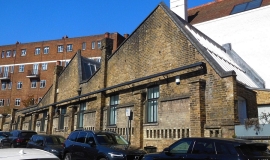
Studio of the painter Mark Gertler in Hampstead
Although I have visited Hampstead often over a period of more than six decades, it was only yesterday in April 2021 that I first noticed what looks like a small industrial unit with two sloping roofs each with large skylights along one side of Well Road. This is not what it looks like but was formerly artists’ work places, named Well Mount Studios. A commemorative plaque affixed to the building records that the painter Mark Gertler (1891-1939) lived here. I first became aware of this artist when visiting an exhibition at Dulwich Art Gallery in 2013 (www.dulwichpicturegallery.org.uk/about/press-media/press-releases/dulwich-picture-gallery-presents-nash-nevinson-spencer-gertler-carrington-bomberg-a-crisis-of-brilliance/) in which pictures painted by artists who had studied at London’s Slade School of Art were displayed. Amongst these artists was Dora Carrington (1893-1932), whose brief sexual relationship with Gertler was the inspiration for a novel, “Mendel”, by Gilbert Cannan. Gertler painted Cannan in about 1916.
Gertler lived at several other addresses in Hampstead in addition to Well Road: The Vale of Health, 13a Rudall Crescent, and 53 Haverstock Hill (https://rosemaryhallart.wordpress.com/2014/07/06/artists-in-hampstead-part-iii/). His parents were poor Jewish immigrants. Gertler was born in London’s Spitalfields in 1891. Soon after that, his parents and the family returned to Austria-Hungary in 1892, settling in Przemyśl in Austria-Hungary (now in Poland). Then, in 1896, the family returned to London. Mark displayed great artistic talent as a child and in 1906, after leaving school, he studied art first at the Regents Street Polytechnic and then, at the recommendation of the artist Sir William Rothenstein (1872-1945), who lived in Hampstead between 1902 and 1912, he entered The Slade. Rothenstein lived at 12 Church Row, where he painted “Mother and Child” in 1903 (www.tate.org.uk/art/artworks/rothenstein-mother-and-child-t05075).
While at the Slade, Mark was a contemporary of artists including Paul Nash, Edward Wadsworth, C. R. W. Nevinson, Stanley Spencer, Isaac Rosenberg, and Morris Goldstein (https://en.wikipedia.org/wiki/Mark_Gertler_(artist)). During his time at the Slade, he met and became infatuated with Dora Carrington.
Mark moved to Hampstead in late 1914. According to Caroline Maclean in her book about the Hampstead Modernists, “Circles & Squares”, Mark moved into the studios near New End, i.e. Well Mount Studios, in 1915, and painted his well-known “Merry-Go-Round” in 1916. This painting that is in the collection held by the Tate Gallery was inspired by a special funfair that was held on Hampstead Heath in 1915 on behalf of wounded soldiers and sailors (www.tate.org.uk/art/artworks/gertler-merry-go-round-t03846). The painting is believed to reflect that artist’s reaction to war. He was a conscientious objector. He had written to his patron, the art collector Edward Marsh (1852-1953):
“’I am I believe what you call a “passivist”. I don’t know exactly what that means, but I just hate the war”.
Well Mount Studios were built in the late 19th century (http://hughcullum.com/portfolio/well-mount-studios/). The building’s exterior is not particularly attractive but its interior was tastefully renewed in 2003.
Gertler contracted tuberculosis in 1920. He married Marjorie Greatorex Hodgkinson ten years later and they had a son in 1932. Both he and his wife suffered bad health and Mark’s mental stability deteriorated during the 1930s. Tragically, he committed suicide in 1939 in his studio which was by then at 5 Grove Terrace, Highgate Road (near Parliament Hill Fields), London (https://artuk.org/discover/stories/the-genius-of-the-place-mark-gertler).
A relatively early 20th century artistic arrival in Hampstead, Gertler was followed by a host of other 20th century artists from all over Britain and elsewhere. These included well-known creators such as Barbara Hepworth, Laszlo Moholy-Nagy, Ben Nicholson, Henry Moore, Roland Penrose, Lee Miller, and many others. When I was at the Hall School at Swiss Cottage between 1960 and 1965, one of my fellow pupils was a son of the graphic designer Frederick Henri Kay Henrion (1914-1990) and his wife the sculptor Daphne Hardy Henrion (1917-2003), who was once a close friend of the writer Arthur Koestler (1905-1983). The Henrions lived in Pond Street for twenty years from about 1946 onwards. They had two sons, one of whom attended The Hall with me. I do not recall his first name because at that school everyone addressed each other by their surnames.
Far less well-known than any of the above-mentioned artists was my mother’s cousin Dolf Rieser (1898-1983; https://dolfrieser.com/biography/). Dolf, a fine etcher and engraver, lived in Sumatra Road, West Hampstead. In the late 1970s and early 1980s, I used to attend his inspiring classes in the large studio in his house. Some examples of his prolific output are in important collections such as the Victoria and Albert Museum and the Imperial War Museum, both in London. Apart from being a great judge of composition, my relative Dolf was highly inventive as his son Richard noted:
“Dolf was innovative, experimenting with plaster prints, silk scarf prints for Liberty’s, printing on leather, printing on plastic paper to be laminated table-tops and on fibre glass to create translucent panels. He even designed for the whole side of a building a ‘print’ to be sand blasted into the concrete, at a university Witwatersrand in the form of a Bushman cave painting. Dolf worked with a plastics expert, Richard Wood, to develop the laminated hand made prints and the prints on fibre glass. The prints went off to the factory to be laminated, but the fibre glass he rolled onto the plate which had been inked with specially prepared plastic pigments, then had resin spread on and then another layer of fibre glass. The resin warmed up and emitted a sweet smell, like honey, and when it was set it could be peeled off the plate. A light could be put behind to give a translucent image.” (https://dolfrieser.com/a-personal-memory/)
Working in Dolf’s studio once a week for a few years helped made me feel like I was involved in the Hampstead art scene at least a little bit.
During my childhood in the 1950s and 1960s, when we often visited Hampstead, there used to be an annual summer fair of local artists’ works held on the wide pavement of Heath Street near to Whitestone Pond. Most of these artists were far less well-known than the likes of Gertler or even my relative Dolf Rieser, but seeing the exhibition helped to imprint Hampstead’s rich association with visual art firmly in my then young mind.





 yamey
yamey 