Yesterday, Sunday the 15th of August 2021, we noticed an attractive wall painting not far from the large Liberty shop on Great Marlborough Street. It is the Soho Mural in Noel Street, the eastern continuation of Great Marlborough Street. With the title “Ode to the West Wind”, it was created in 1989 by Louise Vines and The London wall Mural Group, whose telephone number (on the circular blue patch) was then 01 737 4948 (now, the number would begin with 0207 instead of 01).
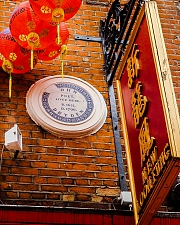
GERRARD STREET IS THE HEART of London’s Chinatown. We often visit it to eat delicious dim-sum and other dishes at our favourite restaurant, The Golden Dragon, which has both indoor and covered outdoor dining spaces. One of our favourite dishes, which was introduced to us many years ago by my sister, is steamed tripe with chilli and ginger. It might sound off-putting, but, believe me, it tastes wonderful. Our visits to Gerrard Street always include a visit to Loon Fung, a Chinese supermarket. This well-stocked establishment bears a commemorative plaque that I only noticed for the first time today (12th August 2021). Partially hidden by a string of Chinese lanterns, it informs the passerby that the poet John Dryden (1631-1700) lived on the spot where we purchase pak-choi, chilli sauce, black bean paste, and a host of other ingredients for preparing Chinese-style dishes at home. I suspect that Dryden was unlikely to have ever come across any of these exotic ingredients back in the 17th century.
“Dryden lived at 44 Gerrard Street with his wife Elizabeth (c. 1638–1714) from about 1687 until his death in 1700. His years there were difficult: his conversion to Catholicism in about 1685 meant that he was unable to take the oath of allegiance after the Glorious Revolution of 1688. As a result he lost his position as Poet Laureate, one he had held for 20 years. He found himself in financial difficulties but remained highly active in London’s literary world.Dryden usually worked in the front ground-floor room of the house, and it was here that he completed his last play, Love Triumphant (1694), the poem Alexander’s Feast, or, The Power of Musique (1697) and translations such as The Works of Virgil (1697). In the preface to the latter, Dryden likened himself to Virgil in his ‘Declining Years, struggling with Wants, oppress’d with Sickness’…
… Number 44 was built in about 1681 and re-fronted in 1793, before being redeveloped in about 1901. At the same time number 43 was demolished, a deed described in the press as ‘a hideous and wonton act of vandalism’ …
… The plaque, though damaged, was immediately re-erected on the new structure. It is unique among surviving Society of Arts plaques in its colour – white, with blue lettering.”
Well, I can add nothing to that informative quote. So, ext time you wander along Gerrard Street do look for this and other reminders of the area’s history. It was a place where several other well-known writers and artists resided several centuries ago.
DUNCHURCH IN WARWICKSHIRE is located where the old road between Oxford and Leicester crosses that between London and Holyhead. This charming village was a place where, in its heyday, up to forty carriages a day stopped to change their horses for a fresh team. This was done at the various coaching inns in the village. One of these hostelries, which is still in business today, is The Dun Cow, where we ate a good English breakfast. Some of this inn’s previous guests included the engineer George Stephenson (1781-1848) and his son, another engineer, Robert (1803-1859), who dined at the hotel on the 23rd of December 1837. Their dinner was to celebrate the completion of the Kilsby Tunnel on the Birmingham to London Railway, a project supervised by Robert.
While we were wandering around the graveyard of Dunchurch’s St Peters Church, which dates back to the 12th century, we asked a gardener working there about where one of Dunchurch’s former famous characters had once stayed. He told us that he had no idea. Half-jokingly but with some earnestness, he added: “…we could do with another one like him.”
Guy Fawkes House in Dunchurch
The man about whom we were asking had associates, who were staying at the village’s former inn, The Lion Inn, in the early 17th century, the year 1605 to be exact. It was in early November of that year that those waiting at The Lion in Dunchurch were wondering about their colleague who was 79 miles away in London.
The fellows at The Lion were waiting to hear whether their co-conspirator Guy (Guido) Fawkes (1570-1606) had been successful in blowing up the House of Lords in London. He was not, and the conspirators waiting in Dunchurch were arrested. Had the plot to blow up Parliament and along with it the Protestant King James I succeeded, the men at The Lion were to have travelled to nearby Combe Abbey to seize Princess Elizabeth (1596-1662), who became Queen of Bohemia. As an informative website (www.ourwarwickshire.org.uk/content/article/rugby-school-science-teaching-around-1900-2) explains:
“In 1605 the monarch was James I; the Princess Elizabeth was his eldest daughter and sister to the future Charles I. In 1605 she was nine and being educated by Lord Harington at Coombe Abbey. She wasn’t a Catholic, but the conspirators planned to convert her and use her as their figurehead … Her main importance with regard to British history is that one of her grandsons (the son of her youngest daughter Sophia of Hanover) became King George I.”
The man about whom we were chatting with the gardener was neither of the Stephensons, who dined at The Dun Cow, nor the Duke of Wellington, who also stayed in the village, nor Lord John Douglas-Montagu-Scott (1809 – 1860), whose statue stands facing The Dun Cow. He was referring to Guy Fawkes, but this time a Guy Fawkes who completes the job before being arrested!
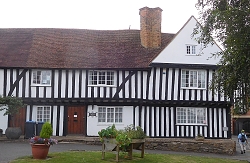
The former inn, a lovely half-timbered edifice is now a private house, named ‘Guy Fawkes House’, even though the famous man never lived there. The rest of the village contains several old thatched cottages, a thatched bus shelter, and the old village stocks. Close to the town of Rugby, this village is well worth a visit.
ONCE A VILLAGE in Kent, Deptford is now a riverside suburb in southeast London, just west of Greenwich. We visited Deptford to see the exhibition of contemporary art, which our daughter has curated. It is being shown at ArtHub in Creek Road and finishes on Sunday, the 25th of July 2021. So, hurry if you wish to see it.
Deptford is becoming not only a trendy place to be, rather like Dalston has become, but it also attracts artists and art galleries. Maybe, Deptford’s proximity to Goldsmiths College, which educates many kinds of creators, might explain its emergence as a new artistic district of London. Whatever the reason, Deptford now has an exciting and rather edgy feel about it.
Deptford, which I plan to explore further in the future, has a long history. Its Creek was a harbour for shipping as far back as the 11th century, if not before. King Henry VIII developed an important dockyard at Deptford. Eventually, it was involved with shipbuilding. Many ‘men-of-war’ vessels were launched here. The dockyard thrived until it was closed in March 1869.
Doubtless there is much history to relate about Deptford, but I will mention only one thing and that can be seen today. Albury Street runs east from Deptford High Street and lies just north of the lovely baroque St Pauls Church designed by Thomas Archer and built between 1712 and 1730.
Albury Street, Deptford, London
Originally called ‘Union Street’, Albury Street was laid out between 1705 and 1717. The south side of the street, which is paved with cobbles (or maybe setts), has been rebuilt with modern dwellings. The north side is lined by the original terraced houses built by a local bricklayer, Thomas Lucas. These brick-built dwellings are distinguished by their beautiful porches, each of which has a pair of lovely woodcarvings that support the canopies above each doorway. Many of these have been restored sensitively.
Just who lived in these houses, which would have been remarkably superior in both appearance and construction for what was then a small village outside London, is subject to some uncertainty. Famous characters such as Admiral Benbow and Horatio Nelson have been mentioned, but much doubt surrounds the likelihood that they lived in this street.
In brief, a visit to Deptford is worthwhile not only to see what remains of Albury Street but also to enjoy the vibrant atmosphere and multi-ethnic nature of this corner of London.
FROM THE STREET, the Victorian gothic façade of Hampstead’s Heath Street Baptist Church is unremarkable. Over the past more than 60 years, I have walked or driven past this place of worship, but it was not until today (20th July 2021) that I entered it for the first time.
The church was designed by the architect and surveyor Charles Gray Searle (1816-81) and completed 1860-61. Searle was himself a Baptist. He had been apprenticed to the renowned master builder Thomas Cubitt (1788-1855), who bought stone from his father, John Searle, who owned a quarry near Wapping. Charles set up his own practice in about 1846.
“An early print of the proposed chapel shows buttresses but in its method of construction it was more modern, cast iron being used not only for the pillars and probably for the whole interior framework, but also for the gallery fronts and the mouldings of the pew-ends. The strength of the building is based upon this framework formed by the cast-iron pillars in church and hall below and their linking beams. The brick walls cling to the framework and have tiebars linking the hammer beam roof.”
Cast-iron columns
Cast iron, which has high compressive strength, began being used to create buildings at the end of the 18th century. Pillars made of this material can be made slenderer than masonry columns required to support the same load. The slender nature of the columns in the Heath Street Chapel is immediately evident when you enter the building. What is less obvious is that the decorative fronts of the gallery that surrounds the nave are also made from cast-iron. The material has hardly been used for structural elements of buildings since modern steel and concrete became available at the start of the 20th century.
If you do visit this church, do not miss the fine art-nouveau stained glass window at its western end.
Although the Heath Street Chapel was certainly not the first church to be built using cast-iron structural elements, it must have been one of the first buildings of its kind to have been built in Hampstead, which is why I have given this short piece the title “A High-tech Church in Hampstead”.
When we stepped inside the church, two men were setting up things for a lunchtime concert. They told us that these are usually held on Tuesdays at 1 pm. Details about these can be found on the church’s website, http://www.heathstreet.org/activities/lunchtime-concerts/.
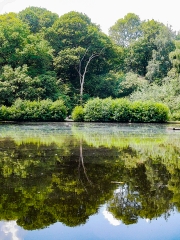
QUEENSMERE POND on Wimbledon is surrounded by woodland. It was dug in marshland to celebrate the Diamond Jubilee of Queen Victoria in 1897. In the 1830s, the area was a popular duelling ground.
In 1984, the corpse of a former Soviet spy Boris Hatton was discovered in the pond. On the 1st of March 1984, The London “Times” newspaper reported:
“Mr Boris Hatton, formerly Baklanov, a former assassin with SMERSH, part of Soviet wartime military intelligence, may have committed suicide or he may have been murdered. Dr Paul Knapman. the coroner at a Westminster inquest, recorded an open verdict, saying ‘It is not impossible that there may be other sinister factors in view of his past’.
Mr Hatton, aged 59, the son of prominent Soviet Commu-nist Party member between the wars, had been a strong swimmer and never spoke of suicide, the court was told.His son Phillip, an accountant. of Westerham, Kent, said that his father defected after the Second World War because SMERSH, wanted him to assassinate dissidents against Communism which his conscience would not allow.”
For 10 years he worked as a researcher at The Daily Telegraph.”Well, I would never imagined that this had happened when I watched a swan with its cygnets swimming lazily by the edge of the lovely pond.
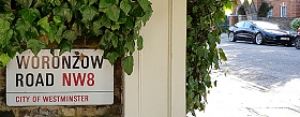
THROUGHOUT MY LIFE, I have been visiting or passing through St Johns Wood in north London. I have often noticed a street called Woronzow Road. It lies between Primrose Hill and St Johns Wood Underground Station. Whenever I have seen this road, I have wondered about the name ‘Woronzow’, but uncharacteristically I have always been too lazy to find out anything about it.
Recently, we visited Wilton House in Wiltshire, not far from the city of Salisbury. Home to the Herberts, the Earls of Pembroke, for many centuries, this is a wonderful place to visit, to see its gardens, the house itself and the outstanding collection of old master paintings within it. The decoration of the rooms that we saw is superb and is kept in good condition by the house’s present occupants, the family of the current, the 17th, Earl of Pembroke. It was whilst visiting this splendid country seat that my ears pricked up hearing the guide mention the name ‘Worontzow’.
In 1808, the widowed George Herbert (born 1759) remarried. His second wife was Catherine Woronzow (1783-1856). Her father was Semyon Romanovich Woronzow (1744-1832), Russian Ambassador to England from 1796-1806, who died in London and was buried in the Pembroke’s family vault. Catharine, who became Countess of Pembroke, did a great deal to improve Wilton House to create much of what we can see today. She is buried in the nearby church of St Mary and St Nicholas, which was built in a neo-Romanesque style between 1841 and 1844. It was built at the instigation of Catharine and her son Sidney Herbert, the 14th Earl of Pembroke (1810-1861).
Between October 1853 and February 1856, the last years of Catharine’s life, Britain was at war with Russia in what is known as The Crimean War. Between June 1859 and July 1861, Sidney Herbert was the Secretary for War in the British government. During the campaign, a supply route called the ‘Woronzow Road’, no doubt named in honour of Catherine’s noble Russian family, ran along the Crimean coast past Sebastopol. Thus, there was once a Woronzow Road in The Crimea. This was an important supply route for the British forces bringing much-needed material south from Alma and Calamita Bay towards Sebastopol. In the winter of 1854, the British lost control of this vital supply route and had to rely on goods reaching them by a far more difficult track,
One of Sidney Herbert’s great contributions to the war effort in the Crimea was his asking Florence Nightingale (1820-1910) to travel to Scutari (now, Üsküdar in Istanbul) with 38 volunteer nurses. She and her team helped to dramatically improve the treatment of the many soldiers who contracted diseases such as cholera and typhus whilst in the Crimea. Incidentally, Florence never visited the Crimea, but remained working in the Turkish city. Herbert and his wife had first met and become friendly with Florence Nightingale in Rome in about 1847.
Now let us return to St Johns Wood in London. Catherine’s father, Semyon Worontzow, lived in the district. The road, where he lived and whose name has intrigued me for decades, is now called ‘Woronzow Road’. It was named after him in 1843. It was not until 2002 that the Russians erected a monument to him on the thoroughfare named after him.
THE ELEPHANT IN the room is something about which we prefer not to speak. This is not the case for the herd of over one hundred elephants that can be found in London’s Green Park today. This is not a change in the creatures’ habitat caused by global warning, because the elephants are not real. They are life-size models of the creatures, constructed with strips of Lantana camara, an invasive weed that thrives in the tropics. Despite being made of strips of this woody material, each one is a fine representation of an elephant. From afar, the sculptures look quite lifelike. Some of the elephants have models of birds found in the UK perched on their backs.
The elephants, so we were informed by a helpful volunteer from Goa who is working for an organisation called Coexistence, are manufactured by local craftsmen living the district of Gudalur in the Nilgiri Hills of Tamil Nadu state in the south of India. By using the Lantana, the craftsmen not only create the models but also clear deleterious plants from their land.
Apart from looking great, the model pachyderms have arrived with a message. Known as the ‘Coexistence Herd’, the beasts have arrived:
“… at a unique moment in time when a global reduction in human activity has had a positive effect on wildlife. Elephants may be giants but they tread softly. This 100-strong herd reminds us that when we lighten our footprint, wildlife bounces back.” (https://elephant-family.org/coexistence/)
So, it seems that the herd has not arrived merely to enhance our enjoyment of Green Park but also to heighten our awareness of the desirability of humans living in harmony with the rest of the animal kingdom.
Green Park is not the only site in London where these elephants from India can be spotted. There are others currently on display at places such as Berkeley Square and St James Park. The elephants are all for sale. The proceeds of the sales:
“…will be directed to grass-roots organisations across India that allow people and wildlife to live together more peacefully.” (https://coexistence.org/elephant-shop/).
Whether or not you are concerned about the message that is supposed to be conveyed by these superb models of elephants, it unlikely that you will be disappointed by seeing them.





 yamey
yamey 