Gin and tonic by the pulpit

NAPOLEON BONAPARTE DIED in captivity on the tiny island of St Helena in the south Atlantic. While he was imprisoned on the island, Lieutenant General Sir Hudson Lowe (1769-1844) was the Governor of St Helena. He was buried at St Mark’s Church in North Audley Street in London’s Mayfair, where a commemorative plaque can be found by the main entrance. St Mark’s was built in the Greek Revival Style in 1825-28, designed by John Peter Gandy (1787-1850). In 1878, the church architect Arthur Blomfield (1829-1899) made considerable alterations to its interior including adding a timber vaulted ceiling over the nave.

During the 1950s and 1960s, the size of St Mark’s congregation diminished significantly. In 1974, the church was made redundant, and this is how it remained until 1994, when the church was used by The Commonwealth Christian Fellowship. It continued to serve this group until 2008. After that, it was used as a venue for occasional events. In about 2019 after a 5 million Pound restoration programme, the church underwent a surprising reincarnation.

After passing beneath the grand portico supported by two columns topped with ionic capitals, one enters the church’s large vestibule. Since 2019, this has become a marketplace selling upmarket Italian delicatessen goods. Entering the body of the church is rather like taking part in a Fellini film. The floor of the nave is filled with tables and chairs and people drinking and dining. The side aisles, north and south, contain several kitchens, preparing and serving a wide variety of foods, from Turkish to Thai. On the north side of the chancel, just behind the neo-gothic stone pulpit, there is a gin bar, and facing it on the south side of the chancel, there is another bar providing alcoholic refreshments. Look upwards and you can admire the splendid timber roof supports. The wide gallery surrounding the nave at the first-floor level is home to more food stalls, each offering tempting looking fare at not unreasonable prices, especially by local Mayfair standards.

In 2019, the church became home to a branch of Mercato Metropolitano, whose first venture was converting a 150,000 square foot disused railway station in Milan during the 2015 World Expo in that Italian city. The idea of the company was:

“The development of the first Mercato Metropolitano was carefully planned to retain the site’s original appearance, which nurtured the local community’s affection for a special part of their urban history.”

 (https://www.mercatometropolitano.com/mmarketplace/#the-mercato-story).

And this is what has been done at the former St Mark’s in Mayfair. Many of the church’s fittings (for example, the tiled floors, the stained glass, the monuments, the pulpit, and the sacred paintings at the east end of the chancel) have been preserved. Entering the church is like entering the scene of a lively gargantuan feast. Seeing the large number of customers on a weekday lunchtime demonstrates that Mercato Metropolitano have successfully created a great place to meet, eat, and drink. It is highly original and exciting, both visually and gastronomically.

In Chapter 21 (verses 12-13) of the Gospel according to Matthew, we learn that:

“…Jesus went into the temple of God, and cast out all them that sold and bought in the temple, and overthrew the tables of the money changers, and the seats of them that sold doves, And said unto them, It is written, My house shall be called the house of prayer; but ye have made it a den of thieves.”

I just cannot help wondering, as many of you might also be doing, what The Good Lord would have made of what can now be seen inside the Church of St Mark’s in Mayfair.

A flourishing pub in Hampstead

ONCE LONDON’S HAMPSTEAD had two pubs or taverns named ‘The Flask’. This should not come as a great surprise as Flask used to be a common name given to pubs. One of them, The Upper Flask, used to be located at the top (northern) end of East Heath Road and the other, The Lower Flask’ was (and still is) on Flask Walk, a street leading off Hampstead High Street.

The Upper Flask used to be a remarkable establishment. Once called ‘The Upper Bowling Green House’ because of its good bowling green, it was a meeting place favoured by fashionable and ‘cultured’ men (mainly) and women during the 18th century. It was a summer meeting place for The Kit Kat Club, which thrived in the early 18th century and whose members included literary figures and political personalities, who supported the Whig Party. The Upper Flask figures several times in “Clarissa”, a lengthy novel by Samuel Richardson (1689-1761), first published in 1747. The place ceased operating as a hospitality business in the 1750s, when it became a private residence (www.british-history.ac.uk/vch/middx/vol9/pp81-91). In 1921, it was demolished to clear the site for building the Queen Mary Maternity Hospital (https://ezitis.myzen.co.uk/queenmaryhampstead.html), which has since become the site of a luxury housing complex.

The Lower Flask (in Flask Walk) is also mentioned in “Clarissa”, but unflatteringly as:

“… a place where second-rate persons are to be found often in a swinish condition,” (quoted from “Old and New London”, by Edward Walford, about 1880).

Unlike the lost Upper Flask, the formerly named Lower Flask is still in business, but much has changed since Richardson published his novel.

Located at the eastern end of the pedestrianised stretch of Flask Walk, the former Lower Flask, renamed The Flask, was rebuilt in 1874 (and extended in 1990; https://historicengland.org.uk/listing/the-list/list-entry/1322190). Formerly, it had been a thatched building and was a place where mineral water from Hampstead’s chalybeate springs was sold. It and Keith Fawkes’ second-hand bookshop are the only things in Flask Walk, which were in existence when I used to visit Hampstead regularly in the 1960s and 1970s. In those, now far-off, days, I remember that there used to be another second-hand bookshop and a butcher, both on the south side of the passageway. Before the 20th century, there used to be a fair held for a few days in August on the triangular open space a few yards downhill from The Flask pub. Close to The Flask, also on Flask Walk, miscreants could be found languishing in the parish stocks. Both the stocks and the fair are now but long distant memories recorded only in books published many decades ago.

Oddly, despite visiting Hampstead literally thousands of times during the last more than 65 years, it was only on Halloween 2021 that I first set foot in the Flask pub, and I am pleased that I did. The front rooms of the pub retain much of their Victorian charm and the rear rooms are spacious. Although we only stopped for a drink, I could see that the Sunday lunches being served to customers around us looked delicious. We hope to return there soon.

A sculpture, a steeple, and stucco

LANCASTER GATE IS ten minutes’ walk or a three-minute bus ride away from where I have lived for over 29 years. I have passed it innumerable times, yet I have never explored it. Yesterday, the 30th of October 2021, I decided it was high time that I took a closer look at the place. The name refers to an entrance to Kensington Gardens as well as a nearby network of streets. The network includes a long street extending from east to west between Craven Terrace (near Paddington Station) and Leinster Terrace. The section of road between Craven Terrace and Bayswater Road is also called Lancaster Gate. Midway along the long east-west section of the Gate, there is a wide street, almost a square or piazza, that leads to Bayswater Road. This rectangular piazza is south of a rectangular loop to the north of the east-west section, in the centre of which there is a 20th century building called Spire House. If this sounds confusing, then please look at a map!

What I have called the ‘piazza’ opens out onto Bayswater Road. In the middle of it, there is a monument topped with the weather worn sculpture of a seated child, probably male. The sculpture sits above a bas-relief depicting the western façade and the dome of London’s St Paul’s Cathedral. Below, on the south side of the pedestal, there is a bas-relief, depicting the face of a man with a bushy moustache and a long luxuriant beard.  Weather and/or pollution has worn away details from his portrait. At first sight, I thought that it was a representation of George Bernard Shaw as an old man, but it is not. It is, according to the almost undecipherable inscription beneath it, the face of Reginald Brabazon, the 12th Earl of Meath, who lived from 1841 to 1929. The words on the plinth include that he was “a patriot and a philanthropist”.

Brabazon was Anglo-Irish and born in London (https://en.wikipedia.org/wiki/Reginald_Brabazon,_12th_Earl_of_Meath). Educated at Eton, he became a diplomat, but resigned from the Diplomatic Service in 1877. Ten years later, he joined the House of Lords as a Conservative peer. Reginald and his wife, Mary, devoted much of their lives to relieving human suffering and ameliorating social conditions. Amongst his many good works was the establishment (in 1882) of a charity called the Metropolitan Public Gardens Association, whose aim  was the preservation of public open spaces and the creation of new ones, which might explain why the memorial to him faces Hyde Park. The Portland stone monument, known as The Meath Memorial, was designed by Joseph Hermon Cawthra (1886-1971) and unveiled in 1934.

A few feet north of Brabazon’s memorial, which stands on a wide traffic island, there is a slender stone column topped by an ornate octagonal structure surmounted by a shiny metal crucifix. The base of this column reveals that it is was built as a WW1 memorial. In the pavement between the two memorials, the City of Westminster has set several informative panels about the history of Lancaster Gate. The development of Lancaster Gate, originally known as ‘Upper Hyde Park Gardens’, began in the late 1860s, an initiative of the developer Henry de Bruno Austin. Many of the houses he built have rich stucco facades and porches supported by neo-classical style pillars. Quite a few of them are now hotels. These buildings are interspersed with a few newer buildings, presumably where the originals were bombed during WW2. However, most Lancaster Gate’s houses are those built in the 19th century.

The name Lancaster Gate was chosen to honour Queen Victoria, who was amongst many other things, the Duchess of Lancaster.

Before Lancaster Gate was developed, it was mostly agricultural land. Until 1775, the composer, actor, botanist, and playwright John Hill (1716-1775) had his Physic Garden here. By 1795, visitors flocked to the area to enjoy the springs and fresh air at the Bayswater Tea Gardens, which later was renamed the Flora Tea Gardens, and then the Victoria Tea Gardens. This establishment closed in 1854.

At the southern end of the loop and towering above the plaza with its two monuments, there is a tall church tower with a spire. This is all that remains of the Christ Church, Lancaster Gate, whose construction began in 1854. The last service to be held in the church was in 1977, by which time the roof was badly infected with dry rot. The church was demolished, but the tower retained. Where the body of church stood, there is now a block of flats. Opened in about 1983, it is appropriately named Spire House. Its 20th century architecture is quite attractive and contrasts dramatically with the stuccoed Victorian buildings that face its west, north, and east sides. Spire House has external concrete supporting pillars that suggest an updated version of the flying buttresses used in mediaeval church architecture.

Lancaster Gate is a relatively unspoilt example of mid-Victorian town planning and worthy of a short visit. While walking around the area, I only spotted one blue plaque, commemorating a resident worthy of note. It recorded that the “Chemical Scientist” Sir Edward Frankland (1825-1899) lived in Lancaster Gate from 1870 to 1880. He was one of the founders of organo-metallic chemistry and a discoverer of Helium. Also, he took an active interest in the problem of pollution of rivers and the quality of London’s water. I trust that he would be pleased to know that fish have returned to London’s once filthy River Thames.

After exploring Lancaster Gate and its sea of stuccoed facades, head east into Craven Street, where you can find several cafés and at least one pub.

Cafés with coffins in Ahmedabad and London

IN CENTRAL AHMEDABAD, a large city in India’s state of Gujarat, there is a curious café called Lucky. This popular eatery is not unusual because it does not serve coffee but because its tables and chairs are placed between Moslem graves. Lucky’s is sited on an old Moslem graveyard, but this does not put off a steady flow of customers from enjoying a wide variety of vegetarian snacks in this eatery. Closer to home, near the south side of London’s Lambeth Bridge, there is another café sited on a former graveyard. Unlike Lucky in Ahmedabad, which is housed in an architecturally unremarkable building, the café in Lambeth, The Garden Museum Café, is a marvellous example of contemporary architecture.

Café at The Garden Museum in London

The café, completed in 2018, is at the east end of the Church of St Marys, Lambeth, which now serves as the home of The Garden Museum. The church stands next to the main Tudor entrance of Lambeth Palace. The tower was built in about 1378. The rest of the church contains structural elements that were built in later eras. Appropriately for a museum dedicated to gardening history, the repurposed Church of St Mary’s is the burial place of the famous gardener and plant collector, John Tradescant the Elder (c1570s-1638). It is also the final resting place of Captain William Bligh (1754-1817) of The Bounty Mutiny (1789) fame. This famous mariner owned a house in Lambeth. Customers of the café do not sit on the graves of these two well-known persons, but on gravestones that, unlike the graves at Lucky in Ahmedabad which are raised above the ground, are level with the rest of the café’s floor.

The graves at Lucky in Ahmedabad are coffin shaped and probably contain the remains of the deceased. I am not sure whether there are human remains beneath the grave slabs in the floor of the café in Lambeth. A young waiter, whom I asked, was concerned to reassure me that he believed that there are no skeletons beneath the gravestones upon which customers walk and sit. I wonder whether this is really the case.

The Garden Museum was founded in 1977 by Rosemary and John Nicholson in order to preserve the church, which was due for demolition (https://gardenmuseum.org.uk/the-museum/history/). In 2015, the museum was closed for a year and a half whilst it was being redeveloped. Part of the improvements made was the construction of an extension at the eastern end of the retired church. The new construction, designed by Christopher Bradley-Hole and Dan Pearson, includes the café and other structures that together surround a new courtyard that contains a lovely garden, The Sackler Garden designed by Dan Pearson. It contains several tombs including that of the Tradescant family and of Captain Bligh.

The café borders the western side of the courtyard. Its mainly glass walls provide good views of the garden, the buildings across the river and the leafy remains of the churchyard west of the café. Where there is no glass, the walls are covered with overlapping brown coloured metal panels. Serving great coffee and both snacks and meals, the legs of the chairs and tables rest on the gravestones that form part of the floor.

Compared with Lucky, which is in a very busy part of Ahmedabad, the Garden Museum café, although close to a busy main road, is far more peaceful. However, both are delightful places to enjoy refreshments.

Unveiled at last

THE CORONET CINEMA in London’s Notting Hill Gate was renamed The Print Room a few years ago. Once a cinema, it is now a theatre. Like other theatres, it was closed for a long time during 2020 and early 2021 because of the covid19 lockdowns. During this prolonged period of closures, a statue was placed upon the dome that stands above the theatre’s main entrance. In my book “Walking West London” (freely available as a pdf file from https://adamyamey.co.uk/walking-west-london/), I wrote about the Coronet/Print Room as follows:

“… the former ‘Coronet Cinema’. This was designed as a theatre by WGR Sprague (1863-1933) who designed many of London’s theatres. It opened in 1908. By 1923, the Coronet had become a cinema, and remained so for many years. Apart from the screen, the fittings inside the auditorium were those of an unmodernised Edwardian theatre. Until smoking was banned in all public places, the Coronet was one of the last cinemas in London which permitted smoking (but only in the balcony seating). Between 2004 and 2014, the Coronet doubled up as both a branch of the Kensington Temple Church and, also, as a cinema. And, in 2015 the Coronet reverted to being used as a theatre, now called ‘The Print Room’. This sensitively restored theatre puts on interesting plays, which are well-produced. The bar, which is located beneath the stage in what was once the stalls area of the cinema, is worth visiting to see its ever changing, tastefully quirky décor. In 2020, the theatre was redecorated and a statue by the British sculptor Gavin Turk (born 1967) has been placed upon the dome above the building’s main entrance. The new artwork replaces one that was removed many decades ago.”

When I wrote this, the sculpture was enshrouded in a tarpaulin. Only recently, the covering has been removed and the sculpture can be seen in all its glory. The artwork depicts the artist Gavin Turk posing as the famous artist Sir Joshua Reynolds (1723-1792) just as he appears his sculptural in the Annenberg Courtyard of Burlington House in the grounds of the Royal Academy. When seen from the east, the new sculpture looks like a painter holding a palette and his brush. However, when seen from the west, the viewer might be led to believe that the statue is of a man holding a gun. I feel that the sculpture is a great addition to the landscape of Notting Hill Gate, but a bit too high above ground level to be able to see it easily with the unaided eye.

A bridge near Regents Park

PARKWAY LEADS GENTLY uphill from Camden Town Underground station to a short road called Gloucester Gate, which leads to the Outer Circle that runs around Regents Park. Much of Gloucester Terrace runs along what looks like a bridge, which is lined on its north side by red-coloured, decorative stone parapet.

St Pancras, Regents Park, London

The bridge traverses a grassy dell that does not appear to contain any kind of watercourse. I wondered why such an elaborate bridge had been built to traverse what appears to be merely a grassy hollow. Well, when it was built, it did cross a waterway, the Cumberland Market Branch of the Regent’s Canal  known as ‘The Cumberland Arm’ (www.londonslostrivers.com/cumberland-arm.html). This waterway, built in 1816, ran for about half a mile from the Regents Canal to a basin near Euston Station, running for most of its length parallel to Albany Street. During WW2, the Cumberland Arm, which had up until then been used to transport freight, was used to supply water to firefighting appliances. By the end of the war, the canal had been filled with rubble from buildings destroyed by bombing and then covered with topsoil. All that remains of the Cumberland Arm is a short blind-ending stretch of water near Regents Park Road, on which there is a large floating Chinese restaurant and a few moorings for narrow boats.

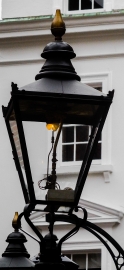
The Gloucester Gate bridge with its decorative parapet and elaborate cast-iron lampstands also includes two interesting memorials. One of these relates to the fact that the bridge was constructed by the St Pancras Vestry, the then local authority governing the area (www.andrewwhitehead.net/blog/the-most-pointless-bridge-in-london). There is a bronze bas-relief depicting the martyrdom of St Pancras. It was a gift of William Thornton and sculpted by the Italian Ceccardo Egidio Fucigna (c1836-1884), who died in London. St Pancras (c289-303/4) was born a Roman citizen. He converted to Christianity and was beheaded for his beliefs when he was 14 years old (https://en.wikipedia.org/wiki/Pancras_of_Rome). The bronze relief on Gloucester Gate bridge shows a young man being mauled by an animal, possibly a lion. Why this motif was chosen when the saint was beheaded puzzles me.

Near the St Pancras panel, also on the bridge, there is an old but elaborate drinking fountain. A metal plate attached to it has faded letters that read:

“Saint Pancras Middlesex.

This fountain and works connected therewith were presented to the Metropolitan Drinking Fountain Association on the (?) day of August 1878 by

Matilda

Richard Kent esq. Junior Churchwarden 1878.

The figure … cast in bronze was designed by Joseph Durham ARA.” (https://victorianweb.org/sculpture/durham/1c.html)

The fountain, known as ‘The Matilda Fountain’, is part of a miniature cave made with granite boulders. A sculpture of a milkmaid stands above the cave. At her feet, there is a wooden pail with two handles. The girl with a rich crop of hair on her head is depicted shielding her eyes from the sun with her right hand as she stares into the distance. Cast in bronze, the female figure and the pail were sculpted by Joseph Durham (1814-1877). Matilda might possibly have been Richard Kent’s wife, but the plaque does not specify this. The sculpture is not unique; several other copies of it, all by Durham, exist. One of these, dated 1867 and called “At the Spring/Early Morn”, can be seen in Blackburn’s Town Hall (https://victorianweb.org/sculpture/durham/1d.html).

Today, the bridge is redundant since the canal was filled-in long ago. However, it is used by many people walking to and from Regents Park and its zoo and a steady stream of vehicular traffic crosses it. Although it has outlived its original purpose, the bridge serves as a reminder of a once important element of London’s continuously evolving transportation system.

Street market in Portobello Road

THIS IS AN EXTRACT from my latest book, “Walking West London”, which can be downloaded in its entirety (as a pdf file), free of charge and with no strings attached, from: https://adamyamey.co.uk/walking-west-london/ (just click on the green button, labelled “Download”). The sample below relates to the street market on Portobello Road:

NO LONGER A COUNTRY LANE (PORTOBELLO)

Lovers of street markets, whether they be searching for antiques, bric-abrac, jewellery, telephone covers, clothing, snacks, cafés, flowers, fruit, or vegetables, will enjoy browsing the diverse stalls and small shops that line Portobello Road. This street, which used to be called ‘Portobello Lane’ runs from Notting Hill Gate to just south of the main railway line that begins at Paddington Station. In days gone by, it ran from the gravel pits at Notting Hill Gate to the now long-since demolished Portobello Farm,which stood roughly between Orchard Close and Blagrove Road in NorthKensington.

Before the mid-19th century Portobello Lane, as it was then called, was to quote the historians Florence Gladstone and Ashley Barker (writing in1924):

“‘… one of the most rural and pleasant walks in the summer in the vicinity of London’, and within living memory it led ‘through fields to Kensal Green … cornfields and meadow land on each side … ‘”

Well, Portobello Road is no longer bucolic. It is lined with buildings along its entire length. Currently, it begins with a short section that leads off Pembridge Villas. It is here that you can stop for a drink at the Sun inSplendour pub, which was built in the early 1850s. After running a few yards westwards, Portobello Road heads off in a north-westerly direction, which it maintains with barely any deviation for the rest of its length. Number 22 was the first London home of the writer George Orwell. He lived there as a lodger in the winter of 1927.

After crossing Chepstow Villas, the road slopes downwards and soon after this the market area commences. On most weekdays, much of the market is dedicated to daily domestic needs, mostly food. On Fridays and Saturdays, the number of stalls and the variety of goods on offer increases dramatically. In normal times (i.e., when there is no pandemic), Portobello Road is choked with crowds of people from all over the world, especially on Saturdays.

In the 1860s, the Metropolitan Line (now the ‘Hammersmith and City Line’) was built. It crosses Portobello Road close to the Ladbroke Road station, which was originally known as ‘Notting Hill’ station. Rail access probably accounted for the urban development of what was once ‘Portobello Lane’. The market in Portobello Road probably began operating in the second half of the 19th century. Until the 1940s, it served people’s daily needs. Then, in the 1940s, traders selling anything from junk to antiques began trading along the road, alongside the purveyors of daily  requirements, and that has how it has remained.

The architecture of Portobello Road is far from distinguished. Much of it is ‘bog standard’ Victorian suburban sprawl, but this is hardy disturbing as the eye has plenty of other things to distract it along the multicultural, bustling, colourful, sometimes quirky market street.

Next, I will point out several things worth noticing if you can take your eyes off the shops, the buskers, and the stalls in the market. The Electric Cinema on Portobello Road was first opened in 1910, making it one of the oldest still working cinemas in the UK. It was one of the first buildings in the area to receive a supply of electricity. It has an Edwardian façade. Despite having been closed for several short periods during its lifetime, it still shows films. Since its extensive repairs in 2000, it has become a luxurious space in which to watch films. It is near to Talbot Road that leads to the church of All Saints.

The Victorian church was built between 1852 and 1861 …

END OF SAMPLE. If you have enjoyed it, please download a copy of my book to learn more about London west of Park Lane.

An invisible abbey and Vietnamese food

THERE IS A SUPERB Vietnamese eatery on London’s Bermondsey Street, called Caphe House. After eating a tasty banh mi, a baguette filled with meat and fresh vegetable, a dish no doubt inspired by the French occupation of Vietnam, and a pho, a clear broth with meat, vegetables, and noodles, we crossed the road to examine a sculpture. This eye-catching artwork had not been present when last visited Caphe House, sometime before the pandemic and well before October 2019. It consists of a row of seven piles of stone carvings of differing heights, resembling short totem poles. Made of Portland stone, Bath stone, marble and other materials found in the River Thames, this was created in 2020 by Austin Emery and members of the local community.  Over 100 members of the community made carvings in a workshop, and these have been assembled by Emery to create what we saw, an artwork named “Cornerstone”. Cornerstone also incorporates fragments from Southwark Cathedral, Westminster Abbey, London Bridge Station, and bones from the Thames.

Cornerstone, a sculpture in London’s Bermondsey

After admiring this unusual and intriguing sculpture, I spotted a notice nearby. It relates to the history of Tanner Park, where the sculpture stands, and includes the following:

“… Originally part of the grounds of Bermondsey Abbey the site of the Park was later in use as a Tannery …”

Reading this notice, I realised that this was the first time I had seen mention of an abbey at Bermondsey.

There had been an abbey in Bermondsey since the early 9th century (https://en.wikipedia.org/wiki/Bermondsey_Abbey). This was centred on the site of the present-day Bermondsey Square, about 390 yards south of the Cornerstone sculpture. The abbey to which the notice at Tanner Park refers was a Benedictine abbey, which was dedicated to St Saviour and was founded in the early 11th century. A wealthy religious establishment, it was, like so many other similar institutions,  dissolved by King Henry VIII in the 16th century, in 1537. But where was it?

By 1822, only tiny fragments of the abbey were still standing. Today, nothing remains, although occasional archaeological digs have exposed parts of it, albeit temporarily.  Fathome’s map of Southwark compiled in 1643-48 shows that then the abbey was still standing intact in its grounds (https://www.british-history.ac.uk/old-new-london/vol6/pp117-133). According to one writer (https://knowyourlondon.wordpress.com/2018/07/06/bermondsey-abbey/), who does not give the source(s) of his information, the site of the abbey was:

“The abbey lands extended from the present church of St Mary Magdalene, across today’s Tower Bridge Road.”

A map included by this writer marks the abbey church as lying along Abbey Street with the nave to the west of Tower Bridge Road and the chancel east of it. A wall plaque (www.londonremembers.com/memorials/bermondsey-abbey) which I have not yet seen informs that the abbey:

“… occupied ground between Bermondsey Street, Abbey Street, and Grange Walk…”

The church of St Mary Magdalen stands on Bermondsey Street just before its crossing with Abbey Street. This stands on the site of a church that existed in 1290 and which served lay workers of the abbey. This was demolished in 1680, but the late mediaeval tower was kept. It was rebuilt ten years later. During the 19th century, the exterior was covered with rendering and various other architectural modifications were made both internally and externally (https://en.wikipedia.org/wiki/St_Mary_Magdalen_Bermondsey). Apparently, the church’s mediaeval arches are visible inside the tower behind the organ and the church also contains some mediaeval stone capitals that might well have been parts of Bermondsey Abbey. St Mary Magdalen is the oldest surviving building in the area. It is open occasionally. I have entered it once, but that was long before I knew about the mediaeval remnants it contains.

Despite the fact that Bermondsey Abbey is now merely a historical memory, Bermondsey Street is an interesting place to visit. Amongst its attractions are Peter Layton’s glass studio, where you can watch glassblowers creating fantastic artworks in glass; Rachel Eames Gallery, which often has good exhibitions of contemporary artists’ works; The Fashion and Textile Museum; The White Cube (Bermondsey), which hosts spectacular shows of contemporary art; and the Cornerstone sculpture, described already. I suggest starting your visit with an early lunch at Caphe House, rounding it off with Vietnamese filter coffee, and ending it with another good coffee at the cheekily named, quirkily decorated Fuckoffee café.

Images of Africa in south London

THE WHITE CUBE Gallery in London’s Bermondsey Street is overshadowed by the recently constructed (2013) glass-clad skyscraper, popularly known as ‘The Shard’. The gallery, a single-storeyed structure, contains a long wide corridor flanked by three vast exhibition spaces and a smaller bookshop.  The exhibition spaces are deliberately sparsely decorated so as not to distract viewers from the usually wonderful contemporary artwork on display. At the end of the corridor, there is an auditorium in which videos relating to the existing temporary exhibition are screened. The current exhibition, which fascinated me and closes on the 7th of November 2021, is dedicated to displaying works by Ibrahim Mahama.

Mahama was born in Tamale, Ghana in 1987. He lives and works in the country of his birth but has exhibited widely in Africa and Europe. Not only are the works, which we saw at White Cube, exciting and intriguing visually but they also provide an interesting insight into the artist’s perception of modern Ghana and its past, when it was known as The Gold Coast.

Many of the works on display are gigantic collages, which from afar look like interesting abstracts or even modern tapestries. Closer examination of these reveals that the artist has glued fragments of photographs onto a background of usually either old maps of his country and/or a latticework consisting of numerous production order dockets issued by The Ghana Industrial Holding Company. Photographs of fruit bats in various poses often run around the fringes of the collages or appear within their main body. Photographs of aspects of life in Ghana are glued onto the backgrounds. Often, they have been trimmed so that the backgrounds intrude, and the photographs appear to merge or mingle with them. I felt that this was particularly effective when the map backgrounds mingled with the trimmed photographs, making me think that the maps were being brought to life. Also, they give the impression of modern Ghana emerging from the out-of-date maps. I was also impressed by one collage showing images of flying bats glued onto a sea of old order dockets: wildlife contrasting with man’s industrial enterprise.

One half of the largest display space is dedicated to a fantastic art installation. About 100 old-fashioned wooden school desks are arranged in rows facing a line of black boards to create the illusion of an enormous classroom. On each desk, there is an old-fashioned electric sewing machine.  Every few minutes some of the sewing machines begin operating, creating a wonderful, loud noise, which varies as different groups of machines are activated and then silenced. Sewing machines, so the leaflet issued by the gallery inform us, were often used in Ghana by labourers wanting to learn a new trade. This exhibit aims, amongst other things, to resurrect the ghosts that Mahama feels reside within these discarded machines.

In the auditorium, a short video projected onto two neighbouring screens continues the artist’s interest in sewing machines. On one of the screens, the video shows in close-up the innards of sewing machines being cleaned and oiled. Simultaneously, the video on the neighbouring screen shows workmen doing messy maintenance work through a manhole cover and beneath the ground. The circular manhole cover is mirrored in the other video by the small circular orifice through which the innards of the sewing machine are maintained. Odd subjects, but well filmed and fascinating visually.

I am neither an art critic nor a sociologist, nor whatever it takes to ponder the deeper meaning and messages that the artist is trying to convey, but I enjoyed the exhibition greatly without having to worry about its deeper intellectual content. Visually, everything on display was exciting and often quite novel: a feast for the eyes and ears. If you can get to see this show, I am sure that you will not leave it unaffected by its impact. And, after feasting your ears and eyes at the gallery, I recommend a short walk down Bermondsey Street to treat your taste buds and olfactory sense to Vietnamese food, magnificently prepared, at Caphe House.