FORT KOCHI IN Kerala was occupied by three European powers: first by Portugal, then ny the Netherlands, and then by the British until 1947. It was whilst the British were in charge that a small jail was built on what is now Tower Road. Next to a police station and close to a string of roadside seafood restaurants, there is a gate that leads into the Jail of the Freedom Struggle. This prison was built by the British at a forgotten date during the 19th century. One clue to its age is that some of its roof tiles can be dated to 1865. The prison has a row of eight cells, each equipped with a 6 foot long concrete bed.
The prison, which might have been used as a transit establishment for prisoners waiting to be taken elsewhere, is said to have held leading freedom fighters such as Mohammed Rehman, Accamma Cherian, and K J Herschel, A K Gopalan, E M S Namboothiripad, and Abdurahiman Sahib. However, this is not known for certain. The prison, which had become disused and dilapidated, was restored in 2009, and opened as a museum.
In February 2023, we visited Fort Kochi to explore the 2022 Kochi Muziris Art Biennale. Unconnected with this major event, we visited an exhibition of artworks being displayed in the former prison. This included both paintings and sculptures. What made it an usual exhibition is that the exhibits are all contained within the cells behind strong iron doors with vertical bars. The doors that once prevented the prisoners from leaving the cells now prevent visitors from entering them.
THE COCHIN CLUB’S main, long, single-storey building is a lovely example of British colonial architecture. The club, located near the sea in a large well-maintained garden was officially recorded as having been established in 1914, but might have been in existence before that.
Originally established as “The English Club”, its members were mainly the British elite of Kochi and European tea planters. Some individuals, high level Indians, might have also been welcome. The Club’s Presidents all had British surnames until at least 1969. However, there was one exception – Honourable Justice P Govindan Nair who was President 1963-64. After 1969, the Presidents had Indian surnames.
Today, the Club is a tranquil spot. Usually, there are more crows and egrets than humans in its compound. The Club has five spacious, bedrooms, which can be hired. Their occupants are almost the only people using the Club. There are plenty of staff members, but few people for them to serve.
The Club has a splendid bar with windows overlooking the sea in one direction and the garden in the other. But it is a bar with a difference. Instead of shelves being lined with bottles of booze, they are used to display cups and other prize trophies. And this might be a clue as to why the Club is so often so empty.
The Club does not have a liquor licence. Therefore, it cannot sell alcoholic drinks. The cost of buying an annual licence is so prohibitively high in Kerala that the Club might not be able to break even. The availability of alcohol is one of the factors that brings life to the exclusive clubs of India.
On special occasions such as Diwali and Christmas and Onam, the Club buys a costly 24 hour licence. The rest of the time, the Club is ‘dry’. However, food and soft drinks are available in the bar. The South Indian filter coffee served there is the best we have found in Fort Kochi (Fort Cochin).
Largely because liquor is not available and because there are few members (about 500), this charming Club has acquired a certain unintended (undesired?) tranquillity.
ASPINWALL HOUSE IN Fort Kochi is the epicentre and largest exhibition space of the Kochi Muziris Art Biennale. We have attended this event four times to date – 2014, 2016, 2018, and 2022. Outside the main entrance to Aspinwall House, there is a list of those companies, organisations, and individuals, who have donated money to the Biennale. The current (2022/23) list has the following heading “Principle supporters”. Is this wording an undetected typographical error, or is it intentional, or is it a Freudian slip? I ask this question because the sentiments expressed in many of the exhibits question the consequences of the activities of some of the donors.
Far too many of the exhibits in Aspinwall House are more like well-made documentaries than what has until recently been regarded as art. The documentary exhibits are mostly well put together with superb still photography and cinematography, and quite a few of them are highly informative – akin to, for example, National Geographic productions.
The majority of the documentary-like exhibits have elements of political protest, often leftward leaning. Now, I have no objection to political protest in art, but I wonder whether some of these exhibits have strayed too far from what used to be considered art, and have become more documentary than artistic. In the past, to mention but a few, artists such as Picasso, George Grosz, Otto Dix, Joan Miró, Subhi Tagore, Diego Riviera, and currently William Kentridge, have made artworks with political content. These artists and some of their contemporaries produced artworks which are not purely political or polemic, but can also be enjoyed as purely visual experiences; knowing the message is not important to the impact the works make on the viewer, but can add to that. Much of what is on display at Aspinwall House during the current Biennale simply thrusts political messages at the viewer. There is little else to appreciate but often depressing messages and images.
As for the abundance of photography it is mostly superb. Since the invention of photography, it has been used highly creatively by some photographers. Examples of these include Julia Margaret Cameron, Charles Dodgson, László Moholy-Nagy, Ansel Adams, and Alfred Stieglitz. Artists like these were competent photographers who exploited the camera to create original images that would have been difficult if not impossible to produce with other artistic materials. In contrast, many of the beautiful photographic works in the current Biennale seem to be aiming at documentary or archival accuracy rather than creative images – works of ‘pure’ art.
Having blasted at what I did not like about the Biennale, I must point out that there are many artworks that satisfied me purely visually. Some of them are in Aspinwall House, but many of them are elsewhere, notably in the Durbar Hall in Ernakulam. The works that impacted me positively because of their purely aesthetic 7characteristics might also be conveying political sentiments, but the nature of these did not impede my immediate, visceral rather than cerebral enjoyment of them.
Returning to the predominantly documentary exhibits, those that made most impact on me were housed in the TKM warehouse complex in Mattancherry. Some of the works there are not only political or polemical, but also highly creative and artistic (in the old sense of the word).
As for the odd use of “principle” on the list of donors mentioned above, I found this not only careless but ironic. Many of the artworks in the current Biennale question the principles of some of the donors, who funded the show.
Having read this, you can call me ‘old-fashioned’ or ‘politically incorrect ‘ if that makes you feel better. I might well be both, but I was brought up by my artistic parents to appreciate the works of both old masters and contemporary artists equally, be they works by Piero della Francesca or JMW Turner or Brancusi or Barbara Hepworth or Rachel Whitehead or Anish Kapoor.
Visit the Kochi Muziris Art Biennale if you can before it ends in early March 2023, and judge it for yourself. Almost all of the exhibits are housed in heritage buildings, which are alone worth seeing. I look forward to the next show in 2024/25.
SOME YEARS AGO, I bought a book in the antique shop on Princess Street in Fort Kochi. It is a modern reproduction of a book published in about 1910. Its subject matter, mostly in English, is a detailed description of the benefits of living in Cochin. Its intended audience was Gujarati speaking people thinking of settling in the area. It was aimed at Hindus, Moslems, Jains, and Parsis.
A few days ago (in February 2023), I purchased a recently published book by Bony Thomas called “Kochiites”. It describes the many different communities that have settled in Kochi. One brief chapter is about the small group of Dawoodi Bohri, Shia Moslems, who live south of the historic centre of Kochi. Another is about the Hindu and Jain Gujaratis (and Kutchis), whose communal activities are centred along the 1 mile long Gujarati Road. As my wife has roots in Kutch and the rest of Gujarat and we enjoy visiting those parts, we decided to take a stroll along Gujarati Road, which is in the Mattancherry District of Fort Kochi. It was Sunday morning.
Gujarati Road runs in a north south direction. We began our exploration at the Jain temple and moved southwards. At the Jain temple, we were not the only tourists. My wife was the only visitor who could speak in Gujarati with the lady who showed us around the spotlessly clean Mandir. Its interior has a beautiful inlaid multicoloured floor and the inside of the main dome was a replica of the kind of domes with concentric ridges that one sees in mediaeval Hindu and Jain temples, as well as in mosques constructed during that period. Photography was not permitted within the temple.
Our next port of call was the shop of Chamanlal H Mithalwala. For many generations, this shop, owned by Gujaratis, has been selling Gujarati sweets and farsan (savoury snacks). We were able to buy some freshly made dhokla. However, we were told that khandvi always runs out in the early morning on a Sunday, soon after it has been made. The owner is Kutchi, as are many of the folk who live near Gujarati Road.
The Sri Jalaram Dham, a Hindu temple frequented by Gujaratis and financed by them, is almost opposite the sweet shop. Built quite recently (2012), it is not particularly noteworthy architecturally. It contains several brightly coloured idols and a small tulsi tree grows outside. The priest (pandit) told us he came from Rajkot, and almost all of the worshippers are Kutchis.
Just to the south of the Jalaram Dham, we reached the Sri Cochin Gujarati Vidyalaya, a Gujarati school in which most of the teaching is done in English. Founded in 1920, it has about 3000 pupils and covers education from lower kindergarten to college entry.
Within the school’s compound, there is a Hindu temple – about 140 years old. Its ceiling is decorated with larger than life bas-relief lotus flowers. We spoke with a trustee of the temple, who showed us some of the original idols and explained that in the area there are about 200 Gujarati families. Of these, 48 are Kutchi Bhatias, about 100 are other Hindu Gujaratis, and the rest are Jain. The temple is Shaivite. Our informant told us about another temple, which is Vaishnav and is frequented by the local Kutchi Bhatias. This interested us because my wife’s mother was a Kutchi Bhatia.
As can be seen all over Gujarat, there is a chabutra (dovecote) next to the temple. There is another one at the Jain temple, mentioned above
We continued south along Gujarati Road, passing the Gujarati Bhavan (which we did not enter) and several wonderful fruit and vegetable stalls.
Near the fruit and veg shops, which are located near the southern end of Gujarati Road, there is yet another temple – the Shri Navneeta Krishna Mandir. This is the Vaishnav temple used by many of the Kutchi Bhatias. The main temple was locked up, but behind it there was a lot of activity. This was centred around the mandir’s gaushala (cow shelter), where cows are provided with a pleasant home.
Worshippers were feeding the cows and calves. They were also placing cloths on the cows before handing them to the priest who was standing amongst the congregation. We were asked to touch one of these cloths before it was handed to the priest. The congregants took it in turns to touch the priest’s feet, and receive a blessing.
Near to the temple, there is a large housing compound, all of whose residents are Kutchi Bhatias. One sweet couple invited us into their ground floor flat, saying to us: “Welcome to our home. As guests, you are gods.” We chatted with them both in English and Gujarati. They gave us lovely cups of chhaas (buttermilk, a typical Kutchi drink). They offered to cook us lunch, but we declined because we had to get somewhere else. This charming couple, Deepika and Harish, did not want us to leave. When we did eventually go, I felt that we had been in the company of genuinely warm-hearted loving people.
Before setting off for Gujarati Road, I was worried that it might offer little of interest. How wrong I was! Although I have only briefly summarised our experiences, we saw many interesting places and met many friendly people. Over the years I have been falling in love with Gujarat and Kutch. This small outpost of people from that part of India in Kerala has only increased my affection for Kutch and Gujarat.
[NB Kutch, which is now a large district in the State of Gujarat, was an independent kingdom until 1947. Even today, no self-respecting Kutchi likes to be called a Gujarati!]
I VISITED INDIA at least 50 times over the last 29 years. It was not until this trip (2022-2023) that I began noticing letter boxes of historic interest. I spotted three of interest in Bangalore, and now I have found one outside the post office in Fort Kochi in Kerala.
Painted green with some gold coloured details it is hexagonal with a decorative top. Between the words “Post” and “Office”, there is a British royal cipher with the lion and unicorn. Beneath this is a V and a R entwined, a logo I have seen on Victorian letter boxes in the UK.
The old letter box, now sealed up so that nothing can be put in it, stands close to the verandah at the front of the post office. Within the verandah, there is a panel giving some information about postal services in the former Kingdoms of Cochin and Travancore
Postal services began in the Kingdom of Cochin in about 1864. It was known as the Anchal Service. The letter box described above might have been an Anchal post box originally, although it is unlikely.
The post office outside which stands the historic letter box is on Ridsdale Road opposite the east end of the church of St Francis (Church of South India), and was constructed in May 1928. At that time, Fort Kochi was in the Kingdom of Cochin. In 1949, it and its neighbour, The Kingdom of Travancore, were integrated into India and merged to form the State of Thiru-Kochi. In 1956, this state was renamed Kerala and its postal service became incorporated into the Indian Post system.
Interestingly, the post box outside the Fort Kochi post office bears the intertwined V and R. The information panel has a drawing of an anchal letter box. Similar in shape to the Victorian post box, the one in the drawing bears a different logo and the words “Travancore Anchal” and something in Malayalam script. If I am not mistaken, Cochin, unlike Travancore, became a British Protectorate. In which case it might well have become part of the British Indian postal system. This could explain why the historic letter box in Fort Kochi has a British logo instead of that used in the Anchal system. There might also have been Anchal boxes in the Kingdom of Cochin, but I am uncertain about that.
Today, letters are posted in a simple red cylindrical letter box not far from the historic one. The Victorian letter box is one of a huge number of interesting historic survivals that can be seen whilst wandering around Fort Kochi.
MY FIRST VISIT TO Fort Kochi (Fort Cochin) in Kerala was in 1994. By then, I already knew that there was one or more Jewish communitis in Fort Kochi (‘Kochi’). As we drove into Kochi, I noticed many six-pointed stars, all identical to Jewish Stars of David (‘Magen David’). For a while I was amazed by the sight of so many of what I believed then to be Jewish shops and other establishments. Not long after this, I became aware that like the Om and the swastika, the six pointed star is a commonly used Hindu symbol. For example, the Canara Bank, not a Jewish outfit, uses the six pointed star as its logo.
Several communities of Jewish people lived in Jew Town, which is in the district of Mattancherry. Today, flocks of tourists visit the area to explore its numerous handicraft shops and the beautifully preserved Dutch (Paradesi) Synagogue, whose floor is paved with blue and white tiles made many centuries ago in Holland.
Apart from the much-visited synagogue, there are very few other buildings that have recognisable marks that indicate their former Jewish connections. On previous visits, I spotted what must have been another synagogue; a house bearing Magen Davids; and a locked up, well maintained Jewish cemetery.
Today, the 10th of February 2023, I spotted a building with Hebrew lettering above its main door. This edifice, which is undergoing restoration, is close to the Masjid Aisha on Jew Street, and about 0.5 miles south of the Dutch Synagogue. In need of much work, this is what remains of the Kadavumbhagam Mattancherry Synagogue (constructed by 1544 AD).
Kadavumbhagam Synagogue under restoration
Another building with well-documented Jewish connections, but no obvious marks, is currently being used to house exhibitions contemporary with the 2022/23 Kochi Muziris Art Biennale. Called the Kashi Hallegua House, this grand dwelling is about 150 yards south of the Dutch Synagogue. Above its carved wooden framed front door is the date 1761. This was during the period that the Dutch were the dominant European presence in the area: they were intimately connected with Kochi between 1663 and 1814.
For over 250 years, the Dutch house, formerly known as Krathi Veedu, was home to many generations of the Hallegua family. From where they originated, I have not yet found out but they were Paradesi – European Jews who arrived in Kerala from abroad, as opposed to Jewish people whose origins were other than European (no one knows from where they arrived in Kerala).
The last Jewish residents of the house, 85 year old Mrs Juliet Hallegua and her daughter Yael, left for Israel in 2019. The place was then purchased by Edgar Pinto, who converted the huge family home into an art gallery. Although the furnishings used by the Hallegua family have been removed, many of the original wooden window frames and cupboard doors are in place. The kitchen, now a gallery space, has a huge oven and a special carved stone workspace used for grinding food ingredients with a stone rolling pin.
The two Hallegua women were amongst the last of the Kochi Jews living in the town. There was another, Sarah Cohen (1922-2019) who lived very close to the Dutch Synagogue. Until she was in her nineties, she had a shop selling tablecloths and other handmade cloth items, many of them with Jewish decoration. Today, the only Jews in Kochi’s Jew Town are visiting Jewish tourists, a few of whom might have had ancestors who lived there.
Since our last visit in 2019, a couple of shops have opened. Named Shalom, their signboards bear the Jewish six pointed star. The company sells ready-made garments, but I suspect that apart from the name, it has no Jewish connections … but I might be wrong!
AFTER A VERY DISAPPOINTING experience at a café we have often enjoyed when staying in Fort Kochi, we went to another eatery, which had been recommended by our friend Sharada S , when we visited Kochi at Christmas in 2019.
Our friend had introduced us to Oceanos. In this pleasant but unpretentious restaurant, we have enjoyed some of the best prepared sea food in Kochi. The dishes served at Oceanos are not only tasty but also authentic, by which I mean that they are not prepared to be ‘fine dining’ fancy; instead they give a good experience of genuine Keralan food.
Currently (February 2023), In addition to an á la carte menu, there is a seafood set lunch – a seafood thali. This included deep fried mackerel; clams (vongole) out of their shells; Aleppey fish curry; roasted prawn curry; sardine steamed in a banana leaf; Malabar paratha; rice; chhaas (buttermilk); and payasam (a local dessert). Every item was exquisitely prepared and tasted very fresh. This wonderful, faultless meal was 390 INR (£3.90) per head. We plan to explore the rest of the menu at Oceanos in the next few days.
Had it not been for the incompetent management at Kashi Art Café today, we would have eaten lunch there. However, as we had not been served our food for almost one our after ordering it, we asked for an explanation of the delay, and were told that there was a problem with the gas in the kitchen. Having been told that we would have our food “in about 10 minutes”, we walked out. If we had been served our food sooner, or been given an explanation without having to ask for one, we might have missed out on the superb lunch at Oceanos.
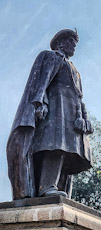
SUBHASH CHANDRA BOSE Park, formerly named Irwin Park, runs parallel to the seashore at Ernakulam in Kerala. At the south end of this pleasant open space, there is a tall statue depicting Sri Sir Rama Varma GCIE, LLD, Maharaja of Cochin (c1861-1941). He reigned between 1932 and 1941. The statue was unveiled in January 1939 by the then Viceroy of India, Lord Linlithgow during a visit to the city. He was Viceroy from 1936 to 1943.
Rama Varma
While visiting Ernakulam that day, the Maharajah arranged for him to watch a display of Bharatnathyam dancing (https://www.cochinroyalhistory.org/). This was held before tea in the grounds of the Maharaja‘s nearby Durbar Hall. The statue was unveiled after tea.
The Durbar Hall was constructed over 100 years ago in extensive grounds owned by the Maharajahs of Cochin. For many years, it has been used as an art gallery. Beautifully restored by the organisation that runs the Kochi Muziris art biennale, it serves as one of the art festival’s venues during the 4 months that the Biennale runs. The current 2022/23 event in the Durbar Hall is a show called “Idam” which contains a variety of visual art exhibits, all of which have been created by 34 Malayali artists. Overall, it is an enjoyable exhibition by artists displaying an exciting variety of interesting imaginative ideas, all expressed in well executed artworks.
The works in the Durbar Hall are in stark contrast to the Maharaja‘s statue that stands in the hot sun not too far away. Unlike the Maharajah, who was probably unwilling to break out of his comfortable colonial mould, the artists are showing that they are willing to attempt to escape from prevailing convention
ST IVES IN CORNWALL is chock full of art galleries apart from the better-known Tate St Ives (highly overrated), the Penwith, and the splendid Barbara Hepworth house. Many of these galleries are best bypassed because they contain artworks of pedestrian workmanship and often poor aesthetic qualities. Last year, we visited a mediocre exhibition in the Crypt Gallery below the St Ives Society of Artists, which is housed in a deconsecrated church. So, when we passed the gallery today, I was reluctant to enter until I spotted that the exhibition was entitled ‘Cornwall and India’. The artist whose works were on display is called Paul Wadsworth.
Born in East Anglia in 1964, Paul studied at the art school in Falmouth (Cornwall). He told us that he has made three lengthy visits to India. One trip was to Rajasthan, another to Goa, and a third to Kerala. While in India, he commissions lovely leather-bound books to be made in Pushkar (Rajasthan). He fills these with line drawings and painted sketches. These visual records become the basis for his paintings inspired by his observations of India. Some of his Indian paintings are completed in India and others in his studios in Cornwall. To my eye, Paul captures the essence of India well: its colours and vibrancy.
Some of the paintings on display were those inspired by India. Others that involve skilful application of paints with a palate knife depict the spirit of the landscape of Cornwall. These paintings, Paul explained, are not done from photographs or preliminary sketches, but straight from true life. Given how the sky often changes so quickly in Cornwall, the artist has done a great job of seizing the moment and recording it on canvas.
Circus is another subject that attracts Paul. Some of his vivid depictions of life in the circus arena were on display. Complementing these, his sketch books have many lovely images created whilst he spent time with Kathakali dancers in India. Some of these sketches have been translated into paintings.
Paul spent time with us, patiently answering our numerous questions as well as showing us his works. He has the gallery for three weeks, starting 20th September 2020 and has filled it not only with his artworks but also the materials that he uses to create his works of art. He has created an exhibition within what he will use as his temporary studio.
I am truly glad that I entered the Crypt Gallery despite initial misgivings. If I had not, I would have missed out a highly enjoyable collection of good quality, well-executed art and meeting Paul, its affable creator.
Last year, we were booking our daughter into a simple home-stay by the sea in Kerala, India. While we sat in the owner’s office, I spotted a framed certificate issued by the Booking.com website. It showed that the home-stay had earned a 9.8 out of 10 satisfaction rating. I congratulated the owner for achieving this. Sadly, he told me, the latest rating was now 9.4.
“That’s still pretty good,” I said.
“Maybe,” the owner replied, “but it keeps going down. The problem is the Indian guests who stay at my place.”
“Why?” I asked.
“When foreigners come and pay £10 per night, they know what to expect,” the owner began, “but when Indians come here they expect accomodation worth £100 even when they are only paying £10”
“The problem is,” he continued, ” that Indians arrive expecting included breakfast, a swimming pool, and other facilities, for which they would usually have to pay £100 or more. These are not available at £10 per night. So, when they write their reviews on Booking.com, they give us a low rating, which is not fair given how little they have to pay. These low ratings bring down my overall rating.”
I sympathised with the man, who then admitted:
“I would rather have no Indians staying here. I prefer the foreigners because they know what to expect of budget accommodation.”
When I stay at places that I have booked on Booking.com, I tend to be over generous with my rating unless there is something very seriously bad about the place. Also, when choosing where to stay, I am not put off by ratings of just over 6 out of 10. I have often found hotels with lowish ratings to have been under-rated because people have been over-critical about minor defects.
So, when you next rate a place you have visited, try to be fair and reasonable with your ratings.




 yamey
yamey 