The conqueror’s ruined castle in north Wales

THESE DAYS WE ARE so preoccupied with the Russian invasion of Ukraine that the English invasion of Wales is not in the forefront of our minds. In the 13th century, King Edward I of England (reigned 1272-1307) decided to conquer Wales. To do this, he built a series of castles from which his armies could enter Wales. One of these was built at Flint on the left bank of the River Dee not far from Chester, from which supplies could be easily carried either by land or by water (sea and river).

The castle at Flint was designed by Richard L’engenour and built between 1277 and 1278. Its form was based on Savoyard models. One of its circular towers was built larger than the others and separated from the rest of the castle – it served as the ‘donjon’ or keep.

Many of those who constructed the castle – English people – stayed on in the area to become the inhabitants of the new fortified, walled town of Flint. They felt safe within the town’s walls, but this sense of security was soon to be disturbed. For in 1294, the Welshman Madog ap Llywelyn led a revolt of the Welsh against their English rulers, and attacked Flint. Rather than letting the town fall into the hands of the Welsh, the Constable of Flint Castle ordered that the town be burned to the ground so that the Welsh rebels would be denied shelter and food.

The castle remained functional until the Civil War, when it, along with other strongholds, was destroyed following orders issued by Oliver Cromwell, soon after 1647.

Today, the impressive ruins are open to the public and well maintained by CADW, a Welsh Government body that looks after sites of historic interest. In 1838, JMW Turner created a watercolour painting showing the castle with a beautiful sunset behind it. We visited it on a rainy day in May 2024. Despite the inclement weather, seeing the castle gave us great pleasure.

Just in case they attack

AFTER WW2 MANY thousands of concrete bunkers were built all over Albania because the country’s paranoid and brutal dictator Enver Hoxha, who ruled between 1944 and 1985, was concerned that the country would be invaded by its neighbours or others further afield. The invasion never happened. Likewise, the much-feared invasion of the UK during WW2 never occurred (except for the Channel Islands). However, in anticipation of a feared German invasion of the UK, the country, like Albania, was covered with concrete fortifications in many shapes and sizes. During a recent visit to Sidmouth in Devon, I spotted one of these, a small concrete ‘pill box’.

Located high on a cliff (overlooking Jacob’s Ladder Beach) next to Sidmouth’s Connaught Gardens, this small bunker was probably constructed as part of a coastal defence system in  1940-41. Later in WW2 when the risk of a German invasion was getting smaller, it was used during the training exercises that were performed prior to the Allied invasion of Normandy in early June 1940. It was from the south Devon coast that the invasion force set out for France.

Designed to resist destruction, bunkers such as the small one I saw in Sidmouth (and the multitude of mostly hemispherical bunkers I have seen in Albania), they are both difficult and expensive to remove when they are no longer needed. Interestingly, these concrete defences are no guarantee against successful invasion, as can be seen from the ineffectiveness of the Maginot Line in eastern France and the huge structures built by the Germans on the Atlantic coast of that country.  

Roman and Saxon stones in Yorkshire

ROMANS TRAVELLING ON the ancient Dere Street, a road constructed by the Romans, between York and Hadrian’s Wall crossed the river Ure near the present Yorkshire village of Aldborough, which archaeological research has revealed stands on the site of a large Roman town called ‘Isurium Brigantum’. Some of the Roman remains can be seen at the beautifully laid out English Heritage site in Aldborough. The parish church in Aldborough is built on the site of the forum of the former Roman town and contains a Roman sculpture, which might well depict the god Mercury. Excavations, which we viewed, being undertaken by archaeologists from Cambridge University are discovering that the Roman town was an important way station for supplying and servicing troops travelling to and from Hadrian’s Wall. The archaeologists, who kindly showed us around their dig,  asked us not to reveal what they have discovered because they have yet to be published in the appropriate way.

A carved Saxon stone incorporated into the masonry of a church wall at Kirby Hill, Yorkshire

After crossing the Ure at Aldborough, Dere Street, so named after the Romans had departed from Britain, travelled north to Catterick (Roman: ‘Cataractonium’). A few miles from Aldborough, the old road used by the Romans passed close to the Yorkshire village of Kirby Hill, whose parish church, All Saints, perches on the summit of a hill. It is possible that the church is sited where once there was a Celtic and/or Roman shrine. The church’s informative website (www.allsaintskirbyhill.org.uk/) reveals:

“… there are some large stones in the lower walling; one of these at the South West angle is clearly Roman and has a sunk panel, which once contained a 13 line inscription. Unfortunately, it is now very badly weathered. It was a posthumous dedication to either Antonins Pius or Caracalla, the first such recorded from Roman Britain.”

Unfortunately, when we visited this lovely church recently, we missed seeing this interesting souvenir of the Roman occupation of Britain. However, during our brief look inside the church we did see evidence of some of the invaders who arrived in Britain after the Romans had left.

The church contains some well-preserved carved fragments of Saxon crosses. High up on the south side of the church, we noticed that such a fragment had been incorporated in the stonework of its wall, just as the Roman stonework had been incorporated elsewhere in the structure of the church as already described.

The nave of All Saints was built both during the Saxon and Norman eras. Its structure includes some Saxon slabs as well as those placed after the Norman invasion in 1066. A north aisle was added in about 1160 and is separated from the older part of the church by semi-circular masonry arcades supported by sturdy stone pillars topped with capitals dating back to Norman times.

The church, which we only visited because we followed a roadside direction sign with the words “Ancient Church”, contains many other interesting features, which we did not have time to examine as we were in a bit of a hurry to reach an appointment on time. When we told a lady, who was telling us about the church, that we were rather pressed for time, she said to us, smiling:

“That’s a pity. You’re speaking with the wrong person. You can’t expect someone from Yorkshire to be brief.”

He paid with spears and swords

MALDON IN ESSEX is best known for the sea salt, prized by cooks and gourmets, which is produced nearby. The town perches on a hill overlooking a marshy inlet of the River Blackwater and the River Chelmer, after which Chelmsford is named, flows through a lower section of the place. We have visited Maldon several times over the last 18 months and always walked along part of its promenade that provides attractive views over the marshes and streams watered by the Chelmer and the Blackwater. However, it was only during our most recent visit (August 2021) that we walked the entire length of the promenade to its end point, which is out of sight of the town. The promenade ends abruptly, a bit like the end of a pier. There at the furthest extremity of the walkway, there is a tall statue. It depicts a man in a helmet, brandishing a sword in his right hand, holding a circular shield in his left, and looking out to sea.

The statue overlooking the sea is a sculpture of Byrhtnoth, Ealdorman of Essex, an Anglo-Saxon aristocrat or high official, who lived during the reign of Ethelred the Unready (c996-1016). Byrthnoth died during the Battle of Maldon on the 11th of August 991. The battle was fought by the Anglo-Saxons against an army of Viking invaders. It is said that before the battle, the Vikings offered to sail away if they were paid with gold and silver. Byrhthnoth was recorded as replying that he would only pay the attackers with the tips of his men’s spears and the blades of their swords.

After the battle, the then reigning Archbishop of Canterbury, Sigeric the Serious, advised Ethelred to pay off the Vikings instead of continuing the fight against them. According to an article on Wikipedia, this payment of 3,300 kilogrammes of silver was the first example of the so-called Danegeld in England. This was a ‘tax’ paid to the Vikings in exchange for them desisting from ravishing the territory which paid it.

So, the statue depicts a participant in a defeat of the English (Anglo-Saxons), and much loss of life amongst the Viking invaders. It was created by John Doubleday (born 1947) and unveiled in 2006. Byrhtnoth stands on a tall cylindrical base decorated with bas-relief depictions of scenes of life in the 10th century and moments during the Battle of Maldon. A plaque embedded into the promenade’s pavement near the statue gives more background to the historical event. It reads:

“Byrthnoth, represented by the figure standing on this monument, was the principal voice in rejecting the policy of appeasement which dominated the court of King Ethelred in the closing years of the 10th century. The leading military figure of his time; he was probably aged 68 when he confronted the Vikings at the battle of Maldon. He surrendered his life in defence of the people, religion and way of life represented in the lower relief panel of the column. Above it you will see aspects of the battle in which he died. Around the base is a quotation from his final prayer as recorded in the surviving fragment of the poem ‘The Battle of Maldon.’”

The poem, mentioned above, was written in Old English. However, much of it has now been lost.

Apart from the statue, Maldon has much to offer the visitor. Along the quayside, there are several old Thames Barges with their maroon/brown sails and a lovely pub, The Queen’s Head Inn. Church Street climbs from the riverside to the High Street which is lined by several old houses; a disused church, now a museum; an attractive parish church; and plenty of decent places to eat and drink. Within easy reach of London, this is a delightful place for a day out or as a base for exploring rural Essex.

Seduced by style

DURING VARIOUS VISITS TO AHMEDABAD, we have often driven past the Ahmed Shah Masjid, but never visited this venerable mosque. Close to the great Bhadra Fort and built in about 1414 AD by Ahmed Shah, the founder of Ahmedabad, this is the oldest extant mosque in the city. Today, we entered this exquisite mosque and its garden and discovered a perfect example of Indo-Islamic architecture.

When this mosque, and many others built in western India up to at least a century later, was constructed its creators incorporated many design features that can be seen in Hindu and Jain temples that were constructed centuries before believers of Islam entered/invaded India.

The grounds of the Ahmed Shah Masjid are entered through a small stone pavilion. The step inside it is just like the entrance steps to Hindu and Jain temples in that it includes a centrally located semicircular projection.

The patterning on the exterior stonework of the mosque and the many pillars within it would not look out of place on pre Islamic places of worship in India. However, the presence of figurative carving found in Hindu and Jain temples is completely absent in mosques. One small exception, which I saw at the Ahmed Shah Masjid and others in Ahmedabad, are carvings of trees, the Tree of Life.

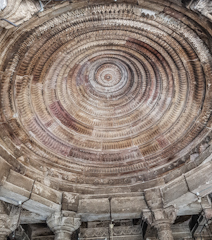
The Ahmed Shah mosque and many other medieval mosques in Gujarat are topped with numerous domes. Seen from the outside of the mosques, they do not look exceptional, but viewed from within, the influence of Hindu/Jain temple architecture is obvious.

The domes are usually supported by 8 pillars arranged as a regular octagon. Neighbouring pillars support horizontal lintels, which together form an octagon. The dome rests on these lintels. The internal surfaces of the domes, when seen from below, consist of a series of concentric rings that decrease in circumference as they approach the top of the dome. The stonework of the rings can be either plain or elaborately ornamented. The design of these domes and their supporting supporting pillar systems are identical to what can be seen in Indian temples built long before Islam arrived in India.

Unlike the non-Muslim temples that inspired their design, medieval mosques contain features that are unique to mosques, such as elaborately decorated mihrabs, niches in the wall of the that worshippers face when they pray.

The Ahmed Shah mosque has an elevated internal chamber, where the king could pray separated from the rest of the congregation.

Having at last visited this fascinating mosque, I would reccomend all visitors to Ahmedabad to visit it first before exploring the other wonderful 15th and 16th century mosques that enrich the city.

The Ahmed Shah Masjid is a fine example of how conquerors can be conquered by the culture of those whom they have invaded. Just as the Muslims were bewitched by the wonders of Indian culture, so were the British many years later, as well exemplified by the Brighton Pavilion.

Island of history

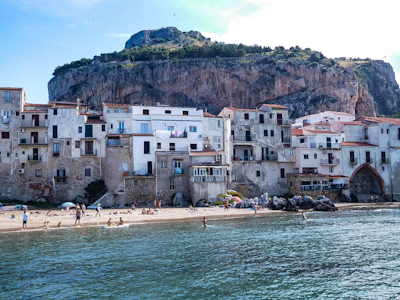
The timeless Mediterranean washes the shores of an ancient land, Sicily.

Here in Cefalu, the Normans built a magnificent cathedral after taking over the island from its Arab rulers.

Sicily has been invaded many times, each invasion adding to the variety of culture and traditions on this piece of land that separates the western part of the Mediterranean from the eastern part.