
A Roman town near to Hadrian’s Wall in Northumberland

HADRIANS WALL WAS constructed by the Romans in about 122 AD. Its purpose was to separate Roman Britain to the south of it from the ‘barbarians’ who lived north of it. Before it was built, they built a fort at a point where Dere Street, a major Roman road that ran in a north-south direction met Stane Road, a road that before the construction of Hadrian’s Wall marked the northernmost boundary of Roman Britain. This fort, established in the 80s AD, was called Coria, for short, and its full name might have been Corstopitum or Corie Lopocarium or, even, Coriosopitum, Corsopitum or Corsobetum. The site where they built the fort is near the town of Corbridge in Northumberland. Archaeological evidence suggests that the site of Coria had been occupied in the Iron Age, long before the Romans arrived.
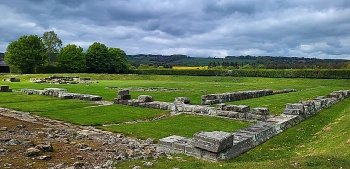
After the construction of Hadrian’s Wall and its forts, Coria ceased to be a military centre, and began to be developed as a Roman town for civilians. It is believed from archaeological investigations that the town had temples, granaries, a fountain house, and a civic forum. Additionally, the place had residential buildings, both grand and modest. The town served as a supply centre for the military as well as being a market place for the lead, iron, and coal mined in the neighbourhood. After the Romans left Britain, their town fell into decline. Nearby Corbridge was founded by the Anglo-Saxons sometime after the Romans had cleared out of England.

It was not until 1861 that the first excavations that revealed remains of the town were discovered by Mr Coulson. Between 1906 and 1914, more extensive archaeological work was carried out by Francis J Haverfield (1860-1919) and Leonard Woolley (1880-1960). After working at Coria, Woolley travelled to the Middle East, where his excavations in Mesopotamia were to make him famous. Later, the site of the Roman town became Britain’s first training site for young archaeologists.

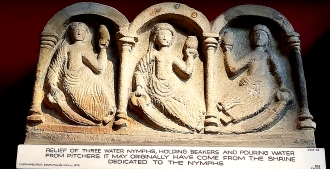
Today, the remains of the town, mostly stonework, are in the care of English Heritage. The site is well-cared for and labelled with useful information panels, without which one might have little idea about the nature of what one can see. Next to the sight, there is a small museum filled with beautiful artefacts found in and near the town. Most of them are stone carvings, and all of them are well displayed. Whereas a visit to Coria does not give one as much of an impression of Roman architecture, as does, say Ostia near Rome, it is a pleasant place to visit and quite thrilling to consider that you are in what was once the northermost part of the Roman Empire.
The town clerk who helped to save a wall built by the Romans

HADRIANS WALL WAS commenced in 122 AD to fulfil the order of Emperor Hadrian, who wanted to separate Roman Britain from the so-called barbarians who lived in what is now Scotland and parts of Northumberland. The wall stretched 73 miles west from Bowness-on-Solway to Wallsend (next to Newcastle) on the River Tyne. Soon after it was built, it began to decline, and over the years, people used some of its stones to construct their own buildings.

Had it not been for the efforts of people like John Clayton (1792-1890), much of what we can see of Hadrian’s Wall today might have been lost forever. After having had a classical education, Clayton was a Town Clerk of Newcastle-on-Tyne and an antiquarian.

In 1796, John’s father, Nathaniel, bought the Chesters Eastate, through which part of Hadrian’s Wall runs. In its grounds, there stands a mansion, which was built in about 1771. After his father’s death in 1822, John inherited Chesters. John, who was keen on antiquities, excavated the Roman ruins on his land. These included what was left of a Roman fort known as ‘Cilurnum’. He also discovered the remains of a Roman Bridge that traversed to Tyne from the fort. After 1832, Clayton purchased other pieces of land on which there were remains of the Wall and its associated forts.

We visited Chesters, which is maintained by English Heritage. In addition to its well conserved remaims of the various parts of the Roman fort, there is a wonderful museum that contains many roman sculptures and inscribed stone discovered by Clayton. The museum, which is filled with many fine carvings, is delightfully old-fashioned. The museum was built after John Clayton’s death, but I am sure that he would have approved of the way his finds have been displayed.

Roman and Saxon stones in Yorkshire

ROMANS TRAVELLING ON the ancient Dere Street, a road constructed by the Romans, between York and Hadrian’s Wall crossed the river Ure near the present Yorkshire village of Aldborough, which archaeological research has revealed stands on the site of a large Roman town called ‘Isurium Brigantum’. Some of the Roman remains can be seen at the beautifully laid out English Heritage site in Aldborough. The parish church in Aldborough is built on the site of the forum of the former Roman town and contains a Roman sculpture, which might well depict the god Mercury. Excavations, which we viewed, being undertaken by archaeologists from Cambridge University are discovering that the Roman town was an important way station for supplying and servicing troops travelling to and from Hadrian’s Wall. The archaeologists, who kindly showed us around their dig,  asked us not to reveal what they have discovered because they have yet to be published in the appropriate way.

A carved Saxon stone incorporated into the masonry of a church wall at Kirby Hill, Yorkshire

After crossing the Ure at Aldborough, Dere Street, so named after the Romans had departed from Britain, travelled north to Catterick (Roman: ‘Cataractonium’). A few miles from Aldborough, the old road used by the Romans passed close to the Yorkshire village of Kirby Hill, whose parish church, All Saints, perches on the summit of a hill. It is possible that the church is sited where once there was a Celtic and/or Roman shrine. The church’s informative website (www.allsaintskirbyhill.org.uk/) reveals:

“… there are some large stones in the lower walling; one of these at the South West angle is clearly Roman and has a sunk panel, which once contained a 13 line inscription. Unfortunately, it is now very badly weathered. It was a posthumous dedication to either Antonins Pius or Caracalla, the first such recorded from Roman Britain.”

Unfortunately, when we visited this lovely church recently, we missed seeing this interesting souvenir of the Roman occupation of Britain. However, during our brief look inside the church we did see evidence of some of the invaders who arrived in Britain after the Romans had left.

The church contains some well-preserved carved fragments of Saxon crosses. High up on the south side of the church, we noticed that such a fragment had been incorporated in the stonework of its wall, just as the Roman stonework had been incorporated elsewhere in the structure of the church as already described.

The nave of All Saints was built both during the Saxon and Norman eras. Its structure includes some Saxon slabs as well as those placed after the Norman invasion in 1066. A north aisle was added in about 1160 and is separated from the older part of the church by semi-circular masonry arcades supported by sturdy stone pillars topped with capitals dating back to Norman times.

The church, which we only visited because we followed a roadside direction sign with the words “Ancient Church”, contains many other interesting features, which we did not have time to examine as we were in a bit of a hurry to reach an appointment on time. When we told a lady, who was telling us about the church, that we were rather pressed for time, she said to us, smiling:

“That’s a pity. You’re speaking with the wrong person. You can’t expect someone from Yorkshire to be brief.”