Most tough regimes come
And reach their end at long last
Only stones remain

Most tough regimes come
And reach their end at long last
Only stones remain
I HAVE NO IDEA how many commercial art galleries there are in Central London. Today (the 14th of May 2024), we visited an art gallery, whose existence was previously unknown to us, and there we saw an exhibition of works by an artist, who was also new to us. The gallery is Carl Kostyal in Savile Row. Its discreet entrance is sandwiched between two fashionable tailors’ stores. Half Hungarian and half Swedish, Carl Kostyál opened his gallery in Savile Row in 2010. Three years later, he opened another gallery in Stockholm.
The artist, whose work is being exhibited, is Leo Park, who was born in Sweden in 1980. His exhibition in Savile Row is called “Beyond Pleasure”. It consists mostly of large paintings, but also a wall covered with a mosaic of small sketches, The beautifully executed artworks are eye-catching, and reminded me a little of the works of some of the pre-WW2 Surrealists. The paintings and sketches are of imagined forms that immediately made me think of human bodies. The images are clearly meant to evoke such thoughts, but looked at objectively, they are all shapes that do not exist in nature. The paintings and drawings are all displayed in the beautifully restored rooms of the 18th century building that houses the gallery.
The show ends on the 2nd of June 2024, and is well worth visiting.
A DISTINCTIVE BUILDING stands opposite the Art Deco Winter Garden (built by 1936) high above the seashore of Ventnor on the south side of the Isle of Wight. With a tower overlooking the sea, the edifice facing the Art Deco structure was which was built in 1846 by the Reverend Richard John Shutte (1800-1860), who had once been a canon at St Paul’s Cathedral. It was named St Augustine Villa (see photograph below), and now houses a hotel and restaurant.
Several Russians opposed to the Imperial Romanov regime, including the writer Ivan Turgenev(1818-1883) visited Ventnor during the 19th century. Amongst these was Alexander Herzen (1812-1870), who was the ‘father’ of Russian Socialism’. In 1852, he and his family began living in England for several years. During this sojourn, he made some visits to the Isle of Wight. In September 1855, Herzen stayed in Augustine Villa, which he had rented. However, he was not alone as the commemorative plaque on the Villa notes. He stayed there with Malwida von Meysenbug (1816-1903).
Now, I had already heard of Herzen. I became familiar with his name when watching a trilogy of plays by Tom Stoppard about 19th century Russian Socialism. However, I had never come across Malwida von Meysenbug until I saw that plaque in Ventnor. A writer, she was born in Kassel (Germany) and was a friend of both Friedrich Nietzsche and Richard Wagner. By the time that Herzen and Malwida had their holiday in Augustine Villa, she was living with Herzen’s family and helping to look after his children. Alexander’s wife Natalia had died in 1852, and he had hired Malwida to educate his children.
Malwida was much more than a mere governess as the UCL academic Sarah J Young explained in her excellent, highly informative article (http://sarahjyoung.com/site/2011/11/10/in-herzens-footsteps-a-visit-to-ventnor/). In this essay, Dr Young gives excerpts from Malwida’s published “Memoirs”. The following is particularly interesting:
“We spent happy days in beautiful Ventnor. In the evenings we were usually with the Pulszkys, who were spending the summer there. Therese’s mother, an educated and intelligent Viennese lady, had come to visit them, and this made for many a pleasant hour with her keen humor and wit. The Kossuths were also there, and he was much more pleasant in a more intimate setting than he had been at the formal gatherings in London. At the time, our thoughts were preoccupied by the war Russia had started with Turkey. Herzen, more so than the others, was very excited. He prophesied the Russian defeat and wished for it, since he believed it would lead to the downfall of autocracy.”
The Kossuths, were members of the family of the Hungarian revolutionary Louis Kossuth, whom Herzen was extremely excited to have met during his stay in Ventnor. Another exiled Hungarian revolutionary, Ferenc Pulszky (1814-1897) was also staying with his family in Ventnor at the same time as the Herzens and the Kossuths. Pulsky’s wife, Theresa, and Malwida spent time drawing together in Ventnor, and made several competent sketches of Ventnor and its surroundings,
Dr Young also quoted Herzen, who noted in his diaries that Malwida:
“… spent all her time in the water …”
From what Dr Young and others have discovered during their research, Malwida was out of the sea long enough to create works of art depicting the seaside resort.
Herzen liked Ventnor but had some reservations as he wrote in a letter (quoted from Dr Young’s article):
“For three days the weather has been like June – and I’m bathing recklessly in the sea. But before that there were four days of storms, rain and bitter cold … If it were not so boring, I would live here, but there are no resources at all. And getting to Ryde is expensive … “
Many years have passed since Herzen and Von Meysenbug holidayed in Ventnor. Slightly less time has elapsed since the future Mahatma Gandhi visited Ventnor in 1890 and 1891. According to one source (www.bonchurchvillage.co.uk/post/bonchurch-gandhi), Gandhi:
“… had wanted to study medicine but his father had objected, and his studies were in law. He was a prominent member of the London Vegetarian Society, and that may have led to his staying at Shelton’s Vegetarian Hotel at 25 Madeira Road in Ventnor, in January 1890 and again in May 1891, on the second occasion addressing a Vegetarian meeting in Ventnor.”
In his autobiography, Gandhi wrote of the following experience in Ventnor:
“My cowardice was on a par with my reserve. It was customary in families like the one in which I was staying at Ventnor for the daughter of the landlady to take out guests for a walk. My landlady’s daughter took me one day to the lovely hills round Ventnor. I was no slow walker, but my companion walked even faster, dragging me after her and chattering away all the while. I responded to her chatter sometimes with a whispered ‘yes’ or ‘no’, or at the most ‘yes, how beautiful!’ She was flying like a bird whilst I was wondering when I should get back home. We thus reached the top of a hill. How to get down again was the question. In spite of her high-heeled boots this sprightly young lady of twenty-five darted down the hill like an arrow. I was shamefacedly struggling to get down. She stood at the foot smiling and cheering me and offering to come and drag me. How could I be so chicken hearted? With the greatest difficulty, and crawling at intervals, I somehow managed to scramble to the bottom. She loudly laughed ‘bravo’ and shamed me all the more, as well she might.”
I do not think that Gandhi made any other visits to Ventnor or elsewhere on the Isle of Wight.
Today, Ventnor is still delightful and although much has been modernised since the Victorian era, it still retains an almost unspoilt old-world charm. I fancy that were it possible for Herzen and Malwida and their revolutionary friends to return today, they would find much in Ventnor that they would easily recognise.
Seeing the plaque on Augustine Villa made me curious about Herzen’s stay in Ventnor and the identity of Malwida von Meysenbug. By reading up about it, I learned of other noteworthy visitors to the town, and as I did so my interest in Ventnor has increased considerably.
PS: a list of some more of the famous visitors to Ventnor can be found at /www.ventnortowncouncil.gov.uk/about-ventnor/famous-residents/
DURING A RECENT VISIT to Cambridge, we spent some time in the magnificent chapel of King’s College. It is difficult to avert one’s eyes from the masterpiece of gothic fan-vaulting that forms the ceiling of this edifice, but it is worth doing so because the chapel is filled with other wonderful things. These include a painting by Rubens, another by Gert van der Lon, and yet another by Girolamo Siciolante de Sermoneta. The brass lectern that stands in the choir was made in the early 16th century and is surmounted by a small statue of King Henry VI. There are many other items of great historical interest to be seen including the stained-glass windows, which have survived since the 16th century. Interesting as all of these are, what caught my attention was something in a small side chapel – The Chapel of All Souls.
This chapel was converted in the 1920s to house a memorial to those members of King’s College (academics, students, choristers, and servants) who died during WW1. The names of those who perished are listed on engraved stone panels on one wall of the small chapel. Amongst these names is that of the famous poet Rupert Brooke (1887-1915).
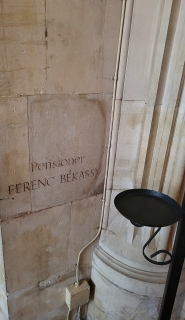
On another wall of the chapel, separate from the list of names, I spotted an inscription carved into the stone. It reads:
“Pensioner Ferenc Békassy”
Ferenc Istvan Dénes Gyula Békássy (1893-1915) was a Hungarian poet born in Hungary. In 1905, he was enrolled at Bedale’s School in Hampshire. In 1911, he began studying history at King’s College Cambridge. He was what is known as a ‘pensioner’. In Cambridge University usage, this word was used for a student, who has no scholarship and pays for his tuition as well as his board and lodging. During his time at the college, he was elected a member of The Apostles and courted the same woman as Rupert Brooke. He composed poetry both in Hungarian and English.
Just before the outbreak of WW1, Ferenc returned to Hungary, where he enlisted as a hussar in the Austro-Hungarian Army. On the 22nd of October 1915 he was killed in action whilst fighting the Russians in Bukovina. He was buried on his family’s estate in Hungary.
After the war, the memorial in King’s College Chapel was established. Because it was considered objectionable for the name of an enemy soldier to be listed amongst those who fought and died for Britain, his name was not included on the memorial. Instead, it was placed on another wall nearby.
Though separated from Rupert Brooke’s name by a few feet, this small chapel serves as a memorial to two great poets, who were killed in their prime.
OFTEN WHEN ONE IS SEARCHING for something, something, which you were not looking for, comes to light. A day or so ago, one of my old passports was discovered. It is an old-fashioned, blue-covered book with barely a trace of the wording and crest that used to be on the cover. I used to carry my passport in a trouser pocket, which rubbed against it and gradually denuded the cover. The ten-year document expired on the 19th of March 1990. This was a couple of months before I made my last trip to what was still known as ‘Yugoslavia’. Soon after that, civil wars erupted, and the country became divided into smaller independent units.
The passport gives my height but not my eye colour, which used to be recorded in earlier passports. It contains eight Hungarian visa stamps (one is illustrated above), all issued in London except for one which was affixed in Belgrade. There is also a Bulgarian visa stamp, which was issued in March 1983. In addition to these visa stamps, for which I was charged roughly $10 each, there are many border stamps – entry and exit. Most of these are for Hungary and Yugoslavia, which I visited frequently throughout the 1980s. In those days, Brits did not need a visa to enter Yugoslavia.
One of the border stamps is of special interest. It was issued when I entered Yugoslavia at Bozaj on the 5th of June 1984. Bozaj, now in the Republic of Montenegro, was a Yugoslav border post on the shore of Lake Shkodra. The stamp was placed in my passport a few minutes after leaving the Albanian border post, also beside the lake, at Han-i-Hotit. It was here that an Albanian entry stamp was put in my passport two weeks earlier when I visited the country, which was then even far more mysterious than North Korea is to us today. In 1984, the Stalinist regime headed by Enver Hoxha was still in place. The two weeks spent in Albania were both fascinating and unusual to say the least. I have described that holiday in my book “Albania on My Mind.”
In addition to the visas and stamps issued by socialist countries, there is one Greek entry and one exit stamp, both issued at Athens airport in August 1981. It seems that I was in Greece from the 11th to the 17th. Another stamp issued on the 13th by the Piraeus branch of the National Bank of Greece takes up most of one page and has something to do with money and traveller’s cheques, but my Greek is not up to translating it.
The accidental finding of this old passport brings back many happy memories of travelling in parts of Europe that have now changed beyond recognition – for better or for worse.
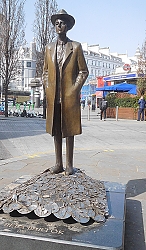
With his back to the former entrance to the Piccadilly line station at South Kensington and standing at the corner of Pelham Street and Old Brompton Road, is a sculpture depicting the Hungarian composer Béla Bartók (1881-1945). He visited Britain at least sixteen times, often staying in London. To save money, he stayed with his friend the diplomat Sir Duncan Wilson at least twelve times between 1922 and 1937. Wilson owned a house (designed by Basevi) in South Kensington, number 7 Sydney Place, which is just south of Onslow Square. The sculpture, depicting the composer standing on what looks like a pile of fallen leaves, was created by Imre Varga (1923-2019) and unveiled on a traffic island in 2004. This, Varga’s fourth sculpture of the composer, was moved to its present location in 2011.
Moving northwards, possibly passing the residential Onslow Squares, we reach Queensbury Place, which connects Harrington Road with the section of Cromwell Road that runs past the Natural History Museum. A 20th century brick and concrete building on Harrington Road is home to part of a French school, the Lycée Français Charles de Gaulle de Londres. This educational institution for both French- and English-speaking children was created in 1915. After several changes of location, it moved into a building facing the Natural History Museum on Cromwell Road in about 1958. In 1980. the school was named after Charles de Gaulle.
At the east corner of Harrington Road and Queensbury Place, there is a French library. The southern half of the east side of Queensbury Place is occupied by the French Institute, whose building has an imaginatively decorated brickwork façade. This building houses cultural facilities including a library and an auditorium, which hosts the Ciné Lumière. There is also a café. It was designed by Patrice Bonnet (1879-1964) in the Art Deco style and ready for use in 1939. The edifice contains artworks by Sonia Delaunay and Auguste Rodin.
Facing the French Institute is number 16 Queensbury Place, home of The College of Psychic Studies. Founded in 1884, this organisation does the following (according to its website http://www.collegeofpsychicstudies.co.uk):
“The College of Psychic Studies offers courses, workshops and talks on all aspects of healing, self-development, spirituality, and psychic and mediumship training.”
The College moved into its current premises in 1925. A plaque attached to its building commemorates the creator of Sherlock Holmes, Arthur Conan Doyle (1859-1930). Apart from being a prolific author, he was President of the College from 1926 until 1930. The College’s website reveals much about his interest in spiritualism. He:
“… published his two volume History of Spiritualism and his novel, The Land of Mist, while he was the College’s President … [he] was tireless in helping the bereaved and spreading the word of spiritualism including urging people to join the Alliance and read the latest news in Light.”
Unlike Sherlock Holmes’s fictional address in Baker Street, this townhouse in South Kensington has a real connection with Holmes, at least with his creator.
I ENJOY THE OBSCURE, or, at least, what is new and unknown to me. I am also interested in Hungary and the Hungarians. So, recently, when we were walking along Branch Hill, a road beneath and west of Hampstead’s Whitestone Pond, I spotted a circular blue commemorative plaque that I had not noticed before. Close to a house where the singer Paul Robeson lived for one year, it commemorates a celebrated Hungarian, whom I had never come across before. The plaque reads:
“Alfred Reynolds, Hungarian poet and philosopher lived here 1980-1993”
Sadly, the two most knowledgeable Hungarians I knew, who could have told me something about him, the philosopher Imre Lakatos (1922-1974) and one of my father’s co-authors, the economist Peter Bauer (1915-2002), are no longer in the land of the living. So, I have had to resort to that font of all knowledge, Wikipedia, for information about Reynolds, a name that hardly sounds Hungarian to me. Searches of the internet reveal little other biographical information in English apart from what is noted on Wikipedia.
Alfred Reynolds (1907-1993) was born Reinhold Alfréd in Budapest, Hungary (the Hungarians put their surnames before their first names). His mother was Jewish and his father Roman Catholic. After graduating from the University of Leipzig in 1931, he founded a magazine called ‘Haladás’ (‘Progress’), which published the works of various Hungarian poets and was closed by the police soon after it began. Next, he founded another journal, a monthly with leftish tendencies called ‘Névtelen Jegyző’ (‘Anonymous Chronicler’), which was also soon closed by the police. After a brief spell as a member of the Communist Party of Hungary and a spell of imprisonment in Hungary, Alfred moved to the UK, to London, in 1936.
During WW2, Alfred served in the British Army, joining the Intelligence Corps in 1944. When the war was over, he became a leading light in the Bridge Circle, a group of libertarians. The group produced a journal called “London Letter”, some of whose articles were published in a book called “Pilate’s question: Articles from ‘The London Letter’,1948-1963”, which was released in 1964 and contains articles by Reynolds. In 1988, he published another book in English, “Jesus Versus Christianity”. The aim of this book was:
“…to redefine the prevailing image of Jesus of Nazareth. The author considers that Jesus remains a living figure reminding us of our humanity – the kingdom of Heaven within us. He argues that we should free the image of doctrinal encumbrance.” (https://www.goodreads.com/book/show/4932942-jesus-versus-christianity).
Prior to his arrival in England, Reynolds published his writings in Hungarian and those of other Hungarian poets, mostly in the journals he founded. Many of his papers, publications, and other memorabilia are currently on display at the Petőfi Literary Museum in Budapest.
And that is about all I can tell you about Reynolds who spent the last years of his life in a fine house that affords good views over Hampstead Heath. I wonder whether he ever frequented Louis on Hampstead’s Heath Street. Louis was opened as a Hungarian patisserie and café in 1963 by the Hungarian Louis Permayer (died 2017), who fled from Communist Hungary during the Uprising in 1956 (http://budapesttimes-archiv.bzt.hu/2014/10/04/louis-patisserie-a-hungarian-tea-temple-in-the-heart-of-north-london/). Louis still exists and has maintained its original wood-panelled interior décor that owes a lot to traditional Central European taste. It was where my wife and I had our first ‘date’. Today, the café is under different management from what it was when Reynolds moved to Hampstead.
Yet again, whilst walking for pleasure and exercise, I have spotted something that intrigued me because it seemed so unfamiliar and made me want to investigate it. Having discovered that there is not much information easily available about Alfred Reynolds, I am not surprised that I had never heard of him. The plaque commemorating his residence is unusual in that it does not state the name of the organisation or whoever it was that placed it. That adds to the mystery that partially shrouds this Hungarian refugee’s life and his relative obscurity that appeals to me.
SOME YEARS AGO, I began listening to music performed by the German group Kraftwerk, formed in 1970 in the West German city of Düsseldorf. They specialise in electronically generated music, a field in which they were pioneers in their country. In the 1980s, I used to drive across Europe from my home in North Kent to places as far afield as Italy, Hungary, and Yugoslavia. The cars I drove at the time were equipped with music cassette players. I recorded my own cassettes from LPs and CDs in my own large collection. Amongst the music I found satisfying during the long journeys I made were some of the creations of the Kraftwerk band. Amongst my favourite of their albums were “Autobahn” (first released 1974) and “Radio-Aktivität” (released 1975). The music was a great accompaniment to speeding along the highways of Europe including Germany’s Autobahns.

I used to break my journeys along the highways at regular intervals, stopping in villages or towns to take a short rest and refreshment. On one journey, I drove off the Autobahn into a picturesque small town in Bavaria, whose name I have forgotten. I entered a busy Gasthaus (pub with a restaurant) and found a vacant seat next to an elderly gentleman who was enjoying a stein of lager.
I remember seeing people sitting nearby drinking beer with slices of lemon. However, what I remember most is the brief conversation I had with my elderly neighbour. My German was, and still is, rudimentary but sufficient to have a simple conversation. He asked me where I was from and what I was doing. I explained that I was driving to Yugoslavia. Then, I said something about the high quality of motorways (Autobahns) in what was then West Germany. The old man smiled, and said (in German):
“Naturally. They were made by our leader Adolf Hitler.”
I was at a loss for words because few if any Germans I had met until then had ever mentioned Hitler and certainly not in such a favourable light. Without waiting for me to respond, he explained that he had been taken as a prisoner of war by the Russians during WW2 and had spent many years in prison camps there. I would have loved to have discussed this with him in detail, but my German was not up to it and also, I had to get on with the journey I had planned for that day.
Most people, including yours truly, credit Hitler with stimulating the building of Autobahns and similar highways. This is a mistake depending how one defines a motorway. In this context, a motorway is a road often with limited access and limited to motorised vehicles.
While Germany was being ruled by the government of the Weimar Republic, work began on an ambitious scheme to build a car only highway/motorway linking Hamburg to Frankfurt/Main and Basel (Switzerland). Parts of this were constructed before Hitler came to power. That road lacked a central reservation as found on modern motorways, but excluded traffic such as cyclists, pedestrians, and vehicles pulled by animals. The Autobahns constructed after Hitler came to power were similar to those currently constructed.
In the 1920s before Hitler ruled Germany but after Mussolini became Italy’s dictator, Italy was the first country in the world to build motorways reserved for motorised vehicles travelling at speed. The first Italian autostrade (motorways; singular: autostrada) were completed between 1924 and 1926 and by the end of the 1930s, the country had over 250 miles of both single- and dual-carriageway autostrade. It is sad to relate that the UK had to wait until 1958 for its first motorway, the Preston by-pass, now part of the M6. In 1959, the first section of the M1 was opened, linking Watford and Rugby. This stretch of highway had no central reservation, no lighting, no crash barriers, and no speed limit. Things have changed since then.
When I used to cross Germany, the motorways (Autobahnen) had long stretches where there were no speed restrictions. Once, I decided to check out the ability of my box-like Volvo 240 estate car on a German Autobahn. To my surprise, the vehicle whose shape looked anything but aerodynamic, effortlessly achieved a speed of 105 miles per hour going up a steep incline. When driving at high speeds in Germany, you can be sure that there will be plenty of vehicles that shoot past you at even higher speeds.
After the Berlin Wall crumbled in 1989, many former East Germans flooded the Autobahns with their poorly powered Trabant vehicles. Often when driving along the motorways in Germany I saw these slow-moving cars valiantly sitting in the overtaking lanes trying to pass vehicles with far more powerful engines. The drivers of speedy cars like Porsche, Audi, and Mercedes Benz, needed fast reflexes and good brakes to avoid crashing into the Trabants being driven by those who were enjoying the freedom of travel after many years of repression in the former DDR.
My days of driving across Europe from the UK have ended. The short journey from Kensington to the Channel crossings is tedious on account of the heavy traffic in London and South East England. Also, it is tiring to drive for at least a day and a half before reaching lovely countryside, be it the south of France or the mountains of Switzerland or Austria. I still enjoy driving but not the great distances I used to cover, and my enjoyment of the music of Kraftwerk remains as great as ever.
I WAS STAYING IN BELGRADE with my friends Peter and his wife. Peter said to me that because it was just over the border from (the former) Yugoslavia and neither of us had been there before, we should make a short trip to Hungary. That way, we could ‘tick off’ another country as having been visited. I agreed to accompany him. This was in 1981 when Hungary was still in the Soviet bloc.

British people required a visa to enter Communist Hungary. The Hungarian embassy in Belgrade was in Krunska, a leafy street near the Hotel Slavija. I entered and filled in a form. One of the questions on it related to the colour of an applicant’s car. It gave several options like ‘red’, ‘blue, or ‘green’, and one translated from the Hungarian as ‘drab’. I suppose that ‘drab’ was a mistranslation of the Hungarian word for ‘grey’ (the Hungarian for ‘grey’ is ‘szürke’ and for ‘drab’ is ‘sárgásszürke’). After filling the form, I walked to a counter by a small window in the wall. It was covered by an opaque green cloth curtain. I waited. After a few moments, the curtain was pulled open sharply by a lady behind it and the counter. I handed her my passport and the application form. My passport was full of bits of paper that I wanted to preserve safely. The lady plucked these out of the passport and handed them to me, saying:
“This I do not need.”
I picked up my passport with its new multi-coloured Hungarian visa stamp a couple of days later.
Peter and I boarded an overnight train from Belgrade to Budapest. Very soon, Peter fell asleep. After passing the station of Subotica in northern Serbia (Vojvodina), we reached the Hungarian border station at Kelebia. The train halted at the floodlit station for a long time. Apart from a few men in uniform, the platforms were eerily empty. Hungarian border guards entered the train. They carried satchels with shoulder straps. Each satchel was fitted with a hinged wooden lid that served as a small desk. Peter was sleeping deeply when two border officials entered our compartment. It was with great difficulty that the three of us, the two officials and I, managed to get him to open his eyes. Once he was awake, the guards took our passports. They looked at our passport photographs and then at our faces, and then back at the photos, then at our faces, and so on. This procedure was repeated several times until they were satisfied that our ‘mugshots’ were true likenesses of Peter and me. Then, they placed each passport on to the little desks attached to their satchels and pounded them with rubber stamps.
Some years later, the late Arpad Szabo, a philosopher in Budapest and a good friend, told me what he did when he was travelling out of East Germany (the former DDR) by train. The border guards in that country were particularly tough and very thorough. They entered his compartment and began prodding and opening the passengers’ baggage. When they approached his bag, he told them:
“Be careful with my luggage: I am smuggling an East German out of your country.”
The guards failed to appreciate the humour.
We arrived in Budapest Keleti Station early in the morning with no idea where we were going to stay. Someone directed us to a small window in a booth in the station. It was an official agency for arranging accommodation in people’s homes. We registered and were handed a scrap of paper with the address of our hosts. Without knowing the layout of the city, we hailed a taxi, which drove us across one of the Danube bridges to Obuda, a suburb north of Buda. Our accommodation was with a couple, who lived in a flat high up in a modern tower block. They were friendly but spoke no English. Somehow, I managed to communicate with them my interest in folk music. They recommended a singer called Katalin Madarász and told me that there were good record shops in Vaci Utca (Vaci Street), a shopping street in central Pest.
We made our way to Vaci Utca, where we found the Anna Café. This eatery served the most delicious cakes and savoury snacks in the form of open sandwiches. We found the record shops that we had been told about and that afternoon I bought the first of many Hungarian folk and classical LPs that are still in my enormous collection. I ate a toasted sandwich in a Café named Martini. It was there that I was able to add the words ‘meleg szendvics’ (hot sandwich) to my minute knowledge of Hungarian, a language outside the Indo-European language family.
I fell in love with Budapest, with the unfamiliar (to me) vocabulary of the Hungarian language, the food, and the friendly people we met. Peter and I explored many things in the city including a visit to the Young Pioneers’ Railway that ran in the Buda Hills. This was run and operated smoothly by youngsters, mostly teenagers, dressed in uniform. We visited Szentendre, a village north of Obuda, the Hampstead of Budapest. Not only is this place picturesque, but also it has a significant community of people with Serbian ancestry as well as a Serbian Orthodox church.
One evening, Peter wanted to visit a night club. In the early 1980s, Budapest seemed devoid of life after dark, but we found that the Hotel Astoria boasted a night club. This was entered through a discreet, almost hidden, street entrance and then up a staircase. We entered a darkened room full of people seated at tables. Soon, the cabaret, such as it was, began. The highlight of the rather unadventurous show was a magician performing tricks. The audience was subdued but showed its appreciation by genteel clapping. The people seated around us did not look as if they were used to visiting night clubs; they looked dowdy and provincial. I am quite sure that what was on offer at the Astoria was not what Peter was hoping for.
I do not know whether Peter ever visited Budapest again, but I did often. My appetite for Hungary was truly whetted by my first brief visit. I made another trip the following year, but not before doing some careful ‘contact tracing’ as they say in the current pandemic crisis. I wanted to meet Hungarians in their homes. One of my many contacts was supplied by my PhD supervisor’s wife, Margaret.
Margaret, gave me the contact details of Dora Sos. Dora was trained as a chemist in Hungary. Just before WW2 started, her company sent her to the UK on a business trip. When the War broke out, she was stuck in Britain and detained as an ‘enemy alien’. Soon, she was released from internment because she was not regarded as being a threat to the security of the UK. She was sent to work in a chemical laboratory in the Slough Trading Estate, just west of London. There, she met and assisted Margaret in her work connected with extracting valuable elements from household and other metal goods donated for the war effort. Dora and Margaret became close friends. During her stay in Britain, Dora was given a British passport.
After the war, Dora returned to Budapest and began working in a laboratory there. Every now and then, the British embassy invited her and other holders of British passports to parties. One evening, she arrived at the embassy, but the Hungarian guards at its door prevented her from entering. She was arrested and her British passport confiscated. She was told never to visit the embassy again. This would have been during the harsh times, when Stalin was still alive and before the failed 1956 Hungarian Uprising.
Working in the laboratory soon became difficult and unpleasant. Every night, everything, all notebooks and other paperwork, had to be locked up. An atmosphere of secrecy and suspicion reigned. As Dora had lived in the West, she was regarded as being unreliable by the state. She left and became an interpreter: she was fluent in Hungarian, German, and English.
Some years later, restrictions eased a little in Hungary. Dora was permitted to visit Holland, which she did using her Hungarian passport. She made her way straight to the British Embassy at The Hague and told them about her British passport. After checking her story, the ambassador issued a replacement. He told Dora that in the future when she wanted to travel, she should travel somewhere with her Hungarian passport and then she could pick up her British passport at the British embassy at that place. And, when she was about to return to Hungary, she was to hand it into the nearest British embassy at the end of her trip. This worked well for her. A British passport was subject to far fewer visa requirements and travel restrictions than a Hungarian one.
By the time I first met Dora in her flat in Buda, she had stopped travelling abroad. In her seventies, she was still busy working as an interpreter. Because young Hungarians had to study Russian as a foreign language at school, few learnt German or English. This meant she was in high demand. At international technical conferences, she told me, she was able to make simultaneous translations for people speaking in German to those who only understood English and vice versa. It is not a common skill to be a three-way simultaneous translator.
Every time I visited Budapest, I used to spend time with Dora, usually in her flat. A chain smoker, she used to have frequent bouts of uncontrollable coughing. She was a good cook. Her speciality was chicken paprika, which she served with home-made pasta, which she extruded through a perforated metal disc straight into a pot of boiling water. I used to write to her before I arrived in Hungary, asking if there was anything she wanted from the West. Invariably, she asked for the latest editions of technical dictionaries, which she needed for her translation work. She did not ask for works of literature forbidden in Hungary, like the works of Solzhenitsyn. She enjoyed trying to smuggle those illicit books into her country after her occasional trips abroad. She told me that whenever she returned to Hungary, the customs officials would ask her if she was carrying any ‘Solzhi’ in her baggage.
While writing this, I remembered a joke I was told in Hungary. Two policeman’s wives were discussing the flats where they lived. One said boastingly:
“We’ve got Persian carpets on our floors.”
The other said:
“We’ve got Rembrandts on our walls.”
To which the first replied:
“Gosh how awful. How do you kill them?”
Enough of that. There was little for the average Hungarian to laugh about living in Communist Hungary. I recall seeing a shop where foreign goods could be obtained with hard currency (US Dollars, UK Pounds, Deutschmarks, Swiss Francs, etc.). Crowds of Hungarians pressed their noses towards the shop’s windows, staring at things that they might never afford. These goods, which were otherwise unobtainable in Hungary, included tins of Coca Cola, imported alcohol, western cigarettes, and electronic equipment that was no longer the latest in the world outside the ‘Iron Curtain’.
For several years after the ending of Communist regimes in Eastern and Central Europe, I did not return to Hungary. In the late 1990s, after our daughter was born, we drove to Hungary and stayed with some young friends in Budapest. Under Communism, Pest, which to some extent resembles 19th century Paris, lacked the ‘buzz’ of a city like Paris or London. After the end of Soviet control of Hungary, Budapest sprung to life as if it had come out of a coma or recovered from a general anaesthetic.
I wanted to introduce my wife to Dora. I tried ringing the number I had for her a few times, but there was never an answer. So, one morning we took a tram to the place where Dora had her flat. We entered the building and used the ancient lift to reach Dora’s floor. Her front door opened onto a gallery overlooking an inner courtyard where rugs were hung on wooden stands and beaten by their owners to rid them of dust. Dora’s name was no longer on the small plate next to the doorbell. I rang the bell. Nobody answered it. I never saw or heard from or of Dora again. Maybe, her chain smoking had finally got the better of her.
As for Peter, whose suggestion in Belgrade led to my love affair with Hungary, I lost contact with him for many years. About two years ago, we re-established contact via Facebook. Last year, after he and I had returned from our separate trips to India, we arranged to meet up again face to face. I was really looking forward to seeing this highly witty and intelligent friend of ours again. A few weeks before the rendezvous, he sent me an email telling me that he was unwell and that we would need to delay our meeting until he recovered. Sadly, he never did.
Picture shows Peter seated in the Young Pioneer’s Train at Buda

IN 1971, I WAS AN UNDERGRADUATE STUDENT. That year, I made my first unaccompanied trip abroad. I was travelling by ferry and rail to Vienna and beyond. My late mother, who was very worried about how I would fare, wanted me to stay in a decent hotel for my first night on the Continent. That was to be in Cologne (Köln) in what was then West Germany. Back in 1971, there was no Internet to look up hotels in Cologne or anywhere else for that matter. The only guidebook to Germany in my possession was a pre-1914 Baedeker guide to The Rhine. Amongst the few hotels listed in the book in the entry for Cologne was a Dom Hotel. I rang the international telephone directory operator and asked if the place still existed. It did, and still does, and she supplied the number. I rang the Dom and booked a room for one night. My mother was happy about this, and said that as soon as I arrived, I was to ring her from the hotel.
I set off from London with my luggage in a metal framed canvas rucksack, kindly lent to me by my uncle Sven. I arrived in Cologne in the early evening and soon arrived at the very grand Dom Hotel, the ‘poshest’ in Cologne, in the late afternoon. It was a short distance from the Hauptbahnhof. I was greeted at the bottom of the steps leading up to its main entrance by a liveried doorman. He asked me for my luggage. So, I handed him my well-used rucksack. He held it gingerly as if it were a rat that had been dead for several days. At great expense, I telephoned my mother to assure her that I had survived the journey so far. From then on, she seemed to lose interest in my well-being during my adventure. I was not required to send progress reports back home.
After Cologne, I spent every night in a youth hostel or similar. From Cologne, I travelled by train to Würzburg, where I was planning to see the brilliant paintings by the Venetian painter Tiepolo inside the city’s Würzburger Residenz. Between Frankfurt and Würzburg, there was a middle-aged lady in my compartment. She wore what looked to me like very old-fashioned traditional German clothes including a hat with a feather stuck in its hat band. As the afternoon light began to fail, we began travelling through hilly country. I had just enough German to understand that the barely visible hills we were passing were the Spessart Hills. She told me that they were very beautiful. I have no idea why I remember her telling me about those hills. The next day, having spent a night in a comfortable youth hostel, I fulfilled my desire to view the Tiepolo wall and ceiling paintings.
At each of the German youth hostels in which I stayed, there was a different method employed to wake the guests in the morning. At Würzburg, A young man playing a flute wandered from dormitory to dormitory. At Munich, where I stayed one night, the morning call was someone shouting “Raus, Raus!”, which immediately conjured up thoughts about POW camps in Germany during WW2.
I decided to attend an opera performance on my first night in Munich. I bought the cheapest ticket for Berg’s “Wozzeck”. I note from the Internet that the opera was performed in Munich on March the 23rd 1971, which helps to date my trip. The ticket I bought allowed me to see the opera from the highest tier of the auditorium. When I arrived in my casual travelling clothes, I was the only man in the audience not dressed in formal evening wear. I enjoyed the opera from my eyrie near the ceiling of the theatre.
The following morning just after I had eaten a very modest breakfast, I met my friend, the late Michael Jacobs, at the famous Hofbrauhaus. We had arranged this sometime earlier when we were both in London. Each of us ordered a large stein of lager, probably a litre each. We chatted and drank in one of the establishment’s large noisy halls. Then, we went our own ways. I walked to the railway station with my rucksack on my back. It seemed to me that the hitherto flat pavements had become wavy. The alcohol had gone to my head.
My uncle Felix had recommended that I should make a stop at Linz in Austria in order to visit an interesting monastery nearby. I enjoyed the trip from Linz to Sankt Florian in what looked like an antique tram. The composer Anton Bruckner was associated musically with Sankt Florian.
From Linz, I travelled eastwards to another town with an important monastery. The monastery at Melk is perched on a hill overlooking the Rhine. I spent a night in the town’s youth hostel before continuing eastwards.
Deliberately, I overshot Vienna and continued from there by bus to the small town of Rust on Lake Neusiedl. The water of this shallow lake is shared between Austria and neighbouring Hungary. I was told that if the wind blows hard, the lake shifts position: more of it moves into Hungary or into Austria depending on the wind direction. From Rust, little could be seen of the lake apart from endless beds of reeds. I was the only guest at the youth hostel because it was so early in the year. At night, I was left alone in the hostel. As I lay waiting to be overcome by sleep, I could hear an incessant croaking of a multitude of frogs coming from the direction of the lake. This strange sound did not help me fall asleep.
The next day, I took a bus to Mörbisch am See, a village on the lake, close to Austria’s border with the then communist Hungary. I asked a village shopkeeper if I could leave my heavy rucksack in his shop so that I could take a stroll. My aim, which was fulfilled, was to see for myself the notorious ‘Iron Curtain’. I walked south of the village and soon spotted the tall watch towers overlooking the no man’s land between the two countries. I only crossed the Iron Curtain for the first time about ten years later. Then, I hurried back to the village because I knew that there was a bus about to leave for Vienna at noon. The bus was waiting. I asked the driver to delay departure while I collected my rucksack. Unfortunately, the shop had closed for its lunch break. The forbearing bus driver helped me find someone to unlock the shop. We set off for Vienna.
My father had an American secretary called Nancy Berg. She and her husband had very kindly torn out and given me the pages about Vienna from their copy of “Europe on Five Dollars a Day”. From this useful source of information, I discovered that there was an extremely cheap, centrally located hostel near Mariahilfer Strasse in Vienna. This was no ordinary hostel. It was subterranean. It had been a bomb-proof underground shelter built by the Nazi Germans. The rooms were somewhat spartan, but each was served by an air-conditioning system that had been installed by the Nazis. The hostel required guest to leave the premises between 8 am and 4 pm. This was not a problem because there was so much for me to explore in and around Vienna. The hostel was good value as was almost everything else in the city. In 1971, £1 Sterling was worth 80 Austrian Schilling. About ten years later, when I next passed through Austria, £1 only bought 20 Austrian Schilling.
I ate most meals at the popular Rathauskeller under the City Hall, which served good food at very reasonable prices. I particularly enjoyed ‘Gulaschsuppe’. One memorably enjoyable meal was at Grinzing at one of its Heurige, or wine taverns. I was not alone there. My friend Michael Jacobs had arrived in Vienna, where he was about to study German for a few months. He joined me and some other people, friends of my Uncle Felix. They were a couple in Vienna, whom my uncle had met. He was very keen that I should meet them. They invited me to afternoon at their residence in the city. It was a fine day and we sat on their terrace. I remember being given a cup of tea and a warm soft-boiled egg in its shell at the same moment. I had never been given this combination before. I hoped that it was not the local habit to break the egg into the tea. Had it been, I am sure that I would have not been able to even sip the strange mixture that would have resulted. Fortunately for me, the egg was designed to be consumed separately. I introduced Michael to this pleasant couple, and they became good friends.
By the time I travelled to Vienna, I had become a fan of the Dreigroschen Oper (Threepenny Opera) by Kurt Weill and Berthold Brecht. I had a gramophone record of the main songs in this work, which I never tired of hearing. Most people will be familiar with one of its opening songs, “Mack the Knife”. Many years later, I discovered a recording one of Ella Fitzgerald’s renderings of this song to a ‘live’ audience, during which she forgets the words following the first half of it. As luck would have it, there was a performance of the opera while I was in Vienna. I sat spellbound, listening to it at the city’s Volksoper.
Amongst Vienna’s many attractions, there were several that I particularly enjoyed. One of these was the magnificent fairground at the Prater. This was on a scale I had never seen before. The Soviet War Memorial also sticks in my mind. I loved walking amongst the stalls in a street market that ran along the banks of a canal. Many of the stalls sold food from a part of Europe that I had not yet visited but wanted to: the Balkans and Communist Eastern Europe. Seeing road signs in Vienna pointing to places such as Bratislava and Budapest, both behind the Iron Curtain, thrilled me. I was also delighted by my visits to the Albertina art museum, Schönbrunn Palace on the edge of the city, and the Belvedere within the city.
It is curious that many details of my first ‘solo’ trip to mainland Europe remain in my mind but the return to London by train has left me no memories at all. I can only suppose that I travelled back without making any intermediate stops before reaching the English Channel. One thing that I regret is that I have mislaid the photographs, which I know that I took on this trip. I have an idea that they might be in a remote storage place that we rent on the outskirts of London. This is not accessible at present and even if it were, it might take hours or days sifting through what is being stored there to find them.
Photo: Melk Abbey from Wikimedia Commons