A freedom fighter,  an architect,  and a hotel in Ahmedabad

MADAM BHIKAJI CAMA (1861-1936) was an Indian freedom fighter. Aa member of the Parsi community,  she is remembered for various activities including unfurling one of  thee earliest versions of a flag of Indian independence  at a socialist Congress in Stuttgart in 1907, several years before Gandhi returned to India to start his struggle to make India independent of the British.


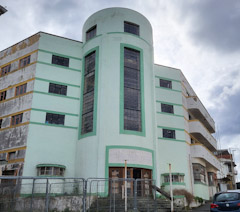
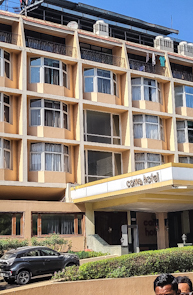
 In 1960, Rustom Cama, who was related to Bikhaji Cama,  opened his 26 room luxury Cama Hotel, close to the River Sabarmati in Ahmedabad. With a delightful garden, it was the city’s first hotel offering deluxe accommodation.


The hotel was one of the earliest projects of the renowned Indian architect Charles Correa (1930-2015). He designed the hotel in 1958-59. Not too far away from the hotel is the Memorial Museum at Gandhi’s Sabarmati Ashram in Ahmedabad.


I have read that  the  Cama Hotel has been modified over the years. So, although it is recognisable modernistic, some of what Correa designed has been changed. We visited the hotel, hoping to drink some coffee. Despite having placed the order, it never arrived, and we left thirsty. Nevertheless,  I was pleased to have entered a building designed by Correa. And I was fascinated by the fact that the hotel was established by a member of Madam Bhikaji Cama’s family.


I first became aware of Madam Cama when I was researching my book, “Indian Freedom Fighters in London (1905 – 1910), which is about some Indian revolutionaries, who were active several years before Gandhi came on the scene. [The book is available from Amazon: https://www.amazon.co.uk/INDIAN-FREEDOM-FIGHTERS-LONDON-1905-1910/dp/0244270716 ]


Revisiting an old hotel in Bombay’s Colaba district

ALMOST EXACTLY TWO years ago (in December 2023), we spent a few nights in the Moti International hotel in a street leading off Bombay’s bustling Colaba Causeway. Despite its impressive sounding name, this hotel was curiously interesting.

It is housed in Moti Mansion, a large house built by a Parsi family in about 1900.

Moti Mansion in November 2025

We had not booked the hotel in advance, but walked in to enquire whether we could stay fir a few nights. The young man at the small reception desk asked us:
“Are you married?”

We told him that we were and then he said:
“I have to ask you because, you see, my grandfather who lives with us on the top floors, is an old fashioned orthodox Hindu.”

Our ground floor room was adequate, air-conditioned,and had a decent attached bathroom. Sadly, the windows had been painted over. So there was no daylight. When we asked for a kettle, the young man explained:
“Yes, but I must charge you an extra 100 rupees for three days of electricity.”
We were happy with that.

On our last morning, we met the boy’s mother. She showed us the buildings impressive main wooden staircase. She explained that many of the rooms in the building were occupied by long-stay guests.

Today, 19 November 2025, we walked past Moti Mansion. Its street facing facade wast partly hidden by scaffolding and almost all the windows were covered over with wooden boarding.

I wonder what the future holds for this charming edifice.

Catastrophic usage of kettles in the Blue City

 WE ARE STAYING IN a charming guest house in the heart of the old part of  Jodhpur (the aptly named ‘Blue City’) in Rajasthan.  Our comfortable bedroom is supplied with an electric kettle, tea bags, and instant coffee sachets. However, unlike many places where we have stayed all over the world, there are no sachets of powdered milk.


One morning while enjoying breakfast on the roof, we chatted with Mr Munni, the owner of the guest house.  He told us that he was about to add other ‘goodies’ to the rooms, including toothbrushes, fruit, and snacks.

 When we asked him why there were no milk powder sachets, he told us the reason. Normally,  when making a hot beverage with milk powder, hot water is poured from the kettle into a cup  which already contains a teabag or coffee powder along with the milk powder.


But things can go wrong as Mr Munni has discovered. He has found that some of his Indian guests were putting water and the milk powder INTO the kettle, and then boiling this mixture.  This wrecks the kettle. He told us that since he opened the guest house a few years ago,  he has had to replace 50 kettles because of ignorance about the correct use of milk powder.


So, this is why Mr Munni no longer provides his guest rooms with powdered milk. On reflection, most Indians probably do not have electric kettles to make tea in their homes. When they make tea, they usually use a saucepan and boil the tea together with fresh milk and water.

PS we have stayed in many places in India, but this is the first time we have encountered this kind of kettle problem!

An Art Deco hotel in Ryde on the Isle of Wight

WE PARKED OUR CAR in Ryde on the Isle of Wight. I noticed that we had stopped outside a building that looked as if it had been transported from Marine Drive in Bombay to the Isle of Wight. Like many of the buildings that line Marine Drive, this one in Ryde is a beautiful example of the Art Deco architectural style, which became popular in the 1930s.

The former Royal York Hotel

The building in Ryde was constructed as the former Royal York Hotel. Completed in 1938, it was designed by JB Harrison and HP Gilkes.

When the hotel was opened, Ryde had become a popular destination for ’high society‘ holidaymakers. The then state-of-the-art hotel would have been in high demand. Partly because of the increasing ease of foreign travel, the hotel’s customers gradually decreased in number. So, in 2006, the hotel closed forever, and remained disused and looking dejected.

When we saw it in October 2023, there was scaffolding on the edifice and evidence that work was being carried out. I have read that there are plans to work on the building to create residential flats as well as a new hotel within it. Let us hope that this splendid example of Art Deco architecture will be preserved.

A grand hotel in Goa

OUR FIRST VISIT to Goa was in about 2007. We stayed at a state run hotel in Colva, a seaside place in South Goa. It was August and the middle of the monsoon season. Much of the time, there was rain and frequently the beach was inaccessible because if the furious waves and wind dashing against it.

One day, we were driven to Panjim North of Colva, and stopped for lunch in the city’s tall Mandovi Hotel. The food served in its grandiose dining room was good. However, what impressed me most was that the hotel, which was built as a luxury establishment when the Portuguese ruled Goa, was a perfectly preserved and well maintained example of an old-fashioned inter-war European grand hotel.

Because the hotel at Colva was, to put it mildly, very badly managed, we left it sooner than we had planned and spent a few days in the Mandovi. As far as I can recall, the hotel was both comfortable and well managed.

In 2018, we paid another visit to Panjim, and had a meal in its restaurant, which looked the same as it did in 2007. Sadly, the quality of the cooking and service had deteriorated.

The Mandovi Hotel was constructed on a plot that had belonged to a Noronha family. The seven storied building was ready to receive its first guests in December 1952, on the day that the Cardinal of Lisbon arrived in Goa. The hotel was where important Portuguese persons stayed. It was the best hotel in all of the territories ruled by Portugal. Stepping inside it was like taking a time trip back to the 1950s, if not before.

Behind the hotel, away from the riverfront, there is a domed Chapel attached to the hotel. This was built by the Noronhas family in 1827, and has been used ever since.

December 2022 found us back in Panjim. We walked over to the Mandovi Hotel and were horrified to find that its main entrance was padlocked closed and the place looked lifeless. A bystander told us that the hotel closed about 4 years ago because the two families who own it are fighting over it in a court of law.

I hope that the Mandovi Hotel will reopen and that it’s remarkable late Art Deco and Indo-Portuguese decorative features will be preserved. Even if it’s interior is modernised, which would be a pity, I hope that the terracotta coloured bas-reliefs on the hotel’s external wall will be saved.

Not my cup of tea

BEFORE REACHING MADEIRA, many people insisted that we should visit Reid’s Hotel in Funchal and to take afternoon tea there.

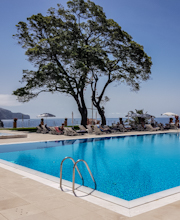
Pool at Reid’s Hotel in Madeira

Located in the western part of Funchal,  Reid’s was founded by William Reid, a Scotsman who arrived in Madeira in 1836. The hotel was his idea but he died before it was completed (in 1891). The massive seafront establishment was designed by George Somers Clarke and John Thomas Micklethwaite. It is not great architecture.

Since its opening, the hotel has hosted many famous guests including Winston Churchill,  Albert Schweitzer, George Bernard Shaw, and Rainer Maria Rilke. Apart from its celebrated guests, the establishment is famed for its afternoon teas. We decided against partaking of this treat because it contains far too many sugary confections. We had morning coffee and a pot of tea by the swimming pools on a terrace overlooking the ocean. By Funchal standards, it was costly (10 euros) but not outrageously so.

Undoubtedly, Reid’s is luxurious with good service. Its position overlooking a rocky cove is superb even though it is located in a part of Funchal, which resembles unexciting slightly upmarket seaside resorts on Italy’s Adriatic coast. However, the well-appointed hotel seemed somewhat sterile. If sun and sea is your top priority, then Reid’s is the place to go if you can afford it. However, it lacks the charm of other places in Funchal.

Well, we did visit Reid’s as people had suggested before we left London but I must say that it is not my ‘cup of tea’.

Marconi slept here

DURING A SHORT VISIT to Chelmsford in Essex, we noticed an old hotel The Saracens Head. Situated in the centre of the city – yes, Chelmsford is a city; it has a fine cathedral – it bears a commemorative plaque which states that the inventor of radio Guglielmo Marconi (1874-1937), founder of the Wireless Telegraph Company, stayed at the hotel between 1912 and 1928, when he made visits to his New Street factory in Chelmsford. Marconi made the city a place that was to change the world. It is hard to imagine how our world would be today without radio signals.

I wondered why he had chosen Chelmsford to site his factory. The only explanation I can find is that Marconi needed electricity for his factory and that Chelmsford had a good supply of it. In any case, his factory provided work for many (up to 6000) people in the city.

As for The Saracens Head hotel, I have not yet stayed there, which might be a good thing as it receives many poor reviews on Tripadvisor.

Prior to establishing his factory in Chelmsford, he lived in a terraced house near London’s Westbourne Grove, at number 71. He lived there between 1896 and 1897. That was 2 years after he had made the world’s first demonstration of radio transmission. He arrived in London from Italy in 1896 because few in his native land could see much of a future in what he had demonstrated.

Hotel Oslo

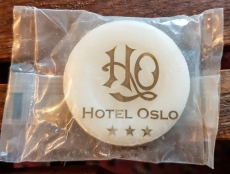
A BAR OF SOAP reminded me of our first visit to Portugal. I am looking at a small, round piece of soap sealed in a transparent package labelled “Hotel Oslo”, which we would never have acquired had I not been a victim of pick pocketers on a tram in Lisbon. We had only been in Portugal for about four hours when we took a ride on a picturesque old-fashioned tram (route 28) in the Portuguese capital. I was on the point of taking a picture of a sign that told passengers to beware of pick pocket thieves when I became one of their victims. Amongst the valuables that were stolen from me was my driving licence.

Losing the licence was a disaster as we were planning to hire a car to visit several country places in Portugal. Without the licence, the car hire company was unwilling and unable to lend me a vehicle, but it was good about refunding the money we had paid. We decided that we would attempt to carry out our plans using public transport.   

The first place on our itinerary was to have been a farmhouse in small rural place, whose name I do not remember, east of Coimbra. We travelled by train from Lisbon to Coimbra, which has two railway stations in the centre of the city. We discovered that there was a railway line from Coimbra to a spot near our planned destination. When I say “near”, it was really about half an hour’s taxi drive from where we were to stay. After lugging our baggage through the rain about 1000 yards from the station, where the Lisbon train arrived, to the other station from which we were about to depart, we ‘phoned the accommodation to which we were heading. They told us that they did not provide food, not even breakfast, and that the nearest restaurant was about half an hour’s drive from them. As we had no car and were planning to spend three days there, we began to worry how we would survive so far away from any supply of food.

Our next train was not due to depart for another two hours. I decided to walk back to the centre of Coimbra to see whether there was a hotel where we could stay instead of heading out into the ‘wild’. I rushed through the rain and found the Hotel Oslo, which had space for us and did not seem unreasonably priced. After reserving a room, I dashed back through the rain to the rest of the family, who were waiting on the platform. These were the days before we had more than one mobile ‘phone in the family, so I had to reach them to tell them about the Oslo instead of phoning them. Using our one ‘phone, we rang the rural accommodation and explained our plight. They were helpful in that they cancelled our booking gracefully and without cost.

Although not a de-luxe hotel, the Hotel Oslo was solidly built and extremely comfortable. It was located close to most of the sights in Coimbra, a place that had not been on our original itinerary. We spent four pleasant days in this delightful university city, and we were fortunate that, by chance, we were in the city at the time when the university students were starting a new academic year. By day and by night, we encountered groups of boisterous, happy students wandering about the city dressed in traditional  capes.

Had my driving licence not been stolen, I know that we would never have stayed in Coimbra and that we would have missed seeing one of the loveliest places that we have so far visited in Portugal.  As people say, every cloud has a silver lining. Although I was deprived of a lot of cash, I gained the pleasure of spending time in a wonderful place and witnessing some age-old traditions that added to our fondness of a country that we have grown to love.

The Hotel Oslo was, when we visited it, an old-fashioned style of hotel even though the 20th century building that housed it did not look archaic. Some years after staying there, we spent a couple of nights in the Hotel Mandovi in Panjim, Goa (India). This hotel had been built in 1952 by the Portuguese while they ruled Goa as a colony. It was built to coincide with the Pope’s visit to the Tenth Exposition of the relics of St Francis Xavier, which are kept in Goa. They are ceremoniously displayed once every ten years, subject to the discretion of the authorities who keep them in the Basilica of Bom Jesus in Old Goa. Although the Mandovi looks much older than the Oslo, they both have high standards of service and comfort that are old-fashioned in the best sense of the term. I am not sure whether we have kept any soap from the Mandovi as a souvenir, but you never know, one day we might find we have one lurking about somewhere in our home.

A hotbed of demoralisation and crime in north London

A WINDING LANE leads from Hampstead’s East Heath Road into the picturesque Vale of Health. I wrote about this isolated, small settlement surrounded by Hampstead Heath in the summer of 2017 (https://hampsteadadam.travellerspoint.com/2/) and have not revisited the place until today, the 2nd of January 2021. Little appears to have changed since then, but I have learnt a little more about the place.

As for its name, the place was not always as healthy as its name suggests. I wrote:

The land on which the Vale is situated is mentioned in the Domesday Book (1086 AD). It was then owned by the Abbots and monks of Westminster. By the 18th century this swampland in the middle of the part of the Heath, then known as part of ‘Gangmoor’, was inhabited by impoverished people and was malarial. In the 1770s, the area was known as ‘Hatches’ or ‘Hatchett’s’ Bottom, because Samuel Hatch, a harness-maker, had owned a cottage there before 1770. This unsavoury hollow was described in about 1817 as a “stagnate bottom, a pit in the heath” by the sculptor Joseph Nolleken’s wife (see: http://www.british-history.ac.uk/vch/middx/vol9/pp71-73). It was a vale, but not a healthy one.”

However, by 1801 when the land had been drained and property developers began building houses in the area, it gained the salubrious-sounding name by which it is known today.

Apart from the famous Indian artistic genius Rabindranath Tagore (1861-1941), who stayed in the Vale in 1912, the settlement was home to many other well-known people including the author Compton Mackenzie; the barrister Alfred Harmsworth; DH Lawrence; the philosopher Cyril Joad; and Stella Gibbons. Earlier notable residents included the law reformer Sir Samuel Romilly (1757-1818); the poet and essayist James Leigh Hunt (1784-1859), who entertained leading literary figures such as Hazlitt, Keats, Lord Byron and Shelley in his house in the Vale; the publisher Charles Knight (1791-1873); and, also, a Prince Eszterhazy.

During the 19th century, not only were the literati and wealthy attracted to the Vale but also it was a popular place for hoards of trippers, whose names never made it into the annals of history. The author of “The Northern Heights of London” published in 1869, William Howitt (1792-1879), describes these pleasure-seekers and what they did in some detail. He wrote that:

“This Vale of Health used, till of late years, to present a sight at once picturesque and pleasant. In front of a row of cottages, and under the shade of willows, were set out long tables for tea, where many hundreds, at a trifling cost, partook of a homely and exhilarating refreshment. There families could take their own tea and bread and butter, and have water boiled for them, and table accommodation found for them, for a few pence…”

And then, everything changed for the worse according to the puritanical-sounding Howitt:

“Recent times have seen Sunday dissipation reasserting itself, by the erection of a monster public house with a lofty tower and flag, to attract the attention of Sunday strollers on the Heath. Of all places, this raised its Tower of Babel in that formerly quiet and favourite spot, the Vale of Health … that taps and gin palaces on a Titan scale should be licensed, where people resort ostensibly for fresh air, relaxation, and exercise, is the certain mode of turning all such advantages into popular curses and converting the very bosom of nature into a hotbed of demoralisation and crime…”

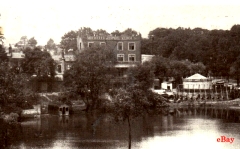
This demoniacal-sounding establishment is marked as ‘Suburban & Hampstead Heath Hotel’ on a map surveyed a year before Howitt’s book was published. On a map surveyed in 1912, it is marked simply as ‘Hotel’. Just a few houses away southwest of it, another building is marked ‘Hall’, to which I will refer shortly. According to both maps, the hotel stood where today there is a twentieth century block of flats called Spencer House. Opposite this edifice, there is a caravan park, which has been in the possession of the Abbotts family for over 160 years. Since the late 19th century, this patch of land has been fairground land. About ten members of the family live on the site in caravans, and other travelling fair workers can camp there free of charge. In exchange, members of the Abbott family, who operate travelling fairs, are allowed camp for nothing on other fairground owners’ sites when they travel around the country.

Returning to the building that upset Howitt, “A History of the County of Middlesex: Volume 9” (https://www.british-history.ac.uk/vch/middx/vol9/pp71-73) notes:

“… the Suburban hotel (also called the Vale of Health tavern) with towers and battlements and accommodation for 2,000 was built in 1863 …”

This source also notes another establishment, which was being built whilst Howitt was writing or just about to publish. This was the ‘Hampstead Heath Hotel’, which was built in 1868. This stood between two groups of ‘villas’, that is between 1-6 Heath Villas and 7-12 Heath Villas. It was the building marked as ‘Hall’ on the 1912 map. It is now occupied by a mid-twentieth century block of flats, smaller than Spencer House, named ‘Athenaeum’.

The Hampstead Heath Hotel closed in 1877, when it passed into the ownership of Henry Braun. His great grandson, Frances Francis wrote (www.francisfrith.com/uk/hampstead/vale-of-health-hotel_memory-7431):

“My great grandfather Henry Braun owned the Vale of Health Hotel … overlooking the lake, from 1877 until the early 1900’s. The hotel was used as an Anglo German club called the Athenaeum and by 1908 had 1200 members – 500 English, 700 German, including many political radicals. The hotel became a factory during World War I and then remained derelict for some years. The hotel was eventually pulled down in 1958, when I was 15 and I remember with sadness watching ‘luxury’ flats being erected in its place.”

The club closed in 1914 and then became used as a factory until it was demolished and replaced by the present building in 1958.

According to the County History to which I have already referred, The Athenaeum club’s larger neighbour, the hostelry that Howitt detested was:

“The large Vale of Health tavern, originally intended as a hotel and sanatorium, was sold in 1876, became associated with the fair, was let as flats, and c. 1900 became a hotel again on a smaller scale, with the upper rooms let as studios … Spencer House (flats) replaced the Vale of Health hotel in 1964.”

Howitt would have been even more dismayed to have learnt that there was a third hotel built in the Vale of Health in the 1880s. It stood next to the Athenaeum on the site now occupied by Byron Villas. It was at number 1 Byron Villas that the writer DH Lawrence lived in 1915.

Today, Howitt would most probably be happier with the Vale of Health than he was in 1869. The hotels have gone, and there is not even the tiniest of stalls where refreshments may be obtained. He might disapprove of the parked cars and the caravan site opposite Spencer House, but there would be hardly anything that he could find to decry.  By the edge of its large pond, one of the sources of the River Fleet, the Vale of Health remains a quiet oasis in the heart of north London.

Melting moments

IN THE EARLY 1990s, I was invited to a wedding in central Italy. Although I could have flown or driven to Italy, I decided to travel by train and ferry (the Channel Tunnel had not yet been opened for use). In my bachelor days, I was not a careful packer. I used to stuff my clothes and other belongings into a rucksack in a disorderly way. I was puzzled about what to do with my smart suit that I planned to wear at the marriage ceremony. I was concerned that it would become badly creased whilst stuffed in my rucksack. I consulted one of my female colleagues at the dental practice in Kent, where I was working at the time. She gave me some useful advice that did not include asking the hotel to iron it for me.

Photo by Pixabay on Pexels.com

On my way to Italy I stopped for a few days to visit some good friends who lived in Basel in Switzerland. They lived near to the terminus of a tram line that ran from the French Border, close to my friends’ flat, across the Swiss city to the German border. Although they no longer live in Basel, we now have other friends who live at the end of the same tram line, but close to the German border. Getting back to the early 1990s, I spent an enjoyable time in Basel. Before leaving, I bought an immoderate number of large bars of Swiss chocolate. My rather unhealthy plan was to take this chocolate to Italy and then after the wedding festivities were over, I would spend many happy hours eating obscene amounts of Swiss chocolate on the train while travelling back to the French coast. It seemed like a splendid plan at the time.

I arrived at the hotel in the Italian city where the wedding was to take place. As I was not yet trained to hang my clothes in wardrobes, I left my full rucksack on the floor for the duration of my stay.  Following my colleague’s advice, I extracted my creased jacket and trousers from my ruck sack, put them on hangers, and hung them in the room’s attached bathroom. Following the instructions I had been given in Kent, I turned on the hot water and closed the bathroom door so that the bathroom filled with steam from the hot water, and then I went out for some hours. On my return, the suit looked respectable enough to wear after its steaming.

The wedding festivities stretched enjoyably over three days. On each day, I attended meals in restaurants and the marriage ceremony in a municipal office. We all ate well and drunk fine Italian wines. As the saying goes, ‘a good time was had by all’.

At the end of my stay, I crammed everything into the rucksack lying on the floor of the hotel room, and then made my way to the city’s station. I boarded a train heading north through Italy towards Switzerland and then Paris, where I had to travel between the Gare de l’Est and the Gare du Nord, from where trains to Calais departed.

As my train headed across the plain of the River Po south of Milan, I began to feel the urge to make inroads into my stash of Swiss chocolate bars, which at that moment I treasured as if they were bars of gold. I opened my rucksack in which they had been stored while I was staying in the hotel in Italy, my heart sunk, and I was filled with gloom. No, they had not been stolen. Far worse, they were still there but completely and utterly inedible. Each bar of chocolate had melted and then re-solidified. However, when they had been in a molten state, they had been distorted in such a way that the silver foil in which they had been wrapped by the manufacturers had become intimately intermingled with the chocolate. After it had cooled down and solidified, all of my chocolates were welded to the silver foil in such a way that it was impossible to separate what was potentially edible from the inedible distorted strata of foil running through the chocolate. What had happened, you might well wonder. Well, there had not been a heatwave during my stay in the Italian city. What I had not realised when I was staying in the hotel was that my hotel room had under floor heating and it was this that had been warming my rucksack filled with chocolate that had been lying on the warm floor for several days.

Looking back on this after so many years, it was probably a good thing that I had not been able to consume a huge amount of chocolate all in one binge, but this is not what went through my mind at the time.