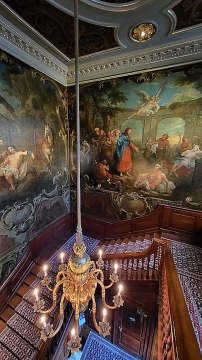
RECENTLY I WENT to a hospital, St Bartholomew’s (‘Barts’), which is near to London’s Smithfield meat market and the Barbican. I went there not because I was ill, but to view a magnificent artwork. It is in the hospital’s North Wing.
The walls of the main staircase in the North Wing are covered with huge paintings depicting scenes from stories in the Holy Bible. What makes them both attractive and interesting is that they were painted by the English artist William Hogarth (1697-1764). According to a website relating to this artwork (https://bartsnorthwing.org.uk/):
“Hogarth decorated the stair free of charge, allowing him to indulge his ambition, and giving the hospital a grand entrance to the Great Hall at no cost.”
Hogarth was a Governor of the hospital. The paintings that illustrate ‘The Pool of Bethesda’ and ‘The Good Samaritan’, were created in 1736–1737.
In 2025, the restoration of the paintings was completed, and the staircase was opened for public viewing at last – they had been hidden from public view for about 300 years. The stairs lead up to the spectacular, vast Great Hall (designed in 1732 by architect James Gibbs), which can also be visited.
And when you have admired the artwork and the Great Hall, head around the corner into Long Lane, and enjoy refreshments at Details, a charming café (near Barbican station) with interesting interior design.
IN THE 1980s, there was a shop that sold a variety of products imported from Communist Albania, which was then ruled by the Stalinist dictator Enver Hoxha and, after 1985, by his successor Ramiz Alia. I visited it once or twice. Although it had a few items of interest, it was quite expensive. The shop, which had closed by 1990, was in Betterton Street, which leads from Drury Lane to Endell Street, which is not far from the Seven Dials.
Yesterday (20th of June 2024), we walked along a part of Endell Street and then into Betterton Street, on our way to the Garden Cinema (in Parker Street). We watched a completely weird, arthouse film called “Daisies”, which was made in Communist Czechoslovakia in 1966. Despite being awarded a Czech film prize in 1966, it was banned by the censors in 1967.
Returning to Endell Street, we spotted three buildings of interest. The first of these is on the southeast corner of Endell Street and Shorts Gardens. It bears a commemorative plaque that reads:
“Zepherina Veitch (1836 -1894) Dame Rosalind Paget (1855 – 1948) Pioneering midwives trained at the British Lying-in Hospital, founded 1739 and sited here, 1849 – 1913.”
The tall Victorian building, to which this plaque is attached, is red brick with white stone facings. Between 1849 and 1913, this place housed a hospital for married women in the last month of pregnancy. A website concerned with former hospitals (https://ezitis.myzen.co.uk/britishlyingin.html) related:
“The staff consisted of two physicians and two surgeons who practiced midwifery, a Matron skilled in the same, a chaplain, an apothecary, nurses and ‘other inferior servants’. Women were admitted in the last month of their pregnancy – they were only permitted to stay for three weeks – and needed a letter of recommendation from a subscriber (patients were not charged by the Hospital) and an affidavit of their marriage and their husband’s settlement.”
Adjoining the former lying-in hospital, there is an edifice made with layers of bricks that vary in colour and white stone trimmings. It has Victorian gothic features, and its Endell Street facade bears an inscription, which reads:
“Lavers and Barraud Stained Glass Works”
This firm was founded in 1858 by Nathaniel Wood Lavers (1828–1911) and Francis Philip Barraud (1824–1900). When Barraud (of Huguenot descent) became dissatisfied with the firm’s designs, he was recommended to hire Nathaniel Westlake (1833-1921) as a designer. Westlake’s knowledge of mediaeval art and skills in the pre-Raphaelite style of art brought fame and fortune to the firm in the 1860s. In 1858. He became one of the firm’s partners, and in 1880, he became the firm’s sole owner.
A building on the corner of Betterton Street and Endell Street, across the road from the former stained glass works bears a plaque that informs the viewer that in this house, number 20 Endell Street, Westlake resided in the 1880s. His firm continued in business until his death.
So, today, neither the lying-in hospital nor the stained-glass works are still operating, and the Albanian shop has long gone. However, one place that would have been in business when those two places were functioning, is still in business: The Cross Keys Pub. Established in 1848, this pub has a baroque Victorian façade. The interior of this long narrow hostelry is most people’s idea of a real old-fashioned pub. A long bar with brass fittings runs along one side of the saloon, The walls are covered with numerous paintings and prints and several glass cases containing stuffed (taxidermy) fish. All manner of things, including a brass instrument and an archaic diver’s helmet, are suspended from the ceiling. Yet, despite this great amount of assorted ‘clutter’, the pub has a cosy atmosphere. When we dropped in for some mid-afternoon refreshment, there were a few other customers – mostly elderly local people. Although in the heart of the city, the pub has a rustic feeling about it. I suspect that workers and other staff from the stained-glass factory used to pop into the Cross Keys for liquid refreshment. But I wonder if many of those associated with the lying-in hospital -staff or patients – were patrons.
After dallying in Endell Street, we walked the short distance to the Garden Cinema in Parker Street to see the Czech film. If you have not been to this cinema, you are missing a treat – it is a truly independent, art-house cinema (see www.thegardencinema.co.uk).
I STUDIED AT University College London (‘UCL’) between 1970 and 1982. I was not there for so long because I kept failing examinations. Instead, I was a student there while I completed three different degree courses. Today (and during the years I attended UCL), the Students Union building is still located in a not particularly attractive building on the southwest corner of Gower Place and Gordon Street. Whereas it was a popular haunt of many of my fellow students, I hardly ever entered it except for a very brief period in the mid-1970s, when I was a PhD student in the Physiology Department.
During that short period, an Italian man opened a small restaurant on one of the floors of the Union building. His menu was limited to beautifully prepared beefsteaks that were accompanied by salad. This wonderful steak was priced no more than the often mediocre (or sometimes even poor) food that was available in the various subsidised student canteens in UCL. The reason for the Italian’s low priced, superb fare became obvious when after a few weeks, his eatery closed – or was closed. It turned out (so I was led to believe) that he was using the Union’s premises, but not paying the rent that he owed.
Winding the clock forward to the 26th of June 2023, we walked past the Union building, and I noticed something that I had never seen before. The building has a commemorative plaque that reads:
“This building housed the London School of Tropical Medicine and the Hospital for Tropical Diseases. 1920-1939.”
The plaque was placed by the Seamen’s Hospital Society, based in Greenwich. I do not know when the memorial was affixed to the Union, but I feel sure that it was not there when I was a student. It is interesting that what was once a hospital has become a centre for hospitality.
WHEN RUDYARD KIPLING (1865-1936) died in London’s Middlesex Hospital, his body was placed in the hospital’s chapel before being taken to be cremated at the Golders Green Crematorium, Charles Carrington wrote in his biography of Kipling that just as his coffin, draped with the Union Jack flag, arrived at the crematorium:
“… the followers of Saklatvala, the Indian Communist who had been cremated just before Rudyard Kipling, were singing the Red Flag.”
Kipling was not a sympathiser of Communist ideas and ideals.
Middlesex Hospital in the Fitzrovia area of London, where Kipling breathed his last, no longer exists. Founded in 1746, it provided medical care on a square plot of land bounded one one side by Mortimer Street between 1757 and 2005. In 2008, almost all of the hospital was demolished. The only part of the complex, which was preserved, is the Fitzrovia Chapel, in which Kipling’s body reposed briefly. Between 2012 and 2016, a new development, Fitzroy Place, consisting of flats and offices, was constructed on the hospital’s site.
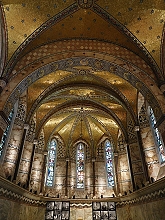
The small Fizrovia Chapel, beautifully restored, stands in a small garden in the middle of the new development, dwarfed by the buildings around it. This gem of a Victorian ecclesiastical construction was designed by the Gothic Revival architect John Loughborough Pearson (1817-1897) and was ready for use by 1892 (although the interior decoration was not fully completed until 1929). The chapel’s spectacular colourful interior must be seen to be believed. Its magnificent appearance is the result of skilful use of mosaic, marbles of different types and colours, and amazing decorative motifs inspired by early Italian, Byzantine, and Moorish architecture. Some of the metal lampshades that hang from the decorative ceiling seemed to have been influenced by the types of lamps typical of Turkish tradition.
The chapel is maintained by The Fitzrovia Chapel Foundation. It is open on most Wednesdays for public viewing as well as during the occasional exhibitions and concerts that are held within it. This charming place is also available for hire for weddings, fashion shoots, book launches, and other events.
Until we attended an exhibition in the Fitzrovia Chapel in late May 2022, we had no idea that this small architectural gem existed. Along with nearby All Saints in nearby Margaret Street, the Fitrovia, a treasure chest with its sparkling golden ceiling, should not be missed by lovers of Victorian architecture and/or fine mosaic work (as well as masterful use of inlaid stonework).
OF CRIMEAN WAR fame, Florence Nightingale (1820-1910) established a nursing school in what is now St Charles Hospital in North Kensington in 1884. In that time, the hospital near the northern end of Ladbroke Grove was called ‘the St Marylebone Union Infirmary’. It was so named because it was built to serve the poor of the parish of St Marylebone. It had to be put up outside the parish because there was no room available to build a hospital within it. This institution was opened in 1881 by the then Prince (future King Edward VII) and Princess of Wales. A very informative website, https://ezitis.myzen.co.uk, revealed that the hospital was:
“… three storeys high, with a central block and four pavilions. It had accommodation for 744 patients … and 86 resident staff (the Infirmary also had 82 non-resident staff).”
In 1923, the hospital was renamed the ‘St Marylebone Hospital’ and the next year, the then Minister of Health and future Prime Minister Neville Chamberlain (1869-1940) opened an extension, which had just been completed. By 1926, some wards had bedside wireless sets installed.
The hospital was given its current name when the London County Council took over its running in 1930. During WW2, wards on the top floors were closed, but the hospital suffered little damage from enemy bombing. After the war, St Charles served as a general hospital, but by 1998, there were very few beds for in-patients. Currently, the establishment is run by both the Central London Community Healthcare NHS Trust and the Central and North West London NHS Foundation Trust. Now, it is known as St Charles’ Centre for Health and Wellbeing. Most of its patient care is out-patient and since the development of vaccines against covid19, it is also a ‘vaccination hub’.
The original edifices were designed by Henry Saxon Snell (1831-1904). In grey weather, the late Victorian buildings of St Charles with their brickwork and neo-gothic decorative features present a somewhat gloomy or even ominous appearance. In bright sunlight, although they do not seem particularly welcoming, they have a certain charm. The website, http://www.british-history.ac.uk/survey-london/vol37, describes the architecture in more detail:
“The excellent plain brickwork, strong selfconfident design, and assured functional planning and detail make St. Charles Hospital a most significant building for its period. It occupies a rectangular site of three and a half acres near the north-west end of Ladbroke Grove … The buildings are planned on the pavilion principle, each block being, as far as compatible with facility of communication, isolated from the others. There are five parallel pavilions, the central administrative block being flanked on either side by two blocks of wards. The central block is surmounted by a massive tower, 182 feet in height, which forms a prominent landmark when viewed from the north and west. The chimney-shaft from the boilers below is carried up inside this tower, the upper part of which has a corbelled stage derived from northern Italian work of the Middle Ages. The tower contains a number of large tanks, providing storage for 25,000 gallons of water pumped from a well 500 feet in depth … The pavilions on either side of the tower are linked to each other by cast-iron galleries and canopied walks. A block of buildings situated at the entrance contained the residences of the medical officers, and over the spacious arched gateway in the centre there was a chapel 60 feet long by 30 feet wide, with a boarded wagon-roof of trefoil section. In a report on the infirmary written by Snell, he described the elaborate systems of heating and ventilation. Open fires heated coils of pipes containing water which then circulated, humidity also being contrived so that air would not be dried, a great advance for the time. The lighting was by gas, and fumes were carefully vented away. This ‘Thermhydric’ system, patented by the architect, included upright flues in the external walls, inlets being provided for fresh air which was warmed as it entered, and air was also admitted directly through the walls into skirtingboxes between the beds, while flues carried off the foul air and the products of gas combustion.”
Although it was clearly an advanced building for its time and it is not far from the much-visited Portobello Road, this hospital is unlikely to be on many visitors’ itineraries. However, lovers of Victorian architecture might enjoy seeing it even if they had no clinical requirement to do so.
MOST OF SOUTHEND in Essex was built after the Victorian era. The town on the estuary of the River Thames was and still is the nearest seaside resort to London. According to “Encyclopaedia Britannica”, Southend:
“…became fashionable as a seaside resort when visited by Princess Charlotte of Wales in 1801 and by her mother, Princess Caroline (wife of George IV), in 1803.”
Originally, Prittlewell, once a village north of Southend but now one of its suburbs, was the only settlement in the area now occupied by the modern town of Southend. South east of it on the coast was a tiny village called Leigh, which is now the much larger Leigh-on-Sea. The resort now known as Southend-on-Sea was developed at the end of the 18th century in Prittlewell’s southern district of South End. Today, more than seven miles of buildings extend from Leigh-on-Sea through Southend to Shoeburyness.
The High Street, part of a road heading south from Prittlewell, runs from near Southend Victoria Station towards the sea, ending at the edge of a steep slope that falls to the seashore below. Various roads and a lift can be used to descend this incline. At the top of the slope, the High Street meets the eastern end of Royal Terrace. At the corner where these two streets meet, stands the Royal Hotel. Next to the hotel and lining Royal terrace, numbers 1 to 15 were built in the 1790s at the same time as the hotel. These were backed by the Royal Mews, a road still in existence. These constructions were part of a then new phase of development of the town, which was known as ‘New Town’.
The hotel, a fine Georgian edifice, opened with a grand ball in 1793. Princess Caroline House that adjoins the hotel. number 1 the High Street, is a listed building, which looks as if it is contemporary with the hotel. The gardens on the slope in front of the hotel and the Terrace are known as The Shrubbery and were originally for the exclusive use of residents in the Terrace, but now they are open to the public. According to www.southend.gov.uk/historic-southend/history-southend/2:
“The Terrace was named “Royal” following visits by Princess Caroline, wife of the Prince Regent, in 1803 and for a short time attracted fashionable society. But difficult access from London by road and river discouraged further development until the construction of the railway in 1856. Royal Terrace is the only surviving Georgian terrace in Southend.”
Just east of the High Street and dominating the shoreline is the massive Park Inn Palace hotel, formerly the The Metropole. Built in 1901, this hotel that looks like an oversized liner had 200 rooms, a billiard room, and a splendid ballroom. During WW1, it was temporarily used as a Royal Naval Hospital. An online article (http://beyondthepoint.co.uk/first-world-war-southend-the-palace-hotel/) related:
“The Palace Hotel was built in 1901 and served great use in the war effort. Messrs Tolhurst; the owners of the hotel, were generous enough to offer the building up for free as a naval hospital for the rest of the war. Its glorious five star interior would’ve been quite bizarre with hospital beds placed amongst its lounges and ballrooms. It held possibly the world’s first purpose-made x-ray department. It recently underwent refurbishment by Park Inn to bring it back to its former glory.”
Both hotels overlook both the sea and Southend Pier. The older, Royal Hotel, is less of a blot on the landscape than the Palace hotel.
WE JOINED A SMALL queue at the vaccination centre, or “hub” as it calls itself, early one sunny but cool morning. All of us were waiting to receive our covid 19 booster vaccine, six months having elapsed since receiving the second of our first two ‘jabs’. Eventually, we were invited into the local hospital, in which the hub is located.
I was directed to a cubicle where a lady, a volunteer vaccinator, was seated. After having been asked some preliminary medical questions and given some advice about possible aftereffects of the vaccine, she said to me, having already noted my name:
“Are you South African?”
“My parents were,” I replied.
“I know a Craig Yamey,” she said.
“He is a relative of mine.”
Then, she said:
“I knew an old gentleman, a Mr Yamey married to a Greek lady.”
“He was my father,” I replied, adding: “How do you know him”
It turned out that the lady’s mother lives next door to where my father lived for the last 27 years of his long life.
Having established that and just before giving me the injection, quite painlessly I should add, she said:
“In that case, I must take very special care of you.”
The world can seem remarkably small, don’t you think?
BROTHER PETER IS one of six retired ex-servicemen who reside at The Lord Leycester Hospital, one of the oldest buildings in the town of Warwick apart from its famous, much-visited castle. He explained to us that the word ‘hospital’ in the name refers not to what we know as a medical establishment but to a place providing hospitality. The men, who reside in the Hospital are known as the ‘Brethren’.
The Hospital is contained in an attractive complex of half-timbered buildings that were erected next to Warwick’s still standing Westgate in the late 14th century. They are almost the only structures to have survived the Great Fire of Warwick that destroyed most of the town in September 1694. The buildings and the adjoining chapel that perches on top of the mediaeval Westgate were initially used by the guilds of Warwick, which played a major role in administering the town and its commercial activity. The ensemble of edifices includes the mediaeval Guildhall in which members of the guilds carried out their business. Between 1548 and 1554, it was used as a grammar school.
In 1571, Queen Elizabeth I’s favourite, Robert Dudley, Earl of Leicester (1532-1588), who lived in nearby Kenilworth Castle, was asked by the queen to clear the streets of Warwick of ailing, infirm, and disabled soldiers, by establishing a refuge (i.e., ‘hospital’) to shelter them. It is said that Dudley persuaded the town’s officials to give him their Guildhall to be used for this purpose. This ended the guilds’ use of the complex of mediaeval buildings, now known as Lord Leycester’s Hospital.
Initially, Dudley’s hospital provided accommodation for The Master, a clergyman, and twelve Brethren, poor and/or wounded soldiers, and their wives. According to the excellent guidebook I bought, the original rules of the hospital include the following:
“That no Brother take any woman to serve or tend upon him in his chamber without special licence of the Master, nor any with licence, under the age of three-score years except she be his wife, mother, or daughter.”
To accommodate them, modifications of the interiors of the buildings had to be made. Brother Peter, with whom we chatted, is one of the current Brethren. He introduced us to another of his fraternity, a young man with a scarred head, who had survived an explosion whilst serving in Afghanistan.
Dudley’s arrangement survived until the early 1960s, when the number of Brethren was reduced to eight. By this time, the Master was no longer recruited from the clergy but from the retired officers of the Armed Forces. What is unchanged since Dudley’s time is his requirement, established in an Act of Parliament (1572), that the Brethren must attend prayers in the chapel every morning. They recite the very same words chosen by Dudley when he established the hospital.
We did not have sufficient time to take a tour of the buildings that comprise the hospital, but we did manage to enter The Great Hall, which now serves as a refreshment area for visitors. This large room has a magnificent 14th century beamed timber ceiling made of Spanish chestnut. It was here that King James I was entertained and dined in 1617, an event lasting three days. We were also able to catch a glimpse of the Mediaeval Courtyard, which is:
The Lord Leycester Hospital is less well-known than the nearby Warwick Castle, which has become something of a costly ‘theme park’. However, the hospital is a far more interesting place to visit, However, you will need to go there before the 23rd of December 2021, when it will be closed for restoration for quite a lengthy period.
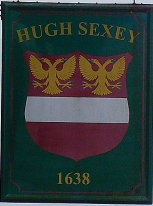
THE RIVER BRUE flows through the Somerset town of Bruton. In the Domesday Book (1086), its name was recorded as ‘Briuuetone’, which is derived from Old English words meaning ‘vigorously flowing river’. In brief, this small town is picturesque and filled with buildings of historical interest: a church; several long-established schools; municipal edifices; an alms-house; shops; and residences. On a recent visit, we drove past a Tudor building that was adorned with a crest labelled “Hugh Sexey” and the date “1638”. At first, I thought it was a sort of joke, rather like ‘Sexy Fish’, the name of a restaurant in London’s Berkeley Square. I walked back to the building after parking the car.
I looked at the sign, and my curiosity was immediately aroused. The crest bears a pair of eagles with two heads each, double-headed eagles (‘DHE’). Now, as some of my readers might already know, the DHE is a symbol that has fascinated me for a long time. This bird with two heads has been used as an emblem by the Seljuk Turks, the Byzantine and Holy Roman Empires, Russia (before and after Communism), the Indian state of Karnataka, Serbia, Montenegro, Albania, and some people in pre-Columbian America, to name but a few. In the UK, several families employ this creature on their coats-of-arms. These include the Godolphin, the Killigrew, and the Hoare families, to name but a few. Each of these three families has connections with the county Cornwall, which, through Richard, Earl of Cornwall (1209-1272) and King of the Germans, had a strong connection with the Holy Roman Empire, whose symbol was the DHE. Until I arrived outside the building in Bruton, Sexey’s Hospital, I had no idea about the existence of the Sexey family nor its association with the DHE.
Sir Hugh Sexey (c1540 or 1556-1619) was born near Bruton. He became royal auditor of the Exchequer to Queen Elizabeth I and later King James I, and amassed a great fortune. After his death, much of his wealth was used for charitable purposes in and around Bruton. Two institutions that resulted from his money and still exist today are Sexey’s Hospital, outside of which I first spotted the crest with two DHEs and Sexey’s School (www.sexeys.somerset.sch.uk/about-us/the-sexeys-story/). The school, which is now housed in premises separate from the hospital (now an old age home), was first housed in the same premises as the hospital.
According to the school’s website:
“…a two headed spread eagle is taken from the seal used by Hugh Sexey later in his life which can be seen on his memorial on Sexey’s Hospital …”
The article then considers the DHE (‘spread eagle’) as follows:
“Traditionally the spread eagle was considered a symbol of perspicacity, courage, strength and even immortality in heraldry. Prior to notions of medieval heraldry, in Ancient Rome the symbol became synonymous with power and strength after being introduced as the heraldic animal by Consul Gaius Marius in 102BC (subsequently being used as the symbol of the Legion), whilst it has been used widely in mythology and ancient religion. In Greek civilisation it was linked to the God Zeus, by the Romans with Jupiter and by Germanic tribes with Odin. In Judeo-Christian scripture Isa (40:31) used it to symbolise those who hope in God and it is widely used in Christian art to symbolise St John the Evangelist. An heraldic eagle with its wings spread also denotes that its bearer is considered a protector of others. Sexey’s seal and crest may have included the spread eagle to symbolise the family’s Germanic heritage.”
Some of this is in accordance with what I have read before, but I need to cross-check much of the rest of it, especially the Greek and Roman aspects. The final sentence relating to Germanic heritage seems quite sound, as the DHE was an important symbol in the Holy Roman Empire.
There is a sculpted stone bust of Sir Hugh Sexey in the courtyard of his hospital (really, almshouses), which was built in the 1630s. This portrait was put in its position in the 17th century long after his death. Above the bust, there is a carved stone crest bearing two DHEs, which was created by William Stanton (1639-1705) from London. According to the Oxford Dictionary of National Biography (‘DNB’):
“ Later in the seventeenth century a stone bust of Sexey, together with a coat of arms (that of the Saxey family of Bristol, with which he had no known connection), was placed over the entrance hall…”
The plot thickens as I now wonder whether the DHEs are related to the Sexey family or that of the above-mentioned Saxey family. A quick search of the Internet for the coats-of-arms of both the Sexey and the Saxey families revealed no DHEs except on crests relating to Bruton’s two Sexey foundations.
One family that was involved in the history of Bruton and whose crest bears the DHE is Hoare. They took over the ownership of the manor from the Berkely family in 1776. This is long after Hugh Sexey died and is therefore unlikely to be the reason that William Stanton included the DHEs on the crest above Sir Hugh’s bust. So, as yet, I cannot discover the history of the DHEs that appear all over Sir Hugh’s hospital and neither can I relate them to any other British family that uses this heraldic symbol. But none of this should mar your enjoyment of the charming town of Bruton.
SIXTY-NINE YEARS ago on the 8th of May 1952, a lecturer in economics at the London School of Economics was sitting anxiously in the ante-chamber of an operating theatre in the Royal Free Hospital, which was at that time in London’s Grays Inn Road. It is now part of the Eastman Dental Hospital, the post-graduate dental school of University College London, where I have attended courses.
The lecturer looked up from what he was trying to read to distract himself when the gloved surgeon came out of the operating theatre, and talking to himself, but loud enough to be heard, said:
“Shall I use the Simpsons or the Kiellands?”
He was referring to forceps used to deliver babies. My father, who thought that the question had been addressed to him, replied:
“I am sorry I can’t help you with that. I am only an economist.”
The surgeon gave him a withering look, and returned to the operating theatre, where the economist’s wife was lying, deeply anaesthetised. In the end, the surgeon decided to deliver the baby with a Caesarian section.
That baby was me. The economist was my father. That I am writing this today is at the very least a minor miracle, as I will explain.
Back in the early 1950s, one did not argue with medical practitioners; they always knew best. My mother had informed her physician when I had been conceived, but he did not believe what she had said. I can imagine the doctor thinking: “what would she know? Only a woman.” So, when my mother did not give birth when she expected, at about nine months after conception, the doctor told her to be patient as he thought she had another month to go
After I had been ‘in utero’ for ten months, my mother began getting worryingly ill. Eventually, those who claimed to know best admitted her to hospital and I was delivered. Both my mother and me had developed symptoms of toxaemia. It was touch and go as to whether we would both survive, but we did.
Because I had been inside the womb for a month longer than I should have, I was born with several problems. One of these was a cerebral haematoma, which I hope has resolved itself by now. Years later, my mother told the school that I should not play rugby for fear of disturbing this. The other thing was that my neck was bent over to one side; I had a torticollis. The medics told my mother that it was incurable and that she should get used to the idea that I would just have to live with the distortion.
If I am not misrepresenting my late mother, I am certain that she would not have been happy living with a distorted child. She was a sculptor and decided that the doctors were wrong about being certain that my neck condition was incurable. Every day, she stretched my neck gently and gradually it began to grow in the normal way. I am incredibly grateful that she did this.
Getting back to my first days on earth, I had to spend the first fortnight in an incubator. In those far-off days, visiting babies in incubators was limited if it was allowed at all. My mother was exhausted after the traumatic birth and, given that she would not have been able to see me much whilst I was in the incubator, she and my father took a holiday in Cornwall. I only learnt about this a few years ago, Had I known about it when I was younger, who knows but I might have had a rejection complex. My behaviour might be considered unusual at times, but I feel it would be unfair to blame that on my spell in the incubator in London while my parents relaxed in Cornwall.
Well, there you have it: the story of the first few days of my life. Of course, I cannot remember any of it, but what I have told you was related to me by people who were around at the time.






 yamey
yamey 