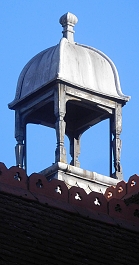
GROVE PLACE IS a short street running southwest from Hampstead’s steeply inclined Christchurch Hill. We often walk along it on our way to the lovely café at nearby Burgh House. A building containing numbers 29-31 Grove Place has often attracted my attention because its roof is topped with a couple of cupolas, each supported by four carved wooden pillars. These stand on either side of a grand central façade. The edifice bears a plaque, which is in an excellent state of preservation, that reads:
“This stone was laid by Mrs Sarah A Gotto on the 13th of July 1886 being the 50th Yr of the reign of her majesty Queen Victoria”
Elsewhere on the wall facing Grove Place there is a metal shield, painted black, which bears the following:
“1871. SPPM”
I was a bit puzzled by this because 1871 was some years before the stone was laid by Mrs Gotto.
I was pleased to discover that this building has been described in a book I possess, “The Streets of Hampstead” by Christopher Wade. He revealed that it was converted in 1970 from Bickersteth Hall, a hall built for the nearby Christ Church in 1895, and named after a former vicar, who later became the Bishop of Exeter. This gentleman was Edward Bickersteth (1825-1906), who had been vicar of Christ Church in Hampstead from 1855 to 1885 (www.praise.org.uk/hymnauthor/bickersteth-edward-henry/). Wade adds that it is confusing that the 1871 St Pancras shield and the 1886 Mrs Gotto plaque have been placed on the building. So, it seems that Mrs Gotto might have had little to do with laying the first brick of the building, but I wondered who she was.
Wade describes Sarah Gotto as Mrs Edward Gotto. Edward was most probably Edward Gotto (1822-1897), a civil engineer and architect who entered a partnership with Frederick Beesley in 1860 to create the engineering firm of Gotto and Beesley, which flourished for 30 years and carried out drainage works in towns all over the world including Rio de Janeiro, Seaford, Trowbridge, Evesham, Huyton and Roby, Redditch, Brentford and Cheshunt; and the drainage and water-supply of Campos (Brazil), Oswestry, Leominster and Cinderford (www.gracesguide.co.uk/Edward_Gotto). According to his obituary, Mr Gotto lived in Hampstead in a house called The Logs on East Heath Road. Built in 1868, The Logs, was as I have described elsewhere (see https://adam-yamey-writes.com/2021/02/01/finding-boy-george-and-bliss-in-north-london/), much later home to the comedian Marty Feldman and the singer Boy George. Edward’s wife Sarah was born Sarah Ann Porter (1829-1901; https://ancestors.familysearch.org/en/L1Q6-7NL/major-harold-ralph-gotto-1868-1957), She and Edward had eight children, one of whom was Harold Ralph Gotto. He was born in 1868 in Hampstead and later became a major in the British Army.
All of this is interesting enough, but none of it explains (to me) why Sarah is commemorated by the plaque on the house in Grove Place. If anyone knows the reason, I would be pleased to hear from them.
HAMPSTEAD IN NORTH London is full of interesting nooks and crannies.
At the west end of Well Walk in Hampstead, near the lower end of Flask Walk, there is a corner building with a Georgian shop front. It is now a small theatre but was once the Well Walk Pottery, which occupied this place for many years. The pottery was started by the potter Christopher Magarshack in 1959. According to Bohm and Norrie, writing in their “Hampstead: London Hill Town”, published in 1980, Elsie, the widow of the Russian Jewish translator and writer David Magarshack (1899-1977), lived there. She bought this corner building, which had formerly been Sidney Spall’s grocery shop in 1957, for Christopher to use as his pottery. His father, David, left his birthplace Riga, then in Russia in 1918 and later lived above the shop. Elsie died in 1999, aged 100. In addition to selling pottery there, the pottery also held classes for ceramicists, some of whom now have good reputations. David’s daughter Stella, a fine artist, was the Head Art Teacher at King Alfred’s, a ‘progressive’ school situated between Hampstead and Golders Green. In 2016, aged 87, she was brutally attacked in the street close to her home. Now, the premises is to be home to a theatrical enterprise, The Wells Theatre. Its present owners have decorated one of its windows has been decorated with a pictorial history of the premises.
Before returning uphill along Flask Walk towards the pub, you will pass a pair of doors covered in metal studs arranged neatly in geometric patterns. According to an article in the January 2018 issue of “Heath and Hampstead Society Newsletter”, this pair of studded doors:
PLATTS LANE WINDS its way between London’s Finchley Road and West Heath Road in Hampstead. It follows the route of a track between Hampstead Heath and West End (now West Hampstead). This track was already in existence by the mid-18th century. According to a historian of Hampstead, Christopher Wade, the thoroughfare was first called Duval’s Lane to commemorate a 17th century French highwayman. Louis (alias Lodewick alias Claude) Duval (alias Brown) who was, according to another historian, Thomas Barratt, famed for being gallant towards his victims, many of whom he robbed on Hampstead Heath. Barratt related:
“It used to be told that, after stopping a coach and robbing the passengers at the point of the pistol on the top of the Hill, he would, having bound the gentlemen of the party, invite the ladies to a minuet on the greensward in the moonlight.”
Duval was hung at Tyburn soon after 1669.
Over time this track’s name became corrupted to Devil’s Lane. A pious local resident, Thomas Pell Platt (1798-1852), probably put an end to that name after he had built his home, Childs Hill House, nearby in about 1840.
Platt graduated at Trinity College in Cambridge in 1820 and became a Major Fellow of his college in 1823. While at Cambridge, he became associated with the British and Foreign Bible Society and was its librarian for a few years. He was also an early member of The Royal Asiatic Society (founded 1823) as well as a member of The Society of Antiquaries of London. In 1823, he prepared a catalogue of the Ethiopian manuscripts in a library in Paris. In addition, he did much work with biblical manuscripts written in the Amharic and Syriac languages. Apart from being a scholar, he was an intensely religious man. He died not in Hampstead but in Dulwich.
Platt lived near the lane named after him for quite a few years. The same cannot be said for a later resident of Platts Lane, Tomas Garrigue Masaryk (1850-1937), who was born in Moravia (now a part of the Czech Republic). Masaryk added the name Garrigue to his own when he married the American born Charlotte Garrigue (1850-1923) in 1878. A politician serving in the Young Czech Party between 1891 and 1893, he founded the Czech Realist Party in 1900. At the outbreak of WW1, he decided that it would best if the Czechs and Slovaks campaigned for independence from the Austro-Hungarian empire. He went into exile in December 1914, staying in various places before settling in London, where he became one of the first staff members of London University’s School of Slavonic and East European Studies, then later a professor of Slavic Research at Kings College London.
In London, Masaryk first lived in a boarding house at number 4 Holford Road in Hampstead (http://tg-masaryk.cz/mapa/index.jsp?id=285&misto=Pobyt-T.-G.-Masaryka-1915-1916). In June 1916, he moved from there to number 21 Platts Lane, which was near to the former Westfield College where his daughter Olga was studying. The house, the whole of which he rented, became a meeting place for the Czechoslovak resistance movement in England. Masaryk stayed in Platts Lane until he departed for Russia in May 1917. It is possible that he returned there briefly when he made a visit to London in late 1918. On the 14th of September 1950, the Czechoslovak community affixed a metal plaque to the three-storey brick house on Platts Lane, which was built in the late 1880s. It reads:
“Here lived and worked during 1914-1918 war TG Masaryk president liberator of Czechoslovakia. Erected by Czechoslovak colony 14.9.1950”
Actually, Masaryk only used the house between 1916 and 1917. The year that the plaque was placed was a century after Masaryk’s birth year. The day chosen, the 14th of September, was that on which he died in 1937.
Not too far away from Masaryk’s Hampstead home, there is a place on West End Lane that used to be called The Czechoslovak Club before it became the Czechoslovak Restaurant and currently Bohemia House. Here you can see a portrait of Masaryk and enjoy yourself sampling Czech beers and food. The establishment is within the Czechoslovak National House, which was founded as a club in 1946.
The houses where Czechoslovakia’s freedom fighter lived in London still stand in Hampstead. However, that is no longer the case for another freedom fighter and founder of a new nation, who lived near Platts lane on West Heath Road, the wealthy barrister and founder of Pakistan, Muhammad Ali Jinnah (1876-1948). In the 1930s, Jinnah practised law in London. One of his biographers, Hector Bolitho (1897-1975) wrote (in 1954):
“One day in June 1931, when Jinnah was walking in Hampstead, he paused before West Heath House, in West Heath Road. It was a three-storied villa, built in the confused style of the 1880s, with many rooms and gables, and a tall tower which gave a splendid view over the surrounding country. There was a lodge, a drive, and eight acres of garden and pasture, leading down to Childs Hill.
All are gone now, and twelve smaller, modern houses occupy the once-pretty Victorian pleasance. Nearby lives Lady Graham Wood, from whom Jinnah bought the house; and she remembers him, on the day when he first called, as “most charming, a great gentleman, most courteous…
… In September 1931 Jinnah took possession of West Heath House, and he assumed the pattérn of life that suited him. In place of Bombay, with the angers of his inheritance for ever pressing upon him, he was able to enjoy the precise, ordained habits of a London house. He breakfasted punctually and, at nine o’clock, Bradbury was at the door with the car, to drive him to his chambers in King’s Bench Walk. There he built up his new career, with less fire of words, and calmer address, than during the early days in Bombay.”
It was at West Heath House that Jinnah entertained Liaquat Ali Khan (1895-1951), another of Pakistan’s founding fathers and its first Prime Minister, who had arrived from India. Bolitho wrote:
“A great part of the fortunes of Pakistan were decided оn the day, in July 1933, when Liaquat Ali Khan crossed Hampstead Heath, to talk to his exiled leader.”
Bolitho recorded that Liaquat’s wife recalled the occasion:
“Jinnah suddenly said, ‘Well, come to dinner on Friday.’ Sо we drove to Hampstead. Іt was a lovely evening. And his big house, with trees—apple trees, I seem to remember. And Miss Jinnah, attending to all his comforts. I felt that nothing could move him out of that security. After dinner, Liaquat repeated his plea, that the Muslims wanted Jinnah and needed him.”
At the end of the evening, Jinnah said to Liaquat:
“’You go back and survey the situation; test the feelings of all parts of the country. I trust your judgment. If you say “Come back,” I’ll give up my life here and return.’”
Jinnah returned to India in 1934, and Pakistan was created in August 1947.
Judging by Bolitho’s description, Jinnah’s Hampstead house could not have been very far from the house which Masaryk rented in Platts Lane, which, like Jinnah’s garden, is close to, or more accurately on, Childs Hill. I have found Jinnah’s house marked on a map surveyed in the 1890s. It was located on the west side of the northern part of West Heath Road, about 430 yards north of Masaryk’s residence on Platts Lane.
It might come as much of a surprise as it was to me to learn that the founders of two countries, each of which was founded soon after the ending of World Wars, both lived in Hampstead for brief periods in their lives.
THE COUNTY OF Essex is traversed by numerous rivers (http://essexrivershub.org.uk/), one of which is the Crouch. This lies south of the Blackwater and north of the Thames. The small town of Burnham-on-Crouch with its picturesque river front and much-favoured by yacht owners lies on the north bank of the estuary of the Crouch, about five miles from the North Sea. So near London, the town feels so far away from the metropolis – another world. Once home to several boat-building yards and various factories, Burnham appears to have become a centre for leisure activities. If you are staying in the town and have had your fill of pubs, cafés, and bistros, there is also a small cinema that shows the latest films.
The Rio cinema, despite its name, is not on the river front, but not far from it. Its decorative façade and foyer are backed by a shed like building with a corrugated iron roof, which contains the auditorium and screen, which I was not able to enter as we visited Burnham one early morning. The cinema has a long history (http://burnhamrio.co.uk/history.php), which I will summarise.
Burnham’s first cinema, The Electric, opened in 1910, making Burnham-on-Crouch one of the first towns in England to have a cinema. In 1931, this ran into problems when a rival, a purpose-built cinema, The Princess, was opened. The Electric closed and the larger Princess thrived. In the late 1960s, its name was changed to its present one, The Rio.
Burnham-on-Crouch is one of the towns and villages in the Dengie Peninsula, which until quite recently was a relatively impoverished part of Essex. During The Great Depression when money was scarce and people lived literally ‘from hand to mouth’, they had little or no money to buy cinema tickets. In those difficult times, the cinema was prepared to accept goods instead of money for tickets. The history relates:
“A Jam Jar would get you admission for the Saturday morning picture shows. Something as uncommon as an orange would admit a whole family midweek…”
Things have changed in the Dengie Peninsula. Today, many of its inhabitants and visitors are:
“… fat merchant bankers, Hooray Henrys, Minor Celebs and eastern Europe nouveau rich.”
The Rio was one of the last cinemas in England to have a gas-powered emergency lighting system. Reading this reminded me of my visits to The Everyman Cinema in Hampstead during the 1960s. I saw many films there. My enduring memory of the auditorium was that it always smelled of leaking gas. I now wonder whether The Everyman, like The Rio, also had a gas-powered backup lighting system.
The Rio in Burnham has survived two of its rivals, The Flicks in nearby South Woodham Ferrers and The Empire in Maldon, also not far away. The latter, which was housed in an Art Deco building, has sadly been demolished. The Rio’s website makes it clear that the 280 seat cinema is not in the Art Deco style. I am not quite sure which architectural style, if any, can lay claim to it. However, next time we visit Burnham, we will make sure that we watch a screening at the long-lived Rio.
ONCE LONDON’S HAMPSTEAD had two pubs or taverns named ‘The Flask’. This should not come as a great surprise as Flask used to be a common name given to pubs. One of them, The Upper Flask, used to be located at the top (northern) end of East Heath Road and the other, The Lower Flask’ was (and still is) on Flask Walk, a street leading off Hampstead High Street.
The Upper Flask used to be a remarkable establishment. Once called ‘The Upper Bowling Green House’ because of its good bowling green, it was a meeting place favoured by fashionable and ‘cultured’ men (mainly) and women during the 18th century. It was a summer meeting place for The Kit Kat Club, which thrived in the early 18th century and whose members included literary figures and political personalities, who supported the Whig Party. The Upper Flask figures several times in “Clarissa”, a lengthy novel by Samuel Richardson (1689-1761), first published in 1747. The place ceased operating as a hospitality business in the 1750s, when it became a private residence (www.british-history.ac.uk/vch/middx/vol9/pp81-91). In 1921, it was demolished to clear the site for building the Queen Mary Maternity Hospital (https://ezitis.myzen.co.uk/queenmaryhampstead.html), which has since become the site of a luxury housing complex.
The Lower Flask (in Flask Walk) is also mentioned in “Clarissa”, but unflatteringly as:
“… a place where second-rate persons are to be found often in a swinish condition,” (quoted from “Old and New London”, by Edward Walford, about 1880).
Unlike the lost Upper Flask, the formerly named Lower Flask is still in business, but much has changed since Richardson published his novel.
Located at the eastern end of the pedestrianised stretch of Flask Walk, the former Lower Flask, renamed The Flask, was rebuilt in 1874 (and extended in 1990; https://historicengland.org.uk/listing/the-list/list-entry/1322190). Formerly, it had been a thatched building and was a place where mineral water from Hampstead’s chalybeate springs was sold. It and Keith Fawkes’ second-hand bookshop are the only things in Flask Walk, which were in existence when I used to visit Hampstead regularly in the 1960s and 1970s. In those, now far-off, days, I remember that there used to be another second-hand bookshop and a butcher, both on the south side of the passageway. Before the 20th century, there used to be a fair held for a few days in August on the triangular open space a few yards downhill from The Flask pub. Close to The Flask, also on Flask Walk, miscreants could be found languishing in the parish stocks. Both the stocks and the fair are now but long distant memories recorded only in books published many decades ago.
Oddly, despite visiting Hampstead literally thousands of times during the last more than 65 years, it was only on Halloween 2021 that I first set foot in the Flask pub, and I am pleased that I did. The front rooms of the pub retain much of their Victorian charm and the rear rooms are spacious. Although we only stopped for a drink, I could see that the Sunday lunches being served to customers around us looked delicious. We hope to return there soon.
FROM THE STREET, the Victorian gothic façade of Hampstead’s Heath Street Baptist Church is unremarkable. Over the past more than 60 years, I have walked or driven past this place of worship, but it was not until today (20th July 2021) that I entered it for the first time.
The church was designed by the architect and surveyor Charles Gray Searle (1816-81) and completed 1860-61. Searle was himself a Baptist. He had been apprenticed to the renowned master builder Thomas Cubitt (1788-1855), who bought stone from his father, John Searle, who owned a quarry near Wapping. Charles set up his own practice in about 1846.
“An early print of the proposed chapel shows buttresses but in its method of construction it was more modern, cast iron being used not only for the pillars and probably for the whole interior framework, but also for the gallery fronts and the mouldings of the pew-ends. The strength of the building is based upon this framework formed by the cast-iron pillars in church and hall below and their linking beams. The brick walls cling to the framework and have tiebars linking the hammer beam roof.”
Cast-iron columns
Cast iron, which has high compressive strength, began being used to create buildings at the end of the 18th century. Pillars made of this material can be made slenderer than masonry columns required to support the same load. The slender nature of the columns in the Heath Street Chapel is immediately evident when you enter the building. What is less obvious is that the decorative fronts of the gallery that surrounds the nave are also made from cast-iron. The material has hardly been used for structural elements of buildings since modern steel and concrete became available at the start of the 20th century.
If you do visit this church, do not miss the fine art-nouveau stained glass window at its western end.
Although the Heath Street Chapel was certainly not the first church to be built using cast-iron structural elements, it must have been one of the first buildings of its kind to have been built in Hampstead, which is why I have given this short piece the title “A High-tech Church in Hampstead”.
When we stepped inside the church, two men were setting up things for a lunchtime concert. They told us that these are usually held on Tuesdays at 1 pm. Details about these can be found on the church’s website, http://www.heathstreet.org/activities/lunchtime-concerts/.
WEST HAMPSTEAD, FORMERLY known as ‘West End’ in the time, before the 20th century, that Hampstead was a small town separated from London. Now, yet another of London’s numerous suburbs, West Hampstead has several churches as well as a synagogue. One of these places of worship, St James Church, is worth entering because it is not what it seems from its external appearance.
The large Parish Church of St James, built mainly with red bricks, was erected in about 1887 (www.lwmfhs.org.uk/parishes/6-middlesex/28-hampstead). It was designed by Sir Arthur William Blomfield (1829-1899), the fourth son of CJ Blomfield, Anglican Bishop of London between 1828 and 1856, who encouraged much new church building during the 19th century. This large church could seat 1000 people (www.british-history.ac.uk/vch/middx/vol9/pp145-152#h3-0007) and has some fine 19th century stained-glass windows.
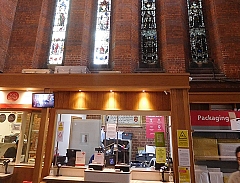
On entering the church through its electrically operated glass sliding doors, you will be surprised by what you find beneath its fine hammer beam timber ceiling. The west end of the nave is occupied by a post office, the first main-branch of a UK post office ever to be housed within a church. The north aisle of the church contains a children’s ‘soft play’ area, appropriately named ‘Hullabaloo’. The floor of the nave is filled with tables and chairs occupied by people of all ages, some enjoying refreshments from the church’s Sanctuary Café. All these things that you would not normally expect to find inside a church are part of The Sherriff Centre, a community organisation that began operating in 2014 (https://thesherriffcentre.co.uk/). The Centre’s activities also include a stationery store, a free food bank, live music as well as other events, free wi-fi, debt advice, and more.
Jesus is said to have thrown the moneychangers and others involved in commercial activity from the Temple in Jerusalem (“The Holy Bible”, John, Ch 2, v 13-16). However, he might have approved of the commercial activities within St James because profits from the sales outlets in the Centre are used to help finance charitable work. In addition to everything that I have already described about what goes on within St James, there is one more thing to mention. Despite the activities that you might not expect to find inside a church, regular religious Church of England services are held there. It is wonderful that St James, instead of becoming yet one more barely used Victorian church in London, has become a vibrant and beneficial part of a local community, catering to more than only just its by now small congregation.
PERCY BYSSHE SHELLEY (1792-1822), the poet, was a friend of the literary critic and essayist James Henry Leigh Hunt (1784-1859), who lived at various times in Hampstead, north London. Shelley’s poetry and other writing attracted the attention of radical thinkers including, for example, Karl Marx, who wrote:
“The real difference between Byron and Shelley is this: those who understand them and love them rejoice that Byron died at 36, because if he had lived he would have become a reactionary bourgeois. They grieve that Shelley died at 29, because he was essentially a revolutionist and he would always have been one of the advanced guard of socialism.” (https://www.marxists.org/archive/eleanor-marx/1888/04/shelley-socialism.htm)
Hunt, who knew him well, wrote of the poet:
“Shelley was not only anxious for the good of mankind in general. We have seen what he proposed on the subject of Reform in Parliament, and he was always very desirous of the national welfare.”
I mention this about Shelley because it chimes with what is to follow.
The Vale of Health, Hampstead, north London
A few months ago, I acquired a copy of Leigh Hunt’s wordy but fascinating autobiography. After being released from a spell in prison in 1815 having libelled the Prince Regent, the future King George IV, Hunt moved to the Vale of Health in Hampstead. Shelley often used to visit Hunt there, sometimes staying at his home for several days. Hunt wrote that Shelley:
“… delighted in the natural broken ground, and in the fresh air of the place … Here also he swam his paper boats on the ponds, and delighted to play with my children…”
Hunt was returning to his home in the Vale of Health one evening after having been to the opera when he heard a woman shrieking and a man’s voice coming from within his house. The woman’s voice was that of a lady, whom Shelley had found lying:
“… near the top of the hill, in fits. It was a fierce winter night, with snow upon the ground; and winter loses nothing of its fierceness in Hampstead. My friend, always the promptest and the most pitying on these occasions, knocked on the first house he could reach, in order to have the woman taken in.”
Shelley’s request was turned down. Hunt continued:
“The poor woman was in convulsions; her son, a young man, lamenting over her. At last my friend sees a carriage driving up to a house at a little distance. The knock is given; the warm door opens; servants and lights pour forth…”
And Shelley asks for help employing the voice:
“… which anybody might recognise for that of the highest gentleman as well as of an interesting individual …”
He relates his story to the elderly gentleman emerging from his carriage and asks whether he will go and see the distressed female. The passenger replies:
“No, sir; there’s no necessity for that sort of thing, depend on it. Impostors swarm everywhere: the thing cannot be done; sir, your conduct is extraordinary.”
To which Shelley replied to the astonishment of the man who refused to provide assistance:
“Sir, I am very sorry to say that your conduct is not extraordinary; and if my own seems to amaze you, I will tell you something that will amaze you a little more, and I hope will frighten you. It is such men as you who madden the spirits and the patience of the poor and wretched; and if ever a convulsion comes in this country (which is very probable), recollect what I tell you: – you will have your house, that you refuse to put the miserable woman into, burnt over your head.”
By ‘convulsion’ Shelley meant revolution, something that England did not suffer as had France or later Russia and elsewhere. Leigh’s reporting of what Shelley said may help to show that whatever Marx saw in his writings was in harmony with his own ideas.
As for the poor woman, she was:
“… brought to our house, which was at some distance, and down a bleak path (it was in the Vale of Health); and Shelley and her son were obliged to hold her till the doctor could arrive.”
In case you are wondering how the woman got into such a sad state, Hunt informs us:
“It appeared that she had been attending this son in London, on a criminal charge made against him, the agitation of which had thrown her into fits on her return. The doctor said that she would have perished, had she laid there a short time longer.”
Now, I am no reader of poetry. I find that I enjoy it more if it is read to me. Further, I must confess that I am unfamiliar with Shelley’s works, but this story related by Hunt, has begun to endear the poet to me. Shelley not only met Hunt in Hampstead but also in Italy on the 1st of July 1822, where they, along with Lord Byron, made plans to start a new journal “The Liberal”. On the 8th of July, Shelley died at sea when the boat he was travelling in sunk.
THE TOWER OF BABEL greeted anyone who climbed the staircase at my childhood home in Hampstead Garden Suburb. Well, actually it was a large engraving of the tower as imagined by Dolf Rieser (1898-1983). Dolf, who was born in King Williams Town in South Africa, was related to my mother’s grandmother Hedwig Ginsberg (née Rieser). My mother and Dolf were cousins. Even though they lived not far from us in north London, I saw little of Dolf and his family until about 1976 when I began studying dentistry. It was then that my uncle Sven, married to my mother’s sister, and his daughter told me that they were about to join the printmaking classes that Dolf held in his studio above his home in Sumatra Road, West Hampstead. As I liked drawing and painting, I signed up as well. The three of us attended the weekly evening classes that Dolf held on Tuesdays. Out of a class of on average six to eight students, three of us and the teacher were all closely related.
At the top of the stairs leading to the studio, there was a small colourful image created by the artist who is now very famous. It was a gift to Dolf given by the artist when both were living in Paris in the 1920s and 1930s. Dolf, who had studied biology in Switzerland and was awarded a PhD in 1922 (https://dolfrieser.com/), began studying art in Munich in 1923, and then moved to Paris to study print-making in Atelier 17, the studio of the great surrealist painter and etcher Stanley Hayter (1901-1988) and the engraver Jozef Hecht (1891-1951).
In the compulsory half hour tea breaks during the classes, we used to sit with Dolf whilst he regaled us with tales about his life in Paris during the 1920s and 1930s. Every winter, he used to go to Switzerland to ski. He used to enter the railway station carrying his wooden skis, and Parisians would stop him to ask what they were. For, in those days, it might surprise you to learn, the average Frenchman was unfamiliar with skiing. Dolf used to visit the Café Les Deux Magots in the Saint-Germain-des-Prés district of Paris, where he would enjoy the company of other artists. He told us that he often saw Pablo Picasso there, sitting at one of the tables. Dolf said that being a junior and relatively unknown artist at the time, he had to sit at a table near to Picasso’s, which was reserved for the ‘upper echelon’ of the artists community in the city. I cannot recall all that he told us, but much of it was both informative and highly entertaining, if not always entirely suitable for polite company. One bit of French that I learned from him during these entertaining intervals in the class was ‘poule de luxe’, which you can look up for yourself.
Dolf’s lofty studio had several large tables where we worked on our copper and zinc plates. At one end of the studio there was a raised platform, a gallery, on which there was a couch or bed. The tables were surrounded with a great assortment of stuff, both works of art by Dolf and the plethora of materials and equipment need to make prints, not only on paper but also on plastic and silk, techniques he developed. There was a table with large shallow trays containing nitric acid in which plates of zinc prepared for etching were bathed. The acid in the trays was of variable concentration, unknown even to Dolf, who used to periodically chuck in unmeasured dollops of concentrated acid from brown glass Winchester bottles whenever he felt (rather than knowing for sure) it might be necessary. Often, he did not tell us when he was about to strengthen the liquid. This could prove difficult if someone were trying to make small delicate adjustments to his or her zinc plate. Occasionally, one or other of us would shout, dismayed:
“Oh, Dolf, you didn’t say you were adding acid. Now, see: the acid has eaten deeper than I was expecting.”
But the ever-ingenious Dolf usually always had a way of remedying what looked to be disastrous at first sight. Today, I doubt that the studio would have passed health and safety rules. There were no extractor fans above the acid baths to remove the toxic fumes emitted when a plate was in the acid. This did not bother any of us.
One end of the studio near the acid baths was dominated by a large, hand operated printing press. The etched or engraved plate was placed on a soft woollen cloth, after having been inked up. A sheet of damp paper was placed over the plate, and this was covered by another cloth. Then, Dolf or one of us turned the large wheel that drove the plate between a pair of metal rollers that applied high pressure to the dampened paper, driving it into the ink-filled grooves on the etched or hand-engraved plates. When Dolf turned the large wheel, always moving his body rhythmically, he often used to say in Swiss German:
This referred to a slightly lewd joke he often told us. It went like this. Two Swiss peasants come to Zurich, where they decided to employ the services of a prostitute for the first time in their lives. To save money, they agreed that only one of them should pay for the experience. When the chosen one had finished with the prostitute, he joined his friend, who asked him how it was. The other fellow replied that it was quite pleasant, adding: “Aber die Bewegung is immer die glierchen.”
Printing was always a messy business. To remove the ink from one’s hands, we used a petroleum-based jelly often used by motor mechanics, which Dolf kept in his studio. Removing the ink from one’s hands was easier than removing the lacquer that was painted on to zinc plates to prevent acid from reaching parts that were not to be etched. To explain, a zinc plate is covered with lacquer, which is then removed with tools of varying sharpness to expose parts of the plates which the artist requires to be etched. This is of course an oversimplification. Dolf who was very inventive showed us many other techniques for producing etched plates. It is likely that his early training in science helped him to develop interesting new ways in printmaking. Dolf maintained an interest in science, as is exemplified by his book “Art and Science”, published in 1972. Its opening words are:
“Art and science are generally considered totally different disciplines. The aim of this book is to draw attention to some of the qualities they share.”
Dolf was a superb teacher. Although the students in our classes were of mixed ability, he brought out the best in each and every one of us. I found that he was particularly good on critiquing composition. The compositions and ideas embodied in his own creations were mostly superb. He used to look at one’s work, immediately understand what we were trying to achieve, and to nudge us gently and constructively in such a way that we ended up with what we were hoping to produce and express.
Once, he held an exhibition of our, his students’, work in his studio and asked us to invite our friends. At the end of the evening, Dolf had sold several of his own prints, but none of us managed to sell any that we had created. Dolf told us off, saying that none of us had worked hard enough, if at all, on getting our friends to buy our works.
After Dolf’s wife died, he continued the classes, but used to be reluctant to see us leave at the end of the evening. I liked Dolf so much that I was always sad when the classes came to an end. However, after he became a widower, we used to follow the classes by walking with him to a Turkish restaurant nearby in Willesden, where we all enjoyed a late supper with him.
The last time I saw Dolf was when he was lying in a hospital bed near the end of his life. Even in hospital, he was in reasonably high spirits, telling his visitors stories and jokes. His house in Sumatra Road still stands. I do not know whether his wonderful studio is still being used to create works of art, but it is with Dolf and his students that I will remember it.
Finally, having read the above, I hope that you will not get the wrong idea when I invite you to “come up and see my etchings”. Many years ago, a young lady did accept this invitation when I made it; she is now my wife.
THE PAINTER GEORGE ROMNEY (1734-1802) moved to Hampstead in north London for health reasons near the end of the 18th century. His home on Holly Hill, originally named ‘Prospect House’ because of the views over London that could be seen from it, still stands today, even thouh it has been altered since Romney occupied it. During 1792, he made frequent visits to Hampstead and the following year he decided to move to the suburbs north of London. In June of that year, he took lodgings at a place he called ‘Pineapple Place’ near Kilburn. Dissatisfied with his Kilburn abode, and having been persuaded that it would be better to buy an existing building rather than to build from scratch, he bought the house on Holly Hill, an old house and its stables, in 1796. It is this building that bears a plaque commemorating his residence there. The Holly Hill house contained his studio, which was completed after the artist had spent £500 on alterations to his new home. While the alterations were being carried out, Romney lived in a building called The Mount on Heath Street, so the informative historian Barratt reveals in Volume 2 of his encyclopaedic history of Hampstead.
Romney’s house in Hampstead, London
The works that Romney had paid for resulted in the creation of:
“…strange new studio and dwelling-house … an odd and whimsical structure in which there was nothing like domestic arrangements. It had a very extensive picture and statue gallery …”
Barratt continues:
“At last Romney got rid of the builders and decorators, and all his town treasures —paintings, casts, statues, canvases, and what not—scores of cart-loads of them—were deposited in the new house and gallery, and the painter began to think that his higher aims were about to be attained.”
But this was not to be. His health failed and in January 1799, he shut up his Hampstead abode and travelled to Kendal. He returned to Holly Hill briefly but returned to Kendal after the 28th of April. He died in Kendal. His house in Hampstead was sold and by 1808, it contained ‘Assembly Rooms’ and three years later it became home to ‘The Constitutional Club’. Barratt revealed that the rooms in Romney’s house were:
“…For sixty years these rooms were practically the Town Hall of Hampstead and the centre of the town’s municipal life. The Hampstead Literary and Scientific Society, formed about 1833, met here, and many learned men at its invitation gave lectures in the rooms …”
Lord Ronald Sutherland Gower, author of “George Romney” published in 1904, wrote of FRomney’s Hampstead dwelling:
“…externally the building, which is covered over with a kind of wooden boarding, has the appearance of a large stable; but within are some remains of the great gallery in which the artist placed his collection of casts, and handsome columns decorate this room; it is now a Conservative Club, and appears to be well attended by the residents of that portion of Hampstead. As a living house it must have been supremely uncomfortable; and one no longer has the advantage of the view over London from the upper windows from which Romney loved to look out and watch the distant dome of St. Paul’s lying in the Thames Valley below; the great city has crept up and around Holly Bush Hill, and crowded out the prospect which gave the great painter almost the last solace in his melancholy decline of life.”
Recently, I wrote an essay (see https://adam-yamey-writes.com/2021/04/29/artists-in-hampstead-londons-montmartre/) about some artists who lived in Hampstead and mentioned George Romney. Someone who read it wrote to me and reminded me that Romney’s former home was also the abode of another artist, the Welsh born architect Sir Bertram Clough Williams-Ellis (1883-1978), most famous for his creation of Portmeiron in western Wales. At about the same time as my correspondent mentioned Williams-Ellis, I found a copy of the architect’s autobiography, “The Architect Errant”, in a disused telephone box, now being used as a book exchange, in Madingley, Cambridgeshire. Although I have not yet read the whole book, I have found what he wrote about his time living in Romney’s former home in Holly Hill. He bought this building in 1929 and redesigned it considerably.
Clough left Chelsea for Hampstead. He wrote of Hampstead and its proximity to the Heath:“It was this love of spaciousness that had propelled me first from South Eaton Place … to Hampstead where the desire for bracing air, a garden, and good schools for the children, were factors determining our choice.
From the edge of a plateau high above the dome of St Pauls we looked southwards from George Romney’s old house across the maze of London …”
The autobiography provided a description of Romney’s house as it was when Clough lived there:
“The fine old house, much altered and adapted to our curious habits, being far too large either for our needs or means, was proportionately delightful to inhabit, and with two ex-billiard rooms (it was once a club) at the disposal of the children, its size had compensations.”
Referring to Romney’s picture gallery, Clough added:
“For myself I had taken the immense old picture gallery as my studio, and I did not hesitate to play up to the magnanimity of its proportions in my embellishments … my wife was surprised and a little shocked at my choosing to work in what she not unjustly called my ‘ballroom’…”
He noted that Romney’s former home was “… splendid for large parties…”, and he held many of them. For example, Clough hosted:
“… dances every so often, a show by Ballet Rambert, David Low drawing large cartoons and selling them for charity. We also gave a party to meet the Russian Ambassador, M Maisky, who made a speech from the gallery balcony …”
The balcony can be seen clearly in a photograph on the RIBA website (www.architecture.com/image-library/RIBApix/image-information/poster/romneys-house-hollybush-hill-hampstead-london-romneys-studio/posterid/RIBA71050.html).
Ivan Mikhailovich Maisky (1884-1975) was the Soviet Ambassador to the Court of St James from 1932 until 1943. Unfortunately, the party referred to above does not get a mention in Maisky’s diary (as edited by Gabriel Gorodetsky), which is perhaps not surprising in view of the huge number of events an ambassador is obliged to attend. A year before Maisky became the ambassador:
Rather oddly, Clough does not mention this trip in his autobiography.
Clough wrote that the South African-born scientist Sir Solly Zuckerman (1904-1993), who was studying primate behaviour:
“… wished one of his research baboons on us, as he wanted to study its reactions to ‘bright, intelligent young society’. He was then writing his rather ambiguously entitled book “The Sexual Life of Primates” – so Betsy had quarters on the flat roof at the top of the house for several months.”
The book referred to above was probably “The Social Life of Monkeys and Apes”, published in 1932. Betsy’s stay in Romney’s old house was not entirely successful. It was not:
“… the social success that we had hoped, unresponsive and dirty, we bade our little lodger farewell without regrets. The experience may have been good for Betsy, but I don’t think our children benefitted markedly from the association.”
Clough and his family left Hampstead for Wales at the outset of WW2, keeping a London ‘pied-a-terre’ in Carlton Mews, now demolished. His and Romney’s house in Holly Hill, an edifice altered for Romney by Samuel Bunce (died 1802), has since been used as the studio for an architect’s firm, Hancock Associates, in the 1970s (information from Beth Portwood) and other purposes. In 2012, the architect’s firm ‘6a’ worked on the building to modernise its interior and restore it to a single family dwelling as it had been when Romney acquired it (www.6a.co.uk/projects/more/romneys-house).
The house stands amongst a small cluster of buildings near Fenton House and this charming ensemble makes me think that externally little has changed since these houses were built in the 18th century.