Almost hidden from view

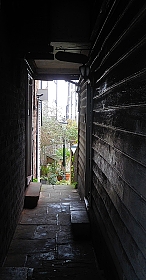
A GAP BETWEEN the houses almost opposite the long-established La Gaffe restaurant (opened in 1962) on Hampstead’s Heath Street leads into an alley lined on one side of a wall covered with overlapping planks of timber, i.e., clapboard. Steps lead down from the alleyway to a small sunken paved square surrounded by houses, some of which are 18th century.  This almost hidden nook is called Stamford Close. The name derives from the now-demolished Stamford Lodge, where John Constable and his family were briefly lodgers in 1823 after they had left their rented accommodation on Hampstead’s Lower Terrace, where they lived between 1821 and 1823.

According to Christopher Wade, in the 1930s, six old cottages were condemned and the close was considered to have been:

“…a miserable dark square – a black spot.”

Today, the square is far from miserable, and many would kill to own a house there. I am not sure how practical this would be as far as shifting heavy shopping and luggage is concerned. Also, parking cars is not possible close to the houses. Despite these disadvantages, this square would be a lovely place to live.

Mahatma Gandhi in Hampstead

WHEN I USED TO visit Hampstead with my parents in the early 1960s, we always walked past a place that intrigued me when I was a youngster. It was the still standing Hampstead Quaker Meeting House, which has a lovely front garden. The latter is overlooked by its neighbour, the late 18th centuryMansfield Cottage, which in the 1960s housed a tearoom or restaurant. The Meeting House with art nouveau (Arts and Crafts) features was built in about 1907 to the designs of Fred Rowntree (1860-1927). According to James D Hunt in his detailed book “Gandhi in London”, Mohandas K Gandhi (1869-1948), the future Mahatma, spoke in this meeting house on the 13th of October 1909:

“… perhaps travelling there by the recently opened underground line … The Society of Friends (Quakers) were not at this time much interested in Indian affairs … The 1909 meeting was sponsored by the Hampstead Peace and Arbitration Society”

The speech, as recorded by Robert Payne in his “The Life and Death of Mahatma Gandhi”, was entitled “East and West” and outlined the evils of the British occupation of India and the sufferings of Indians in South Africa. I knew nothing of this or about the house when we used to stroll down Heath Street.

Blood on the Page

HAPPY CHRISTMAS !

I WAS THE EDITOR of the newsletter of the Anglo Albanian Association (‘AAA’), when a writer, Thomas Harding, sent the following email in late 2016:

“… I am researching the life of Allan Chappelow, a former member of Albanian Society and Anglo-Albanian Association. My former books include ‘Hanns and Rudolf’ and ‘The House By The Lake’. I would welcome hearing from anyone who remembers or has stories about Allan Chappelow…”

I had already heard of the two books and seen a little bit of correspondence about Chappelow, which suggested to me that he was a mysterious fellow. He interested me because he had been a member of one of the earliest groups to visit Communist Albania soon after the end of WW2 and he was a participant in the first student tour of the USSR made after Stalin had died.

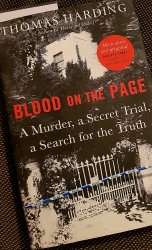
Thomas Harding published his book, “Blood on the Page” in 2018. The secretary of the AAA and I attended a launch of this publication in Daunt’s bookshop in Hampstead’s South End Green. The book is about Chappelow, and I have only just finished reading it, having purchased a copy only recently.

Chappelow (1919-2006) lived and died at number 9 Downshire Hill, a lovely Georgian house in Hampstead. Sometime in May or June 2006, he was brutally murdered in his home. His rotting body was only discovered many days later after a bank had been investigating some irregularities in his account and had been unable to contact him. Wang Yam, a man of Chinese origin was accused of, and found guilty of, his murder and stealing his identity to carry out fraudulent financial transactions. All of this is detailed in Harding’s un-put-down-able book, which reads like a good thriller. In addition, Harding describes the trial of the man accused of having been the murderer.

The trial of the accused, who now languishes behind bars, was unusual for a murder case. Some of it was held ‘in camera’ for reasons that have never been disclosed and cannot be, without risking contempt of court. Trials are usually held ‘in camera’ either to protect national security interests and/or to protect the identity of witnesses. Chappelow’s was the first ever murder case to have been held ‘in camera’ in the UK. Why this was the case was not revealed in Harding’s wonderful book. It is clear from his text that he was not privy to the reason for the secrecy. As I read the book, I kept wondering what it is that the government wants to keep secret. From the detailed account of the murder and what Harding was able to find out about it and the 86-year-old victim, by then a recluse, I could not detect anything that could have been a threat to national security

One possible reason for the secrecy during the trial is mentioned in an article in “The Observer”, published on the 25th of January 2018 (https://www.theguardian.com/news/2018/jan/25/murder-in-hampstead-did-secret-trial-put-wrong-man-in-jail-allan-chappelow). Here is a relevant extract:

“Before, during and after the trial, the government went to extraordinary lengths to ensure that details of Wang’s links with MI6 would remain secret. Two cabinet ministers told the trial judge that Wang’s entire defence must be heard behind closed doors. A contempt order issued by the judge prevents the media from speculating about the reasons for the secrecy.”

Elsewhere, the article mentioned:

“Between his arrest and the start of the trial, it emerged that Wang had acted as an informant for MI6 in London for a number of years. Wang was well placed to be an informant for Britain’s foreign intelligence agency. He had family links with China’s first communist leaders, he was opposed to repressive measures taken by Beijing, and he was something of a computer expert.”

Chappelow had visited both the USSR and Albania during the height of the so-called Cold War. I first visited Albania in 1984, when the Cold War was still ongoing, and the Stalinist dictator Enver Hoxha still held the country in his repressive grip. Our group included people who, after the trip, revealed that they were not what they had claimed to be while we were in Albania. For example, a lady who told me during our visit to Albania she was an archaeologist revealed to me later that she was really a journalist. At that time, journalists were forbidden from visiting Albania unless invited by the regime. Chappelow revisited Albania in 1993 after the ending of Communist rule. In his book, Harding quotes a member of the AAA, who was on the trip with him. She remembered that he had said he was a teacher, but she never “got to the bottom of his background”. Most biographical notes about Chappelow refer to him as a photographer and an author, not a teacher. That got me thinking, as did recalling an incident from my 1984 trip.

At least one of my fellow travellers told me that after the trip that he had been approached in Tirana discreetly by one of our Albanian tour guides and some of her colleagues. They invited him to become an agent to provide Albania with information about his country, Australia. Remembering this incident, I wondered whether Chappelow’s murder trial was held behind closed doors because his trips behind the Iron Curtain had either not been purely for reasons of tourism, or possibly while he was there, he had been approached by the local authorities as was the case of my Australian travelling companion.

Returning to Chappelow’s visits behind the Iron Curtain, here is something else I noticed in the Guardian’s article:

“Chappelow was the product of an educated, socialist family, whose liberal-leaning father, a successful decorator and upholsterer, had moved to Denmark rather than be conscripted into military service during the first world war. At the end of hostilities, the family returned to London and bought 9 Downshire Hill. Allan grew up in a politically progressive home; his parents were active members of the Fabian Society. At the onset of the second world war, the bookish Chappelow was faced with the same dilemma as his father, as well as his schoolboy hero, George Bernard Shaw, who had refused to fight in the first world war and was strongly opposed to the second.”

Interesting as speculations about whether Chappelow could have been involved with intelligence work might be, we will probably not find out the real reason for the secrecy for many years to come. In any case, this mysterious episode, centred in and around Hampstead, is a good reason to read Harding’s exciting and intriguing book … and possibly you might come up with your own hypothesis about why Wang’s trial was held ‘in camera’.

Putting Hampstead on paper

I HAVE TOLD SEVERAL friends that I am busy writing a book about Hampstead in North London. Hearing this, each one of them has said something like “Aren’t there already so many books about the place?” Well, those words are hardly encouraging. Had I been writing a love story or a book about WW2, they would not have expressed any sentiments about the untold number of already published love stories and books about WW2.

I wondered how many books there are about Hampstead, non-fiction rather than fiction. I searched for “Hampstead” in the book section on Amazon’s UK website and found that there are not more than about 40 different non-fiction titles relating to Hampstead rather than only Hampstead Heath or Hampstead Garden Suburb. Of these titles, 11 were published since 2000, and most of these before 2015. The rest were published before 2000, and of these at least 16 were published before 1980. Since 2015, only 3 books, which deal mostly with Hampstead, have been published. Therefore, although there are many books about Hampstead, few of them have been published in the last six years. So, maybe it is time that another one should appear in print.

While researching the book I am writing, I have consulted many of the books still available on Amazon and many others which have chapters about Hampstead, as well as a wealth of information that can be found on the Internet. I am making much use of what I have discovered from these sources and from my own observations, and I believe that when it is completed my book will contain a distinctive combination of facts and observations, which differs from presentations in other books about the locality.  

The greater part of the book’s subject matter will be about Hampstead and its ‘satellites’, North End, Swiss Cottage, Belsize Park, and West Hampstead. I am also including shorter, detailed sections on Highgate and Golders Green. I am still at an early stage in the book’s production, but I do not feel deterred by observations that my friends have made that imply that I am simply ‘sending coals to Newcastle’, by writing yet another book about Hampstead. Time will tell.

A foreign wind

THERE IS A HOUSE in Hampstead’s Downshire Hill, where John Heartfield (1891-1968) lived between 1938 and 1943. Born in Germany as Helmut Herzfeld, he was an artist who employed art, and in particular photomontage, as a political weapon. He was anti-Nazi and fled Germany in 1933, arriving in England in 1938, having spent some time in Czechoslovakia. Nearby, are houses where three other artistic creators lived: Roland Penrose and his wife Lee Miller; and the creator of The Muppets, Jim Henson.

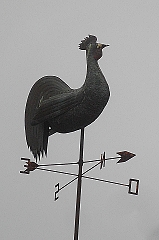
Heartfield’s home on Downshire Hill has a peculiar feature, which might have been added long after he lived there. It is a weathervane. That is not a particularly unusual embellishment, but on closer examination, it is not a run-of-the-mill British weathervane. Weathervanes in England often have the four points of the compass abbreviated as NSEW, that is, north, south, east, and west. The one on Heartfield’s former home has the letters NSOE. At first, I thought that the O was an abbreviation for the German for east, ‘Ost’. If the weathervane was German, it should have had the letters NSOW. Then, I thought that the O is probably an abbreviation for the Italian for west, ‘ovest’ or for ‘oeste’ the Portuguese and Spanish words for west. This makes sense because the other points of the compass in those languages are abbreviated as: N, S, and E. Short of ringing the doorbell to ask, the linguistic identity of the weathervane will have to remain a mystery to me for the present.

Relief below ground

IT IS NOT OFTEN that I feel the need to write about answering the call of nature but after a recent visit to Hampstead’s South End Green, I must satisfy the urge.

There is a yard at South End Green, where buses serving the route number 24 wait before setting off to Victoria station. Long ago, this yard used to have tram tracks as it was the terminus of a tram line. A lovely small café, Matchbox by name, stands beside the yard. Its owner, Mirko, a friendly Slovenian, serves excellent hot beverages and a range of mouth-watering snacks, both sweet and savoury. The nearest public toilets are across the yard, almost opposite to Matchbox.

The toilets are below ground level and accessed by staircases with cast-iron structures above them. It was only on our most recent visit to South End Green, in December 2021, that I had reason to descend into the ‘gents’, and I am pleased that I did, not only for reasons related to my physiology but also to satisfy my curiosity.

The ‘gents’ is magnificent, with its white glazed brick walls decorated with bands of light green bricks, its long narrow, black and white chequered floor, its polished dark wood cubicles, and its row of white urinals all topped with grey (marbled with white streaks) granite separators. Although there is electric lighting, a skylight admits some natural light.

The underground toilet facilities, both the men’s and the ladies’, were constructed in 1897 for the benefit of passengers using the tramway. Stephen Emms, writing in the “Kentish Towner” in October 2013, noted that the gent’s underground facility at South End Green was a pick-up place used by homosexuals. He noted:

“But most memorably South End Green is the only public toilet still in use known to have been visited by iconic 1960s playwright Joe Orton. Apparently it was his “favourite pick-up point” too””

You might be relieved to learn that my recent brief visit was completely uneventful.

Artists and secret agents

A REMARKABLE ENGINEER and furniture entrepreneur Jack Pritchard (1899-1992) and his family lived at 37 Belsize Park Gardens, in London’s Hampstead district. before WW2. Pritchard, who studied engineering and economics at the University of Cambridge, joined Venesta, a company that specialised in plywood goods. It was after this that he began to promote Modernist design. In 1929, he and the Canadian architect Wells Coates (1895-1958) formed the company, Isokon, whose aim was to build Modernist style residential accommodation.

Pritchard and his wife, a psychiatrist, Molly (1900-1985), commissioned Coates to build a block of flats in Lawn Road on a site that they owned. Its design was to be based on the then new ideas for communal housing that had been realised in Germany including the influential Bauhaus in Dessau. The flats are close to Fleet Road and the Mall Studios in Parkhill Road. Completed in 1934, they were, noted the architectural historian Nikolaus Pevsner, “… a milestone in the introduction of the modern idiom to London.” He continued, writing in 1952, clearly critical of the edifice, which:

“…put on a forbidding face towards the street, with large unmitigated concrete surfaces … It is all in the spirit of revolution, unaccommodating and direct to the verge of brutality.”

Well, I quite like the building’s elegant simplicity. In the basement space of the block, there was a refreshment area known as the Isobar. This and its furniture were designed by Marcel Breuer (1902-1981). Regularly, exhibitions were held in the Isobar and, according to an on-line article in The Modern House Journal these were attended by artists including Adrian Stokes, Henry Moore, Barbara Hepworth, Ben Nicholson and Naum Gabo. The article also noted that this refreshment area was frequented by modernist architects such as Erich Mendelsohn, Serge Chermayeff and, Wells Coates, as well as by left-wing politicians. Pritchard occupied the penthouse flat. In 1969, he sold the block, and now it contains accommodation for 25 keyworkers on a shared ownership basis and 11 flats are in private ownership. The block, first known as the Lawn Road Flats, is now called ‘Isokon. Lawn Road Flats’.

T F T Baker, Diane K Bolton and Patricia E C Croot, writing in A History of the County of Middlesex: Volume 9, Hampstead, Paddington, noted that the Lawn Road Flats were built partly to house artistic refugees, who had fled from parts of Europe then oppressed by dictators, notably by Adolf Hitler. Some of them had been associated with the Bauhaus. These included the architect and furniture designer Marcel Breuer, the architect Walter Gropius (1883-1969), and the artist and photographer Laszlo Moholy-Nagy (1895-1946). All three of them are regarded as being masters of 20th century visual arts.

Despite both having come from bourgeois backgrounds, the Pritchards aimed to free themselves from middle-class conventions. The concept and realisation of the Lawn Road Flats, were important landmarks in their quest to achieve a new, alternative way of living. It is accurate to say that the atmosphere that prevailed in the community that either lived in, or frequented, the Lawn Road Flats was predominantly left-wing and extremely welcoming to cultural refugees from Nazi Germany. Probably, it had not been anticipated that the place should become a convenient place for Stalin’s Soviet spies to use as a base. According to a small booklet about the flats Isokon The Story of a New Vision of Urban Living, published in 2016, the flats were home to the following espionage agents, who had been recruited by the NKVD in Central Europe: Arnold Deutsch, Simon Kremer, Jürgen Kuczinski, and Brigitte Kucynski Lewis. Jill Pearlman, one of the book’s several authors, noted that they found the Lawn Road Flats convenient for several reasons:

“Above all, they blended inconspicuously into the sociable community of tenants there. Many tenants too were refugees from Central Europe … Even the Lawn Road Flats building worked well for the spies. One could enter and exit any unit without being seen … no one could see in. At the same time, the cantilevered decks on each floor provided the tenants a perfect vantage point from which to survey the street below.”

Today, there is a small exhibition area in the garage of the flats. This is open on some weekends, but I have yet to visit it.

A lady in Hampstead and Boy George

GROVE PLACE IS a short street running southwest from Hampstead’s steeply inclined Christchurch Hill. We often walk along it on our way to the lovely café at nearby Burgh House. A building containing numbers 29-31 Grove Place has often attracted my attention because its roof is topped with a couple of cupolas, each supported by four carved wooden pillars. These stand on either side of a grand central façade. The edifice bears a plaque, which is in an excellent state of preservation, that reads:

“This stone was laid by Mrs Sarah A Gotto on the 13th of July 1886 being the 50th Yr of the reign of her majesty Queen Victoria”

Elsewhere on the wall facing Grove Place there is a metal shield, painted black, which bears the following:

“1871. SPPM”

I was a bit puzzled by this because 1871 was some years before the stone was laid by Mrs Gotto.

I was pleased to discover that this building has been described in a book I possess, “The Streets of Hampstead” by Christopher Wade. He revealed that it was converted in 1970 from Bickersteth Hall, a hall built for the nearby Christ Church in 1895, and named after a former vicar, who later became the Bishop of Exeter. This gentleman was Edward Bickersteth (1825-1906), who had been vicar of Christ Church in Hampstead from 1855 to 1885 (www.praise.org.uk/hymnauthor/bickersteth-edward-henry/). Wade adds that it is confusing that the 1871 St Pancras shield and the 1886 Mrs Gotto plaque have been placed on the building. So, it seems that Mrs Gotto might have had little to do with laying the first brick of the building, but I wondered who she was.

Wade describes Sarah Gotto as Mrs Edward Gotto. Edward was most probably Edward Gotto (1822-1897), a civil engineer and architect who entered a partnership with Frederick Beesley in 1860 to create the engineering firm of Gotto and Beesley, which flourished for 30 years and carried out drainage works in towns all over the world including  Rio de Janeiro, Seaford, Trowbridge, Evesham, Huyton and Roby, Redditch, Brentford and Cheshunt; and the drainage and water-supply of Campos (Brazil), Oswestry, Leominster and Cinderford (www.gracesguide.co.uk/Edward_Gotto). According to his obituary, Mr Gotto lived in Hampstead in a house called The Logs on East Heath Road. Built in 1868, The Logs, was as I have described elsewhere (see https://adam-yamey-writes.com/2021/02/01/finding-boy-george-and-bliss-in-north-london/), much later home to the comedian Marty Feldman and the singer Boy George. Edward’s wife Sarah was born Sarah Ann Porter (1829-1901; https://ancestors.familysearch.org/en/L1Q6-7NL/major-harold-ralph-gotto-1868-1957), She and Edward had eight children, one of whom was Harold Ralph Gotto. He was born in 1868 in Hampstead and later became a major in the British Army.

All of this is interesting enough, but none of it explains (to me) why Sarah is commemorated by the plaque on the house in Grove Place. If anyone knows the reason, I would be pleased to hear from them.

A pottery and a prison

HAMPSTEAD IN NORTH London is full of interesting nooks and crannies.

At the west end of Well Walk in Hampstead, near the lower end of Flask Walk, there is a corner building with a Georgian shop front. It is now a small theatre but was once the Well Walk Pottery, which occupied this place for many years. The pottery was started by the potter Christopher Magarshack in 1959. According to Bohm and Norrie, writing in their “Hampstead: London Hill Town”, published in 1980, Elsie, the widow of the Russian Jewish translator and writer David Magarshack (1899-1977), lived there. She bought this corner building, which had formerly been Sidney Spall’s grocery shop in 1957, for Christopher to use as his pottery. His father, David, left his birthplace Riga, then in Russia in 1918 and later lived above the shop. Elsie died in 1999, aged 100. In addition to selling pottery there, the pottery also held classes for ceramicists, some of whom now have good reputations. David’s daughter Stella, a fine artist, was the Head Art Teacher at King Alfred’s, a ‘progressive’ school situated between Hampstead and Golders Green. In 2016, aged 87, she was brutally attacked in the street close to her home. Now, the premises is to be home to a theatrical enterprise, The Wells Theatre. Its present owners have decorated one of its windows has been  decorated with a pictorial history of the premises.

Before returning uphill along Flask Walk towards the pub, you will pass a pair of doors covered in metal studs arranged neatly in geometric patterns. According to an article in the January 2018 issue of “Heath and Hampstead Society Newsletter”, this pair of studded doors:

“…is supposed to have come from Newgate Prison,”

The prison closed in 1902.