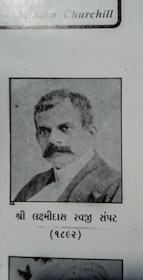
“My wife’s mother’s great grandfather was one Laxmidas Ravji Sapat (aka Sampat), who was born in the mid-19th century, or a bit earlier. Along with Gokaldas Parekh, Laxmidas was one of the first teachers in the Alfred High School in Bhuj (founded by Rao of Cutch, Pragmalji II in 1870). It is likely that he was its headmaster for a time. I have yet to see it, but his portrait hangs in the school. One of my wife’s relatives, also a descendant of Laxmidas, arranged to have it restored a few years ago. In 1890, Laxmidas left the school. Later, along with his son-in-law, Cullyanji Murarji Thacker, he went to London (UK) to become a barrister. He studied for the Bar at Middle Temple and was called to the Bar on the 27th of June 1900, along with his son-in-law, Mr Thacker, who was my wife’s mother’s grandfather.” (https://adam-yamey-writes.com/2023/02/02/running-in-the-family/)
Laxmidas Ravji Sapat
Today, the 25th of November 2023, we visited the Alfred School in Bhuj in search of the portrait of Laxmidas Ravji Sapat. We were shown a board on which the headmasters of the school were listed. On it we discovered that Laxmidas had been headmaster between 1888 and 1892. He was the school’s eleventh headmaster. It appears that he left the school two years later than I had been told.
As for the portrait of Laxmidas, the officials at the school had no knowledge. They suggested we try the museum next door. Part of this now owns the school’s original building, which was restored after the 2001 earthquake that destroyed much of Bhuj. Despite being part of the museum, the old school building stands disused and being renovated.
At the Bhuj Museum, we asked about the portrait. We were told that it is not in the museum. So where is it? In a few days time we will return to the school to visit its current headmaster. Maybe, he might know where it is. Until then, watch this space!
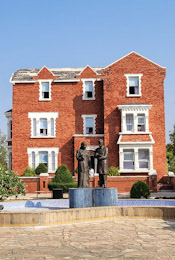
A NARROW ROAD LEADS away from the town of Mandvi (in Kachchh, a part of Gujarat) into an arid sandy area close to the seacoast. Scrubby bushes populate most of this flat terrain. After a few miles, a red building can be seen on the horizon. As you approach it, you can see that it resembles no other in the surrounding area, or, for that manner, in any other part of India. However, if you are a Londoner, it would seem familiar, although quite incongruous.
Replica of India House near Mandvi, Kachchh
The house in the desert is an accurate replica of a typical Victorian house, such as can be found in North London. In fact, it is a full-size copy of number 65 Cromwell Avenue in London’s Highgate area. The reproduction near Mandvi was built as part of a complex to commemorate Shyamji Krishnavarma (1857-1930), who was born in the centre of Mandvi.
Krishnavarma, who became a barrister and worked in various Princely States, moved to London, where he lived until about 1907. He moved to Paris, and then to Geneva, where he and his wife lived until they died.
In London, Krishnavarma lived opposite Highgate Woods. He invested wisely, and became interested in the works of English men, who had their doubts about Britain’s domination of India. He became an opponent of British rule in the Indian subcontinent. At first, his interest was mainly intellectual. However, in 1905, following the partition of Bengal, he became an activist.
One of his several activities was to purchase number 65 Cromwell Avenue. He had it adapted to become a ‘home away from home’ for Indians studying in London – they frequently had to endure the racist attitudes of English people. He named the building ‘India House’ (which should not be confused with the present Indian High Commission in London).
Apart from providing Indian food, some accommodation, and some leisure facilities, India House also hosted meetings that discussed the injustice of British rule in India. Soon, India House attracted the attention of the British police. This was because India House was becoming a nucleus or hotbed of anti-British activism. For example, some of the people who frequented the House experimented with bomb making and smuggling firearms to freedom fighters in India.
Krishnavarma left London in 1907, when he feared that he might be arrested. India House continued to be active until mid-1909 when one of its visitors assassinated an important colonial official.
Krishnavarma wrote in his will that after he was cremated, his ashes should be returned to India only after it had become independent of the British.
In the early part of this cemetery, the Chief Minister of Gujarat, then Narendra Modi, decided to bring Krishnavarma’s ashes to India – to Mandvi. Some years later, a complex to commemorate Krishnavarma was built outside Mandvi. Part if this is the replica of Highate’s former India House. The ashes of Krishnavarma and his wife are stored in urns on display in a building next to the replica.
If this story interests you and you want to know much more about India House, its replica, Krishnavarma and his fellow freedom fighters, including the currently influential VD Savarkar, you should read my, dare I say it, very informative book. I have produced two versions of it. One, the latest edition is “Indian Freedom Fighters in London 1905-1910), and is available here: https://www.amazon.co.uk/gp/aw/d/0244270716/ . The other “Ideas, Bombs, and Bullets”, which can only be delivered to addresses in India in available here: https://store.pothi.com/book/adam-yamey-ideas-bombs-and-bullets/.
WE HAD DECIDED TO travel to Mandvi (in Kutch, a part of Gujarat) by taking a train to Gandidham, then going by road the 98 kilometres between there and Mandvi.
The Indore to Gandidham Express arrived 30 minutes late on Ahmedabad Junction’s platform 4. Getting on to our carriage was a veritable scrum. The problem was that people, including us, wanted to board before those alighting at Ahmedabad had reached the carriage entrance. Someone behind us shouted “Hurry up and get inside.” When a passenger who was trying to leave the train replied “We want to get off”, the irritating lout behind us shouted “You should have started getting out quicker.” We struggled along the carriage and found our window seats eventually.
We had reserved seats numbers 73 and 76. A man was sitting in seat 76. When we said it was one of ours, he said that he was occupying his alloted seat, namely seat 77. It took some considerable persuasion before he understood that seat 77 did not have the number ‘76’ above it. This incident reminded me when I used to travel by train in Italy during the 1960s.
Whenever we travelled by intercity trains in Italy long ago, my parents always reserved seats – always in the first class carriages – in advance. Invariably, our reserved seats would be occupied by passengers who should not have been in them. It was o lying after the train conductor had been summoned that the people yielded our seats to us. Moments later, these obstinate people would engage in friendly conversation with us.
Returning to the Indore to Gandidham Express, before it started, vendors selling fruit and bottled water roamed along the platform looking for customers. Meanwhile, a hot tea seller moved along the interior of the train. He and others remained on board during the journey, as did a couple of snack vendors.
Once we got going, the train sped along. There was only one intermediate station where we stopped briefly during the 4 and a 1/2 hour journey. As we traversed the flat plains of Gujarat, we saw many neatly cultivated fields and numerous industrial units of varying sizes. In the area where eastern Kutch begins, we passed vast expanses of land being used as salt pans. Every now and then, we saw conical mounds of grayish white harvested salt.
Many trains passed us, travelling in the opposite direction. Almost all of them were freight trains. The line along which were moving leads to and from the busy port of Kandla on the south coast of Kutch. What little we saw of Gandidham and its outskirts was unattractive.
The air temperature at Gandidham station was well over 30 degrees Celsius and there was little shade. To exit the station, we had to use an escalator. Once again it was a scrum trying board it. Some passengers were too frightened to step on it which made using it even more difficult.
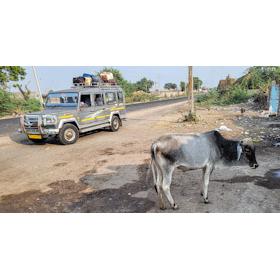
Our host in Mandvi had kindly booked us seats in a shared taxi to travel from Gandidham to Mandvi. This vehicle was like a jeep. It had a front row of seats – sofa like – and behind that there was another similar seating arrangement. Behind that, there was a far less comfortable seating space that accommodated any number of people that could be squeezed in. We were booked into the seating behind the front seats and in front of the rear ‘compartment’.
Although the middle seating had been booked for my wife and me, Lopa invited one of the three passengers who had squeezed in the front seat next to the driver to join us. He turned out to be a friendly chap. He and his friends were returning home from several days of a religious pilgrimage. Our new companion was a trader in rice, sugar, etc. He bought commodities and sold them for export. During our journey, he received a telephone call. He told us that soon after getting home, he had to go to Bombay for some urgent work. He and his business partner would have to drive for 11 hours through the night to reach Bombay from near Mandvi.
Our driver decided not use the 4 lane highway between Gandidham and Mandvi because of heavy traffic. Instead – and it made the journey far more interesting – he took us along a “short cut”, using country roads, some of them minor. This added fascination because we passed through rustic villages. At one of these, we were stopped by an elderly lady standing beside the road. She wanted to go to Mandvi, and was invited on board.
At another place, we stopped and the driver picked up a bundle tied in cloth, which he delivered to someone in another village we passed through later. After about an hour, to my great relief because my mouth was parched, we stopped for about 20 minutes at a stall where snacks and cold drinks were available.
At one point early during our journey, someone in the rear compartment asked our new companion to dial a certain number on his phone. Some conversation in Gujarati ensued. It turned out that there were some labourers travelling in the rear compartment. As they had not yet been paid by their employer, they claimed that they did not have the 300 Rupees needed to pay for the ride. Our friendly sugar trader allowed the employer to electronically transfer the required amount to his account. Our neighbour then suggested that he could electronically transfer that fare money to the driver’s account. However, the driver wanted to be paid in cash, which the trader kindly agreed to do.
Most of the way, the driver used one hand to steer, and the other to hold his mobile phone to his ear. Despite this hazardous practice, there were no scary moments along the way. We arrived at our destination safely, but somewhat cramped.
When we sat inside our host’s air-conditioned large saloon car to drive to his house, it felt as if we had moved from a stone seat into a feather bed. Never before has a modern saloon car felt so comfortable.
Despite moments of discomfort, our rail and road trip was enjoyably interesting. By the end of the journey we felt as if we had been truly travelling – a feeling that air travel often fails to provide.
THE LAW GARDEN in Ahmedabad was developed into a park in about 1997. Previously, it had been a vast triangular vacant plot in the heart of an affluent residential area. Named after an adjacent college of law, it was an undeveloped, rather disreputable bit of land. In 1997, it was tidied up and turned into what is now a pleasant place for people to relax and ‘take the air’.
Market stalls can be found along the street on one side of the park. After dark, a busy night market springs to life. This existed even before the park was completed.
Many of the stalls sell clothing made using colourful traditional patterned textiles – both embroidered and printed. Several stalls were selling cloths embroidered with small mirrors – work from Kutch.
In addition to clothing, there were hawkers selling toys and balloons. Foodsellers pushed small barrows from which they sold fruit, confectionery, and soft drinks.
This lively market reminded me a little of Fashion Street in Bombay, but it is somewhat smaller and offers less variety. The Law Garden night market is well worth a visit.
THE INDUSTRIALIST KASTURBHAI Lalbhai (1894-1980) filled his Ahmedabad home (built 1905) with works of art. One of his relatives had married a member of the famous Tagore family of Calcutta. When the Tagores decided to sell their fabulous collection of Indian art in the 1940s, Lalbhai purchased it and thereby saved it from being sold to buyers who did not live in India. These works are on display in the house, which is now known as the Kasturbhai Lalbhai Museum.
The Museum houses works of Indian art dating from as early as about the 4th century AD to the 1940s. Visitors to the museum are obliged to go on a prebooked informative guided tour through the rooms of the museum. Although a bit of a speedy experience, one leaves having seen an enlightening cross-section of the history of art in India. Photography in the museum is not allowed.
In the special exhibition
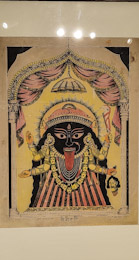
In the beautiful grounds of the museum, there is a recently constructed annex, where temporary exhibitions are held. We were treated to a show entitled “The Babu and The Bazaar”. It is a collaboration with the Delhi Art Gallery.
This fascinating exhibition contains a display of images created by Bengali artists, who painted in traditional styles that prevailed before art in Bengal became influenced by British art schools, Western European art, and the art of China and, especially, Japan. These external influences were most famously introduced by figures such as Rabindranath Tagore and his nephews Gagendranath and Abanendranath.
During my visits to India, I have seen plenty of paintings by Bengali artists who incorporated non-Indian artistic styles into their creations, but I cannot remember having seen such a large collection of Bengali paintings and other works in vernacular styles derived more from tradition than from outside influences. Most, but not all, of the artworks depicted Hindu religious subject matter. Many of the paintings were by artists I had never heard of, or were by unidentified painters. The well-labelled exhibits, which were beautifully displayed, were refreshing eye-openers.
THE BUSTLING KHWAJA Market in the heart of old Ahmedabad (Gujarat, India) stretches from the Bhadra Fort to the three-arched Teen Darwaja – a magnificent medieval gateway. Between the two, on one side of the marketplace, there is a 20th century edifice that is hard to miss. Built in the Brutalist style, this massive concrete building is the Premabhai Hall.
Premabhai Hall in Ahmedabad
It was completed in 1972. Its architect was Le Corbusier’s disciple and collaborator, the late BV Doshi (1927 – 2023). His building – an auditorium -replaced an earlier meeting hall, which had been built during the British occupation of India.
Looking like a giant piece of moder sculpture Doshi’s building hardly clashes with the mediaeval buildings on either side of it. Sadly, because of concerns about fire hazards, the Hall ceased being used in the 1990s. Luckily, it is still standing, but when looked at closely, it is showing signs of deterioration.
I hope that one day, the Premabhai Hall will be restored to its former glory.
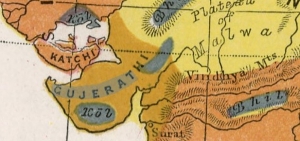
MY WIFE’S COUSIN lives in a part of the Indian state of Gujarat called Kutch (‘Kachchh’). He and his wife have a lovely farmhouse near the port city of Mandvi, where you can watch huge wooden dhows being constructed along the riverbank. Although Kutch is now a part of the state of Gujarat, it has not always been. The people of Kutch (‘Kutchis’) speak a language quite distinct from Gujarati. The Kutchi language has closer similarity to Sindhi than to any other Indian language (Kutch is bordered to its north by Sindhi speaking people*). It is a spoken language, but not written. Even though Kutchi people can speak and write in Gujarati, they will proudly inform you that they are Kutchis and definitely not Gujaratis. During our several visits to Kutch, my wife’s cousin’s driver, who can speak good Gujarati, insists on speaking to my wife in Kutchi, which she cannot speak as well as Gujarati.
Many people with whom I have discussed my travels, look puzzled when I say that we have been to Kutch. Just in case you are wondering, it is the furthest west part of India. Most of the north of the region is bordered by Pakistan, from which it is separated by the arid Rann of Kutch. To the south and separated from it by the Gulf of Kutch (a part of the Arabian Sea) is the peninsula of Saurashtra – now also a part of Gujarat.
Until 1947, Kutch was a kingdom founded by unifying three separate kingdoms, ruled by branches of the Jadeja family, in the 16th century. In 1819, having suffered a military defeat (at The Battle of Bhuj in March 1819), the Kingdom of Kutch accepted the sovereignty of the British East India Company. Under the watchful eyes of the British, members of the Jadeja family continued to rule Kutch – it became one of India’s many ‘Princely States’. On the 16th of August 1947, one day after India became independent, Kutch voluntarily acceded to the new Indian state.
Kutch became a state of India. In November 1956, as a result of the State Reorganisation Act (1956), Kutch ceased to be a state in its own right, but became a part of the then huge Bombay State. The latter was effectively a bilingual region, most people were either speakers of Marathi or of Gujarati. The Marathis and the Gujaratis began to clash. In 1956, the Mahagujarat Movement began campaigning for a state for Gujaratis, which was separated from that for Marathis. The movement was spearheaded by Indulal Yagnik (1892-1972). His nephew, who lives in Bangalore is a family friend, whom we meet whenever we are in the city. As the Gujaratis clamoured for their own state, so did the Marathis, Blood was shed, and much property was damaged. On the 1st of May 1960, the old Bombay state was divided along linguistic grounds. The states of Maharashtra and Gujarat were formed. The latter includes the Gujarati speaking district of Saurashtra as well as the northern part of the former Bombay State, and also Kutch. And that is how it remains today.
Since 2017, we have made several enjoyable visits to Kutch, from which my wife’s maternal ancestors hail, and enjoyed many fascinating experiences there. Some of these can be found in my new book – a collection of true stories about life in India seen through my eyes. The book (also Kindle) is available from Amazon websites including https://www.amazon.co.uk/HITLER-LOCK-OTHER-TALES-INDIA/dp/B0CFM5JNX5/
*When Lord Napier conquered Sindh *which neighbours Kutch) in 1843, he is reputed to have sent a single word message to London in Latin “Peccavi”, which means ‘I have sinned’.
THE MAJOR AUCTION HOUSES in London, such as Sotheby’s, Christies, and Bonham’s, provide a wonderful service that benefits as well as enticing potential buyers. For several days prior to big auctions, the lots that are about to be sold are beautifully displayed in galleries, which can be viewed by members of the public. What makes these exhibitions so special is that the artworks and other objects on display are usually not viewable by most people because before and after they are sold, they are housed in places, which are completely inaccessible to the general public, such as private collections. Today (5th of June 2023), we paid a visit to Bonham’s in New Bond Street. In addition to seeing a superb display of paintings and prints by contemporary or recent artists from the Indian Subcontinent, there was a fascinating display of – for want of a better word – ‘antiques’ made mostly in India.
One of the lots that will be auctioned is a bowl made of mother-of-pearl. It is described as “Indo-Portuguese” from Gujarat. When it was made, there were already well-established Portuguese settlements in Gujarat – for example, Daman and Diu. Beside the attractive bowl, there was a hand-written note which read as follows:
“Given by Anne Boleyn Queen of Henry the 8th to Sir John Brereton Kt & given in 1839 by Miss Brereton of Brereton Hall Cheshire to Henrietta E Sharpe who has collateral descent from Sir John Brereton”.
Anne Boleyn lived from c1501-1507 until 1536. Brereton Hall, in Brereton, Cheshire, was built after Anne’s beheading in 1536 by Sir William Brereton (1550–1631). So, who was the person to whom Anne gifted the bowl? Before answering that question, I will tell you about William Brereton (c1487-1536) of Cheshire. One of Henry VIII’s courtiers, he was accused of committing adultery with Anne Boleyn, found guilty, and executed. He was a son of William Brereton, who died in 1485. Many historians no doubt that he was guilty. Guilty or not, there was at least some connection between him and Anne Boleyn. If the handwritten label I saw at Bonham’s is accurate, then the recipient of the bowl must have been alive when Boleyn lived. John might have been William’s brother, Sir John Brereton (c1447 – 1527), but I cannot be certain. As for the ‘Miss Brereton of Brereton Hall’, she is difficult to identify without her first name(s). And Henrietta Sharpe, who was given the bowl is also not readily identifiable.
How exactly the bowl came into Anne Boleyn’s possession is yet another mystery, but during the reign of Henry VIII and his predecessor, England and Portugal were on friendly terms. The bowl is not only attractive but also poses many questions, which I am as yet unable to answer. One of these is: who will become its next owner? If you want to know the answer, the auction is being held on the 7th of June. But often, the buyer is anonymous.
Somnath in the state of Gujarat is one of India’s important Hindu pilgrimage centres. People flock to the small town to worship in the Somnath Temple (also known as the ‘Deo Patan’). The shrine has been in existence for many centuries, but was demolished by Muslim invaders several times, and re-built after each episode of demolition. The structure you see today was built in the early 1950s.
To enter the temple, one must first divest yourself of cameras, all electronic equipment, and anything made with leather – remember, the cow is sacred in Hinduism. Although we did not enter the crowded temple because of the long queue, we watched the line of people waiting to file through the security check point at the temple compound’s entrance. Everyone passed beneath a metal detector archway and then was frisked. But it was a frisking with a difference. The security personnel passed their hands up and down, and close to, each of the visitor’s bodies, but made no physical contact with them.
Far less visited than the temple, but close by, there is a fascinating museum containing artefacts – sculptures and architectural fragments. All of the exhibits had once been parts of the former Somnath temples, which had been destroyed. Part of the collection was housed in a building constructed with domes and pillars from the former reincarnations of the temples.
After viewing the museum on a warm morning in March 2018, we were ready for a drink. It was around 11 am and coffee would have been very welcome, but our chances of finding some were pretty slim because we had discovered that in most of Gujarat coffee is not available in outlets providing drinks. As we walked away from the museum, a lady, hearing us speaking in English, stopped us in the street, and told us that she was a retired English language teacher. Kindly, she asked us to come into her home, next to which we were standing, to join her for a cup of – we could hardly believe what we were hearing – coffee. Full of anticipation, we followed her indoors. She told us that she drank coffee all day.
Our hostess fetched two disposable cups and filled them with hot milk to which she added a few grains of instant coffee powder. She seated us in her living room, and soon we were joined by another lady, who had just dropped in to say hello. At about the same time, some (wild) street dogs also entered the house, and our hostess fed them biscuits. Now, I do not want to sound ungrateful, but it was difficult even to imagine that we were drinking coffee because the amount of coffee she had added to the milk was so little; it was homeopathic in quantity.
After a while, our hostess’s husband arrived home and joined us. A retired businessman, he had become a pandit (a Hindu priest). As with many people we had already met during our travels in Gujarat, the first question he asked my wife was about her caste. In her case, that is not a simple question to answer because her parents, who did not believe in the importance of the caste system, were not from the same caste. In fact, my wife had no idea of what her caste until she was 27 years old. One of them was a Kayasth. The pandit explained that the Kayasths are offshoots of the Brahmins, but essentially Brahmin. Later, we spoke about the temples in Somnath. He was attached not to the main pilgrimage temple but to a smaller one nearby, which is much older than the Deo Patan. We had visited it earlier in the day. Kindly, he walked with us through the town, helping us find our way back to our hotel, which was near the town’s quite grand railway station.
Although the coffee was not quite what we were hoping for, the disposable cups deserve more of a mention. The Pandit’s wife cannot have been sure of our castes and was too polite to ask. Well, I do not qualify for any reference to the caste system, and she had not asked my wife about her caste, or even whether she is a Hindu. As a devout Hindu, and a pandit’s wife, she could not risk her coffee cups becoming polluted by being touched by people who were not, or might not be, of the right caste. For safety’s sake, she used the cups that could be disposed of after we had touched them.
SOME YEARS AGO, I bought a book in the antique shop on Princess Street in Fort Kochi. It is a modern reproduction of a book published in about 1910. Its subject matter, mostly in English, is a detailed description of the benefits of living in Cochin. Its intended audience was Gujarati speaking people thinking of settling in the area. It was aimed at Hindus, Moslems, Jains, and Parsis.
A few days ago (in February 2023), I purchased a recently published book by Bony Thomas called “Kochiites”. It describes the many different communities that have settled in Kochi. One brief chapter is about the small group of Dawoodi Bohri, Shia Moslems, who live south of the historic centre of Kochi. Another is about the Hindu and Jain Gujaratis (and Kutchis), whose communal activities are centred along the 1 mile long Gujarati Road. As my wife has roots in Kutch and the rest of Gujarat and we enjoy visiting those parts, we decided to take a stroll along Gujarati Road, which is in the Mattancherry District of Fort Kochi. It was Sunday morning.
Gujarati Road runs in a north south direction. We began our exploration at the Jain temple and moved southwards. At the Jain temple, we were not the only tourists. My wife was the only visitor who could speak in Gujarati with the lady who showed us around the spotlessly clean Mandir. Its interior has a beautiful inlaid multicoloured floor and the inside of the main dome was a replica of the kind of domes with concentric ridges that one sees in mediaeval Hindu and Jain temples, as well as in mosques constructed during that period. Photography was not permitted within the temple.
Our next port of call was the shop of Chamanlal H Mithalwala. For many generations, this shop, owned by Gujaratis, has been selling Gujarati sweets and farsan (savoury snacks). We were able to buy some freshly made dhokla. However, we were told that khandvi always runs out in the early morning on a Sunday, soon after it has been made. The owner is Kutchi, as are many of the folk who live near Gujarati Road.
The Sri Jalaram Dham, a Hindu temple frequented by Gujaratis and financed by them, is almost opposite the sweet shop. Built quite recently (2012), it is not particularly noteworthy architecturally. It contains several brightly coloured idols and a small tulsi tree grows outside. The priest (pandit) told us he came from Rajkot, and almost all of the worshippers are Kutchis.
Just to the south of the Jalaram Dham, we reached the Sri Cochin Gujarati Vidyalaya, a Gujarati school in which most of the teaching is done in English. Founded in 1920, it has about 3000 pupils and covers education from lower kindergarten to college entry.
Within the school’s compound, there is a Hindu temple – about 140 years old. Its ceiling is decorated with larger than life bas-relief lotus flowers. We spoke with a trustee of the temple, who showed us some of the original idols and explained that in the area there are about 200 Gujarati families. Of these, 48 are Kutchi Bhatias, about 100 are other Hindu Gujaratis, and the rest are Jain. The temple is Shaivite. Our informant told us about another temple, which is Vaishnav and is frequented by the local Kutchi Bhatias. This interested us because my wife’s mother was a Kutchi Bhatia.
As can be seen all over Gujarat, there is a chabutra (dovecote) next to the temple. There is another one at the Jain temple, mentioned above
We continued south along Gujarati Road, passing the Gujarati Bhavan (which we did not enter) and several wonderful fruit and vegetable stalls.
Near the fruit and veg shops, which are located near the southern end of Gujarati Road, there is yet another temple – the Shri Navneeta Krishna Mandir. This is the Vaishnav temple used by many of the Kutchi Bhatias. The main temple was locked up, but behind it there was a lot of activity. This was centred around the mandir’s gaushala (cow shelter), where cows are provided with a pleasant home.
Worshippers were feeding the cows and calves. They were also placing cloths on the cows before handing them to the priest who was standing amongst the congregation. We were asked to touch one of these cloths before it was handed to the priest. The congregants took it in turns to touch the priest’s feet, and receive a blessing.
Near to the temple, there is a large housing compound, all of whose residents are Kutchi Bhatias. One sweet couple invited us into their ground floor flat, saying to us: “Welcome to our home. As guests, you are gods.” We chatted with them both in English and Gujarati. They gave us lovely cups of chhaas (buttermilk, a typical Kutchi drink). They offered to cook us lunch, but we declined because we had to get somewhere else. This charming couple, Deepika and Harish, did not want us to leave. When we did eventually go, I felt that we had been in the company of genuinely warm-hearted loving people.
Before setting off for Gujarati Road, I was worried that it might offer little of interest. How wrong I was! Although I have only briefly summarised our experiences, we saw many interesting places and met many friendly people. Over the years I have been falling in love with Gujarat and Kutch. This small outpost of people from that part of India in Kerala has only increased my affection for Kutch and Gujarat.
[NB Kutch, which is now a large district in the State of Gujarat, was an independent kingdom until 1947. Even today, no self-respecting Kutchi likes to be called a Gujarati!]





 yamey
yamey 