Three buildings of historic interest in London’s Endell Street

IN THE 1980s, there was a shop that sold a variety of products imported from Communist Albania, which was then ruled by the Stalinist dictator Enver Hoxha and, after 1985, by his successor Ramiz Alia. I visited it once or twice. Although it had a few items of interest, it was quite expensive. The shop, which had closed by 1990, was in Betterton Street, which leads from Drury Lane to Endell Street, which is not far from the Seven Dials.

Yesterday (20th of June 2024), we walked along a part of Endell Street and then into Betterton Street, on our way to the Garden Cinema (in Parker Street). We watched a completely weird, arthouse film called “Daisies”, which was made in Communist Czechoslovakia in 1966. Despite being awarded a Czech film prize in 1966, it was banned by the censors in 1967.

Returning to Endell Street, we spotted three buildings of interest. The first of these is on the southeast corner of Endell Street and Shorts Gardens. It bears a commemorative plaque that reads:

“Zepherina Veitch (1836 -1894) Dame Rosalind Paget (1855 – 1948) Pioneering midwives trained at the British Lying-in Hospital, founded 1739 and sited here, 1849 – 1913.”

The tall Victorian building, to which this plaque is attached, is red brick with white stone facings. Between 1849 and 1913, this place housed a hospital for married women in the last month of pregnancy. A website concerned with former hospitals (https://ezitis.myzen.co.uk/britishlyingin.html) related:

“The staff consisted of two physicians and two surgeons who practiced midwifery, a Matron skilled in the same, a chaplain, an apothecary, nurses and ‘other inferior servants’.  Women were admitted in the last month of their pregnancy – they were only permitted to stay for three weeks – and needed a letter of recommendation from a subscriber (patients were not charged by the Hospital) and an affidavit of their marriage and their husband’s settlement.”

Adjoining the former lying-in hospital, there is an edifice made with layers of bricks that vary in colour and white stone trimmings. It has Victorian gothic features, and its Endell Street facade bears an inscription, which reads:

“Lavers and Barraud Stained Glass Works”

This firm was founded in 1858 by Nathaniel Wood Lavers (1828–1911) and Francis Philip Barraud (1824–1900). When Barraud (of Huguenot descent) became dissatisfied with the firm’s designs, he was recommended to hire Nathaniel Westlake (1833-1921) as a designer. Westlake’s knowledge of mediaeval art and skills in the pre-Raphaelite style of art brought fame and fortune to the firm in the 1860s. In 1858. He became one of the firm’s partners, and in 1880, he became the firm’s sole owner.

A building on the corner of Betterton Street and Endell Street, across the road from the former stained glass works bears a plaque that informs the viewer that in this house, number 20 Endell Street, Westlake resided in the 1880s. His firm continued in business until his death.

So, today, neither the lying-in hospital nor the stained-glass works are still operating, and the Albanian shop has long gone. However, one place that would have been in business when those two places were functioning, is still in business: The Cross Keys Pub. Established in 1848, this pub has a baroque Victorian façade. The interior of this long narrow hostelry is most people’s idea of a real old-fashioned pub. A long bar with brass fittings runs along one side of the saloon, The walls are covered with numerous paintings and prints and several glass cases containing stuffed (taxidermy) fish. All manner of things, including a brass instrument and an archaic diver’s helmet, are suspended from the ceiling. Yet, despite this great amount of assorted ‘clutter’, the pub has a cosy atmosphere. When we dropped in for some mid-afternoon refreshment, there were a few other customers – mostly elderly local people. Although in the heart of the city, the pub has a rustic feeling about it. I suspect that workers and other staff from the stained-glass factory used to pop into the Cross Keys for liquid refreshment. But I wonder if many of those associated with the lying-in hospital -staff or patients – were patrons.

After dallying in Endell Street, we walked the short distance to the Garden Cinema in Parker Street to see the Czech film. If you have not been to this cinema, you are missing a treat – it is a truly independent, art-house cinema (see www.thegardencinema.co.uk).
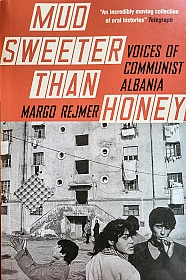
Mud sweeter than honey: Albania under Enver Hoxha

IN MAY 1984, I visited Albania, which was then still under the rule of its Stalinist dictator Enver Hoxha (1908-1985). The year before, I had spent a fortnight in Bulgaria. My impression was that Bulgaria was much less vibrant than Albania. In Albania, which had to be visited in an organised group tour, we were treated well, shown a great deal, and were fed well. I knew that by 1984, Albania was far more sealed off from the rest of the world than North Korea is today. Several things were curious about our visit. First, we were not allowed to converse with any Albanians apart from our three official guides or ‘minders’, and other Albanians were unable to converse with, or even approach, us. Secondly, we were watched carefully, even followed by plainclothes agents. Thirdly, and most strangely, whenever we ate a meal, we were kept out of sight of Albanian onlookers. Either we dined in a private room, or our tables were surrounded by curtains or screens, which separated us from other diners and staff in hotels or restaurants.

Our Albanian hosts successfully showed us some of their country’s beautiful towns, countryside, and other attractions. Their aim was to show us westerners what an ideal country Enver Hoxha and his regime had created. And to some extent, I was fooled by what I saw. Many years later, I visited the country (in 2016), and met people who told me that what I had seen was carefully stage managed – a sort of Potemkin village on a grand scale. One person told me that three days before visitors (foreign or state officials) visited the village to which he had been exiled, the town would be cleaned up, the usually empty shops would be stocked, and other things would be arranged to give the place the appearance of prosperity. And as soon as the visitors had passed through, everything would be returned to its normal depressing condition.

After returning from my second trip to Albania, I read a biography of Enver Hoxha written by Blendi Fevziu, and published in 2016. In it, I discovered something that really shocked me. He wrote that by 1984, when I was being wined and dined royally by our Albanian hosts, most Albanians were starving because of a man-made famine that had begun a couple of years earlier. It was no wonder that whenever we ate, we and our food was kept out of sight of all but the most trusted waiters and staff.  

Even when I was in Albania in 1984, I was aware that Hoxha’s regime, like many others run by dictators, was home to prison camps for those who were alleged to have upset the dictator and his paranoid security services. As Margo Rejmer shows in her excellent book “Mud Sweeter Than Honey”, it did not take much to land up in one of Hoxha’s hellish prison camps, and many people suffered this fate.

Rejmer interviewed many people who had lived during Hoxha’s long reign. She successfully demonstrated that every Albanian from the humblest peasant to the highest state official lived in a constant state of fear. Up to one in three people were employed as informers for Hoxha’s secret police – the Sigurimi. It was even dangerous to express one’s thoughts to close members of one’s family. The paranoid dictator ruled, as did Stalin, by endlessly imprisoning or killing anyone that could even slightly be considered a threat to him. Rejmer’s book illustrates this very well and also describes the unbelievable cruelty that prisoners had to suffer in the camps, where they were made to do unpleasant unpaid work, especially in mines.

I am very glad that Rejmer’s book had not yet been written in 1984, because had I read it then, I am certain I would never have set foot in Albania. It is a highly readable, compelling book about the horrific era during which most Albanians had to suffer. My only criticism of it is that she tends to concentrate on people who suffered badly under the regime. However, I suppose it was difficult for her to find anyone who honestly thought that Hoxha had created the paradise, the existence of which our tour guides hoped to persuade us in 1984.

PS My memories of the 1984 visit to Albania are recorded in my book “Albania on My Mind” (https://www.amazon.co.uk/Albania-My-Mind-Adam-Yamey/dp/1291111476/)

All wrapped up

TODAY, WE SENT some books from Kolkata to Bengaluru (Bangalore) to lighten our luggage because domestic flights in India restrict the amount of baggage one can carry. The process reminded me of sending books from other countries.

I used to visit Yugoslavia a lot when it still existed. One one occasion, I wanted to send some heavy books from Belgrade to London. I went to a large centrally located post office. Within the building there was a counter for wrapping parcels. For book post, the books had to be wrapped a certain way. They had to be packed so that a part of each book was left uncovered. This was so that the customs and postal people could see that it was books that were being dispatched.

In 1984, I visited Yugoslavia’s neighbour Albania, which was then under the strict Stalinist dictatorship headed by Enver Hoxha. We had to travel through Yugoslavia to reach and leave Albania. I had read that books from Albania would be confiscated by the Yugoslav customs, and that it was best to post any books bought in Albania back to the UK. In anticipation of this and following the advice that parcel wrapping materials were not available in Albania, I brought brown wrapping paper, adhesive tape, and string from home.

I bought several books in Albania and wrapped them up with the materials I had brought from England. Along with a fellow traveller, an Australian post office official, I took the parcels to a post office in central Tirana. The parcels were weighed by a person at a counter, and he handed me the right amount of stamps for each package. After affixing the stamps, I handed the parcels to the Albanian post office worker. He examined them, then tore off one of the stamps before rapidly reapplying it. I had inadvertently stuck on the stamp upside down. As he restuck the stamp, which bore an image of Albania’s fictator, he said “Enver Hoxha “. Apparently, sticking him upside down was considerable disrespectful. My Australian companion was horrified. He exclaimed:
“Removing postage stamps from mail is against international postal regulations. He shouldn’t have done that.”

Today, in Kolkata, we took our books to a post office in Park Street. Pn ots steps, there are several men who wrap and label parcels to be posted. One of them took our books, wrapped them in cloth bags, and then in a strong plastic sheet, which he carefully sewed up with a beedle and thick thread. This was then wrapped in another layer of plastic, sealed with tape. Upon this he wrote the address to which it was being sent, and our address in Kolkata. Then the whole thing was wrapped in tough transparent plastic to protect the parcel from adverse weather conditions. After this, he carried to parcel to the correct counter, where we paid the postage: about £2.75 for 8 kilograms. The wrapper’s charge was less than £1.

The books I sent from Yugoslavia and Albania arrived safely. So have other parcels I have sent by post from one Indian city to another. So, I am reasonably optimistic that our 8 Kg packet will arrive ‘in good nick’.

Just in case they attack

AFTER WW2 MANY thousands of concrete bunkers were built all over Albania because the country’s paranoid and brutal dictator Enver Hoxha, who ruled between 1944 and 1985, was concerned that the country would be invaded by its neighbours or others further afield. The invasion never happened. Likewise, the much-feared invasion of the UK during WW2 never occurred (except for the Channel Islands). However, in anticipation of a feared German invasion of the UK, the country, like Albania, was covered with concrete fortifications in many shapes and sizes. During a recent visit to Sidmouth in Devon, I spotted one of these, a small concrete ‘pill box’.

Located high on a cliff (overlooking Jacob’s Ladder Beach) next to Sidmouth’s Connaught Gardens, this small bunker was probably constructed as part of a coastal defence system in  1940-41. Later in WW2 when the risk of a German invasion was getting smaller, it was used during the training exercises that were performed prior to the Allied invasion of Normandy in early June 1940. It was from the south Devon coast that the invasion force set out for France.

Designed to resist destruction, bunkers such as the small one I saw in Sidmouth (and the multitude of mostly hemispherical bunkers I have seen in Albania), they are both difficult and expensive to remove when they are no longer needed. Interestingly, these concrete defences are no guarantee against successful invasion, as can be seen from the ineffectiveness of the Maginot Line in eastern France and the huge structures built by the Germans on the Atlantic coast of that country.  

A chapel that became a barn

PHILIP’S NAVIGATOR BRITAIN is a detailed (1 ½ miles to the inch) road atlas covering England, Scotland, and Wales. It is extremely useful for finding one’s way through Britain’s maze of narrow country lanes if, like us, you do not make use of GPS systems. One of the many features of the maps in this atlas is that it marks old buildings and other sites of interest in both towns and deep in the countryside. Recently (June 2021), we were driving around in rural Wiltshire, having just visited the small town of Bedwyn when I spotted that there was an old chapel nearby, close to the hamlet of Chisbury.

The area in which Chisbury is located is the site of an ancient hill fort in which archaeologists have found artefacts from the Palaeolithic era, as well as the Neolithic and Bronze Ages. The fort, whose earthworks are still discernible, was later used by the Romans. Long after the Romans had left England, the manor house of Chisbury was built within its site.

In the 13th century, the Lord of Chisbury Manor built a ‘chapel of ease’, St Martin’s, close to his manor house. According to Wikipedia, such a chapel is:

“…a church building other than the parish church, built within the bounds of a parish for the attendance of those who cannot reach the parish church conveniently.”

The chapel of ease at Chisbury was built to serve the household of the Manor House as well as villagers nearby, to save them having to travel to the nearest parish church which was in Great Bedwyn.

In 1547, during the Reformation of The English Church, the chapel, like many other places of worship in Henry VIII’s realm, ceased to be used. Instead of being demolished, as so many ecclesiastical buildings were at that time, the chapel was re-used as a barn. The barn continued to be used over several centuries until 1925, when it was designated a building of historical importance. Now, it is maintained by English Heritage. This re-purposing of a place of worship reminded me of what I saw when I visited Albania in 1984. At that time, religion of any sort had been made illegal by the Stalinist regime led by Enver Hoxha. Mosques and churches had either been demolished or re-purposed as sports halls, cinemas, and for other non-religious uses.

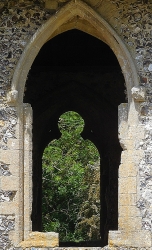
The chapel of Chisbury is beautiful. The glass has been long lost from its windows. Trees can be seen from within the chapel through its carved stone gothic windows. The ceiling of the chapel is timber framed, but I suspect that these are no longer the original timbers. The roof is thatched. The floor is at two levels, higher at the west end than the east. Steps lead from one level to the next. The two levels might reflect the fact that the chapel is built on a steeply sloping hill.

On the inside of the west wall of the building, close to the way into the chapel, there is a faded red painted circle enclosing a cross. Symbols like this were painted on to the walls of buildings during the consecration ceremonies of building about to become churches. What you can see in the chapel at Chisbury must have survived many centuries. Maybe, it has been touched up from time to time.

It is written that Jesus Christ was born in a kind of barn surrounded, as the story goes and many artist have depicted, by farm animals. I wonder whether this went through farmworkers’ heads as they used the former chapel as a barn for a variety of agricultural purposes.

Had it not been for builders working nearby, the chapel would have been silent except for birdsong. I am glad we made the small detour to see this delightful relic of mediaeval life in England.

In memoriam: do not pull it down

TEARING DOWN STATUES or defacing them is nothing new, as some might believe after hearing about dunking Edward Colston’s toppled statue into a river in Bristol.

Violette Szabo

When I visited Albania in 1984, I saw statues of Josef Stalin and the Albanian dictator Enver Hoxha prominently placed in public spaces. Neither of these two gentlemen can be seriously considered to be God’s best gifts to humanity. Many of their actions caused great fear and suffering in both the former USSR and in Albania.

In 1991, Albania’s long (1944-1991) Communist regime crumbled ignominiously. In February 1991, citizens of Albania’s capital, Tirana, attached cables to a huge statue of Enver Hoxha, an admirer of Stalin, and pulled it down. Many of the police guarding the huge monument to repression assisted the people to cause this bronze statue to topple to the ground.

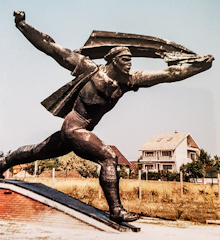
Years later, in 2016, we visited Albania. In the centre of Tirana, there is a national museum of art, which was present when I visited the city in 1984. Back then, and even in 2016, there was a good collection of fine works created in the Social Realism style, so popular amongst Communist regimes. After seeing the gallery in 2016, we happened to bump into one of the museum’s curators. I showed him a picture of a sculpture I had taken in 1984 and asked him if he recognised it. Without answering, he invited us to follow him to a yard at the rear of the gallery.

There, in the yard, stood the sculpture I had photographed in 1984. More interestingly, it was not alone. It stood next to a giant statue of Lenin and another one of Stalin and another large object wrapped in cloth tied down with ropes. The curator explained that these statues, although they depicted people whose ideas and actions had done much harm to the Albanian people, were valuable works of art, not simply because of their great scrap metal value but, more importantly, they helped record the country’s history. In addition, he explained that they were fine examples of their genre. The bundled-up object standing in that yard was, he explained, too sensitive to uncover as it would upset many people viewing it. It was part of an enormous statue of Enver Hoxha, who had not yet been forgiven by many Albanians. Clearly, Lenin and Stalin were thought to be less disturbing as they were not covered up, but sufficiently upsetting to be confined to a relatively unvisited yard behind the gallery open to the public.

Both Trafalgar and Parliament Squares in London contain statues that might cause offense to those whose knowledge of history is more than superficial, yet their actions have not always been 100% reprehensible. Fortunately for these monuments, many of the kind of people who might be inclined to topple statues do not usually read much detailed history.

There are some statues or monuments, which remember people, whose actions cannot rationally be called into question. One of these is that of Edward Jenner (1749-1823), whose work formed the foundation of something on which we are currently becoming extremely dependent: vaccination. Only someone out of his or her mind would consider pulling down or defacing his statue.

Recently, when strolling along an embankment, I spotted a monument close to the River Thames outside Lambeth Palace. Erected in 2009, it commemorates the Special Operations Executive (‘SOE’), whose covert activities in no little way helped to bring about the defeat of Nazi Germany’s forces during WW2. The plinth with metal commemorative plaques is topped with the head of a woman with high cheekbones, a serious, determined face, and luxuriant curly hair, tied back. She stares out across the River Thames toward the Houses of Parliament. The bust depicts Violette Reine Elizabeth Szabo (1921-1945), whose actions behind enemy lines in France were designed to sabotage German military activity. She was one of many women including Noor Inayat Khan (1914-1944), of Indian aristocratic heritage, who risked and lost their lives to assist in the defeat of a repressive regime.

SOE was staffed by both men and women of many nationalities, and their bravery is recorded on this simple memorial outside Lambeth Palace.  Although simple in design, the expression depicted in the face of Violette Szabo gave me a feeling of the great determination of those brave souls who gave up their lives in horrific circumstances. They did so in the hope, fulfilled, that we could enjoy life in Britain and elsewhere without having to bear the burden of inhumane dictatorial rule.  

Unlike Stalin and Hoxha, statues of the purely benevolent such as Jenner and Szabo should be allowed to stand undisturbed for ever, well, at least, so long as they can survive London’s ever-changing weather conditions and pollution.

Hidden in the rocks

MY FASCINATION WITH MILITARY bunkers began after visiting Albania in 1984, when the country was stilled being ruled by the last regime in Europe that still revered Joseph Stalin. Tiny Albania was surrounded by potential enemies, Greece, Yugoslavia, and Italy across the Adriatic. Having had his country invaded many times in the past, Albania’s dictator, Enver Hoxha (who ruled between 1945 and 1985) was determined to make the country as impregnable as possible. One approach that he adopted was to cover (literally) the entire country (towns and villages included) with small (and large) concrete bunkers, many of them were hemispherical in shape. As Albania was never invaded after 1945, the effectiveness of these concrete structures that looked like a severe rash of pimples was never put to the test.

blog cave

Bunker at Torcross

The same can be said of the numerous concrete bunkers that were constructed in many strategic places all over England before and during WW2. Fortunately, the Germans never managed to invade the UK, with the exception of the Channel Islands. Judging by how useless the Maginot Line proved to be in France, I suspect that the British bunkers would have been fairly useless had the Germans invaded.

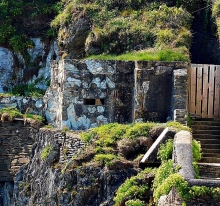
Today, we visited the tiny hamlet of Torcross in south Devon. It lies at the southern end of the long causeway that separates the sea from Slapton Ley, a large freshwater lake. While sitting at an outdoor table on the sea front at Torcross, I was staring at a picturesque rocky outcrop when I noticed what I thought was a rock with a rectangular slit cut in it.

Looking more closely using my camera’s zoom lens, I realised that the slit was really there, but it was cut in something that was not rock, but a thick concrete wall. The wall looked identical in texture to the rocks surrounding it. I realised that what I was looking at is an old bunker that ovelooks the long stretch of Slapton Sands, which is on the sea side of the causeway. It overlooks what would have been a perfect beach for a foreign invasion force to land.

In fact, the stretch of beach known as Slapton Sands was used by an invasion force in 1944. It was not a hostile force belonging to the Axis powers, but a friendly one used by Allied troops. The troops, mostly Americans, were using Slapton Sands to practice or rehearse the planned landings (on D Day) that were about to take place in Normandy as a prelude to recovering Western Europe from German occupation.

As I have described in another post, the rehearsing Allied troops were attacked by German boats, resulting in the tragic deaths of over 700 young Americans. The Germans, based in France, attacked the beach at Slapton Sands because they had picked up very busy radio signal activity in the area. Luckily for the planned invasion of France, the German attackers had no idea of what was being rehearsed at Slapton. Had they known they might well have returned to do even more damage that might have sabotaged the D Day invasion plans.

An amphibious tank, recovered from the sea in 1974, stands at Torcross as a memorial to the men who lost their lives during the German attack of the boats and other military positions at Slapton Sands.

The bunker, which I spotted at Torcross, is known as ‘Pillbox Torcross’. Near to the former Torcross Hotel, this was one of six bunkers at the south end of Slapton Sands. What I thought was concrete is actually local stone (see https://www.heritagegateway.org.uk/Gateway/Results_Single.aspx?uid=MDV39402&resourceID=104).

 Hence, it blends with its surroundings far better than it would have had it been built in concrete. Whether or not this and the other bunkers nearby were of any use when the Germans attacked during the very early hours of the 28th April 1944, I cannot say. However, I feel that given the devastating results of the German attack, this is unlikely.

Today, Torcross is a popular place with visitors. It has several eateries and places to stay. During past visits to this delightful spot, once the scene of a horrible tragedy, we have eaten good seafood at the Start Bay Inn, which is only a few feet away from the tank memorial. The inn was established in the 14th century, when it was known as ‘The Fisherman’s Arms’.

Visiting Torcross provides a good place to reflect on the heroism of those who fought in WW2. Little did those 700 or more men lost in this place in 1944 know that their sacrifice has allowed us to enjoy holidays at this beautiful spot. Whenever I am at Torcross, I have mixed emotions: joy because of the place’s great natural beauty, and sadness when I look at the tank memorial and remember why it is there. Had the D Day landings been thwarted, who knows under what kind of regime we would be living today.

Death of a theatre

ON SATURDAY THE 17th MAY 2020, an act of cultural barbarism was performed in Tirana, the capital of Albania. The National Theatre of Albania in the heart of the city was demolished. It is unclear who ordered this demolition of a much-loved cultural monument located in a part of the city where property prices are high. The theatre was built in 1939 during the period that the Italians, under Mussolini, were ruling Albania. It was originally a cinema designed by the architect Giulio Berte, but later its screen was replaced by a stage.

TIR 4 BLOG

In 2016, my wife and I visited Tirana and attended a dramatic performance at the National Theatre. I have described this in my book “Rediscovering Albania”:

“…we visited the National Theatre, a building that dates back to before Communist times. A Pirandello play (Play without a Script) was to be performed in Albanian that evening. The charming ladies clustered around the ticket desk assured us that we would enjoy it because it was going to be full of song and dance. We bought a couple of tickets … The rectangular auditorium of the National Theatre was delightfully old-fashioned, with many drapes and an upper gallery that extended around three sides of it. Everything was red including the plush upholstery of the comfortable seats. Although we did not understand a word of it, the Pirandello play was acted beautifully. The expressive acting was so good that we were able to get a rough idea of what was going on. Some years earlier in London, Lopa and I once attended a performance of Gogol’s Government Inspector acted by a Hungarian troupe entirely in Hungarian, and on another occasion a play from Kosovo in Albanian, during the course of which one of the actors threw a fake chicken at me! On both of those occasions and also in Tirana, great acting compensated for our inability to understand the words. If the actions of actors move me more than their words, I feel this is a sign of truly skilful acting. As the great Constantin Stanislavski said: “The language of the body is the key that can unlock the soul”. This is exactly what the actors in Tirana achieved. The audience was appreciative, and, unlike at the opera, hardly anyone used their mobile ‘phones during the show.”

That has now disappeared. So, has also the unusually attractive appearance of Tirana as it was when I first visited it in 1984 during the dictatorship of the faithful follower of Joseph Stalin, Enver Hoxha. In those repressive times, Tirana was a quiet city with only one high-rise building, the 12-storey Hotel Tirana. Of course, back in 1984, times were tough for the average Albanian citizen. They remained quite difficult during the decade following the ending of Communist rule in 1991. Even now, many Albanians prefer to increase their prosperity by seeking work abroad.

When we visited Tirana in 2016, I found it to be a far busier place than it was in 1984. The traffic was busy – a sign that motoring, an option not available to most Albanians during the dictatorship, had become popular and also affordable. Some of the charm of pre-1991 Tirana remained, but many picturesque old buildings, examples of traditional Turkish and Balkan vernacular architecture, had disappeared (or were about to). In their place, there were many high-rise buildings of little or no architectural merit. I suspect that whoever ordered the demolition of Tirana’s historic, much-loved National Theatre has in mind to construct yet another aesthetically unpleasing edifice.

If as Shakespeare said, “All the world is a stage”, then the demolition of this theatre in Tirana is yet another tragedy enacted on that stage.

Park of memory

REGIMES RISE AND FALL, as was the case of the Roman, Ottoman, and British empires. Each has left a physical legacy in the form of buildings, works of art, and a plethora of monuments. In India, a part of the both the former Mughal and British Empires, visitors flock to see their tangible remains.

In the late 1980’s, it was turn of the Soviet Empire to decline and fall. In many of its former ‘colonies’, its citizens hastily tried to erase its physical traces. Statues were toppled and monuments destroyed. Some of these artefacts were removed from public view by governmental authorities (maybe because they feared a possible return of Russian domination?)

For good or evil, the Soviet Empire has had a profound influence on what followed in its wake. Whatever one thinks about the Soviet Empire, it has become a significant part of 20th century history and it is a shame to try to erase memory of it. This was also the opinion of the Hungarian architect Ákos Eliőd, who designed the Szoborpark (Memento Park) in the countryside near Budapest.

The Szoborpark opened to the public in 1993. About 6 years later, we drove to Hungary from London. We stayed with a good friend of ours, Ákos, a pioneer of Hungarian rock music, and his family in his home in the outskirts of the hilly Buda section of Budapest. It was Ákos who alerted us to the existence of the Szoborpark.

One sunny day, we drove to the park. It was a wonderful place containing a collection of the Soviet era statues and monuments gathered from all over Hungary. It was/is a treasure trove for those who like or are fascinated by socialist realism art forms, an aesthetic that I like. We spent a couple of enthralling hours in the hot sun, wandering about this open air exhibition.

I took many photographs of the Szoborpark, which I have ‘unearthed’ recently. One of them is of wall plaque celebrating Béla Kun (1886-1938) son of Samu Kohn, a non obervant Jewish lawyer. He was the dictator of a short-lived communist regime that terrorised Hungary for a few months in 1919. With its downfall, Kun fled to the USSR, where he organised the Red Terror campaign in the Crimea in 1921. He was executed in 1938, a victim of Stalin’s anti-Trotskyist purges.

Many years after seeing the Szoborpark, my wife and I visited Albania in 2016, more than 3 decades after the downfall of its highly repressive Marxist-Leninist regime piloted for 40 years by its dictator Enver Hoxha.
Interestingly, all over the country there were still numerous monuments erected during the dictatorial era. Many of them were in need of tidying up or cleaning, but they were still there despite being daily reminders of what was a difficult and fearful time for most Albanian citizens.

We believed that the endurance of these monuments erected during difficult times was due to at least two factors. One of these is that many of them were put up to celebrate heroic feats of Albanians carried out against their German invaders during WW2. The other is that despite Hoxha’s repressive regime, many things were done to move Albania from being a Balkan backwater in the former Ottoman Empire to getting nearer to being a 20th century European state.

This is not to say that statues of Enver Hoxha, Lenin, Marx, and Stalin (the mentor and hero of Enver Hoxha) were not pulled down in Albania. They were, but fortunately a few have been preserved by an art gallery in the country’s capital Tirana.

In countries like Hungary and the former Czechoslovakia, the arrival of the Soviet Army and the Russian domination of their countries was not felt by most citizens to have been even remotely beneficial. Obliteration of memories of this era were not surprising in places like these.

To conclude, I am glad that I have neither lost nor obliterated the photographs I took at the Szoborpark so many years ago.

Postage stamps in Albania

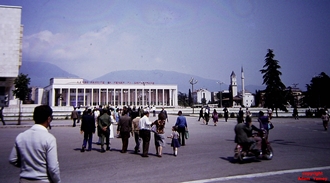
TIRANA Skand Sq with House of Culture and mosque


Recently, I read a blog (Click here) written by an Australian, who has visited North Korea twice. On one of his trips, he visited a museum or exhibition of postage stamps, many of which depict important leaders of the country. Given that it is against the law to deface pictures of these people, he wondered how careful postal officials would have to be when they cancel the stamps with the rubber stamps used for franking. One false move and the great leder’s face might become defaced. In that case, the postal official would risk punishment. This story reminded me of something that I observed in an Albanian post office when I was visting Albania in 1984. In those days, Albania was even more isolated from the outside world than North Korea and it was governed by a stern, repressive regime led by the dictator Enver Hoxha.

This excerpt from my book  Albania on my Mind describes what I saw:

I wrapped my books into a number of parcels, addressed them, and then began leaving the hotel to visit Tirana’s main post office. The Australian, who was travelling with us, spotted me in the lobby and asked me what I was doing. When I told him, he askedwhether he could accompany me to the post office, as he,working as he did for the Australian postal service, was curious to see how things were done by the Albanian post…

… The clerk behind the counter in the Tirana post office offered no objection to the way that I had packed my parcels. He weighed them and then gave me numerous stamps to stick on them. I stuck them on and returned the parcels one by one. The clerk examined each of them to make sure that I had stuck the right combination of stamps on each packet.

Suddenly, he stopped, looked up at me, then at the parcel, before pointing at one of the stamps. In my haste, I had stuck it on upside down. He tore the stamp off the
parcel, and then replaced it the right way up, pointing at the portrait on it whilst saying:
Enver Hoxha.”
The Australian, who was watching this with wide-open eyes,
turned to me and said:
You know, it’s completely illegal to remove stamps from postage. It’s against all international postal rules.”

I did not know what to say, but admired the respect that even a humble postage stamp could inspire in one of Enver’s subjects.”


ALBANIA ON MY MIND 

is available

on Amazon by clicking   HERE

Picture shows Skanderbeg Square in Tirana, Albania, in 1984