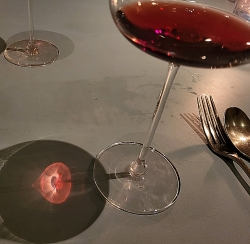
When out dining
Some like red, others prefer white
For quaffing with food

When out dining
Some like red, others prefer white
For quaffing with food
I MUST ADMIT that I have never been much of a sportsma, and I know hardly anything about the game of polo, apart from the fact that it involves both horses and humans. Yesterday evening, as I enjoyed a postprandial brandy in the recently renamed ‘Polo Bar’ (formerly, ‘The Mixed Bar’) at the Bangalore Club, I spotted a large ‘coffee table’ book by Jaisal Singh about Polo and India.

What surprised me is the great age of the game of Polo. It seems to have been existence in some recognisable form as long ago as the 6th century BC. Then, it was played by some nomadic peoples in Central Asia. The book in the Polo Bar has a photograph of a terracotta model of a Chinese woman playing polo. This model was made between the 7th and 11th century AD. Another photograph shows the earliest known picture of a Polo player. This depicts a man on a horse, and was created in the same era as the model.
Much of the rest of the book is about polo in India. It charts the rise in popularity of the game amongst the wealthy rulers of the Princely States and the upper echelons of the British administrators and military in India.
The Polo Bar, which until recently was known by another name, has been decorated with polo memorabilia (e.g., photographs, trophies, and horseshoes). The handle on the door leading into the bar is horse-shaped. However, for me, the most interesting polo related item is in the Club’s Gardens. It is an inscribed stone block, which was the foundation stone of the Domlur Polo Pavilion laid in January 1914 by Lady Daly, wife of the British Resident.
The stone includes the information that one Major C Rankin was “Hon-Secy” and R Evans Esq was the architect. Both were military personnel, members of the “7th (Q.O.) Hussars”. The pavilion’s building contractor was BV Venkataswami Naidu.
In “Bangalore, the Story of a City”, by M Jayapal, the author wrote that initially the race course was out at Domlur. [Hence, the existence of Old Race Course Road]. In the late 19th century it moved to near Lalbagh, and then to its present position near to High Grounds. Presumably, because there had been equine facilities at Domlur, this would have been a suitable place for the Bangalore Club to locate its polo club there. I am not sure whether anything remains of the polo club pavilion whose foundation stone stands in the Bangalore Club gardens.
According to a blog article (https://wp.me/p1YuI1-1xA) about the pavilion, this is of interest:
“Information, thanks to the Bygone Bangalore group on Facebook: The Polo Club was located on Cambridge Road, in the area that is now Cambridge Layout. Opposite the Sai Baba Temple, there exists a portion of an old building which is said to be a part of the Polo Club.”
Incidentally, the centre of Cambridge Layout is less than a mile from the heart of Domlur.
As for the Bangalore Club’s association with polo, the following words quoted from the Club’s website (www.bangaloreclub.com) are of interest:
“Bangalore Club was established in 1868 as the Bangalore United Services Club for the officers of the British Empire. Originally the buildings were occupied by the Polo Club which moved out in the beginning of the 1860’s.”
I do not know how many current members of the Club play Polo these days. Even if it is not many, the Club’s former associations with the military ( the Club was formerly a club for military officers) and the land upon which it stands justify the naming of one of its bars to commemorate what was once known as “The Sport of Kings”.
IN JANUARY 1994, we had a Hindu wedding ceremony in the Indian city of Bangalore. Although the ceremony was attended mostly by family and a few close friends, the reception that followed it had about 350 guests, most of whom I had never met before. So, as an attempt to introduce me to some of them, my parents-in-law arranged a series of parties to introduce me to some of them before the ‘big day’. The gatherings were held in the spacious living room of my in-laws’ home in Koramangala – a suburb of Bangalore. As with many parties held in India, the proceedings began with a long session of drinks and snacks (‘finger food’). The parties end with food served at a buffet. Once, this late supper has been consumed, the guests leave, and the occasion ends abruptly.

My in-laws had a bar counter in their living room. At each party, an off-duty employee from the Bangalore Club was hired to serve as barman. Back in 1994, my preferred alcoholic drink was vodka. I enjoyed drinking it either with lumps of ice or with a drop of water.
At one of the series of parties, I went up to the bar and asked for vodka with water. I was handed a tall glass (approximately 330 ml, I guess) filled with a transparent, colourless liquid. I sipped it. It was rather dilute vodka – not very exciting! When I had finished the glass, I returned to the bar, and said:
“Another vodka, but less water this time, please.”
I did not watch the barman preparing my drink. He handed me a freshly filled glass, which was the same size as the one I had just emptied.
I took a small taste of my second drink. I could not believe what I tasted: it was neat vodka. The barman had poured me a third of a litre of pure vodka. I could not believe my luck. As the evening moved on, I took sips of my reservoir of vodka, and chatted to various people – I hope reasonably coherently.
Eventually, the drinking part of the evening’s proceedings were over, and people began to partake of the dishes on the buffet. Being a member of the family, I waited until the guests had taken their food, before approaching the tables where it was displayed. As I reached a counter, I felt my ankles weakening, and I thought that I might have been just about to topple over, which would not have looked good. Luckily, the vodka had not affected my brain. So, sensing the imminent risk of falling, I gripped the counter with my hands, and thereby averted embarrassing the family.
Now, my drinking habits are not the main point of this short tale. It is the meaning of the word ‘less’ in English spoken in India that is important. If, for example, you want to order coffee without sugar in India, you should say:
“Sugar less.”
That does not mean that you want less sugar in your coffee. It means you do not want any sugar in your beverage. It has taken me years of visiting India to realise this meaning of ‘less’. That is, ‘less’ means ‘none’. I did not know this in January 1994 when I asked for less water in my vodka. I suspect what happened was that English was not the barman’s mother tongue. So, hearing, the word ‘less’, when I had asked for ‘less water’, he had believed that I wanted not a drop of water in my drink.
ONCE A CITY FILLED with lovely gardens and other verdant open spaces, Bangalore (Bengaluru) is growing alarmingly rapidly. So, public spaces that have been as yet saved from being built on are valuable amenities. One of these areas of greenery is the so-called Tivoli Garden, which is in the grounds of Airlines Hotel in the heart of the city.
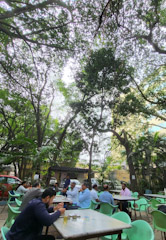
Known popularly as ‘Airlines’, the Tivoli Garden, a name by which it is hardly known, has tables and chairs set out in an open space, a clearing, surrounded by trees, several of them being elderly banyans.
Opened in 1969, the open air café and eatery is still supervised by a man who helped set it up two weeks before it opened all those years ago. Despite its rather untrendy appearance, Airlines is popular with Bangaloreans of all ages. Quite a few of them are students, but many are office workers. Very good South Indian filter coffee is served at Airlines. A wide range of South Indian vegetarian dishes is also served.
The coffee, other drinks, and food are prepared in the kitchen of the hotel. Waiters in white uniforms carry drinks and food across the car park from the kitchen, which is located at the far end of a dingy dining hall, to the garden seating area. Some customers prefer to have their orders served to them whilst sitting in their parked cars.
For my wife and me, Airlines has several attractions. One is the coffee. Another is the pleasant ambience under the trees. And yet another is nostalgia. My wife used to visit Airlines with her family in her late teens. And together with our daughter, my wife and I have been regular visitors to Airlines since when we married in 1994.
For several years, Airlines has been under threat of closure by the people who own the land. Over a decade ago, these people reclaimed half of the area occupied by the café. They built an ugly grey wall (rather like a Berlin Wall) to separate what is left of Airlines from what has now been built on. The supervisor, whom we have known for ages, assured us that as far as he knows the remaining part of the establishment will remain safe from redevelopment.
It would be tragic if Airlines were to disappear, not only because we love it but also it would be yet another example of how what was once a lovely garden city is becoming more and more of an urban jungle
THE BOSTON TEA Party in Salisbury’s High Street serves great coffee and tasty breakfast dishes. It is housed in the premises of what used to be The Old George Inn. This hostelry is in a building, whose construction is said to have begun in the 14th century. Most of the older part of the former tavern straddles a pedestrian footway leading from the High Street to a modern shopping mall and its associated multi-storied car park.
The entrance to The Boston Tea Party is via a shop beneath a building that looks newer than the older looking half-timbered edifice straddling the passageway mentioned above. A staircase leads to a dining area above the shop, which is where we enjoyed breakfast one morning in March 2022. This room has a decoratively patterned plaster ceiling and the remains of an old inscription in gothic script. As we were leaving, I saw a notice that advised customers that if the section, where we ate, was closed, customers should proceed up to the ‘Great Hall’. I was intrigued.
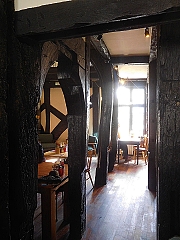
The Great Hall is one of the historical marvels of the city of Salisbury. Its ceiling is supported by beams cut from old ships’ timbers. The Inn has been rebuilt several times. However, the beams that exist today include wood from trees that were felled in the mid-15th century (www.buildingconservation.com/articles/george/inn_conservation.htm). Some of the walls are covered with wood panelling decorated with carvings and there are at least two elaborately carved wooden fireplace surrounds. Other decorative features include plasterwork covered with intricate bas-relief designs, and a lovely bow window overlooking the High Street. The hall is overlooked by a gallery with a balustrade. There is also a window with stained glass that includes a depiction of a royal coat-of-arms and the name of a king, probably Edward VI, who reigned from 1547 until 1553. According to the historicengland.org.uk website:
“On lst floor the south room has early C17 plaster work friezes on beams and carved wood overmantel. Projecting to east on north side open hall through 2 storeys. C15 hammerbeam roof, arched braces to collars. Heavy scissor bracing visible on 2nd floor lath decorated wall plates and spandrels. 2 rooms with tie beams and kingposts with 4-way struts.”
Over the centuries, The Old George Inn has had many visitors including William Shakespeare, Oliver Cromwell, Samuel Pepys, and Charles Dickens. It is believed that Shakespeare and his players, whilst on their way to Wilton, rehearsed “As You Like It” in the garden of the inn. Samuel Pepys spent one night at the inn but moved to another after having argued with the innkeeper over his bill.
Once upon a time, the Great Hall of the Old George Inn would have been filled with guests enjoying tankards of beer and ale and hearty meals. Today, in its reincarnation as The Boston Tea Party, the place is bustling with customers drinking cappuccinos and chai lattes as the consume trendy delicacies such as poached eggs on smashed avocado and ‘The Vegan Boss’. Whether or not you are thirsty or hungry, a visit to the Great Hall is a ‘must’ before or after you have viewed the cathedral.
IT MIGHT BE OBVIOUS to many that the village pub is, along with the local parish church, often the social hub of small settlements all over England. Since the outbreak of the covid19 pandemic, we have not made our usual annual long trip to India. Instead, when public health regulations have permitted, we have been taking the opportunity better our knowledge of the country where we live, England, by making frequent trips to different parts of the land. On all these excursions, we have stopped for food and drink at pubs in many small places. Some of these pubs have become more like restaurants than traditional village social centres, but many still act as communal living rooms where local people gather to drink and chat together.
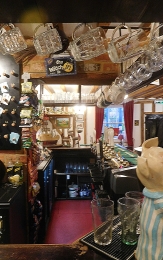
In Cavendish, a small village in Suffolk, there are two pubs. One is more of a restaurant than a traditional pub. By the way, it serves very excellent food. The other pub serves no food except packets of potato crisps. When we visited it, we were told that it only offers drinks. This pub was full of locals talking to each other quite animatedly. One, whom we overheard, claimed to be having a fantastic sexual relationship with a French lesbian, in whose house he had done some plumbing work.
One pub, which we have visited more than half a dozen times since early 2020, is in south Cambridgeshire. The Pig and Abbot at Abingdon Piggots, a village with about 60 households not far from Royston, successfully combines being a meeting place for locals with being a place where very well prepared, tasty food may be enjoyed, either in a small restaurant area or at tables near the centrally located bar.
The current owners, Mick and Pat, have owned the pub for almost 20 years. Pat is a superb cook and warm hostess, and Mick is a knowledgeable and charming host. He told us that the early 18th century building in which his pub is located used to be the local dower house, in which the wife of the lord of the manor lived after she was widowed. Back in those days, women usually outlived their husbands. The dower house was far from being a peaceful retirement home for widows of lords of the manor. It was a hive of activity. It was in the dower house at Abingdon Piggots that bread was baked, and other food prepared, not only for the manor house, but also for all the local families that worked for the lord of the manor. The manor, which had been in the Piggott family, many of whom have memorials in the local church, ended up in the hands of the De Courcy-Ireland family. In the early 20th century, a descendant of the Piggott family, who had inherited the manor married the Reverend Magens De Courcy-Ireland (died 1955). Mick told us that the dower house became a pub during the second half of the 19th century.
While we were enjoying a superb lunch during a recent visit to the Pig and Abbot, we asked Nick how many of the local villagers used the pub regularly. He told us that of the 60 households, 10 were regulars. We wondered whether we were amongst his customers who lived furthest away from the village. He said that we are, but his furthest customer, a former resident in the village, a biologist, now lives in Fairbanks, Alaska. However, whenever he is in England, he makes a point of visiting the Pig and Abbot. Despite this outlier and us, most of the regulars do not come from afar, and I noticed that Nick seems to know most of his customers by their first names.
Of the many pubs that we have visited during our extensive roaming around the English countryside, the Pig and Abbot has become our favourite. From its warm welcoming staff, to its great food and drink, to its range of well-chosen decorations, and to its lovely wood burning fireplaces, it ticks all the boxes, making it a perfect pub. Visiting the Pig and Abbot gives one a wonderful idea of what has made the English country pub such a successful institution over many centuries.

IN THE CENTRE of Warwick, there is a building with superb examples of Victorian decorative terracotta work. High on its façade, in terracotta lettering are the words “coffee” and “tavern” because this edifice began its life as a coffee house back in 1880.
Designed by a Warwick architect Frederick Holyoake Moore (1848-1924), it was constructed for a local manufacturer and philanthropist Thomas Bellamy Dale (1808-1890). He was mayor of Warwick three times and:
“…was a philanthropist in every sense of the word, for his name was connected with the principal benevolent institutions of England, of which he was a generous supporter; as a public man he took a very active part in the sanitary improvements of the borough of Warwick, and in the adoption of the Free Library Act. He was a generous supporter of every useful institution in the town, and, though exceedingly charitable, was most unostentatious in all his benefactions.” (www.mirrormist.com/t_b_dale.htm)
In the 19th century, alcohol consumption was considered to be responsible for the ill-health of poor people and detrimental to their general well-being. Dale built his coffee tavern and hotel to offer an alternative to alcohol and pubs. His establishment had:
“…a bar and coffee room on the ground floor with service rooms at the rear; a bagatelle room, smoke room and committee and club room on the first floor, and rooms for hotel guests on the second floor.” (www.ourwarwickshire.org.uk/content/article/coffee-tavern-warwick).
The place was designed to keep people away from alcohol, “on the wagon”.
Now, all has changed. Today, the building still offers refreshments and hotel rooms, but does something that the late Mr Dale, who encouraged people to become teetotal, would not approve. Customers at what is now named “The Old Coffee Tavern” can now enjoy not only coffee but also a full range of alcoholic drinks. He might be pleased if he knew that when we visited its pleasant lounge decorated with colourful tiled panels, we chose to sip coffee rather than drinks containing an ingredient that did not meet with his approval.
NAPOLEON BONAPARTE DIED in captivity on the tiny island of St Helena in the south Atlantic. While he was imprisoned on the island, Lieutenant General Sir Hudson Lowe (1769-1844) was the Governor of St Helena. He was buried at St Mark’s Church in North Audley Street in London’s Mayfair, where a commemorative plaque can be found by the main entrance. St Mark’s was built in the Greek Revival Style in 1825-28, designed by John Peter Gandy (1787-1850). In 1878, the church architect Arthur Blomfield (1829-1899) made considerable alterations to its interior including adding a timber vaulted ceiling over the nave.
During the 1950s and 1960s, the size of St Mark’s congregation diminished significantly. In 1974, the church was made redundant, and this is how it remained until 1994, when the church was used by The Commonwealth Christian Fellowship. It continued to serve this group until 2008. After that, it was used as a venue for occasional events. In about 2019 after a 5 million Pound restoration programme, the church underwent a surprising reincarnation.
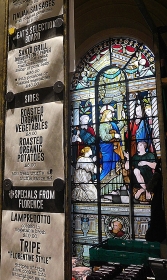
After passing beneath the grand portico supported by two columns topped with ionic capitals, one enters the church’s large vestibule. Since 2019, this has become a marketplace selling upmarket Italian delicatessen goods. Entering the body of the church is rather like taking part in a Fellini film. The floor of the nave is filled with tables and chairs and people drinking and dining. The side aisles, north and south, contain several kitchens, preparing and serving a wide variety of foods, from Turkish to Thai. On the north side of the chancel, just behind the neo-gothic stone pulpit, there is a gin bar, and facing it on the south side of the chancel, there is another bar providing alcoholic refreshments. Look upwards and you can admire the splendid timber roof supports. The wide gallery surrounding the nave at the first-floor level is home to more food stalls, each offering tempting looking fare at not unreasonable prices, especially by local Mayfair standards.
In 2019, the church became home to a branch of Mercato Metropolitano, whose first venture was converting a 150,000 square foot disused railway station in Milan during the 2015 World Expo in that Italian city. The idea of the company was:
“The development of the first Mercato Metropolitano was carefully planned to retain the site’s original appearance, which nurtured the local community’s affection for a special part of their urban history.”
(https://www.mercatometropolitano.com/mmarketplace/#the-mercato-story).
And this is what has been done at the former St Mark’s in Mayfair. Many of the church’s fittings (for example, the tiled floors, the stained glass, the monuments, the pulpit, and the sacred paintings at the east end of the chancel) have been preserved. Entering the church is like entering the scene of a lively gargantuan feast. Seeing the large number of customers on a weekday lunchtime demonstrates that Mercato Metropolitano have successfully created a great place to meet, eat, and drink. It is highly original and exciting, both visually and gastronomically.
In Chapter 21 (verses 12-13) of the Gospel according to Matthew, we learn that:
“…Jesus went into the temple of God, and cast out all them that sold and bought in the temple, and overthrew the tables of the money changers, and the seats of them that sold doves, And said unto them, It is written, My house shall be called the house of prayer; but ye have made it a den of thieves.”
I just cannot help wondering, as many of you might also be doing, what The Good Lord would have made of what can now be seen inside the Church of St Mark’s in Mayfair.
WE USED TO DRIVE to France during the early 1960s when I was a child and before the M2 motorway was in use. The first part of the drive was from London to Dover and prior to the opening of the M2, it was a slow journey because the main road went through numerous small towns in Kent instead of bypassing them, which the M2 does. To break the tedium of the lengthy drive, I used to count how many Esso filling stations we passed as well as the number of Fremlin signs along the road. I liked the name Fremlin, but in my childhood, I was unaware that this was the name of a brewery based in Maidstone (Kent) and founded in 1861. It is a long time since I passed the time on journeys by counting signs such as Esso and Fremlins, whose name appealed to me. Recently, we drove through the centre of Hertford (in Hertfordshire) and I spotted several buildings bearing a name that intrigued me because we have friends with the same name (as surname). The name is McMullen and it, like Fremlins, is the name of a brewery.

Peter McMullen (1791-1881), the son of a Scottish nurseryman, founded his first brewery at Railway Street in Hertford in 1827. It was his wife’s idea. She suggested that it would be better to open a brewery rather than to continue his hitherto rather unsatisfactory life poaching and undertaking failed apprenticeships (www.mcmullens.co.uk/about-us/our-history). Given that the first railway station opened in Hertford in 1843 (www.hertford.net/history/railway.php), Railway Street must have had another name when the brewery was established. The business was expanded in 1860 by his sons Alexander and Osmond McMullen, when they took over the brewery. They bought some other breweries and opened several pubs run by tenants. By 1910, McMullen was one of 1284 brewing companies that were in business in the UK. By the 21st century, it was one of the 38 of these that remains. Now in 2021, it is run by the sixth generation of Peter McMullen’s family (https://en.wikipedia.org/wiki/McMullen%27s_Brewery).
One of the first beers brewed by Mcmullen, which has been available since 1833, was Mcmullen AK. This and several other brews are cask ales. The company also produces bottled beers including McMullen Hertford Castle, which is named after Hertford Castle, where Queen Elizabeth I visited frequently during both her childhood and her reign. The castle still exists: the remains of an early motte; Norman encircling walls; the so-called Gatehouse, built by Henry VIII; and other more recent additions. Incidentally, the Castle was the home of The East India Company College between 1805 and 1809, which then moved to Hailey, also in Hertforshire. The college’s presence in Hertford was before McMullen began producing beer in the town.
The company produce an IPA (Indian Pale Ale), suitable for exporting to tropical climes, but I do not know whether this was ever shipped out to India. The company’s history relates:
“The McMullen relationship with IPA can be traced back to the 1800’s when Peter McMullen recorded the brewing of an East India Pale Ale with connotations of the brew being commissioned to quench the thirst of the British Army at the East India Company College originally in Hertford.” (www.mcmullens.co.uk/blog/2019/04/mcmullen-rebranding#.YJKaSrVKhPY)
Well, you do not have to travel as far as India to sample beer brewed by McMullen. It can be drunk in pubs in the English counties of Hertfordshire, Essex, Buckinghamshire, Kent, Middlesex, Berkshire, Bedfordshire, and more (www.mcmullens.co.uk/our-locals).
After seeing the name of our friends prominently displayed on buildings in Hertford, I rang them and asked them whether they are related to the brewing family. As far as they know, they are not, but they did tell me that there used to be a pub near where they live in north London, which did serve McMullen’s beers, but sadly that has now gone out of business.
Next time, we visit the charming town of Hertford, one of the things I plan to do, which I have not yet done, is to sample some of McMullen’s beer or maybe beers.
PS: One building prominently bearing the name McMullen in Hertford was part of a former seed merchants, A McMullen, established by a brother of Peter Mc Mullen.
THE ONLY MINERAL WATER you can get in London’s Hampstead today is bottled water from a shop or supermarket. In the 18th century, people came to Hampstead to imbibe the allegedly curative iron-rich chalybeate waters available from the spring in Well Walk or at the elegant spa rooms established on that street. Walking along that thoroughfare where once people flocked to take the water, which rivalled that which is still available at Tunbridge Wells in Kent, I remembered an experience in the Slovakian part of Czechoslovakia, before that country split into the separate Czech and Slovak republics in 1993.
With a friend, I drove to what was then Czechoslovakia in about 1992. The objects of my trip were to visit a country I had never been to before and to collect information about music in Czechoslovakia to help my friend, the late Michael Jacobs, who was writing a new edition of “The Blue Guide to Czechoslovakia”.

The furthest east place in which we stayed was the small town of Bardejov in north-eastern Slovakia. We did venture a bit further towards the edge of the country, to the Dukla Pass where there was a Soviet Russian victory over the Germans during WW2, but only as a day excursion.
At Bardejov, we booked into a hotel just outside the centre of the old, picturesque town. The accommodation was part of a spa complex, where people came to take the curative spring waters that issued from beneath the ground. My friend and I were keen to sample these, not because we were unwell, but out of curiosity.
The waters were dispensed in a building a few yards away from the hotel. It was late afternoon when we entered the tap room. A tubby woman in white uniform indicated that she was just about to close up for the day, but somehow, we communicated to her that we only wanted to taste one or two of the different spring waters. She was happy to oblige. She picked up a small porcelain beaker, and before filling it with some water from one of the springs, she rubbed the inside of the vessel with her (un-gloved) middle and index fingers. Seeing this, my travelling companion decided to give a miss to tasting, but I took a swig of the metallic tasting water.
I handed the beaker back to the attendant, who wiped it again with her two fingers, before filling it with water from another spring. I cannot remember that there was much difference between the tastes of the two waters I sampled. After thanking her for letting me try the waters, we returned to the hotel. At the back of my mind, I had two thoughts. One was that I hoped that I did not get ill after drinking from a glass that had been ‘wiped’ with fingers that had probably wiped many peoples’ beakers during the day. The other thought was that perhaps it was something in the lady’s fingers that gave the healing powers, rather than the spring waters themselves. I did not get ill but will probably never get to know whether my wild idea that it was the lady’s fingers that had curative properties, rather than the spring water, held even a grain (or drop) of truth.
A long time has passed since that visit to Czechoslovakia, but that brief experience at the spa near Bardejov lingers in my memory. Thinking about it makes me wonder about the hygiene of the conditions prevailing when people came to Hampstead to take the waters in the 18th century, when not much was known about the role of microbes in the transmission of diseases.
This brings me back to the present, when in the UK cafés can only serve hot drinks in disposable cups. Often these are covered with special lids with orifices through which the drinks can be sipped without removing them. I always remove these lids for two reasons. First, I do not like sipping through a tiny hole and, second, I wonder about the cleanliness of the server’s fingers, which place the lid on the cup. I will leave you with that worrying thought.
 yamey
yamey 