Pull it out…

After qualifying at University College Hospital Dental School in early 1982, I practised dentistry for another thirty-five and a half years. I never owned my own practice but worked in those owned by other people. I worked in a total of five practices. With exception of one practice, where I worked for less than eight months, I enjoyed the conditions of the rest. None of my ‘bosses’ (i.e. the practice owners) appeared to mind how much or how little I earned for them and how much time I took off for travelling. I am grateful to them for their tolerant attitudes towards my laid-back approach to work.

My first boss, ‘J’, provided gave me a smooth introduction to the trials and tribulations of general dental practice. He was always ready to give me advice if I needed it, but gently encouraged me to take control of my decision making so that I became in charge of what I was doing.

During the first few months of being in practice, I often encountered difficulties when extracting teeth. Maybe, at that time I had insufficient experience to know when an extraction was likely to be too difficult for me to perform. Maybe, some teeth are just very hard to extract. This is the case.

If I got stuck midway through an extraction, I would ask my dental nurse to summon J. When J, who was very skilled at extracting teeth, arrived, he would work on the tooth up to a certain point. Then he would say to me that I should finish the job. He could have easily completed the extraction himself, but he wanted me to do it so that my patient would not lose confidence in me. I feel that this was extremely kind of him and will always be grateful for his sensitive approach. Later in the day, when there were no patients about, he used to take me aside and explain what he had done to loosen the tooth. Thus, I learned how to improve my technique.

As the years passed, my ability to perform extractions, even difficult ones, increased. Often, I would extract teeth that my colleagues would have referred to specialists. Although some of my other dental skills improved over the years, It is sad to relate that what I became best at was removing teeth rather than saving them!

PS: dentists never PULL out teeth; they use various techniques to widen the tooth socket and to split the collagen fibres that hold the tooth in the socket.

Picture source: “Der Zahnarzt in der Karikatur” by E Heinrich (1963)

I love you…

Teeth_500

In the second half of the 1990s, I worked in a dental practice in West London, not far from Ladbroke Grove. It was also not far from a home or shelter for mentally-compromised people. In those days,  patients with psychiatric problems mixed with the other people in the local community. Many of these people attended our practice as dental patients.

‘P’, one young man, a schizophrenic so he told me, was a regular patient of mine. Usually, treating him presented no problems other than those relating to the technical details of sorting out his dental problems.

One morning, P attended my surgery. He sat in the chair, which I then set to the reclining position. Lying down, he said to me, out of the blue and without any prompting:

“Mr Yamey, I have decided to become a homosexual.”

At a loss as to how to respond adequately, I said:

“That’s nice.”

Then in a strong voice, P exclaimed:

“Mr Yamey, I love you.”

“Thank you,” I responded lamely, adding: “Let’s get on with your treatment now”.

At that moment, my dental assistant, ‘Gemma’, walked into the surgery, ready to assist me with the treatment I was about to provide P. Within seconds, P began unzipping the fly on his trousers.

“Put that away immediately,” I ordered, “otherwise we will have to summon the Police.”

P followed my instruction and behaved perfectly normally throughout the rest of the treatment session.

When the appointment was over, P sat up from the reclining position, and placed a pile of low denomination coins on the armrest closest to me.

“That’s a tip for you, Mr Yamey.”

I thanked him, and then returned the coins, knowing that he could ill afford to waste money on me.

If he were a dog…

dog

‘D’ had terrible teeth. Not only were they broken, but they were also worn down in such a way that they looked like an aged rodent’s teeth.

He had worked for many years in a place where there were high levels of atomic radiation. Naturally, he was concerned about how much radiation he had been exposed to over the years.  On one of his many visits, he asked me somewhat irritably: “How many more x-ray pictures do you need to take?”

I replied: “I have enough pictures to take out your bad teeth, but not enough to save them.”

D seemed reasonably satisfied with my answer. At least, he never raised the subject again.

Some weeks later, D’s wife, who was also one of my patients, asked me why her husband had to make such an enormous number of visits to my surgery. I explained that the repair work was extensive and complicated, each tooth requiring several appointments. She replied quickly:

“If he were a dog with so many problems, I’d have had him put down ages ago.”

Gifts of the grateful

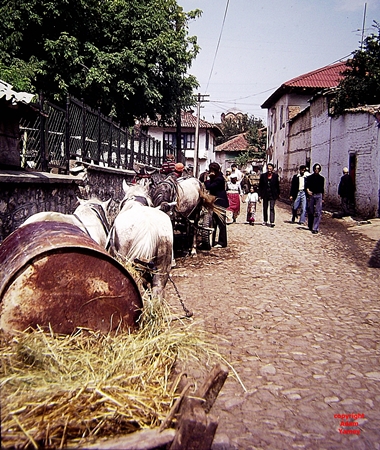
In the 1980s, I visited my friends in the former Yugoslavia frequently. Also, I visited Albania and what is now independent Kosovo. During my trips, I picked up a large vocabulary of Serbo-Croat, including quite a selection of outrageous swear words. Grammar has always been beyond me in foreign languages, and often in my own. My interest in Albania and my brief visits to Albanian-speaking parts of the Balkans resulted in me acquiring some vocabulary in Albanian, but far less than in Serbo-Croat. Until the 1990s, I believed that my fragmentary knowledge of these languages would be useless outside the Balkans.

gift 2

Prizren in Kosovo, pre-1990

During one trip to Belgrade, a friend arranged for me to be an observer in a clinic of a leading oral surgeon. I turned up at a large hospital and spent a couple of hours watching the surgeon reviewing a series of his patients. Although I was grateful to be allowed to watch the great man, I learned little that was relevant to practising dentistry. However, one aspect of this clinic interested me greatly. As each patient entered the consulting room, he or she presented the surgeon with a gift: a bottle, a large piece of cheese, a ham, etc.

The last patient to enter, a man in a somewhat shabby suit, entered and sat in the dental chair without having presented a gift. After his mouth had been examined, the surgeon took the patient and me out into a corridor. We walked through the hospital to a room with locked doors. My host unlocked it, we entered, and he locked the doors behind us. After a brief conversation, the patient handed the surgeon a small brown envelope, which he thrust into his jacket pocket. Then, after the doors were unlocked, the patient went one way, and we went another way. As we walked along the corridor, my host patted the pocket containing the envelope, and before bidding me farewell, said: “Pornographic photographs.”

gift 5 saraj

Poster of Marshal Tito in Sarajevo, Bosnia in the 1980s

My last visit to Yugoslavia was in May 1990.  Soon after that, wars broke out in the Balkans, and the former Yugoslavia disintegrated painfully to form smaller independent states. In the early to mid-1990s, there was terrible strife in Bosnia. Many people fled as refugees to places including the UK. In the late 1990s, Kosovo suffered badly from warfare between the Serbs and the ethnic Albanians. Many of the latter fled to the UK.

I moved from one dental practice outside London to another in London, an inner-city practice, in 2001. A significant number of my patients there had come from the former Yugoslavia as refugees. I was the only person in the practice who could greet them in Serbo-Croat or Albanian. Maybe, I was only one of a few dentists in London at that time who had this ability.

To the Albanian speakers my vocabulary was restricted to words such as ‘hello’ and ‘good-bye’, which brought smiles to their faces. Following a trip to Communist Albania in 1984, I recalled the Albanian words of political slogans such as “Long live Enver Hoxha”, “Enver’s party”, and “Long live the Peoples’ Party of Albania.” As many of my Albanian patients had come from Kosovo rather than Albania, these slogans meant little to most of them.

gift 3 travnik

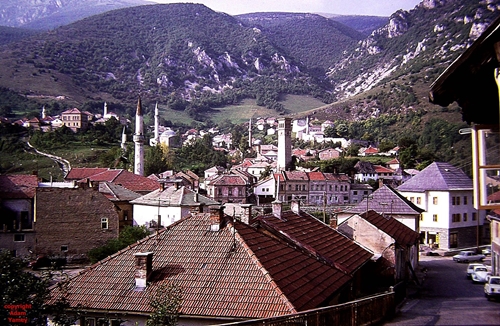
Travnik, Bosnia, 1975

My limited Serbo-Croat was more extensive than my Albanian. I could entertain some of my Bosnian and Serbian patients with polite small-talk. Many of the ex-Yugoslav patients, like those I had seen long before in Belgrade, brought me gifts. Even those, with whom I felt I was not getting along with well, brought me, usually, bottles of home-made alcohol (e.g. rakia, slivovitz, and loza) that had been distilled by relatives who had stayed behind in the former Yugoslavia. These strong alcoholic drinks were delicious, smooth, and delicately flavoured. One fellow plied me with DVDs of the latest Hollywood and other films that he had ‘pirated’. One lovely lady from Bosnia presented me with a pair of earrings, which her uncle had made, to give to my wife. She wears these often, and she is very grateful.

gift 4

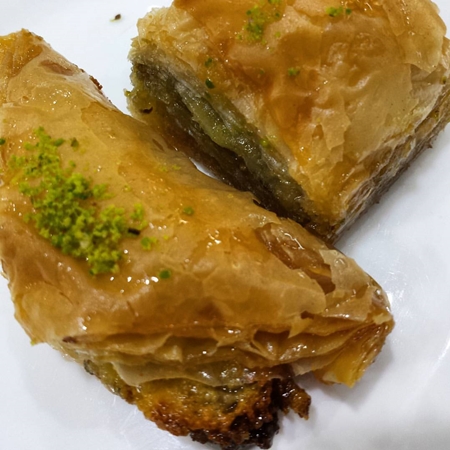
Many Middle-Eastern patients also felt that it was appropriate to bring me gifts. Thus, a lot of delicious baklava and other similar confections came my way. Delicious as these were, they were neither good for my teeth nor for my general health. A Hungarian family kept me supplied with large gifts of paprika powder, and there was a Romanian gentleman who brought me nice bottles of wine. Incidentally, the only words of Romanian I know are “thank you” and “railway timetable”. Once, we employed a Romanian dental nurse and I told her my Romanian party-piece “Mersul trenurilor.” She pondered for a moment and then replied “Ah, the programme of the trains.”

Once, my dental nurse, a friendly West Indian lady, and I were standing near a window facing the main road when a delivery van stopped nearby. A man was delivering trays of baklava to a nearby shop. I said to my nurse: “Why don’t you see if he’ll give us some to try?” She returned with a tray of baklava. Carelessly, because I was in a hurry to see my next patient, I put a large lump of baklava into my mouth, and then bit hard on it. As I was doing this, I heard a deafening bang in my head. The baklava was not too fresh. I had split a molar tooth into two parts, the smaller of which was loose in my gum.

gifts 1

Baklava

Unlike this disastrous piece of confectionary, the gifts kindly given to me by my patients did no harm. Furthermore, what I believed to be a useless tiny vocabulary of Balkan languages proved to be quite useful.  

Finally, you might still be wondering whether anybody ever took me aside to present me with an envelope containing pornographic photographs. To satisfy your curiosity, I can tell you that nobody did.

Shish kebab and sausages

Not long ago, I wrote about Warren Street, which played a significant role during part of my life. Now, let’s move a little further south to a street, which is overshadowed by the Post Office Tower and contains many memories for me.

CHAR 0

London’s Charlotte Street runs between Rathbone Place in the south and Maple Street in the north. It is just over half a kilometre in length. Laid out in 1763, it was named after Queen Charlotte, who married King George III. I began to get to know the street just under 200 years later.

My earliest recollections of Charlotte Street were regular visits in the early 1960s to the Hellenic Stores on the west side of the street south of Goodge Street. My mother bought olives and other Mediterranean products at this store and another Greek shop in nearby Goodge Street. The latter was smaller than the Hellenic Stores, and a little less honest. When something needed weighing in the Goodge Street shop, the shopkeeper would throw it on the scales. The weighing machine’s needle would flash across the dial, and before one had time to think, a price was given. Neither of these purveyors of Greek produce exist anymore.

CHARL 4 site of Schmidts

Site of Schmidt’s, now rebuilt

During the twelve years (1970-82) that I studied at University College London (‘UCL’), I used to visit Charlotte Street often. As a student, I was always keen to find somewhere to eat cheaply. Schmidt’s on Charlotte Street was one such place. This was a German restaurant. Its dining area was on the first floor. Most of the waiters were pasty-faced gentlemen, who added to the gloomy atmosphere of the place. The ground floor served as a delicatessen. It contained a counter where boiled Frankfurter sausages were served with mustard and slices of delicious greyish German bread. They were very cheap and extremely delicious.  A female cashier sat in a booth in the middle of the room. Whenever I saw her, she had a blackish facial hair where men grow moustaches. My father, who was in London during the 2nd World War, told me that during the conflict, the owners of Schmidt’s posted labels on their windows, which read: We are British, NOT German.”

There have always been plenty of eateries on Charlotte Street. L’Etoile, which I never entered because it was beyond my budget, was a long-established restaurant on Charlotte Street. It had a Parisian look about it, but like Schmidt’s, it has disappeared. Near to the posh L’Etoile, there was a Greek ‘taverna’ called Anemos. I never visited it, but plenty of my fellow students did. One did not visit Anemos for its food, but for its riotous atmosphere, which included music, dancing and the trational Greek practice of plate breaking. Venus was another Greek place that has long since disappeared. I was taken there several times by an uncle, who worked nearby and regarded it as his favourite Greek restaurant.
CHARL 3

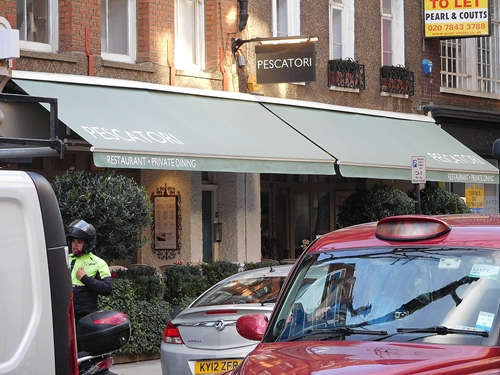
Just north of Goodge Street, there is another long-standing, and still existing, restaurant. This is the Pescatori, an Italian place specialising in fish dishes. It was one of my parents’ favourite restaurants in London. Back in the 1960s, there used to be a life-size boat suspended from the ceilings above the tables. I believe that my father was being serious when he said that he preferred not to sit beneath the boat, in case it fell.

CHARL 5

There was another fish restaurant in Tottenham Street that leads east of Charlotte Street. Pescatori was at the high end of the scale of elegance, and Gigs was at the lower end. Gigs was very popular with students from UCL and workers in the neighbourhood. It was divided into two sections: take-away and sit-down. At lunchtimes, there was always a long queue at the take-away counter. Two gentlemen, oozing with sweat, took the orders for fish and chips and also for the delicious lamb shish kebabs they prepared while you waited. In between taking the cash and wrapping the fish and chips, they threaded lumps of lamb onto skewers, and grilled them. The kebabs were served with salad in a warm pita bread. As the saying goes, they were ‘to die for’. Despite the rather haphazard-looking hygiene, I know no one, who died from these mouth-watering bundles of meat and salad.

Gigs closed many years ago. Then a few years ago, the premises were modernised, and Gigs was brought back to life by some relatives of the original owners. What used to be the take-away section is now an attractive restaurant, and what used to be the sit-down area is now the take-away area. The updated Gigs is both hygienic in appearance and looks as if it is designed to attract a more sophisticated clientele than its ancestor.

My father was a professor at the London School of Economics (‘LSE’) for most of his working life. The LSE has a hall of residence for students, Carr-Saunders Hall, a non-descript 1960s building on Charlotte Street. When it opened in 1964, my father’s colleague Kurt Klappholz was its first warden. Kurt, whom I knew well as a family friend, was a Polish Jewish Holocaust survivor. Later, another of my father’s colleagues was a warden there many years ago. Once, he invited me to his flat. This academic possessed the most wonderful sounding HiFi equipment that I had ever heard. The warden, who owned it, was rather over-built. He told me that he preferred listening to music sitting in a comfortable armchair in front of his HiFi, than trying to squeeze into uncomfortably narrow chairs in concert halls.
CHARL 1

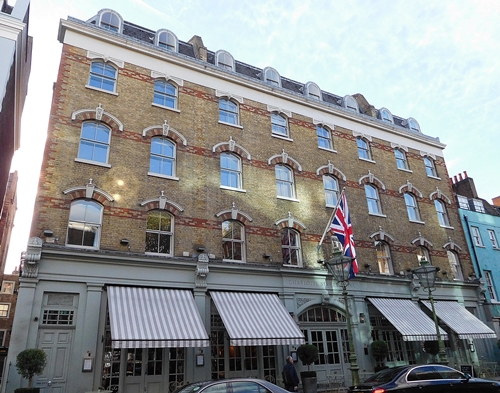
The building that used to house Cottrells

When I became a dental student, I became aware of Cottrells in Charlotte Street. This was near the Rathbone Place end of the street. It was the showroom for a major supplier of dental equipment. Housed in an elegant Victorian building, which still exists (it now contains a restaurant), the firm supplied everything from dental examination mirrors to entire dental operating units (chair plus attachments fordrills etc.) The technician responsible for teaching me how to cast gold crowns (caps) told me to visit Cottrells, not to look at the equipment, but, instead, the pictures hanging on the walls of the showroom. The walls were hung with a large collection of paintings by William Russell Flint (1880-1969). He specialised in depicting women.  Well-painted, and quite artistic, the paintings on the walls of the dental showroom and of its main staircase fell very definitely into the category of extremely light porn.
CHARL 6 Rathb Pl

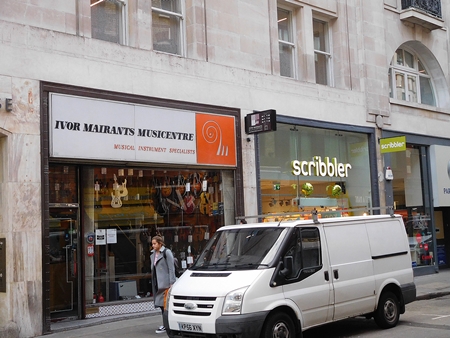
One of the longer established shops in Rathbone Place: Mairants

Rathbone Place, a short street which connects the southern end of Charlotte Street contained a large postal sorting office. Quite late on in life, one of my uncles, a bachelor now sadly no longer living, got a job there as a postman. He often used to tell me about his experiences as a medical orderly in the South African Army in the North African desert during the 2nd World War. He spoke of them fondly, regarding the great camaraderie he experienced amongst his fellow serving men. I often felt that this was one the more enjoyable times in his long and varied life. When he joined the postal team at Rathbone Place in his fifties, he spoke of this in the same appreciative terms. He liked being part of a working team. Now, not only has my uncle gone, but also the sorting office no longer exists.

Charlotte street and its surroundings lie in the shadow of the Post Office Tower, which was ready for use in 1964. Until 1980, it was the tallest building in London. When it opened it had a revolving restaurant high above the ground. I never ate there, but did manage to visit the viewing platform just beneath it. When I looked up from this platform, I could watch the concrete base of the restaurant rotating slowly. A terrorist attack in 1971 put an end to the public being allowed to visit the viewing platform or any other part of the tower.

I still wander along Charlotte Street occasionally. Although it is still extremely vibrant, it evokes many memories of times long past.

Pilgrim on a ‘plane


While I was practising as a dentist, people at parties often asked me what I did for a living. Telling them what I did often brought the conversation to a quick conclusion.

MARY

Medjugorje is a small town in Bosnia and Herzogovina. Between 1942 and ’45 during the Nazi occupation of Yugoslavia, over sixty Roman Catholic friars were killed there, allegedly by Communist resistance fighters. In 1981, when this area was still part of the former Yugoslavia, some six children claimed to have seen visions of the Virgin Mary. Despite opposition by the Yugoslav authorities, Medjugorje rapidly became a place of pilgrimage. The authorities softened their opposition to this during the last few years leading up to the country’s tragic disintegration.

I used to visit friends in Belgrade often during the late 1970s and throughout the 1980s. I flew back and forth, often on flights operated by Jugoslovenski Aerotransport (‘JAT’), one of Yugoslavia’s two major airlines, the other being the former Aviogenex. A friend of mine in Belgrade was once looking after some visiting German bankers, when he told them:

“Yugoslavia has two state airlines. Germany only has one … now that the Luftwaffe has been closed down.”

Many of the JAT flights between Belgrade and London touched down at Zagreb to pick up passengers. In the ‘80s, Zagreb was an airport used by pilgrims visiting Medjugorje. I was travelling back to London with a friend from Belgrade. We had occupied two of a set of three seats. We used the middle seat, which was free when we boarded, to store some of our hand-baggage. Many people boarded at Zagreb, including a man who occupied the middle seat. He told us that he had just been to Medjugorje, and asked my friend:

“Do you believe in the Blessed Virgin Mary?”

“I would love to discuss that with you,” she said, “but not now because I have a terrible headache.”

The pilgrim turned to me, and then asked me something.

Not having heard it properly because of the noise made by the ‘plane’s engines, I replied:

“I am a dentist, actually.”

After that, our initially chatty pilgrim neighbour did not say a word during the flight to London.

African meeting

Timewarp_500

All of the relatives in my parents’ generation were born in South Africa. Some might say that they were ‘Africans’ although many Africans might not agree. One of these always arrived at our house at least an hour before we had invited him, and another usually did not arrive until one hour after we had invited him. My parents, on the other hand, were sticklers for punctuality.

For several years, I worked in a dental practice, which might have well been described as the “United Nation of bad teeth.” My patients had originated from all over the world. They came from, for example: Brazil, Algeria, Morocco, Tunisia, the West Indies, Spain, Portugal, tropical and southern Africa, the former Yugoslavia, India, Pakistan, Afghanistan, Ireland, and a few from the UK. Few of them appreciated the importance of punctuality.

We operated an appointment system in the practice. Patients booked specific times on particular days for their chance to visit me or one of my colleagues. Most of them either turned up at the wrong time or not at all. Consequently, my days were broken up into periods of frenetic activity separated by periods of inactivity, plenty of time to read a book.

One afternoon, a Tunisian gentleman turned up for his appointment at the right time on the correct day. I was so surprised that I said to him:

“How nice. You’ve come on time. Most of my other patients are not as courteous as you. They come whenever they feel like it, if at all.”

The patient listened, removed his coat, sat in my dental chair, and then said:

“Yes, that what we call in French ‘rendez-vous africaine’”

Somehow, after hearing that, my patients’ erratic attendance and timing began to make sense with me, and no longer bothered me. It also chimed with the erratic timings of some of my South African relatives.

In Germany, we only eat…

High up in the sky,

a compartmented tray,

consuming airline food 

FLIGHT 1


Since I was a little boy (many decades ago), I have been travelling on aeroplanes, usually to and from holiday destinations. The food served during flights has always intrigued me. As a child, I used to collect the miniature containers of salt and pepper that appeared on the compartmented food trays. I can remember these better than the far from memorable food served with them.

In 1963, we took an overnight flight from New York to London. When the breakfast tray arrived, I remember that there was a hot, foil-wrapped item on the tray. Cautiously, I unwrapped it to reveal a long spindle of something yellow and rubbery. I hit it with a knife. The knife bounced off it. My mother told me that what I had revealed was an omelette. To this day, omelettes on ‘planes have repelled me. I love freshly made omelettes, but one made several hours earlier and reheated has no appeal for me.

The best food I have eaten in the air was on Air Lanka ‘planes in the mid-1990s when we were travelling between London and Colombo. The food was served in large foil containers, rather than in in tiny neat plastic dishes. Delicious Sri Lankan curries were served. They tasted as if they had been lovingly prepared in someone’s home rather than in an industrial kitchen. My wife recalls eating whole steaks and caviar on an Aeroflot flight between Moscow and New Delhi in the late 1980’s. The burly stewardesses served the food on real porcelain plates.

More recently, I have been travelling regularly to India. There is a direct flight between London and Bangalore operated by British Airways (‘BA’), on which we used to travel. The staff on these flights were coolly efficient. The meals were not so good. For some years I had a dental patient, a friendly fellow, who worked for BA as a cabin crew member. When I told him that I was not keen on what was served on BA, he suggested that I pre-order the seafood meals. These turned out to be better than the regular meals, and we ordered these on several successive flights. Then, on one BA flight I was seated next to a very devout Muslim couple, who did a lot of praying during the ten-hour flight. When their meals arrived, a delicious aroma spread from their trays. When they removed the foil from their hot dishes, I saw that they had been served with what looked like really nice curries and biryanis.

After seeing these halal meals, that is what I pre-ordered on all our subsequent bookings with BA. We were not disappointed. BA used a good quality halal caterer. Many people who order halal food are teetotal. The BA crew did not raise an eyebrow when we ordered gin and tonic or bloody Mary cocktails with our so-called ‘Muslim meals’.

FLIGHT 2

Before BA operated the direct flights between London and Bangalore, we had to make the journey with one change of ‘plane. The German airline, Lufthansa, ran a convenient flight from Frankfurt (Main) to Bangalore. On one occasion, we were served two meals on the flight. The first meal included some meat. Several hours later, the second meal arrived. It was a selection of vegetarian food items. Now, I have nothing against vegetarians and vegetarian food, but I like a bit of meat or fish with my veg. I called the stewardess and asked if there was a non-vegetarian option as there had been during the earlier meal.

“No,” she said abruptly.

“Why?” I asked.

“In Germany,” she explained, “we only eat meat once a day.”

What nonsense, I thought. Whenever I have visited Germany, I have seen people eating meat at breakfast, lunch, dinner, and in between these repasts. I was not going to put up with her inaccurate reasoning.

“Well,” I replied, feeling a little bit hypoglycaemic, “I shall be ill if I eat this vegetarian offering. You must find me some meat.”

“One moment, please.”

She disappeared out of our cabin. Maybe, she was worried that I might eat her. After some minutes, she returned with a tray containing some very tasty pieces of fish.

Apparently, Germans who travel business class eat non-vegetarian food more than once a day.

POSTSCRIPT:

I cannot understand why airlines feel that they have to serve hot dishes mid-air. Most of these dishes are shoddy versions of the descriptions given to them on the tiny menus handed out to fool you into thinking that the airline will treat you to ‘fine dining’. I believe that many people would be happy with a selection of tubs of what the Greeks call ‘meze’. These could include things like hummus, taramosalata, tzatziki, olives, cole-slaw, nuts, mutabel, guacamole, salsa, etc. No cooking required, and fun to eat.

Switch it off, please

Over the airwaves,

messages of faith are heard,

evangelising


radio


‘Mark’, the owner of the first dental practice where I worked after qualifying, told me that it is important to have a good relationship with the dental nurse with whom you work. He pointed out that on working days, the dentist often spends more of his or her waking hours with the nurse than with his or her spouse. During the 35 years I practised as a dentist, I encountered very few dental nurses with whom I could not get on amicably. Let me tell you about ‘Maria’, who was kind, resourceful, and remarkable.

Maria fled to the UK after having had what sounded like a horrendous childhood and adolescence in a troubled part of the world. She worked with me for several years. Sometimes, when needed, she worked as a dental receptionist in our practice. When, as they often did, patients came storming up to the desk, impolitely demanding an appointment without even saying “please”, Maria would calmly reply: “Good morning, Mr X. How are you? And how is your family?” Her polite questioning in a soothing voice quickly ‘civilised’ the patient’s approach.

Once, I was running very late, and the patient I had kept waiting had only 15 minutes left out of the 60 minute appointment I had planned for him. I said to this patient: “I have run so late that I really don’t have enough time to do what we planned.” Before the patient could answer, Maria said to me: “Don’t be silly, Mr Yamey, you can do it in time. I know it.” And she was right. I could not have done a decent job so fast if Maria had not been my assistant. When it came to the time to prepare the dental impression (mould) for the crown (cap) I was preparing, she mixed the two elements – the firm base and the low-viscosity material that picks up fine detail – simultaneously. Ambidextrously, she mixed one constituent with one hand and the other with her other hand. We finished the job to my clinical satisfaction in a quarter of the time I usually needed. “See, you can do it,” she said, “I have faith in you.”

You might wonder why I did not speed up after that when working with Maria. During that curtailed appointment, fortunately everything went smoothly without hitches. I preferred longer appointments so that I would have sufficient time to deal with unexpected problems and to relax the often-anxious patients.

Maria was very practical. In the practice where we worked, equipment often broke down. When this happened, a repair man, ‘H’, would be called to do just enough to get the heavily-used, well-worn piece of equipment to work again. On one occasion, an essential piece of kit stopped working. I told Maria to ring H. She said: “He’s not needed.” I asked her why. “I watched what H did last time the drill broke down. Let me try.” Maria fiddled with the equipment for a few minutes, and successfully repaired it.

Maria was a devout Christian.  She kept a small volume of the New Testament in a drawer in the surgery. Some of the words in it were printed in red. I asked her why, and she explained that the words that Jesus spoke were printed in red. Every now and then, she used to say to me: “All you need to do, Mr Yamey, is to accept Jesus in your heart, and your soul will be saved.”  Out of politeness, not wishing to offend her by questioning her great faith, I would say: “I need more time to think about it.”

We had a radio playing continuously in the surgery. Maria had tuned it to a non-stop evangelical Christian station. Various people speaking with strong North American accents spent hours describing how they had discovered Jesus. Like quite a few of my patients at that practice, many of the speakers on the radio had been locked up in prison. During their long incarceration, the radio personalities had had time to contemplate life, and during this contemplation they had discovered Our Lord and taken Him into their hearts. I found this radio station quite fascinating and listened to it avidly in gaps between appointments. Maria seemed less interested in the broadcasts. She wandered in and out of the surgery when she was not needed to help with a patient’s treatment.

Mr ‘C’ was a regular attender. He had a barely discernible North American accent. On one occasion, just as I was about to begin treating his teeth, he raised a hand, and said: “There are two things I can’t stand. One is coming to the dentist. The other is having religion stuffed down my throat. Maria, please switch off the radio.”

Maria turned it off without argument – she never argued. From that moment onwards, Maria never ever tuned the radio to that evangelical station. She was not only a wonderful assistant, but also sensitive and thoughtful.

The boys from South London

mobile phone stolen

contacts imag-es vanish:

 modern  tragedy


phone

For several years I worked in a west London practice near Portobello Road . My patients came from families that had originated in many parts of the world. Almost all of them had lively characters. They were not your average quiet provincial types, who respect professionals – a bit too much in my opinion. They were unpredictable in their punctuality and behaviour. This made every one of my working days exciting, sometimes a bit too much so.

‘J’ was a frequent attender with many dental concerns. Although he made appointments, I could be sure that the appointment times were those that he was least likely to appear at the surgery. His timing was erratic to say the least.

When J arrived, he ignored the reception desk and would come straight into my surgery even if I was already treating a patient. If I was in the midst of treating someone, he would respect my asking him to wait until I was free. He would then hover around outside my surgery, and if the wait was too long for him he would disappear, only to reappear unannounced and unexpectedly a few days or weeks later.

One afternoon when I was free, J, who was not a nervous patient, ran into my surgery. He was too agitated to sit down in my dental chair. Instead, he leant against one of the walls of my small room.

“What’s the matter?” I asked.

“It’s bad, man.”

“Can you tell me about it? Do you want to talk?” I asked.

“My mobile ‘phone has been nicked.”

“Sorry to hear that.”

“I know who took it.”

“Really,” I said, “then, can’t you get it back?”

“I don’t know, man. But, I know who nicked it, and I am going to get the boys from South London to put him six feet under.”

Having said those worrying words, he settled into my dental chair.