Shortly before setting out on a trip to Yugoslavia in 1975, I had just finished reading “Bosnian Chronicle” by the Yugoslav writer Ivo Andrić (1892-1975). This novel is set in the Bosnian town of Travnik during the early years of the nineteenth century and atmospherically portrays the relationships between the families of the French and Austrian consuls and their Ottoman ‘hosts’. After a short bus ride from Mostar through the forested hills of Bosnia, I disembarked in Travnik – the town in which Andrić was born.
During the journey to Travnik through the hilly Bosnian landscape, I noticed short stretches of disused narrow-gauge railways that wound their way through the countryside. Some years later, when I lived and worked in Gillingham in Kent, I was friendly with an elderly lady, a retired teacher, called Mary Stephenson. We had a common interest in classical music. When I got to know her better, she told me that she had been a keen amateur movie maker and that she and her late husband, both having been interested in railways, had made tours around Europe visiting narrow-gauge lines. They had visited Bosnia, and she was able to show me the brief movies that she had made whilst travelling on the narrow-gauge lines that I had glimpsed.
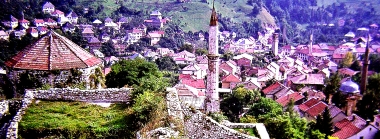
After booking into a hotel, I began to wander around the streets of old Travnik that nestle beneath the city’s fortress, which contains a polygonal tower. I explored the town’s old mosques; ‘türbe’ (small, usually decorative, pavilions containing the Islamic tombs of notable people); and other fine architecture dating back to the Ottoman period. At first, I was alone, but not for long. A young man, maybe in his early twenties, approached me and asked in tolerably good English whether he could show me around. As he seemed friendly enough, I agreed.
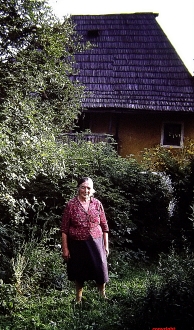
My new companion led me through Travnik and out into the surrounding countryside. We walked along a lane, and soon arrived at a small single-storied cottage with a steeply pitched roof. It was surrounded by a small patch of land filled with flowers and vegetables. The building consisted of not much more than two rooms. We entered, and were greeted by an old lady dressed in folk costume. My friend introduced me to her, his grandmother, and she showed me the many framed sepia photographs that competed for the limited amount of space on her walls. She told me about them in her language, and her grandson translated for me. Many of the pictures looked as if they had been taken before the First World War.
Our next port of call was my new companion’s family home, an apartment on the first floor of an unremarkable modern building in a new part of the town. My friend introduced me to his mother and then to his younger brother, who was labouring over some schoolwork. I noticed that amongst the things on the boy’s worktable there was a textbook on the English language. I picked it up and saw that its first chapter was headed ‘The Black Country’. Its first words were,
“Where there’s muck, there’s brass.”
I still wonder how much sense that would have made to a young Bosnian lad, or even his teacher.
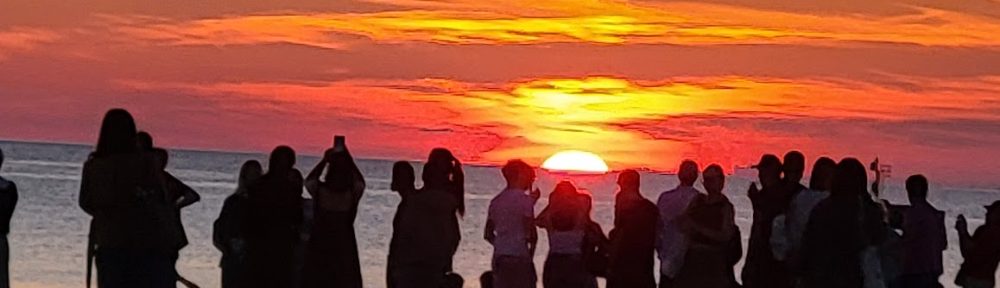
Later that day, my new friend fetched me from my hotel. It was evening and in the centre of the town people were enjoying the ‘corso’. During my visits to Greece, many of which were made long before I began exploring Yugoslavia, I used to watch people enjoying, what I was led to believe was called, the ‘corso’. It occurs in the evening in the centre of a town or along the seashore, and consists of people enjoying the cool evening air and meeting friends whilst wandering to and fro along a more or less well-defined stretch of pavement or street.
Travnik had its own ‘corso’ or evening promenade. Unlike many that I had witnessed before, this one was highly organised. People walked two-by-two around a definite, but unmarked circle in one of the town’s open spaces. My companion and I joined this human conveyor belt. Every now and then, my new friend would suddenly dart off to meet someone, whom he spotted sitting at a table outside a café or standing away from the ‘corso’. After exchanging a few words with his acquaintance, he would rejoin me in the ‘corso’.
Thus, I ended my pleasant day in Travnik.
I never discovered my companion’s name. I am not sure that I will ever be able to find out whether he survived the Bosnian war of the 1990s, and is leading a good life today.


