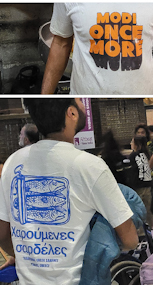
RECENTLY I SAW two eye-catching T-shirts. One that was seen in Indore, speaks for itself.
Top shirt seen in Indore, bottom one in Bombay
The other, spotted while waiting for our luggage at Terminal 2 in Bombay Airport, might look Greek to you, and indeed it is. The rear of the shirt reads when translated into Latin script ‘karimenes sardeles’, and beneath it, written in Latin script “Traditional Greek sardines, Pyrgos, Greece”. This refers to a brand of sardines from Pyrgos on the Greek Aegean island of Santorini.
I asked the man wearing this shirt whether he had got it in Greece. He said that he had bought it at a branch of H&M in India. I asked him what the Greek words on his shirt meant. He had no idea, neither had he ever heard of sardines. Well, I had no idea that this shirt was a best-selling item sold at H&M.
ONE OF THE THINGS that struck me when I first visited India in January 1994 was how everyone was wearing clothing far more colourful than anywhere else I had been before. Wherever I have been in the country, there is a feast of colourful clothing to be seen. Whether the colourful garments are worn purely for aesthetic reasons and/or for ceremonial or group identity reasons, everywhere there is much to please the eye.
I am not alone in noticing the Indian penchant for wearing bright colours. In 1956, the famous style ‘diva’ Diana Vreeland noted in British Vogue magazine: “… pink is the navy blue of India …”. Following from this, an article in India’s “Economic Times” of January 2022, pointed out that “Red is the Indian beige and yellow is the Indian grey…”. In other words, that the exuberant colours worn by Indians contrast dramatically with the much more drab colours currently worn in the West. Actually, as my wife pointed out, long ago in Europe (eg the 18th century and before) clothes – especially those worn by the wealthy and the aristocracy – were far more colourful than now.
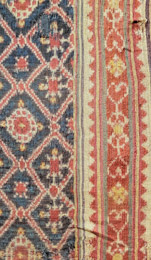
On the 23rd of December 2023, we were fortunate to get admission to an exhibition of sarees on its last day. Intriguingly entitled “Red Lilies, Water Birds”, the show was hosted by The Registry of Sarees in a house on Hayes Road in Bangalore. The Registry (established in 2016) is a trust set up by the Mysore Saree Udyog (founded in 1932). Its purpose is to promote the study, design, and conservation of handspun and handwoven textiles.
The nine rooms of the exhibition contained about 84 examples from the Registry’s much larger collection. Each room concentrated on either a particular region of India, or a specific method of creating the textiles. Every room was filled with sarees, which filled the viewer’s eyes with richly coloured, intricately patterned delights.
Many of the visitors to the exhibition, and the staff looking after, and explaining, the show were wearing clothing that demonstrated what I mentioned at the outset – namely, the preference of many Indians to dress colourfully.
JUST BEFORE I VISITED New York City in early 1992, I needed to buy a new coat. I entered Cordings gentleman’s clothing store on London’s Piccadilly and was greeted by a salesman. He listened carefully whilst I explained that what I was seeking had to be warm, windproof, waterproof, lightweight, and furnished with pockets both outside and inside the garment. After a moment’s consideration, he said to me:
“What you need is a Dannimac, Sir.”
I asked him whether I could see one and try it on. He replied:
“There’s only one problem, Sir.”
“What’s that?” I asked.
“They don’t make ‘em anymore.”
So, I set off for New York with an old coat that needed replacing. One day, I entered a clothing store on the lower east side of Manhattan. I explained my requirements to the very talkative salesman. When I explained my pocket requirement. He said abruptly:
“You want pockets on the inside and the outside? What are you? A private detective? A secret agent?”
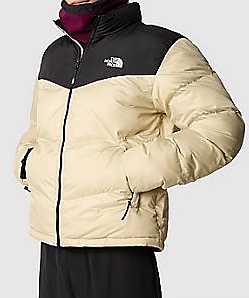
That was the first, and so far, only time, someone has suggested that I did that kind of work. The man showed me some feather-filled puffy jackets made by North Face. They fulfilled all my criteria. I chose a beige one, and happily parted with over 100 US Dollars. I used that North Face for over 25 years until its appearance became too disreputable, and then, sadly, I disposed of it.
Having acquired my fine new coat, I had to get rid of the old one, which I had brought from England. I recall that there were few if any rubbish bins on the streets. As for my friend’s flat, where I was staying, there seemed to be nowhere to dispose of even the smallest bit of rubbish. On my return to the UK, my future wife, who had lived in New York City, explained that there must have been a rubbish disposal shoot in the flat or the building. I did not want to dump the old coat in the street, So, in the end, I handed it to one of the many people begging for money in the city.
SINCE I LEFT school in 1970, I have only worn a shirt and tie on occasions when I can not avoid doing so. Frankly, I hate wearing ties and formal outfits, but unfortunately, I cannot always avoid engagements where this get-up is obligatory. Usually, I wear a tie with a long-sleeved white shirt.
Some years ago, there used to be many street sellers’ stalls on Bangalore’s Mahatma Gandhi Road (‘MG Road’). One day, we spotted a stall selling white 100% cotton shirts for formal wear. They were ridiculously cheap. The seller was asking 100 Indian Rupees (approximately £1 Sterling) for one shirt. The shirts were new, probably surplus stock. I bought two of them.
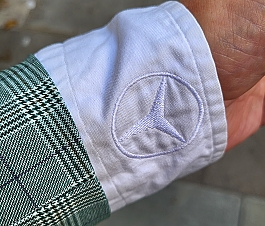
One of the shirts was perfectly satisfactory, but nothing exceptional. The other one had a feature that I only noticed when I first wore it. On its left sleeve cuff, there is a beautifully embroidered Mercedes Benz logo. Otherwise, there was nothing untoward about it. One label inside it bears the words “New England Gentleman” and near it another informs the wearer that it was tailored in Honduras. I suspect that the shirt was part of a batch made for a Mercedes Benz dealership, Whenever I wear it, I do not feel short changed (shirt changed ??), but instead I think that owning it is the closest I have got to possessing a Mercedes Benz.
Later, Edward became a candle maker and grocer in Maldon. His business operated from rented premises opposite the Plume Library, a converted church in the heart of Maldon. He died at the early age of 29, which might not come as surprise when you learn that when he was 28, he weighed nearly 42 stones (265 kilogrammes). A year later, he had put on another two stones. By that time, he was 5 foot and 9 inches in height, his chest measurement was 5 foot and 6 inches, and his stomach measured 6 feet and 11 inches (about 210 centimetres). These measurements necessitated special clothing to be made to fit him.
On the first of December 1751, a bet was made at Maldon’s King’s Head Inn. A prize of a ham, some chickens, and several gallons of wine, was to be awarded if nine men were able to fit inside Bright’s enormous waistcoat. The nine men, whose names and professions are listed on a memorial in Maldon, were easily accommodated inside the vast waistcoat. The memorial, located in an alleyway that connects the High Street with a car park, has a depiction of this occasion, a bas-relief sculpted in bronze by Catharni Stern (1925-2015) in 2000.
Bright fathered at least one child, also named Edward Bright. The parish burial register records that when the overweight man was buried at All Saints’ Church:
“’A way was cut through the wall and staircase to let it down into the shop; it was drawn upon a carriage to the church and slid upon rollers to the vault made of brickwork, and interred by the help of a triangle and pulley. He was a very honest tradesman, a facetious companion, comely in his person, affable in his temper, a tender father and valuable friend.” (www.itsaboutmaldon.co.uk/edwardbright/)
Although there was much of Edward Bright to be seen when this larger than average character lived in Maldon, this pleasant town has much more to offer the visitor including a lovely promenade alongside the estuary of the River Blackwater.
SOME OF YOU WILL KNOW that I am interested in the mythical birds that have one body and two heads (for example, the Russian, Serbian, and Albanian double-headed eagles). Few will know about my interest in shirts with two pockets. Most people are happy if their shirt has only one pocket, but not me. For, I like to keep my mobile telephone in one shirt pocket and my small point and shoot camera in the other.
About twenty years ago, during one of my frequent visits to Bangalore (the capital of an Indian state whose crest bears a double-headed bird), we found a store in the busy Commercial Street that sold short-sleeved (‘half-sleeve’ in Indian English) shirts with two pockets bearing the brand name ‘Camel Classics’. The store no longer exists but was close to another clothing shop called ‘Favourite Shop’ and not far from a Bata shoe shop. Year after year, I returned to refresh my stock of double-pocketed Camel shirts. Then, some years ago, the assistants, who by then knew me well, informed me that the manufacture of my favourite Camel shirts was about to be discontinued. Hearing this, I bought all the shirts in my size that were available in the shop.
Nothing lasts forever. This was true of my Camel shirts, which I wore almost everyday both when at work and, also, when not working. The collars tended to fray. This could be remedied during our visits to Bangalore when we found various helpful tailors who were happy to turn the collars. Even with these repairs, some of the shirts became to disreputable to wear in public.
It appeared that two-pocketed shirts had become unfashionable and therefore less easy to obtain. My wife came up with the solution to the problem of replenishing my shirt stock.
We spent a fortnight in Panjim (Goa) in April 2018. While wandering about in the steamy heat, we spotted a tailoring shop. The tailor was asked if he could replicate one of my remaining Camel shirts. He said that he was able to do so, and we were to return after a week. When we went back after seven days, he had produced two perfect replicas. We wished that we had asked him to have made more than two, but our time in Panjim was running out.
The following trip to India, we decided to find tailors in Bangalore, who were willing to replicate my favoured shirts. We found two, both in the Commercial Street district of the city. We got each to make one shirt so that we could assess who did the best job. A tailor on Dispensary Road ‘won the contract’. He made me another five Camel-style shirts. My stock of double-pocketed shirts is currently up to date. Given the present covid-19 pandemic is preventing us from returning to India in the foreseeable future, I am pleased that we had so many of these items manufactured.
Discussing my liking of the double-pocketed Camel shirts with friends and their unavailability, one of them looked at my Camel shirt, and then pointed out that the American Wrangler company makes the same shirts, which are still easily available. So, I could have replenished my stock by buying them on-line, but this would have been far less enjoyable than finding and getting to know tailors in India.
My late father in law was enthusiastic about everything new until his very last days. Every day, he scoured the newspapers to discover the latest events happening in Bangalore. If I was visiting the family, I often accompanied him to events that events that caught Daddy’s eye.
For example, I accompanied to the launch of the new Tata Indica car. When we arrived in time for the launch, there was a large crowd waiting for the official launch. When they saw my aged father in law, dressed in a smart suit and wearing a tie, being supported by me and his walking stick, the crowd parted as did the Red Sea when Moses arrived on its shore. We were given the honour of being first to be allowed to sit in the new car model.
On another occasion, Daddy spotted that there was to be a huge shirt sale, at which customers, who brought an old shirt as part exchange, would be able to buy a new one at a substantial discount.
Before we set off, Daddy had to find a shirt that he was willing to part with. This was a lengthy business because he possessed a large collection of shirts, each one of which needed to be examined and considered. This task was difficult because almost all of his shirts were good quality and in good condition.
Eventually, a shirt was selected for sacrifice, and we set off.
There were many people and an enormous number of shirts at the sale. Daddy carefully examined what was on offer and kept selecting shirts and asking my opinion about them, flatteringly but unwisely overestimating my sartorial expertise.
The hours passed and time for eating lunch was approaching rapidly. After giving my opinion about many shirts, all of a lesser quality and beauty to the one he was going to exchange, I told him that the latest one that he was showing me was the one to buy. He bought it and handed his old shirt as part payment.
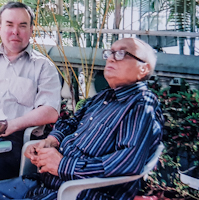
When we got back home, Daddy showed the family his new shirt. Nobody liked it. They were horrified that I had allowed him to buy such a ghastly shirt. Yet, Daddy loved it. He wore it often. The picture shows him wearing it, sitting with me in 2005 at the Bangalore Club.
Many of the smarter social clubs in India have rules about how one should be attired when visiting them. The same is true for ‘elite’ clubs in London.
For example, at the Ootacamund (‘Ooty’) Club in southern India men cannot think oof having a drink at the bar if they are not wearing a formal suit and tie. And, at the Bangalore Club, men can where sandals in the Club House providing the sandals have a back strap. Even worse, at the same club the wearing of smart Indian national outfits is frowned upon if not forbidden. This is surely a hangover from the days when the club only admitted ‘white’ Europeans and a few high-ranking Indian military personel.
Once, I was staying at the Kodaikanal Club in Tamil Nadu state. Dress rules were extremely casual there. Many guests wore shorts and sandals even in the bar and dining room. One day, I entered the club’s small library, and the librarian promptly asked me to leave. I was wearing sandals (with backstraps). Apparently, in the library gentlemen are required to wear formal lace-up shoes. I cannot say why this was required unless the Kodaikanal holds literature in high esteem, and wants it to be respected by library users who have taken the trouble not to be dressed casually.
The short Via dei Tavolini was another of our regular morning destinations in Florence. Situated in the heart of the city between the Duomo and the Uffizi, we visited this street frequently during each visit to the city. It contained 3 important shops: the ice-cream shop called Perché No? (‘Why not?’), a dress material shop, and a shop with the name ‘Busti Biondi’. It was in the latter that my mother had her brassieres made to measure.
During my earlier visits to Florence, when my parents were less confident of their spoken Italian, they were assisted by Giorgio, who owned the material shop between the ‘bra’ shop and the ice-cream parlour. Giorgio, who had learnt English from British soldiers during WW2, translated for my parents. Like so many Italians, he was fond of children, and we grew to like him. For years, he used to send my sister first day covers of newly minted Italian postage stamps. His patience must have been impressive because my mother was not an easy customer. She and my father spent what seemed like hours in Busti Biondi whilst the bras were tried on, discussed, and returned for endless alterations.
My mother was buxom, a trait shared by many ladies in her family, and extremely particular that things should be just right. As far as I was concerned, the positive feature of these visits to the Via dei Tavolini was seeing and talking with Giorgio as well as the chance to enjoy cups of some of Florence’s best ice-cream. We thought that Perché No? was the best ice-cream place in the city, but others favoured Vivoli, a gelateria close to the church of Santa Croce. We did try that place, but it failed to change our high opinion about our favourite place close to my mother’s bra shop. If it had not been for my mother’s breasts we would not have met Giorgio and might have never discovered Perché No.
This is a brief extract from my book “Charlie Chaplin waved to me” available on Kindle and also as a paperback by clicking HERE




 yamey
yamey 