Blood on the Page

HAPPY CHRISTMAS !

I WAS THE EDITOR of the newsletter of the Anglo Albanian Association (‘AAA’), when a writer, Thomas Harding, sent the following email in late 2016:

“… I am researching the life of Allan Chappelow, a former member of Albanian Society and Anglo-Albanian Association. My former books include ‘Hanns and Rudolf’ and ‘The House By The Lake’. I would welcome hearing from anyone who remembers or has stories about Allan Chappelow…”

I had already heard of the two books and seen a little bit of correspondence about Chappelow, which suggested to me that he was a mysterious fellow. He interested me because he had been a member of one of the earliest groups to visit Communist Albania soon after the end of WW2 and he was a participant in the first student tour of the USSR made after Stalin had died.

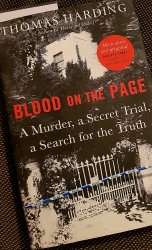
Thomas Harding published his book, “Blood on the Page” in 2018. The secretary of the AAA and I attended a launch of this publication in Daunt’s bookshop in Hampstead’s South End Green. The book is about Chappelow, and I have only just finished reading it, having purchased a copy only recently.

Chappelow (1919-2006) lived and died at number 9 Downshire Hill, a lovely Georgian house in Hampstead. Sometime in May or June 2006, he was brutally murdered in his home. His rotting body was only discovered many days later after a bank had been investigating some irregularities in his account and had been unable to contact him. Wang Yam, a man of Chinese origin was accused of, and found guilty of, his murder and stealing his identity to carry out fraudulent financial transactions. All of this is detailed in Harding’s un-put-down-able book, which reads like a good thriller. In addition, Harding describes the trial of the man accused of having been the murderer.

The trial of the accused, who now languishes behind bars, was unusual for a murder case. Some of it was held ‘in camera’ for reasons that have never been disclosed and cannot be, without risking contempt of court. Trials are usually held ‘in camera’ either to protect national security interests and/or to protect the identity of witnesses. Chappelow’s was the first ever murder case to have been held ‘in camera’ in the UK. Why this was the case was not revealed in Harding’s wonderful book. It is clear from his text that he was not privy to the reason for the secrecy. As I read the book, I kept wondering what it is that the government wants to keep secret. From the detailed account of the murder and what Harding was able to find out about it and the 86-year-old victim, by then a recluse, I could not detect anything that could have been a threat to national security

One possible reason for the secrecy during the trial is mentioned in an article in “The Observer”, published on the 25th of January 2018 (https://www.theguardian.com/news/2018/jan/25/murder-in-hampstead-did-secret-trial-put-wrong-man-in-jail-allan-chappelow). Here is a relevant extract:

“Before, during and after the trial, the government went to extraordinary lengths to ensure that details of Wang’s links with MI6 would remain secret. Two cabinet ministers told the trial judge that Wang’s entire defence must be heard behind closed doors. A contempt order issued by the judge prevents the media from speculating about the reasons for the secrecy.”

Elsewhere, the article mentioned:

“Between his arrest and the start of the trial, it emerged that Wang had acted as an informant for MI6 in London for a number of years. Wang was well placed to be an informant for Britain’s foreign intelligence agency. He had family links with China’s first communist leaders, he was opposed to repressive measures taken by Beijing, and he was something of a computer expert.”

Chappelow had visited both the USSR and Albania during the height of the so-called Cold War. I first visited Albania in 1984, when the Cold War was still ongoing, and the Stalinist dictator Enver Hoxha still held the country in his repressive grip. Our group included people who, after the trip, revealed that they were not what they had claimed to be while we were in Albania. For example, a lady who told me during our visit to Albania she was an archaeologist revealed to me later that she was really a journalist. At that time, journalists were forbidden from visiting Albania unless invited by the regime. Chappelow revisited Albania in 1993 after the ending of Communist rule. In his book, Harding quotes a member of the AAA, who was on the trip with him. She remembered that he had said he was a teacher, but she never “got to the bottom of his background”. Most biographical notes about Chappelow refer to him as a photographer and an author, not a teacher. That got me thinking, as did recalling an incident from my 1984 trip.

At least one of my fellow travellers told me that after the trip that he had been approached in Tirana discreetly by one of our Albanian tour guides and some of her colleagues. They invited him to become an agent to provide Albania with information about his country, Australia. Remembering this incident, I wondered whether Chappelow’s murder trial was held behind closed doors because his trips behind the Iron Curtain had either not been purely for reasons of tourism, or possibly while he was there, he had been approached by the local authorities as was the case of my Australian travelling companion.

Returning to Chappelow’s visits behind the Iron Curtain, here is something else I noticed in the Guardian’s article:

“Chappelow was the product of an educated, socialist family, whose liberal-leaning father, a successful decorator and upholsterer, had moved to Denmark rather than be conscripted into military service during the first world war. At the end of hostilities, the family returned to London and bought 9 Downshire Hill. Allan grew up in a politically progressive home; his parents were active members of the Fabian Society. At the onset of the second world war, the bookish Chappelow was faced with the same dilemma as his father, as well as his schoolboy hero, George Bernard Shaw, who had refused to fight in the first world war and was strongly opposed to the second.”

Interesting as speculations about whether Chappelow could have been involved with intelligence work might be, we will probably not find out the real reason for the secrecy for many years to come. In any case, this mysterious episode, centred in and around Hampstead, is a good reason to read Harding’s exciting and intriguing book … and possibly you might come up with your own hypothesis about why Wang’s trial was held ‘in camera’.
Catching the wind

Cambridge, UK

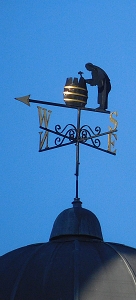
LOOK UP AND if your eyesight is reasonably up to scratch, you might well be lucky enough to see a weathervane on top of a church steeple or some other high point on a building. The ‘vane’ in weathervane is derived from an Old English word, ‘fana’, meaning flag (in German the word ‘Fahn’ means flag). Weathervanes are simple gadgets that indicate the direction of the wind. They usually consist of an arrow attached by a horizontal straight rod to a flat surface that catches the wind. The rod is mounted on a vertical support in such away that it can rotate as the wind catches the flat surface. The horizontal rod with the arrow rotates so that it offers the least resistance to the prevailing wind. Beneath the rotating arrow are often indicators that are labelled with letters denoting the four points of the compass. If, for example, the wind begins to blow from east to west, the horizontal rod will rotate so that the arrow is above the ‘E’ denoting east. Some weathervanes substitute the horizontal rod with a single flat asymmetric object that can catch the wind and rotate. Often the object seen above churches is a cock or other bird, whose beak will indicate the direction of the wind. I suppose that for birds wind direction is quite important.

The weathervane is not a recent invention. It was invented in the 2nd century BC both by the Greeks and the Chinese but separately. Some of the oldest Chinese weathervanes were shaped as birds and later, at least by the end of the 9th century AD, bird shaped vanes became used in Europe. Although avian weathervanes are still very common, a wide variety of other shapes have been used. Sundials, weathervanes, now archaic, only give an approximate indication of time and wind direction respectively. However, unlike sundials, which do not work when the sun is not shining, weathervanes work in all weather conditions and in day and night, although they are somewhat difficult to see at night-time. Despite their relative inaccuracy compared with modern instruments for measurements of  wind, weathervanes are attractive adornments to buildings both old and new.

Poetry and a Chinese supermarket

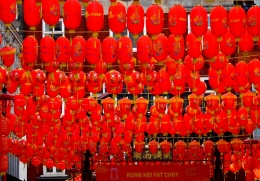
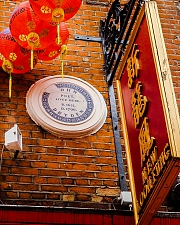
GERRARD STREET IS THE HEART of London’s Chinatown. We often visit it to eat delicious dim-sum and other dishes at our favourite restaurant, The Golden Dragon, which has both indoor and covered outdoor dining spaces. One of our favourite dishes, which was introduced to us many years ago by my sister, is steamed tripe with chilli and ginger. It might sound off-putting, but, believe me, it tastes wonderful. Our visits to Gerrard Street always include a visit to Loon Fung, a Chinese supermarket. This well-stocked establishment bears a commemorative plaque that I only noticed for the first time today (12th August 2021). Partially hidden by a string of Chinese lanterns, it informs the passerby that the poet John Dryden (1631-1700) lived on the spot where we purchase pak-choi, chilli sauce, black bean paste, and a host of other ingredients for preparing Chinese-style dishes at home. I suspect that Dryden was unlikely to have ever come across any of these exotic ingredients back in the 17th century.

According to the English Heritage website (https://www.english-heritage.org.uk/…/blue…/john-dryden/):

“Dryden lived at 44 Gerrard Street with his wife Elizabeth (c. 1638–1714) from about 1687 until his death in 1700. His years there were difficult: his conversion to Catholicism in about 1685 meant that he was unable to take the oath of allegiance after the Glorious Revolution of 1688. As a result he lost his position as Poet Laureate, one he had held for 20 years. He found himself in financial difficulties but remained highly active in London’s literary world.Dryden usually worked in the front ground-floor room of the house, and it was here that he completed his last play, Love Triumphant (1694), the poem Alexander’s Feast, or, The Power of Musique (1697) and translations such as The Works of Virgil (1697). In the preface to the latter, Dryden likened himself to Virgil in his ‘Declining Years, struggling with Wants, oppress’d with Sickness’…

… Number 44 was built in about 1681 and re-fronted in 1793, before being redeveloped in about 1901. At the same time number 43 was demolished, a deed described in the press as ‘a hideous and wonton act of vandalism’ …

… The plaque, though damaged, was immediately re-erected on the new structure. It is unique among surviving Society of Arts plaques in its colour – white, with blue lettering.”

Well, I can add nothing to that informative quote. So, ext time you wander along Gerrard Street do look for this and other reminders of the area’s history. It was a place where several other well-known writers and artists resided several centuries ago.

And then, there was dim sum and dumplings

OUR FAVOURITE CHINESE restaurant is Golden Dragon in Gerrard Street, which is the heart of London’s Chinatown. It is particularly enjoyable to order dim sum dishes there at lunchtime or in the mid-afternoon. Amongst these delicious small plates, allow me to recommend steamed tripe with ginger and chilli, which contains tripe cooked to perfection. The other larger dishes, available during the place’s opening hours are excellent. Chinatown is rich in eateries serving Chinese food. Although we have tried several of them, we keep on returning to Golden Dragon. A visit to Gerrard Street is never complete without entering the excellently stocked Loon Fung supermarket. Between the Golden Dragon and the supermarket, there is often a street stall where followers of the Falun Gong movement, which is frowned upon by the government in China (PRC), issue propaganda material. For anyone wishing to experience a Chinatown district, Gerrard Street and its environs will not disappoint. Recently, when walking along Gerrard Street during the Chinese New Year, I wondered about the street before it became a vibrant centre of London’s Chinese community.

Gerrard Street, which was named after the soldier and courtier Charles Gerrard First Earl of Macclesfield (c1618-1694) who provided a bodyguard for William of Orange during his journey from Torbay to London in 1688, was built in about 1681 (Chinese Year of the Rooster from 18th February 1681). Gerrard built a house, which according to a map drawn in 1870 stood on the south side of Gerrard Street opposite the southern end of the present Macclesfield Street. The north side of Gerrard street, according to the map, used to be a ‘Military Garden’. This was a walled in area for military exercises using arms. This was covered with buildings by 1746, when John Rocque drew his detailed map of London.

Gerrard House occupied the site of numbers 34 and 35 Gerrard Street and was built between 1677 and 1682 (www.british-history.ac.uk/survey-london/vols33-4/pp384-411). In 1708, it was owned by the well-known rake, duellist, and politician Charles Mohun, 4th Baron Mohun of Okehampton (c1675-1712), who was killed whilst fighting a duel (probably about matters both political and financial) with James Douglas, 4th Duke of Hamilton (1658-1712) in Hyde Park. Both participants of the duel were mortally wounded and each of them died soon after the fight. In the 1760s, the house was divided into two dwellings by its then owner, Commodore Sir William James (c1721-1783), who had served with the East India Company. He had been commodore of the Bombay marine and retired to England in 1759 with a huge fortune. James had been involved in various major naval fights against Indian forces along the Konkan coast of Western India.  The house was destroyed by fire in 1887.

Apart from Lord Mohun and William James, many other  well-known people lived along Gerrard Street. These include, to mention but a few: the poet John Dryden (1631-1700); the philosopher Edmund Burke (1729-1797); the antiquary Peter Le Neve (1661-1729); the Dutch painter William Sonmans (died 1708); the biographer and diarist James Boswell (1740-1795); one of the first British balloonists, John Money (1752-1817); and the theatre-manager Charles Killigrew (1655-1725). The street was also home to the ‘Literary Club’ that was founded in 1764 by Dr Samuel Johnson and Sir Joshua Reynolds.  Meetings were held in the Turks Head Tavern, which might have been located roughly where Loon Fung stands today. It was one of at least three pubs that used to exist in Gerrard Street. Between 1794 and 1801, number 39 housed first the ‘Westminster One-Penny Post Office’, which became the ‘Two-penny Post Office’, when postal charges were increased.

In the early twentieth century, Gerrard Street was home to various restaurants serving European food and some clubs of historical importance:

“Irish proprietor Kate Meyrick ran the notorious roaring twenties 43 Club at 43 Gerrard Street and legendary jazz maverick Ronnie Scott set up his first jazz club in the basement of number 39.” (https://chinatown.co.uk/en/about-us/).

However, the area was rather run-down. In addition to restaurants and other businesses, there were also some brothels.

All of this is interesting enough, but I was curious to know about Gerrard Street’s evolution into a Chinese area. According to Wikipedia (https://en.wikipedia.org/wiki/Chinatown,_London), London’s first Chinatown was in the Limehouse district of the East End close to the London Docks. After the Blitz and WW2, the Chinese people began leaving the East End for other parts of London. The Chinese began moving into the part of Soho surrounding Gerrard Street in the 1970s, beginning with Lisle Street that runs parallel to Gerrard. However, I can remember Chinese restaurants in Gerrard Street even in the late 1960s. I recall one example in particular, The Dumpling Inn, which has long been closed. By the 1980s:

“… the area got the full Chinatown treatment; Chinese gates, street furniture and a pavilion were added, plus Gerrard Street, parts of Newport Place and Macclesfield Street became pedestrianised.” (https://chinatown.co.uk/en/about-us/).

In addition, street signs are bilingual, both in English lettering and Chinese (Mandarin) characters.

An area that began to be built-up during London’s expansion soon after the Great Fire of London (1666), has evolved from being a residential street in the late 17th century to an area known for its coffee houses and taverns in the 18th century, Gerrard Street has become world famous for its thriving Chinese activity and wonderful restaurants. Yesterday, 13th of February 2020, despite the pandemic, there were long lines of people, both Chinese and others, who were waiting to celebrate Chinese New Year, the Year of the Ox, by purchasing Chinese cakes from the several Chinese pastry shops in and around Gerrard Street. All that remains is for me to wish you all: “Kong hei fat choy” (which means something like ‘congratulations and be prosperous’.)

Confined in Japanese occupied Manchuria

PARTICLES OF SNOW, whisked by the breeze, were whizzing about in the air in random directions and eventually reaching the ground this early February afternoon in London. I had just finished my midday meal with some nutritious fermented cabbage and was wondering what to write. Maybe, it was the kimchi that helped me remember an old friend who spent some of his working life in Manchuria, which is close to Korea, the home of this weirdly delicious fermented food substance, or was it something else that has brought him to mind?

Sir Norman had already retired from Britain’s diplomatic service when I first met him in the mid-1970s. An accomplished musician, a string player, he used to perform in concerts given by a fine amateur orchestra based west of London, whose treasurer was both a player in it and a friend of mine. Usually, after concerts, my friend and her husband hosted a coffee party at their home for the conductor and selected patrons of the orchestra. Sir Norman was a patron, and it was at these parties that I first got to know him. The few tales that he related about his years as a diplomat fascinated me.

On graduating from university, Sir Norman had a good command of several modern European languages as well as Latin and Greek. He told me that it was typical of the diplomatic service that they decided that his first posting was to Japan, where he was to have a role in the interpreting of a language he did not know: Japanese. Being a good linguist, he was able to learn it.

During the late 1930s, he was sent to Shanghai in China for a year (1937-38). When he arrived, a war between China and Japan was in progress. He told me that every afternoon, he would sit taking tea on the roof of a building in the European cantonment of the Chinese city. As he sat there, he could see shells shooting overhead. They were being fired at the Chinese on one side of the Yangtse River by the Japanese artillery on the other side. This went on day after day for several months. Then one day, the shelling stopped suddenly and for good. Sir Norman wondered why.

Soon after the shelling ceased, he met some senior officers of the victorious Japanese forces. He asked them why the fighting that had been dragging on for so long had ended so abruptly. The officers explained that the Chinese soldiers were mostly mercenaries. Once the Japanese had ascertained how much to pay them to stop fighting, they stopped.

Later, Sir Norman was transferred to Manchuria, where he was the Acting Consul General in Dairen (now ‘Dalian’).  He was serving there when the Japanese attacked Pearl Harbour. After that incident, the Japanese authorities in the city of Dairen ordered him not to leave the consulate building, in which he lived. They cut off his telephone and forbade him to use his wireless to listen to radio broadcasts. Frequently, Japanese officers used to visit his premises to check that the radio was inactivated. Sir Norman, who told me that he had never been much of a technological wizard, told me more about the radio. He said that he had unscrewed a wire in the radio, which rendered it inoperable, and left it disconnected whenever he did not want to use the apparatus. With a smile on his kindly face, he explained to me that whenever he wanted to listen to a news broadcast, it was a simple matter to reattach the wire. During the time that he was being held under house-arrest, none of the Japanese officials who had visited to check on him had ever bothered to examine the radio properly.

In about 1942, the Japanese transported Sir Norman to Tokyo and eventually he was transferred into Allied hands. He said that at no time was he treated badly by the Japanese. In fact, he was looked after by them very well.

The last time I saw Sir Norman was not long before he died. We went to visit him at his home, whose lovely garden ran down to the bank of the River Thames.  He was in good spirits, recovering from a hip replacement. He told my wife and me that both of his hips had prosthetic joints and that every few years they required replacing.

“It’s like changing a car’s tyres, you know,” he explained cheerfully, “except that it lays you up for a few weeks each time.”

Although I did not meet Sir Norman as nearly as often as I would have liked, I feel privileged to have been able to hear about historical events from someone who experienced them first-hand.

Sir Norman died in 2002. Sitting at home today in early February 2021, watching whisps of snow swirling in the air, whipped up by a strong cold wind, had brought him to mind. I am not sure that it was because of the kimchi I had just eaten that made me think of him. I wondered if I had recalled him because just as he was confined in Manchuria, we are also being confined, or at least being restricted in our freedom to move around. Unlike him, we have plenty of access to communications from the outside world, much of which arrives in ways that Sir Norman did not live long enough to experience. However, like him, we are currently limited in our movements. We can leave home, which Sir Norman could not, but we cannot travel as far from it as we had become accustomed to doing before the onset of the covid19 pandemic. Sir Norman used to sit out the several weeks of recovery from his hip surgeries patiently. I suppose that we must also wait patiently, but for far, far longer.

A town in California


Just after Christmas in 1994, we flew to San Francisco in California (USA) for a four-week holiday. My wife was in the sixth month of pregnancy. Before booking our trip, we consulted her obstetrician at St Marys Hospital in Paddington, London. We wanted to know whether it was safe for her to travel at this stage in her pregnancy. The obstetrician did not mince her words:

Yes, go ahead, but make sure that you have good travel health insurance because having a premature birth in the United States might well bankrupt you.”

After spending a few days with friends who live across the Golden Gate Bridge in Marin County, we rented a car, an upmarket Toyota, one of the nicest cars I have ever driven. We drove all over California south of San Francisco. Also, we visited the Grand Canyon and saw it under snow. This was a very beautiful sight because the snow had fallen in such a way that the many stepped strata that line the walls of this spectacular gorge were accentuated. We admired this while trudging through very deep snow. In order to enjoy this, we had had to purchase snow chains and to learn how to apply them to the wheels.

One day, we drove south from the snow-covered Grand Canyon to Sedona, a town famed for its vortices of energy. It was a distance of 106 miles. Yet in that short distance the weather had changed from Arctic to summer. And, the following, day we drove further south past Phoenix and Yuma and then through a southern Californian Desert to San Diego. Even though it was freezing up at the Grand Canyon, from Phoenix to San Diego it was so hot that we had to switch on the car’s air-conditioning.

From San Diego, we spent a few days driving along roads close to the Pacific Coast. We visited most of the historic mission stations between San Diego and San Francisco. We also stopped at Nepenthe in Big Sur, where the writer Henry Miller once lived. The building in which the writer lived was open to the public. While we were visiting it, my pregnant wife needed to use a toilet urgently. Without making any fuss, the guardian unlocked the toilet that Miller used to use and allowed my wife to relieve herself.

Being fans of the architect Frank Lloyd Wright, we visited some of the few buildings that the great architect had designed along the route we were taking. One of these, at San Luis Obisco (between Los Angeles and San Francisco), was a particularly lovely medical centre, the Kundert Medical Clinic that was built in 1956.

On the final day of our road trip, I looked at the guidebook and spotted something that I did not want to miss. To reach it, meant adding 60 miles to our already long (300-mile journey) journey. The place that caught my eye was about 90 miles to the east of our destination Marin County on the left bank of the River Sacramento. The small settlement is called Locke.

Locke is in the wetlands of the Sacramento River Delta. In the 1860s, work was undertaken to drain the malarial wetlands. Many poor Chinese labourers were hired to do this work at disgracefully low wages. In about 1912, the settlement of Lockeport, now called ‘Locke’ was established by three local Chinese merchants. Three years later in 1915, the Chinatown in nearby walnut Grove was destroyed by fire. The Chinese community then moved to Locke and a town grew. Because the Californian Alien Land Law of 1913 forbade Asians buying farmland, the Chinese in the area leased the land from a George Locke.

The town’s population reached 1000 to 1500 in its heyday. It acquired a reputation for its gambling halls, opium dens, and brothels. At one point, according to an article in Wikipedia, it became known as ‘California’s Monte Carlo’. In the 1940s and ‘50s, the towns population dwindled because many people migrated from Locke to major American cities. Currently, there are only about ten people living there.

By 1995 when we drove into Locke it was already a ghost town, a lesser-known tourist attraction. However, it did not disappoint us. Most of the main street’s buildings were picturesquely decaying. They were all made of wood, and no doubt highly inflammable. The place looked like a rundown set for a cowboy film, except that it was for real. One of the buildings that had housed a gambling salon, or maybe a brothel or opium den, was open to the public. Its original dingy décor had been preserved. All that was missing was a haze of opium smoke and the poor Chinese workers squandering their hard-earned money.

From Locke we drove west into the setting sun towards Marin County, pleased that we had made the detour to see the fascinating remnant of a far-off era. Our daughter was born three months later, having travelled several thousand miles around the American west in utero.

Chopsticks


My earliest recollection of eating Chinese food was in a restaurant called ‘Tung Hsing’ in Golders Green almost opposite the old Hippodrome Theatre. It opened in the 1960s and was one of the first restaurants in London to serve Pekinese food, rather than the then usual Cantonese cuisine. The restaurant was owned by a retired ambassador from Chiang Kai-shek’s nationalist China and his wife, whom I believe was responsible for the very excellent food served. 

Although I am sure they were available, I am not sure whether I used chopsticks when eating at the Tung Hsing. Maybe, I learned to use them there, but I really cannot remember. Whatever the case, I have been eating Chinese food with chopsticks for many decades. I would not say that I am 100 percent proficient with them, but I feel that using them to eat Chinese food satisfies me.

Chinese-style food is very popular in India. Most Indians eat in Chinese restaurants using western utensils such as plate, fork and spoon. If you ask for chopsticks, they are usually available, but they are not supplied as default table settings.

Some years ago, early this century, a new Chinese restaurant opened in Museum Road in Bangalore. We visited soon after its inauguration. It was a lovely restaurant and the food was good by Indian Chinese restaurant standards. As usual, we asked for bowls and chopsticks. The waiter disappeared for a while, and then returned empty-handed.

“There are no chopsticks,” he told us.

“Why not?” we asked.

“I will ask the manager.”

The Manager came over, and explained:

“We have been so busy since we opened, and many of the guests have taken them home as souvenirs. So, we have run out of them”


A guilty secret

I was lucky enough to be invited by a friend to the annual Chelsea Flower Show. It would not be exaggerating to say that the displays of plants are all quite wonderful.

Among the show gardens, I spotted some fine examples of peonies, some in bud and others flowering. Seeing these brought back memories of my childhood when we lived in a house with a fine garden in north-west London. At one end of the garden, there were several peony bushes. At the appropriate time of the year, these plants produced almost spherical buds.

My sister and I were attracted to these buds and used to pull them off before they could flower. My late mother used to get very upset by our horticultural vandalism, and told us off so severely that I still recall our midemeanours on the rare occasions that I think of peonies, which is not all that often.

You will be pleased to read that I resisted the temptation to pluck any of the peony buds I saw at the Chelsea Flower Show!

And, here is an interesting fact: Peony is the name of a novel by Pearl S Buck. The story is set in China and features a Chinese Jewish family.

No coriander please


I love eating Chinese food. So, do many people in India, where this cuisine is served everywhere from simple, unsophisticated street stalls to dedicated, smart Chinese restaurants.

Indian Chinese food is prepared to suit Indian peoples’ tastes. To people used to eating Chinese food in London or elsewhere in the UK, the Chinese food in India may seem somewhat different, especially its taste. Although I much prefer eating Chinese food in London, where the restaurants serve food to many people of Chinese origin, I also enjoy eating Indian Chinese food, which is prepared mostly for Indian diners. On the whole, the Chinese food in India is less ‘authentic’ than that served in London, where there is a large population of Chinese from Hong Kong and mainland China. 

Once when we were visiting Mangalore on the coast of the Indian State of Karnataka, we entered a Chinese restaurant. Its main entrance was almost hidden in a dingy yard that would have made an excellent setting for a performance of West Side Story. This establishment was staffed mainly by a Chinese  family, rather than people with slanting eyes who had originated in the north eastern states of India. I was delighted to find steamed pork dumplings on the menu amongst the starters. I ordered these, and was told that I would have to wait atleast 45 minutes. I said that was alright, and we ate other dishes whilst we awaited the dumplings. 

When the dumplings arrived, we found them to be as delicious as the best we had eaten in London. They were made without making compromises to satisfy Indian tastebuds. The reason that they had taken so long to arrive was, I believe, that they had been made fresh, from scratch. Of all the Chinese food I have eaten in over 25 years of visiting India, these dumplings are the best Chinese food I have been served in the country. I have eaten other enjoyable Chinese meals in India, but none matched those dumplings in Mangalore.

There is one feature of Indian Chinese food that particularly displeases me: the over use of fresh coriander. I like this herb in some Gujarati vegetarian dishes and some Mexican food, but I do not think it enhances Chinese food. Almost every Chinese dish served in India is tainted with fresh coriander. 

I am fond of Hot and Sour Soup, both in London and in India. However, in India my enjoyment of it is marred by the obligatory addition of fresh coriander. Recently, a friend of mine in Bangalore made the very sensible suggestion that I should ask for this soup to be made without coriander added. So, the next time I ordered the soup I followed his advice. The waiter noted my request and the soup arrived without coriander. I tasted it. To my great surprise, the soup was tinged with a taste I associate with Polish food. The chef had replaced coriander with freshly chopped dill leaves!