
Two sundials on a church in Hitchin (Hertfordshire)

HITCHIN IS A delightful place to visit in Hertfordshire. It has a pleasant town centre with plenty of picturesque old buildings. Near the town square, stands the church of St Mary, which was constructed during the fourteenth and fifteenth centuries. Its tower has two sundials.
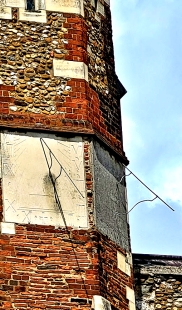
The two sundials are next to each other but face in different directions: one southeast, and the other southwest. The southeast dial carries the date 1660 and the words “Anno Salutis”. It celebrates the year that the monarchy was restored after Oliver Cromwell’s Commonwealth ended and Charles II became King of England.

I wondered why the church has two sundials next to each other. From what I could glean from the Internet, it seems that one dial catches the morning light better than the other, and the second one works best in the afternoon light. A website (https://sundialsoc.org.uk/wp_bridol/pages/S4/S4036.html)  explained that the dial bearing the date 1660:

Shows time 5am to noon in 30 & 15 min marks. Noon marked with cross.”

The other sundial, that facing southwest, comes into its own after noon. There might be other examples of paired sundials, but this is the first I have spotted.
Catching the wind

Cambridge, UK

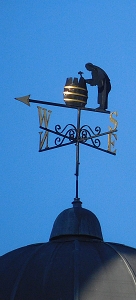
LOOK UP AND if your eyesight is reasonably up to scratch, you might well be lucky enough to see a weathervane on top of a church steeple or some other high point on a building. The ‘vane’ in weathervane is derived from an Old English word, ‘fana’, meaning flag (in German the word ‘Fahn’ means flag). Weathervanes are simple gadgets that indicate the direction of the wind. They usually consist of an arrow attached by a horizontal straight rod to a flat surface that catches the wind. The rod is mounted on a vertical support in such away that it can rotate as the wind catches the flat surface. The horizontal rod with the arrow rotates so that it offers the least resistance to the prevailing wind. Beneath the rotating arrow are often indicators that are labelled with letters denoting the four points of the compass. If, for example, the wind begins to blow from east to west, the horizontal rod will rotate so that the arrow is above the ‘E’ denoting east. Some weathervanes substitute the horizontal rod with a single flat asymmetric object that can catch the wind and rotate. Often the object seen above churches is a cock or other bird, whose beak will indicate the direction of the wind. I suppose that for birds wind direction is quite important.

The weathervane is not a recent invention. It was invented in the 2nd century BC both by the Greeks and the Chinese but separately. Some of the oldest Chinese weathervanes were shaped as birds and later, at least by the end of the 9th century AD, bird shaped vanes became used in Europe. Although avian weathervanes are still very common, a wide variety of other shapes have been used. Sundials, weathervanes, now archaic, only give an approximate indication of time and wind direction respectively. However, unlike sundials, which do not work when the sun is not shining, weathervanes work in all weather conditions and in day and night, although they are somewhat difficult to see at night-time. Despite their relative inaccuracy compared with modern instruments for measurements of  wind, weathervanes are attractive adornments to buildings both old and new.