Pull it out…

After qualifying at University College Hospital Dental School in early 1982, I practised dentistry for another thirty-five and a half years. I never owned my own practice but worked in those owned by other people. I worked in a total of five practices. With exception of one practice, where I worked for less than eight months, I enjoyed the conditions of the rest. None of my ‘bosses’ (i.e. the practice owners) appeared to mind how much or how little I earned for them and how much time I took off for travelling. I am grateful to them for their tolerant attitudes towards my laid-back approach to work.

My first boss, ‘J’, provided gave me a smooth introduction to the trials and tribulations of general dental practice. He was always ready to give me advice if I needed it, but gently encouraged me to take control of my decision making so that I became in charge of what I was doing.

During the first few months of being in practice, I often encountered difficulties when extracting teeth. Maybe, at that time I had insufficient experience to know when an extraction was likely to be too difficult for me to perform. Maybe, some teeth are just very hard to extract. This is the case.

If I got stuck midway through an extraction, I would ask my dental nurse to summon J. When J, who was very skilled at extracting teeth, arrived, he would work on the tooth up to a certain point. Then he would say to me that I should finish the job. He could have easily completed the extraction himself, but he wanted me to do it so that my patient would not lose confidence in me. I feel that this was extremely kind of him and will always be grateful for his sensitive approach. Later in the day, when there were no patients about, he used to take me aside and explain what he had done to loosen the tooth. Thus, I learned how to improve my technique.

As the years passed, my ability to perform extractions, even difficult ones, increased. Often, I would extract teeth that my colleagues would have referred to specialists. Although some of my other dental skills improved over the years, It is sad to relate that what I became best at was removing teeth rather than saving them!

PS: dentists never PULL out teeth; they use various techniques to widen the tooth socket and to split the collagen fibres that hold the tooth in the socket.

Picture source: “Der Zahnarzt in der Karikatur” by E Heinrich (1963)

The lady in blue

What makes for a great work of art? Well, people differ on the answer to this question. Seeing one special painting in the Galleria Regionale della Sicilia in Palermo (Sicily) helped me formulate my answer.

ARTGREAT 1

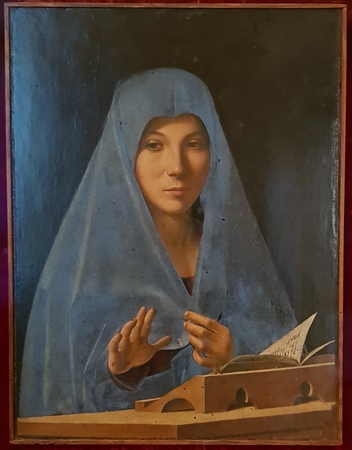
The painting that literally caught my eye and grabbed my full attention is “The Virgin Annunciate”. It was painted sometime between 1474 and ’77 by the Sicilian artist Antonello da Messina (c. 1430-79). It depicts a woman in a blue veil seated at a small wooden desk on which there is an open book. The fingers of her right hand spread forwards towards the viewer. Her left hand holds her veil closed. She appears to be gazing towards her right.  Simple, really, if described like this, but it is not.

The painting grabbed my attention long before my brain had time to analyse what was reaching my eyes’ retinas. It was an intense visceral attraction to the image that made me stop and look at it carefully, an attraction that few other works of art have had for me.

When I had recovered from the initial pleasurable shock of seeing such beauty, I began to notice its subject matter, and with the help of an explanatory note next to the painting, I learnt some of the artist’s deeper intentions.

ARTGREAT 1a

For example, there is a sharp crease in the cloth of the veil  just above the mid-point of the lady’s forehead. This tells the informed viewer that the Virgin is wearing a special treasured, rarely worn, veil that is usually kept neatly folded in a closet or wardrobe. No doubt, art historians would be able to point out many other meaningful details that the artist has depicted. Despite these aspects of symbolic meaning, despite its subject matter and context, this picture is primarily an object of enormous beauty and graciousness that appeals greatly to something in the deep recesses of my subconscious.

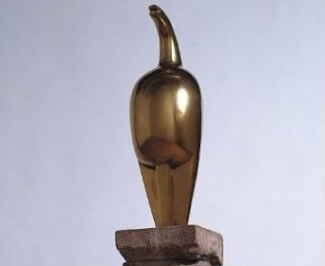
For me, a work of art must first seize the seat, the very source of my emotions in a positive way. If it can do that, then whether or not the artist has imbued it with layers of meaning, the work is in my view a great one. Lest you think that it is only the works of long dead masters that fall into my definition of ‘great art’, let me refer to someone who created more recently, Constantin Brâncuși (1856-1957). Some of his sculptures depict birds or humans as simple, almost abstract, forms, almost devoid of detail. These works evoke the same deep sensations of visceral attraction as the painting by Da Messina, yet they could hardly be more different in all respects from that.

ARTGREAT 2 bookdepository do com

A work by Brancusi [Source: bookdepository.com]

I am unable to formulate why the Da Messina and Brancusi works chime (and even some extremely abstract works such as those by Modriaan or Sean Scully) with my deepest emotional chords, when others, undoubtedly masterful in many ways like the works of Caravaggio and Barbara Hepworth, do not. I suppose this is what folk call ‘taste’. And, tastes differ greatly.

ARTGREAT 3

Sean Scully

For me, a great work of art must first appeal to me emotionally, viscerally if you like, rather than intellectually. If I can only begin to appreciate a work of art after it has been explained, as is the case with much so-called ‘conceptual art’, then, for me, it is not ‘great art’.

Cucumber sandwiches

My late mother-in-law, an Indian living in Bangalore, made the best cucumber sandwiches that I have ever eaten. She used fresh slices of thin white bread with crusts removed. Each slice was spread with a small amount of butter mixed with freshly mixed English-style mustard. Then, finely sliced, peeled and de-seeded cucumber was inserted as the sandwich’s filling. The result was both delicate and refreshingly delicious. Having eaten these superb snacks on numerous occasions, I formed the idea in my head that India is THE place for cucumber sandwiches. This led to an amusing incident.

sliced cucumber on white table

Photo by Pixabay on Pexels.com

Some friends of ours from England were spending a few days in Mysore, which is not far from Bangalore, where we were based. So, we decided to drive to Mysore to spend a day with them.

Our friends were staying in an old palace that had been tastefully converted into a hotel. After we had roamed around Mysore with them, they invited us to have afternoon tea in the lovely garden of the hotel. When we had sat down at a table, I said:

“This is the ideal place to eat cucumber sandwiches. The best cucumber sandwiches in the world are made in India.”

Everyone was happy to order a plate of these. When we asked the waiter for the sandwiches, he asked:

“You want vegetable sandwiches, with capsicum and all?”

“No, just cucumber sandwiches, no capsicums,” we replied.

Some minutes later, the waiter returned with A plate of sandwiches oozing with a bright red paste filling.

“What’s that?”, we asked him.

“Miner’s sauce”, came the reply.

“Miner’s sauce? What on earth is that?” asked one of our friends.

The waiter simply repeated the words “miner’s sauce”.

After a minute or two, the penny dropped, and I said:

“He means mayonnaise.”

Now, many non-English people pronounce this word as ‘my-on-nays’, which is closer to ‘miner’s sauce’ than the English pronunciation.

“We don’t want that sauce,” one of our friends protested, “Only cucumber.”

The waiter looked confused.

“What, no bread?” he asked.

“Let me show you what I mean,” said one of our friends, standing up and accompanying the waiter to the kitchen.

The waiter returned after a while with a very sub-standard collection of cucumber sandwiches.

Later my wife pointed out that just because her mother made excellent cucumber sandwiches, this was not necessarily the case all over India, as I had foolishly assumed.

Gandhi to Hitler

GTO H 2

On the 24th of December 1940 Mohandas Gandhi (the ‘Mahatma’) wrote to the Chancellor of Germany, Adolf Hitler. Amongst other things that he wrote in his letter, the following extracts suffice to give the gist of it:

“I hope you will have the time and desire to know how a good portion of humanity who have view living under the influence of that doctrine of universal friendship view your action. We have no doubt about your bravery or devotion to your fatherland, nor do we believe that you are the monster described by your opponents. But your own writings and pronouncements and those of your friends and admirers leave no room for doubt that many of your acts are monstrous and unbecoming of human dignity, especially in the estimation of men like me who believe in universal friendliness. Such are your humiliation of Czechoslovakia, the rape of Poland and the swallowing of Denmark. I am aware that your view of life regards such spoliations as virtuous acts. But we have been taught from childhood to regard them as acts degrading humanity. Hence we cannot possibly wish success to your arms.

But ours is a unique position. We resist British Imperialism no less than Nazism. If there is a difference, it is in degree. One-fifth of the human race has been brought under the British heel by means that will not bear scrutiny. Our resistance to it does not mean harm to the British people. We seek to convert them, not to defeat them on the battle-field. Ours is an unarmed revolt against the British rule. But whether we convert them or not, we are determined to make their rule impossible by non-violent non-co-operation…

…During this season when the hearts of the peoples of Europe yearn for peace, we have suspended even our own peaceful struggle. Is it too much to ask you to make an effort for peace during a time which may mean nothing to you personally but which must mean much to the millions of Europeans whose dumb cry for peace I hear, for my ears are attended to hearing the dumb millions? I had intended to address a joint appeal to you and Signor Mussolini, whom I had the privilege of meeting when I was in Rome during my visit to England as a delegate to the Round Table Conference. I hope that he will take this as addressed to him also with the necessary changes.” (see: https://www.mkgandhi.org/letters/hitler_ltr1.htm).

I do not think that this unbelievable letter ever reached the Führer. However, it formed the basis for a film, which was on general release in India briefly.

G TO H

[Source: MensXP.com]

In 2011, an Indian film, “Gandhi to Hitler”, was put out on general release in India. One newspaper accorded it a rating of half a star out of five. We were staying in Bangalore when it was showing, and I was dying to see a film whose name juxtaposed the peace-loving Gandhi with the war-mongering Adolf Hitler.

Only one cinema was showing the film in Bangalore. It was a long way from where we were staying. We arrived for the 10 am performance and joined a long queue of school-aged children waiting at the box office of the cinema multiplex. When we reached the ticket office, I said to the ticket seller:

“Two for the Gandhi/Hitler film.”

“Not possible, sir,” came the reply.

“Why not?”

“I must sell three tickets before we can screen a film, and you are only two.”

“But,” I protested, “we have come all the way from London to see this film.”

I thought for a moment, and then said:

“Sell me three tickets, and then you can screen the film.”

The seller was happy with this. We walked over to the lift that would take us up to the cinema. While we were waiting, the ticket man came rushing up to us, waving one of the notes with which we had paid for our tickets. He had managed to find a third taker for the film and refunded our third ticket.

Apart from an usher, there were only three of us in the large auditorium. The film was so dreadful that it was quite amusing. The plot had three main strands that ran in parallel. The first was Gandhi and his followers walking endlessly around a lovely garden. One of the followers was the wife of a man, who appears in the second strand. This aspect of the plot revolved around a group of Indian soldiers who had joined the German Army but were trying to desert from it. For those who are unaware of it, some Indian soldiers did actually join the Wehrmacht during WW2, hoping that a German defeat of the British might hasten the independence of India. Throughout the film, this forlorn band of soldiers trudged through a snowy mountainous landscape that was supposed to be the Alps but looked more like the Himalayas. Somehow, quite inexplicably, the woman in India was able to correspond by letters with the soldier tramping through the ‘Alps’.

The third strand of the film, which had no obvious connection with the other two strands, was set in Hitler’s bunker in Berlin during the last days of the Third Reich. Anyone who has watched the excellent film “Downfall” (2004) would be able to see that the bunker in the Indian film is a very crude copy of that in the German film. Unlike Adolf Hitler, the man portraying him in the Indian film is a true Aryan, an Indian. Goebbels is played by a character who looks like an elegant Italian. The Indian Hitler kept forgetting which of his arms was supposed to be lame.

There was an interval half way through the film. We left the auditorium to stretch our legs. When we returned for the second half of the film, my wife and I were the only people left in the auditorium.

Chicken 65

HAMPI 2a

The state-run Mayura Hotel at Hampi is conveniently located in the midst of the extensive, picturesque ruins of the once very prosperous city of Vijayanagara. The former city was once the world’s second largest metropolis, but it was destroyed in 1565. I have stayed at the hotel on at least three occasions despite its shortcomings, some of which I will describe below. It is only fair to point out that the last time I stayed at this hotel was at least nine years ago. Things might well have improved by then.

On one occasion, we were driving to Hampi from Bangalore, and were running late. We rang the hotel to tell them that we would be likely to turn up by 6 pm. They replied that it would not be a problem: our room was waiting. And, so it should have been because check-out time was 12 noon. Whoever had occupied the room on the previous day should have vacated their room by noon.

When we turned up at the hotel, we were told that the room we had booked was still occupied. We were not pleased. The receptionist explained that the occupants of our room, who should have vacated it by noon, were still using it. We remonstrated and asked for an explanation. We were told that the family that was overstaying in our promised room had also arrived late the day before, and the hotel was kindly letting them extend their stay at our expense.  We were tired and not amused.

The receptionist and another member of staff settled us temporarily in a small bedroom while we waited for our room to become vacant and cleaned up. After a couple of hours, we were shifted to our allotted family room. There were several workmen in the bathroom. They were trying to turn off a jet of water, like a geyser, that was shooting up from the floor. They managed after about an hour.

There were no towels in our accommodation. By now it was well after dark. We asked for towels and were told that we could not have them because the person with the (presumably only) key to the linen cupboard had gone home.

At the end of one of our stays at the Mayura, we asked to have breakfast at 7 am, when the dining area was supposed to open. When we arrived promptly at 7 am, there was no staff too be seen. Apart from us, the dining area was empty. After a few minutes, I walked into the kitchen: it was empty. All of the kitchen and serving staff were standing in a crowd in a nearby room, their eyes glued to a television screen. We learned the reason when, eventually, someone came to look after us. The television was showing the funeral of the much-loved Kannada film star Vishnuvardhan, who died on the 30th December 2009. Vishnuvardhan’s family were dismayed because his loss was not so greatly mourned as that of another star Rajkumar, who had died three years earlier. People had committed suicide on hearing of Rajkumar’s demise. Nevertheless, our driver thought it would be safer if we drove with a photo of Vishnuvardhan attached to the window as a mark of respect. Without it, we might have been attacked!

During one of our stays, we were curious to taste what appears on many South Indian restaurant menus. It is something called ‘Chicken 65’. What appeared resembled breaded chicken nuggets. They were bland and tasteless – very disappointing. 

Some days later, we had dinner with an elderly Dutch couple, who were back-packing around India. It was clear to us that they had had enough of spicy food. We suggested that they ordered French fries (finger chips in Indian English), which, like omelettes and tomato soup, are almost always available wherever you are in India. Their eyes lit up at this suggestion. Also, we recommended that they order Chicken 65, which we assured them was not at all spicy. 

After a while, the chips were served along with a plate of chicken pieces that did not resemble the Chicken 65, which we had ordered a couple of days earlier. Our new friends tasted this dish, and their eyes nearly popped out of their sockets. What had been served to them as Chicken 65 was far from bland; it was fiery hot. It seemed to us that the chefs in the kitchen paid little attention to what was ordered by the customers. We later learned that Chicken 65 is supposed to be hot and spicy. What we had been served before we met the Dutch people, was definitely not that dish.

The spicy dish was originally created at Buhari’s Hotel in Madras in 1965, hence the 65 in the name (see: https://www.thehindu.com/news/cities/chennai/the-hows-whys-of-our-chicken-65/article5042658.ece).

While we were staying in the hotel one visit, a tour group of Italians had dinner one evening. One man, who had had enough of spicy food, shouted out in a hysterical voice: “I want chicken, plain chicken with salt, nothing else, just chicken and salt, no spices, just chicken and salt.” He kept repeatng this, and we thought: “He should be so lucky in this eatery”.

Despite its elements of “Fawlty Towers” hospitality, the Mayura is a lovely place to base a few days of exploration of the substantial  ruins of a once great city.

HAMPI 3

Gifts of the grateful

In the 1980s, I visited my friends in the former Yugoslavia frequently. Also, I visited Albania and what is now independent Kosovo. During my trips, I picked up a large vocabulary of Serbo-Croat, including quite a selection of outrageous swear words. Grammar has always been beyond me in foreign languages, and often in my own. My interest in Albania and my brief visits to Albanian-speaking parts of the Balkans resulted in me acquiring some vocabulary in Albanian, but far less than in Serbo-Croat. Until the 1990s, I believed that my fragmentary knowledge of these languages would be useless outside the Balkans.
gift 2

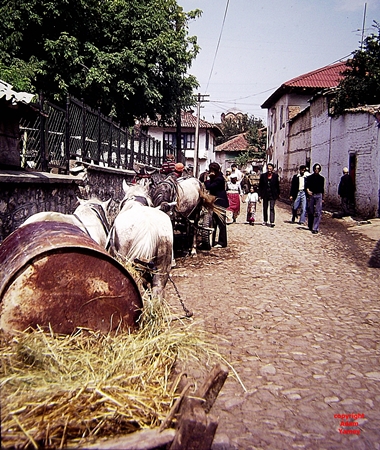
Prizren in Kosovo, pre-1990

During one trip to Belgrade, a friend arranged for me to be an observer in a clinic of a leading oral surgeon. I turned up at a large hospital and spent a couple of hours watching the surgeon reviewing a series of his patients. Although I was grateful to be allowed to watch the great man, I learned little that was relevant to practising dentistry. However, one aspect of this clinic interested me greatly. As each patient entered the consulting room, he or she presented the surgeon with a gift: a bottle, a large piece of cheese, a ham, etc.

The last patient to enter, a man in a somewhat shabby suit, entered and sat in the dental chair without having presented a gift. After his mouth had been examined, the surgeon took the patient and me out into a corridor. We walked through the hospital to a room with locked doors. My host unlocked it, we entered, and he locked the doors behind us. After a brief conversation, the patient handed the surgeon a small brown envelope, which he thrust into his jacket pocket. Then, after the doors were unlocked, the patient went one way, and we went another way. As we walked along the corridor, my host patted the pocket containing the envelope, and before bidding me farewell, said: “Pornographic photographs.”

gift 5 saraj

Poster of Marshal Tito in Sarajevo, Bosnia in the 1980s

My last visit to Yugoslavia was in May 1990.  Soon after that, wars broke out in the Balkans, and the former Yugoslavia disintegrated painfully to form smaller independent states. In the early to mid-1990s, there was terrible strife in Bosnia. Many people fled as refugees to places including the UK. In the late 1990s, Kosovo suffered badly from warfare between the Serbs and the ethnic Albanians. Many of the latter fled to the UK.

I moved from one dental practice outside London to another in London, an inner-city practice, in 2001. A significant number of my patients there had come from the former Yugoslavia as refugees. I was the only person in the practice who could greet them in Serbo-Croat or Albanian. Maybe, I was only one of a few dentists in London at that time who had this ability.

To the Albanian speakers my vocabulary was restricted to words such as ‘hello’ and ‘good-bye’, which brought smiles to their faces. Following a trip to Communist Albania in 1984, I recalled the Albanian words of political slogans such as “Long live Enver Hoxha”, “Enver’s party”, and “Long live the Peoples’ Party of Albania.” As many of my Albanian patients had come from Kosovo rather than Albania, these slogans meant little to most of them.
gift 3 travnik

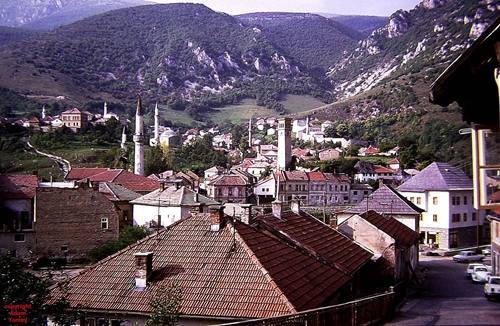
Travnik, Bosnia, 1975

My limited Serbo-Croat was more extensive than my Albanian. I could entertain some of my Bosnian and Serbian patients with polite small-talk. Many of the ex-Yugoslav patients, like those I had seen long before in Belgrade, brought me gifts. Even those, with whom I felt I was not getting along with well, brought me, usually, bottles of home-made alcohol (e.g. rakia, slivovitz, and loza) that had been distilled by relatives who had stayed behind in the former Yugoslavia. These strong alcoholic drinks were delicious, smooth, and delicately flavoured. One fellow plied me with DVDs of the latest Hollywood and other films that he had ‘pirated’. One lovely lady from Bosnia presented me with a pair of earrings, which her uncle had made, to give to my wife. She wears these often, and she is very grateful.

gift 4

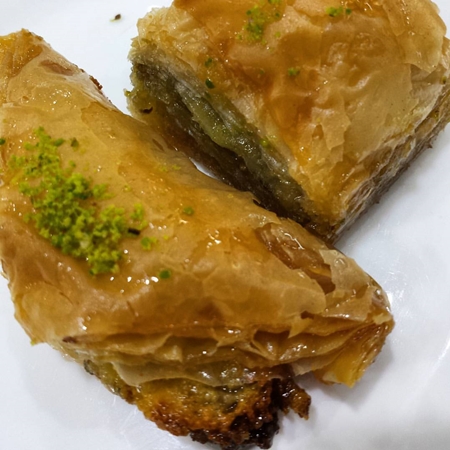
Many Middle-Eastern patients also felt that it was appropriate to bring me gifts. Thus, a lot of delicious baklava and other similar confections came my way. Delicious as these were, they were neither good for my teeth nor for my general health. A Hungarian family kept me supplied with large gifts of paprika powder, and there was a Romanian gentleman who brought me nice bottles of wine. Incidentally, the only words of Romanian I know are “thank you” and “railway timetable”. Once, we employed a Romanian dental nurse and I told her my Romanian party-piece “Mersul trenurilor.” She pondered for a moment and then replied “Ah, the programme of the trains.”

Once, my dental nurse, a friendly West Indian lady, and I were standing near a window facing the main road when a delivery van stopped nearby. A man was delivering trays of baklava to a nearby shop. I said to my nurse: “Why don’t you see if he’ll give us some to try?” She returned with a tray of baklava. Carelessly, because I was in a hurry to see my next patient, I put a large lump of baklava into my mouth, and then bit hard on it. As I was doing this, I heard a deafening bang in my head. The baklava was not too fresh. I had split a molar tooth into two parts, the smaller of which was loose in my gum.
gifts 1

Baklava

Unlike this disastrous piece of confectionary, the gifts kindly given to me by my patients did no harm. Furthermore, what I believed to be a useless tiny vocabulary of Balkan languages proved to be quite useful.  

Finally, you might still be wondering whether anybody ever took me aside to present me with an envelope containing pornographic photographs. To satisfy your curiosity, I can tell you that nobody did.