BY FEBRUARY, daytime temperatures in Pondicherry exceed 30 degrees Celsius. This combined with high humidity levels drive the wild street dogs to sleep a lot in whatever shade they can find. Likewise, sensible people avoid direct exposure to the strong tropical sun.
When you walk along the paths shaded by trees in the centrally located Bharathi Park, you can feel the temperature drop. This park, a peaceful haven, was an unforeseen result of warfare.
In 1709, the French built a fortress, Fort Louis, in the heart of Pondicherry. It was a typical fortress of the type designed by the French engineer Vauban (1633-1707). Pentagonal in plan, it had bastions at each of its five corners. The fort was destroyed by the British in 1761 and not replaced.
The space left after the destruction of the fort remained a wasteland used by the French for military training and celebration of some French national festivals. In 1854, an elegant neoclassical pavilion was erected in the middle of this wasteland. It commemorates a legendary 16th century woman, who discovered a source of water that became very important for the inhabitants of Pondicherry.
In 1946, a tree was planted on the land where Fort Louis once stood. Eventually, the present Bharathi Park was laid out. In its middle, stands the pavilion mentioned already.
One entrance to the park is opposite the entrance to the heavily guarded Raj Nivas (Governor’s Residence), housed in the former French Governor’s House built in 1766.
At the north east corner of the park, there is a statue of a man wearing a dhoti, a long jacket, and a turban. This depicts Chinnaswami Subramania Bharathi (1882-1921), also known as ‘Bharatiyar’. He was a great Tamil poet and independence fighter and opponent of the caste system. He fled to Pondicherry in 1908 to escape from being arrested (for his ‘seditious’ writing in newspapers) by the British and remained there until 1918. In 1906, he edited a newspaper with MPT Acharya, about whom I have written in my book about Indian revolutionaries in London, “Ideas, Bombs, and Bullets”. In Pondicherry, Bharatiya met other Indian freedom fighters seeking sanctuary there, including Sri Aurobindo and VVS Aiyar (also in my book), an associate of Vinayak Damodar Savarkar.
In 1918, Bharatiya moved back into British India, where he was promptly arrested. He died in 1921, impoverished.
The Puducherry Government Museum, housed in an 18th century French mansion, is a few metres from the park and well worth a visit. It contains exhibits dating from prehistory until the era of the French colonization. In need of a little bit more care and attention, there is a fascinating range of objects to be seen.
One display that interested me greatly was about the excavations made by a French archaeologist and the British Sir Mortimer Wheeler at Arikamedu, just south of Pondicherry. They were following up discoveries made in that location by French scholars before WW2. It emerged that Arikamedu was the site of a port at which Ancient Romans and Greeks traded with the local Indians.
The museum contains a few artefacts dug up including some Roman and Greek coins. A few years ago, I saw many of these in a museum at Calicut.
The ports where the Mediterranean people traded in India are contained in “The Periplus of the Erythraean Sea”, a navigational manual that was originally composed in the 1st century AD. The port near Arikamedu is most likely to have been ‘Podouke’ as listed in the “Periplus”.
So, it is evident that the area around Pondicherry was visited by Europeans long before the British, French, and Danes estsblished colonies there.
We left the museum, which also has a nice collection of Hindu sculptures, and the lovely park to enjoy some excellent French inspired cooking at the Villa Shanti. At the table next to ours, there was a very serious looking group of French tourists, who were listening earnestly to their Indian guide, who spoke to them in French with an accent that probably caused them to wince internally. Incidentally, apart from people from all over India, most of the rest of the visitors to Pondicherry are French. I wonder how they feel seeing the souvenirs of their former empire, now an episode fading into the swirling mists of time.



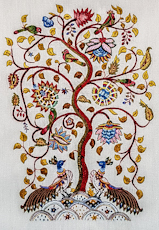 PONDICHERRY IS RICH in wonderful attractions, many of them souvenirs of its French colonial past. One of the most delightful of these is the Cluny Embroidery Centre on Rue Romain Rolland, a street named after a French writer and Nobel Prize winner who met Gandhi and was sympathetic to India and its philosophies.The Embroidery Centre is housed in an 18th century French Colonial building (a former residence, which was built by 1774) that forms part of a religious centre under the aegis of the Order of Cluny. It is believed that one of the former owners of the house donated it to help poor women in need. This must have been before 1829, when the Embroidery Centre was established. Every day except Monday and Sunday, at least twenty women of various ages arrive at the centre and take their places at tables in a large room with tall windows that open out into a verandah supported by neoclassical pillars and decorated with elaborate stucco bas-reliefs. The verandah looks out onto a courtyard surrounded on three sides by other buildings, parts of the convent, and the outer wall with a decorative entrance gate.This ensemble of buildings forms only part of a much larger complex of buildings, some of which surround another courtyard filled with a garden.After singing what sounds like a hymn, the women begin working on their elaborate embroideries. They stitch according to patterns designed by artists who work at the centre. While they work away silently with needle and thread, a simple sound system provides background music at a low volume.Dressed in white habit, Sister Agatha, who runs the convent, watches over the ladies at work and organises the sales of their labours to visitors who step into this peaceful sanctuary a few feet away from the noisy outside world.The resulting products are exquisitely beautiful. They embroider everything from coasters to handkerchiefs to napkins to pillowcases to table cloths and bedcovers. Visitors to the centre can purchase these treasures of fine needlework. Or, customers can place orders for specific items they need. The women who embroider at the centre get paid on a piecework basis. Some of them have had a history of mistreatment before joining the centre. Visiting the Cluny Embroidery Centre is a moving experience. It provides a very good example of how a religious order can work for the benefit of the ‘common’ folk.