Identity crisis

Don’t worry! This is not really a crisis. I used the word ‘crisis’ in the title to catch your attention! And, now that I have caught your attention, you might as well read on for a fewminutes because what I am about to tell you has a good chance of being interesting for you.

ALDWYCH

Since marrying a lady born in India, I have had many opportunities to visit India House on the western arm of the Aldwych in central London. Built 1928-30 and designed by Herbert Baker (1862-1946) with AT Scott, this stone building is profusely decorated with Ashoka lions and many circular, coloured emblems, which were those of the pre-Independence (and pre-Partition) colonial provinces (e.g. ‘Baluchistan’, ‘United Provinces’, ‘Burma’, ‘Madras’ and ‘North West Frontier’).

ALDWYCH 2

Looking upwards, there are two elaborate crests each topped with heraldic lions and including the mottos: “Honi soit qui mal y pense” and “Dieu et mon droit”. These are ‘souvenirs’ of the era when India was a British colony. Just as in post-Independence India there are still some statues of Queen Victoria standing– there is a fine example in Bangalore, these reminders of British imperialism remain attached to the building.

One side of India House faces India Place, which contains a bust of the Indian leader Jawaharlal Nehru (1889-1964), who became a barrister at the nearby Inner Temple. Close to a side entrance of India House, there is a monument to an off-duty policeman Jim Morrison, who was stabbed in December 1991 whilst chasing a handbag thief, who has never been caught. A ‘Friendship Tree’ was planted nearby in 1994 to commemorate the 125th anniversary of the birth of Mahatma Gandhi.

The India House, which now stands in the Aldwych, was NOT the first ‘India House’ in London. It had a predecessor in the north London suburb of Highgate. The earlier India House  stood at 65 Cromwell Avenue was a Victorian house that still exists. The Victorian house was named India House between 1905 and 1910 when it  was owned by Shyamji Krishnavarma who made it a hostel for Indian students and other Indians staying in London. The north London India House had a brief existence because it was under constant police surveillance on account of the anti-imperialist activities that went on within its walls (including producing anti-British propaganda, anti-British meetings, bomb-making, and arms smuggling).

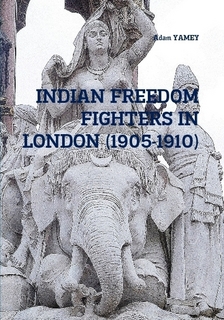
Many Indian patriots, who wanted to force Britain to give its then colony India freedom, lived and congregated in Highgate’s India House. Their activities and often daring deeds are described in my new book about a lesser-known period in the history of India’s independence struggle: “Ideas, Bombs, and Bullets”.


“IDEAS, BOMBS, and BULLETS”

by Adam Yamey is available from on-line stores including:

Amazon, Bookfinder.com, Bookdepository.com, Kindle, and Lulu.com

A suitcase of memories

Memories of childhood. Here is the introduction to a travel book, “CHARLIE CHAPLIN WAVED TO ME”, which I published several years ago:

charlie

The attic of my parents’ house in north London contained a number of old Revelation suitcases. These were plastered with ageing colourful paper stickers bearing the names of shipping lines and also of places such as: Cape Town, Southampton, Harwich, New York, Montreal, and Rotterdam. Had they been animate and able to speak, what tales they would have been able to tell!

If, as a child, I had become a suitcase, I too would have been covered with an exotic assortment of stickers including some of those mentioned above. But, I did not become a piece of baggage, and the stickers that I carry are not made of paper. Instead, they are memories stuck in various compartments of my brain. Unlike the inanimate objects in the attic in the eaves of our house, I am able to speak: to divulge my impressions of the places that I visited in my childhood; to describe the remarkable people I met in those places; and to reveal the unusual experiences that resulted from travelling with my learned father and my talented mother.

This book contains my memories of the holidays and trips that I took with my parents, mostly during the first eighteen years of my life. They are worth relating because they differed markedly from the kinds of holidays that most people took during the 1960s and 1970s. Rather than exposing their children to the sun on the beach, my parents preferred to expose my sister and me to cultural experiences that, they hoped, would benefit us in the future. This was due to my father’s great interest in the history of art, which resulted from my mother being an artist. Whereas now I appreciate what they did for me then, I did not always do so at the time.

Please join me now as I examine the stickers in my memory – the souvenirs of many years gone past. Let them reveal to you how interesting school holidays can be even if they only include the rarest of glimpses of the sea and an almost total absence of ‘child-friendly’ activities.

These memories of my childhood travels are illustrated with photographs, all of which were taken by me or with one of my own cameras unless otherwise stated. I was given my first simple camera when I was about 6 or 7 years old. It was not given to me by my parents, who never took photographs, but by my uncle Sven who was a keen photographer. His grandfather had been a pioneer of professional photography, as I will describe below. I will begin my narrative by choosing a label that could have been pasted on to my suitcase of reminiscences during the late 1950s or any time in the 1960s. It bears the name “Soho”. I have chosen it amongst all of the others because it provides a good introduction to my mother, who affected so much of what we did as a family and what will be related in this book.


CHARLIE CHAPLIN WAVED TO ME

(ISBN: 9781291845051)

is available at:

Amazon, bookdepository.com, lulu.com , and on Kindle

Bad hair day

hair

When I began practising as a dentist, I worked in a small town in north Kent. My working week stated on Monday afternoons. So, Monday morning was available for me to do whatever I wanted. I used to have my regular haircuts on Monday mornings at a barber shop owned by Dave. He often cut my hair and always did a good job.

One Monday morning, I entered Dave’s establishment and as Dave was not around I had my hair trimmed by a young lady. She did a good job but handled my head roughly. She knocked my head around as if it were one of those balls that boxers use for training. I am exaggerating a bit, but there is no denying that having this lady cutting my hair was a stressful experience.

Some hours later, I rang Dave to tell him about my recent visit to his shop. I wanted him to know that if his assistant persisted in treating customers the way she did to me, he would lose business. Dave apologised, and then told me that his young lady had had a bd weekend, a row with her boyfriend. 

I suppose that Monday was what people call a ‘bad hair day’ for me.


Bad hair day: a bad day a day with many problems, annoyances, etc. (https://www.merriam-webster.com/dictionary/bad%20hair%20day)

A German bride


As World War II (‘WWII’) drew to its conclusion in Europe Jim arrived near Aachen in Germany with the British forces. He was stationed near the home of Minny, a young German woman. They met, fell in love, and, after considerable delay, married in Liverpool (UK).

“The Bride’s Trunk” by Ingrid Dixon is about her parents Minny and Jim. It concentrates more on her mother’s history, her life in Germany before, during and after Hitler’s regime. Minny’s is the story of an ordinary German girl growing up in times of ever increasing difficulty and hardship. That alone would make the book interesting, but her encounter with a soldier belonging to the ‘enemy’s’ forces and the difficulties put in the way of intermarriage between Germans and British military personel add to this concisely told story.

Nazi figures who have written about their lives, such as Albert Speer and  Brunhilde Pomsel (one of Josef Goebbel’s secretaries), claim little or even no knowledge of the attrocities perpetrated against the Jewish people and many others during the Nazi regime. It was refreshing to read in Dixon’s book:

The excuse offered by so many after the war -‘Davon haben wir nichts gewusst’ – ‘we didn’t know about any of that’ – is no longer credible … evidence for the fate of Jewish citizens mounted daily as rumours circulated and eye-witness reports increased …”

Amidst a good summary of the history of the Germany in which Minny grew up, there are many intriguing details about the daily life of ordinary German folk living in the rural outskirts of a big city (Aachen).

On the whole, this is a good book, but I would love to have greater detail about Minny’s reception in post-war England. This is dealt with to some extent, but after reading what Dixon wrote, I would have liked to have discovered even more. The book is copiusly illustrated and includes some maps. Many of the illustrations are specific to the story of Minny and then later Minny and Jim, but there are a few of general historical interest, which I have seen in many other publications.

Would I reccomend the book. The answer is ‘Yes’. It is a quick and fascinating read, a useful contribution to the history of Germany.


“The Bride’s Trunk”

by Ingrid Dixon

ISBN: 9780993508028

A French artist in London

Cocteau


The entrance to the Roman Catholic church of Notre Dame de France (‘NDF’) is on Leicester Place, a very shiort walk from London’s Leicester Square. Consecrated in 1868, the church occupied a circular building. After WW”, it iwas rebuilt retaining its ciricular plan. Today, when there are not services, amny of the pews in this lovely building are occupied by sleeping homeless people and a few other folk seeking a peaceful refuge in this busy part of central London.

The Lady Chapel on the north ‘side’ of NDF is closed off by transparent thick glass panels. This is no doubt to protect the frescos lining its walls and the mosaic by the Russian-born Boris Anrep (1883-1969) on the altar. The frescos were created by the French writer/artist Jean Cocteau (1889-1963) in 1960. These beautiful pictures represent the Annunciation, Crucifixion, and Assumption. At the feet of one of the Roman centurions depicted in the central fresco, which illustrates the Crucifixion, there is a self-portrait of the artist. Cocteau drew this three years before his death.

Many people visit Leicester Square every day, but few of them visit NDF. For anyone interested in twentieth century art, seeing this church, which is open daily from 9 am to 9pm,  is a worthwhile thing to do.


Address: 5 Leicester Pl, London WC2H 7BX

A light bulb moment: sudden enlightenment

bulb


After I had completed my first (Bachelor’s) degree, I decided that I would like to apply to become a doctoral (PhD) student. In order to do this in the UK (and elsewhere) it is necessary to enlist a supervisor, an academic who guides you through the process of researching and writing a doctoral thesis.

I knew roughly in which field I wished to pursue my further studies. Someone in Cambridge was looking for a PhD student to work on something that sounded interesting to me. So, I visited the academic in Cambridge. First of all, I was not particularly keen on the man’s personality (albeit having only met him once) and also the project he was offering seemed far too difficult for me, way beyond my ability. 

After the Cambridge episode, I discovered that the Imperial Cancer research institute was offering amazingly generous scholarships for PhD stuents working in their laboratories. I applied, choosing two of the projects that seemed to be in harmony with my interests, and received an offer of interviews at the institute in Lincolns Inn Fields.

At the first interview, I was introduced to the eight or so members of the team i was applying to join. They sat around whilst the senior members of the team interviewed me. It did not take me long to feel uneasy about my future colleagues, and as the questioning continued I could not wait for it to end. Near the end of the session I was asked if I was interested in cancer. In an attempt to cut short the proceedings, I answered that I was uninterested in that subject. 

After an equally unpromising interview with another of the research groups that I had applied to join, I left the building and began walking across Lincolns Inn Fields, feeling relieved that the interviewing ordeal was over. It was then that an important tought entered my head.

A PhD takes about (or at least) three years to complete. During that time, I would have to work in a laboratory with the rest of a research team and in regular contact with my supervisor. I realised while walking in Lincolns Inn Fields that it would be important for me that I enjoyed the people with whom I would be working. A pleasant environment was more important for me than the precise nature of the research topic.

I returned to University College, having made the decision to ask Professor Robert Harkness, whom I liked and whose research interests attracted me, whether he would take me on as a PhD student. To my great delight, he accepted me. As one of his doctoral students, I spent a very happy three and a bit years working in his laboratory with his other researchers, all of whom were friendly and helpful.

Since that day in Lincolns Inn Fields and my ‘light bulb moment’, which happened there, I have attended other interviews (for positions in various dental practices). At each occasion, I have asked myself: would I feel happy working five days a week with the person(s) interviewing me? If I have not felt the right ‘vibes’ at the interview, I have always turned down the job however attractive it seemed. On only one occasion, I have been mistaken with that approach, which I was fortunate to have been able to take when looking for work.

Shrinking cabbages


Golborne Road intersects London’s famous Portobello Road. I practised dentistry in a clinic on Golborne Road between 1995 and 2001. In those days, Golborne was far less chic than it is today. Every day I used to pass E Price and Sons, a vegetable shop on Golborne.

The shop had a disorderly display of vegetables outside it and was run by a very old couple. I never entered their shop because it seemed to be impenetrable.

On the rare occasions that I purchased anything there, either the old lady or the old man would hurl the produce onto the scales and hardly waited to see the true weight. Then, they would mention a price, always adding the word ‘alright’, pronouncing it as if they were asking the question “is that alright?” They said the word ‘alright’ in such a way that suggested that something was not alright.

My lasting memory of this vegetable shop is of watching either of the man or woman sitting outside the shop removing withered outer leaves from the cabbages. Every day, I noticed that the cabbages on display got smaller and smaller; they seemed to be shrinking.

The shop closed a few years ago, and was later reopened by younger members of the Price family. Sadly, their lovely shop went out of business and the premises are awaiting their new reincarnation.

Bookshelf nonsense

bookshelf

Here is something based on an idea I saw posted on Facebook. I took a photo of some paperback books, which have been randomly piled up on a shelf for ages, and using their titles I composed the following:

GOD’S SECRET AGENTS reveal that LENI has MORE LIVES THAN ONE. 

RED PLENTY aka RED PRINCESS uses JITTERBUG PERFUME when visiting WOLF

HALL or escaping from THE SINGAPORE GRIP


Climate, cycles, and trees

cycle


Undoubtedly, there is much concern about the future of planet Earth’s climate. So much so that children are missing school to go on protest marches because they are worried that they might never complete their lives because of catastrophic flooding or abnormally high ambient temperatures. Whether or not the dire predictions will turn out to be fulfilled remains to be seen, but there is no harm in trying to do something to address and then ameliorate or extinguish the perceived causes of the predicted ultimate disaster(s).

One of many measures being taken in London to reduce the output of gases toxic to the environment is to encourage the use of bicycles instead of motor vehicles. At present, cycling in London is fraught with dangers. There have been many collisions between cyclists and motor vehicles with quite a few fatalities amongst the cyclists. Many attempts are being made to segregate cyclists from other road traffic by constructing dedicated cycle lanes. Countries like the Netherlands have demonstrated very successfully that cycling can be made both safe and enjoyable by means of a comprehensive network of cycle lanes. 

Recently, there was a plan to construct a cycle lane along the tree-lined Holland Park Avenue in west London. From my frequent observations of this thoroughfare, there is only heavy cycle traffic in the morning and evening rush hours. Outside these busy times, there are few cyclists using this stretch of road. I felt that because of this a cycle lane was of questionable value.

To build the proposed cycle lane, planners faced a problem, which they might not have anticipated. In order to construct the cycle lane, twenty mature leafy trees would have had to be removed from Holland Park Avenue. This prospect aroused the anger of protestors in the area, who felt it was wrong to chop down trees to make way for a cycle lane. In a way they were correct.

Trees, as most people now know, help to protect the climate, which motorists (in cars powered by fuels other than electricity) are destroying. One need only look at the recent international protests against cutting down the rainforests in Brazil to understand the perceived importance of trees. Granted, Holland Park Avenue is hardly a rain forest, but chopping down trees does not seem like a good thing. In Bangalore (India), many trees have been removed to accomodate the needs of a rapidly growing metropolis, and the city’s climate and water supply are being adversely affected by factors such as this.

So, we have a conundrum: cyclists or trees? Rather than sit on the fence, let me give you my answer. The object of encouraging cycling and preserving trees is to save the future of human existence. If that is accepted, then saving cyclists’ lives and protecting them from harm has to take preference over saving twenty undoubtedly attractive trees.

All I ask of the cyclists is to protect themselves and pedestrians by obeying traffic signals.

For more about the Holland Park cycle lane, see:

https://www.bbc.co.uk/news/uk-england-london-48635369