A MOSQUE DESIGNED by Mimar Sinan (c1489-1588), probably the best of Ottoman architects, stands a few yards away from Istanbul Modern (modern Art museum) designed by one of Europe’s best contemporary architects – Renzo Piano (born 1937).
The mosque is the Kiliç Ali Paşa, designed by Sinan and completed 1580. Like other mosques designed by this architect, the spaces contained within feel most satisfying. Sinan was masterful in his creation of contained spaces. The mosque with buttresses also has some attractive tiled panels both inside and outside.
One minute’s walk away from the 16th century mosque stand Piano’s Istanbul Modern, which was completed in 2004. Quite different from the mosque, it shares one thing in common – brilliant spatial design. Located next to the waterfront of the Bosphorus, brilliant views of Istanbul can be obtained from the waterfront, from the rooftop terrace, and through the gallery windows.
Piano’s building is so utterly engaging visually that it competes with the exhibits for one’s attention. Although many of the mostly Turkish artworks are both beautiful and engaging – we spent three hours looking at them, it is Piano’s building that steals the show.
I found it fascinating that two magnificent buildings, their constructions separated by 424 years, should be standing so close one another. Had I been in Renzo Piano’s shoes, I would have felt honoured to have one of my buildings so close to that of an architect who has easily passed the test of time.
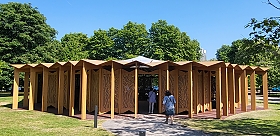
EVERY YEAR SINCE 2000, the Serpentine Gallery in London’s Kensington Gardens has commissioned the construction of a temporary pavilion in its garden. These pavilions have two things in common. One is that they contain a café and the other is that it must be designed by a noteworthy architect who has never had one of his or her creations constructed in England. Almost all the pavilions constructed to date have been examples of adventurous and exciting architecture. This year’s architect is Lina Ghotmeh, who was born in Lebanon and now works in her studio in Paris.
Given the French name “À table”, the circular timber pavilion was conceived as a place for people to sit together and chat, just as they would around a dinner table. Given this aim of the architect, it succeeds. To enhance her aim, the specially designed tables and chairs are arranged in a circle. As my wife said, it is the homeliest of all the pavilions built to date. Unlike some of the earlier pavilions, one does not feel that one is entering an unfamiliar, or even alien, environment. Despite its welcoming nature and very human scale, the pavilion’s design is far from mundane. Although it is far from being amongst the most visually spectacular of the temporary buildings, it is pleasing to the eye. I will certainly visit it again before it is dismantled on the 29th of October 2023.
UNBELIEVABLY, THE ARCHITECT Herbert Baker (1862-1946) demolished a major work of one of England’s greatest architects – Sir John Soane (1753-1837). Imagine the outcry if Sir Richard Rodgers decided to demolish Christopher Wren’s St Pauls Cathedral to replace it with one of his own design. Well, in the 1920s, Baker demolished most of Soane’s Bank of England to replace it with a larger building – the present Bank – which he designed.
There is a small museum in the Bank of England. Some of its rooms have been designed to recreate the kind of interiors that would have existed in Soane’s Bank building. In one of the rooms of the museum, a circular space beneath a glazed dome, there is a framed portrait of Sir Herbert Baker. Baker, who helped design New Delhi, is well known for his architectural work in South Africa. After being commissioned by the imperialist Cecil Rhodes (1853-1902) to redesign Groote Schuur, his house on the slopes of Cape Town’s Table Mountain, he was asked to design many other structures in South Africa.
The portrait depicts Baker standing at a drawing table by a window through which a building in his typical neo-classical style can be seen. At the bottom left corner of the painting, there is a depiction of a framed painting of Cape Town’s Rhodes Memorial, which Baker designed in 1906. If you look carefully at this picture within a picture, an equestrian statue can be discerned. This statue, called “Physical Energy”, was sculpted by George Frederick Watts (1817-1904), who was briefly married to the actress Ellen Terry. The statue was cast in 1902, and placed at the Rhodes Memorial in Cape Town. In 1907, another bronze cast was made, and this stands on a stone plinth in Kensington Gardens almost midway on a line connecting the statue of young Queen Victoria in front of Kensington Palace with the Henry Moore sculpture on the east bank of The Long Water (part of the Serpentine).
When we saw the portrait of Baker, we were viewing an interesting exhibition that explores the Bank of England’s many and varied links with the slave trade. The caption relating to the portrait of Baker concentrated on the small image of the memorial to Rhodes. It correctly pointed out that Rhodes had been a Prime Minister of the Cape Colony, which became part of unified South Africa in 1910. It also mentions that Rhodes: “…held racist beliefs that Africans were inferior.” In 1912, the author GK Chesterton wrote of Rhodes that he:
“… had no principles whatever to give to the world. He had only a hasty but elaborate machinery for spreading the principles that he hadn’t got. What he called his ideals were the dregs of a Darwinism which had already grown not only stagnant, but poisonous … It was not his fault that he “figured out that God meant as much of the planet to be Anglo-Saxon as possible.” Many evolutionists much wiser had “figured out” things even more babyish. He was an honest and humble recipient of the plodding popular science of his time; he spread no ideas that any cockney clerk in Streatham could not have spread for him. But it was exactly because he had no ideas to spread that he invoked slaughter, violated justice, and ruined republics to spread them.”
Well, that is something for recipients of, and those applying for, Rhodes Scholarships to ponder over.
Getting back to the Bank that Baker designed, the museum is well worth visiting not only for its temporary exhibition about slavery but also for its permanent collection of exhibits, all of which have easily understood explanatory labelling.
ON TUESDAY THE 24th of January 2023, we arrived in the city of Ahmedabad in the Indian State of Gujarat. That evening, we visited a friend who had been the curator of a building in Ahmedabad, which had been designed by the architect Le Corbusier. Our friend was pleased to see us but was upset because a close friend had died that morning at the age of 95. That friend had been a disciple collaborator of Le Corbusier.
Our friend’s friend was Balkrishna Vithaldas Doshi, who was born in Pune in 1927. He worked with Le Corbusier in Paris between 1951 and 1954. He returned to Ahmedabad to supervise Le Corbusier’s architectural projects in that city. In 1955, Doshi established his own studio in Ahmedabad, and was working there until the day before he died.
Clearly influenced by Le Corbusier and Louis Kahn, with whom he designed the campus of the Indian Institute of Management (Ahmedabad), his (some might say Brutalist) architecture embodies the ideals of Le Corbusier in a much more user-friendly form than that which his mentor produced.
Amdavad ni Gufa
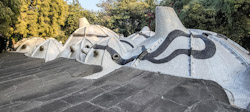
Next door to CEPT University in Ahmedabad much of which was designed by Doshi, there stands Doshi’s most unusual edifice, the Amdavad ni Gufa (the Ahmedabad Cave), which was completed by 1990. Its is difficult to describe this structure, but I will try. Covered in a mosaic of black and white ceramic tiling, it resembles an enormous caterpillar partially submerged in the ground. It is a giant caterpillar punctuated by bulbosities of various sizes, some of which have hemispherical windows at the end of short stalks that project from the dome-like bulbosities.
Steps descend to the two entrances of the Gufa. Originally designed as an art gallery, its irregular shape and wavy floor deemed it unsuitable for its intended purpose. Within the Gufa, the ceiling is supported by irregularly shaped columns that resemble stalactites with have joined with stalagmites beneath them. The strange space, which was too odd to be used as a gallery, is now decorated with sculptures and murals painted by the celebrated Indian artist MF Husain (1915-2011).
The Gufa is one of the ‘must-see’ sights of Ahmedabad. With the recent demise of Doshi and the earlier death of Husain, the Gufa makes a fitting memorial to these two great creators.
THE BOWRING INSTITUTE is a private members’ social club in central Bangalore (Bengaluru). It was established in 1868, and has been standing on its present site since 1888. The club has recently undergone a tasteful restoration and improvement. The old 19th century buildings can be seen in their full glory, looking as if they have only just been constructed.
One external wall of a club building has been adorned with a huge panel decorated with two Modulors. The Modulor is a symbol created by the great pioneer of 20th century architecture, Le Corbusier. It looks like a man with one arm raised and was designed by Le Corbusier to be “ a visual bridge between two scales: the metric and the imperial…” It was also connected with his philosophy that the proportions of structures should be related to those of the human body.
Le Corbusier had several connections with India. For example, he was intimately involved in the design of the city of Chandigarh and created a few wonderful buildings in Ahmedabad.
That said, I have yet to discover why the Modulor was placed twice on a panel at the Bowring Institute so long after its creator’s death. I would like to think that it is a fitting reminder of the considerable influence that Le Corbusier has had on 20th century Indian architects, including Balkrishna Doshi, whose studio and offices are in Ahmedabad.
MY CHILDHOOD HOME was in the heart of north London’s Hampstead Garden Suburb (‘HGS’). For those of you who are unfamiliar with garden suburbs, here is a definition (from Collins online dictionary) that might begin to help:
“…a suburb of a large established town or city, planned along the lines of a garden city”
And a garden city is (from Collins) is:
“…a planned town of limited size with broad streets and spacious layout, containing trees and open spaces and surrounded by a rural belt”
In Brentham garden suburv
The garden suburb differs from the garden city in two main ways. (1) The former is part of a city, whereas the latter is separated from other cities by countryside (e.g., Welwyn Garden City). (2) The garden city is exclusively or mainly residential, but the garden city can include all that other cities contain.
The first houses in HGS, which was founded by Dame Henrietta Barnett, were completed in 1907. Our house in HGS bore the date 1908.
Brentham Garden Suburb (‘BGS’) was founded earlier than HGS: in 1901. One of its founders was Ebenezer Howard, the who founded The Garden City Movement in 1899. BGS is located close to the River Brent, where it flows through the Borough of Ealing. Its architecture was influenced by the Arts and Crafts Movement, which was inspired by the philosophy of the social reformer and designer William Morris.
On a recent visit to BGS, the first for me, I was impressed by the similarity of many of its houses to those which I had grown up amongst in the HGS. The similarities are not surprising when you learn that from 1907 onwards for a few years, BGS’s planning was under the supervision of Raymond Unwin, the architect who planned the layout of HGS. Most of the buildings built after 1907 in BGS were designed by Frederic Cavendish Pearson and George Lister Sutcliffe, who were both in sympathy with Unwin’s ideas.
Most of the houses in BGS were built before the 1920s. This was not the case in the larger HGS, where building on a substantial scale continued into the 1930s. So, whereas Art Deco buildings and some other modern designs can be spotted in the HGS, this is not the case in the more architecturally homogenous BGS. A visit to BGS is worthwhile, especially if you are familiar with other garden suburbs and garden cities.
APPLE TREE YARD is a cul-de-sac near London’s Piccadilly. It runs east from Duke of York Street and parallel to Jermyn Street. On its south corner where the Yard meets Duke of York Street, there is an interesting monument consisting of three slightly separated carved basalt slabs with letters inscribed in them. The letters make up the following words, all in capital letters:
“SIR EDWIN LUTYENS ARCHITECT
DESIGNER OF NEW DELHI
LAID OUT HIS PLANS HERE IN APPLE TREE YARD”
Although I have never been to Delhi, I am familiar with the work of Edwin Lutyens (1869-1944). I was brought up in north London’s Hampstead Garden Suburb not far from its Central Square, which is surrounded by buildings that Lutyens designed before embarking on his projects in New Delhi. Although the above-mentioned basalt blocks were completed in 2015, I had not been past Apple Tree Yard until yesterday (13th September 2022). Next to the inscribed blocks there is an attractive figurative bas-relief carving, also in basalt, mounted on a wall.
The carvings were made by Stephen Cox and he describes them in detail on a web page (www.lutyenstrust.org.uk/portfolio-item/apple-tree-yard-sculpture-honours-spirit-lutyens/). Here is a brief summary of what he wrote. The bas-relief sculpture is called “Relief; Figure emerging”. It was inspired by sculptures in Hindu cave temples, especially those around a town near Chennai (Madras): Mahabalipuram. The basalt that can be seen in Apple Tree Yard was quarried near the south Indian temple town of Kanchipuram. Cox, who has a studio in Mahabalipuram, was assisted by local carvers, when he created the bas-relief. In summary, the monumental slabs and the nearby sculpture have their roots in India, which is highly appropriate as they commemorate an architect, who worked in India.
I must admit that amongst all the foreign architects, who have made significant buildings in India, Lutyens is not my favourite. Those, whose works I have seen in India and liked, include William Emerson (1843-1924), Frederick W Stevens (1847-1900), Le Corbusier (1887-1965), and Louis Kahn (1901-1974).
Lutyens, who was a former Viceroy of India’s son-in-law, drew up the plans for New Delhi in an office at number 7 Apple Tree Yard. Hence, the location of the monumental stones. Number 7 was for a long time the home of the Royal Fine Art Commission, but it exists no longer. It is now covered by a new building. However, his work in both India and the Hampstead Garden Suburb can still be admired by those who like Lutyens’s work. I feel that Cox’s memorial to him is much more elegant than much that I have seen of his buildings.
THE HAMPSTEAD GARDEN SUBURB (‘HGS’), which I mention briefly in my new book about Hampstead, “Beneath a Wide Sky: Hampstead and its Environs”, began to be built as a Utopian experiment in providing housing for all social classes in about 1904. Many of the earlier homes were built in styles that alluded to traditional vernacular architecture such as is found in East Anglia and other rural areas. Many of the older houses incorporate Arts and Craft style decorative features.
Kingsley Close
Lyttelton Road, a stretch of the A1 trunk road, passes through a part of the Suburb known as the Market Place, one of the few parts of HGS with shops. The main road separates an older part of the suburb south of it from a newer section north of it. Close to the Market Place but south of the main road, there is a cul-de-sac, Kingsley Close, which contains houses built in 1934 in the art deco (‘moderne’) style. They have curved suntrap windows made by Crittals. The residences were designed by the architects Herbert Welch (1884–1953), Nugent Francis Cachemaille-Day (1896–1976), and Felix Lander (1890-1960). Welch did much designing in HGS and in nearby Golders Green. According to the website, http://www.encyclopedia.com/education/dictionaries-thesauruses-pictures-and-press-releases/welch-herbert-arthur, Welch:
“… also designed the handsome curved terraces of shops and apartments in Golders Green Road that demonstrate the early C20 change of style from vernacular revival to Neo-Georgian. In collaboration with Frederick Etchells (the translator of Le Corbusier’s works into English), Welch, with Nugent Francis Cachemaille-Day (1896–1976) and Felix J. Lander (1898–1960), designed the pioneering International Modern Crawford’s Office Building, High Holborn, London (1930), with long bands of windows subdivided by steel mullions, much influenced by the Weissenhofsiedlung.”
The Weissenhofsiedlung was an estate built for an exhibition in Stuttgart in 1927. Apart from influencing Herbert Welch, it also stimulated the design and construction of the Lawn Road Flats (the Isokon) in Hampstead, which is described in my new book.
“Handsome” is not how I would describe the terrace of shops mentioned in the quote. However, I feel that the houses in Kingsley Close are more pleasing to my eyes. There are other art deco homes in the HGS, which I hope to write about in the future.
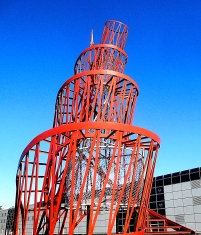
THE MARXIST SOCIETY of the University of East Anglia had just held a meeting around it, so we were told by someone working in the Sainsbury Centre for Visual Arts on the university campus in Norwich. The object around which the political gathering was held is a 35 feet high model of a structure that was never built full size. The Russian architect Vladimir Tatlin (1885-1953) had planned to build a futuristic tower in Petrograd (aka ‘Leningrad’ and ‘St Petersburgh’), an example of Constructivism. The tower, which was to have been 1300 feet high, was planned to celebrate and house The Comintern (3rd International). Hoping to rival Paris’s Eiffel Tower and to symbolise the modernity of Soviet Russia, the tower was never built.
Model of Tatlin’s tower with the Sainsbury Centre behind it
Sometime, back in the early 1970s, it was decided to construct a model of the Tatlin Tower near the Hayward Gallery on London’s South Bank. This was not a simple task because the structure is complex, and proper detailed blueprints were unavailable. To make a model of the Tatlin Tower that was faithful to the designer’s original idea, and which would not topple over, the services of a structural engineer were required. My uncle Sven, who worked for the firm of Felix Samuely and Partners, proved to be the man for the job. Working with the project’s director, Jeremy Dixon, my uncle had to unravel the plans of the structure using photographs of a 17-foot model of the tower that Tatlin had created in 1920 and a few existing images of plans that Tatlin had prepared. There were inconsistencies between Tatlin’s plans and the model produced in 1920. In 1971, Dixon:
“…built small models in balsawood to get it right, and he worked with Sven Rindl of consulting engineer Felix J Samuely & Partners, who generated detailed freehand drawings as they talked” (quoted from “Blueprint”, December 2011)
Dixon wrote about this in Sven’s obituary as follows:
“I particularly remember working with him on the reconstruction of the remarkable tower that Vladimir Tatlin produced as a monument to the Third International, the communist organisation founded in 1919, for the Art in Revolution exhibition at the Hayward Gallery in 1971. The project required us to go back to first principles to reinvent its extraordinary geometry and structure.
Sven would sit listening and commenting during our complex voyage of discovery, and at the same time he would be drawing. These drawings would be remarkable, elegant, three-dimensional sketches straight off the sketch pad, finished and complete. They were graphic works of art as well as documentation of engineering ideas.”
The model was built with timber inside the Hayward Gallery before being exhibited outside it in 1971 as part of an exhibition called “Art in Revolution: Soviet Art and Design since 1917”.
Forty years later in 2011, another model of the Tatlin Tower was produced, this time made of a more durable material, steel. Once again, the project was overseen by Jeremy Dixon. The completed model was first displayed in the courtyard of London’s Royal Academy. In an advance notice of the project (www.architectsjournal.co.uk/archive/ra-unveils-tatlins-tower), my uncle, who had died in 2007, was given a prominent mention:
“The 10.5m high steel structure in the Annenberg Courtyard was designed by architects Jeremy Dixon of Dixon Jones Architects, Christopher Cross, Christopher Woodward and engineer Sven Rindl. The tower will form part of the Royal Academy’s forthcoming exhibition, Building the Revolution: Soviet Art and Architecture 1915-1935 which opens on 29 October 2011.”
I remember going to view the model and then seeing a small exhibition about it and its construction. The exhibition, which was held inside the Royal Academy, included images of some of the beautifully drawn plans and diagrams created by my uncle.
The steel model of the Tatlin Tower, which was exhibited at the Royal Academy in 2011, has been lent to the Sainsbury Centre by the academy. Painted in red, this model of an experiment in futuristic architecture stands outside and close to the magnificent building that houses the Centre. The edifice, which is now over 40 years old, but looks like new, was designed by the architects Norman Foster and Wendy Cheesman.
We had no idea that there was a model of Tatlin’s tower next to the Sainsbury Centre when we visited it in September 2021. My wife and I were pleased to see this reminder of a much-missed relative whom we both loved dearly.
EVERY YEAR SINCE 2000, excepting 2020, The Serpentine Gallery in London’s Kensington Gardens has erected a temporary summer pavilion. Each pavilion is designed by a different architect or group of architects. What they have in common is that their pavilion is the first of their designs to be constructed in London, or maybe the UK. They stand in front of the Serpentine Gallery during the summer months and into early autumn. They are always fascinating visually and always contain a café with seating. Over the years some of them have been used as event spaces.
At the end of the season, the pavilions are dismantled and are never seen again in Kensington Gardens. Some of them might be sold and others re-erected elsewhere, but until recently I have never seen one again.
A few years ago, a contemporary art gallery, Hauser and Wirth, which has a branch in London’s West End, bought a farm on the edge of Bruton in Somerset. They have used some of the farm buildings and constructed some new ones to accommodate another branch of their gallery. In addition to the exhibition spaces, there is a superb restaurant, an up-market farm shop, and a wonderful garden created by the Dutch garden designer Piet Oudolf (born 1944).
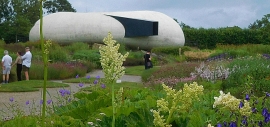
The garden slopes upwards from the gallery. At the top of the slope, there is something that at first sight looks like a giant hamburger patty or the profile of an oversized bagel. I recognised it immediately as being one of the former summer pavilions that once stood next to The Serpentine Gallery in Kensington Gardens. It is the 2014 Serpentine pavilion designed by Smiljan Radic (born 1965 in Santiago, Chile).
When I saw it in London in 2014, I was not overly impressed by it. However, seeing it at Hauser and Wirth in Somerset, it looks great. My description of it as an oversized bagel is not too far from the truth. It is, basically, an annular structure like a ring or a bagel, but it is far more interesting than that. Supported on rocks, the ring is not in one plane, but it undulates gradually. Irregularly shaped holes in its translucent skin provide intriguing views of Oudolf’s garden, which looks good in all seasons, and the surrounding hilly Somerset countryside.
A visit to Hauser and Wirth in Somerset makes a fine day out even if you have only a scant interest in contemporary art. The food served in the restaurant is of a high quality and not unreasonably priced. The buildings on the estate are lovely and the garden is hard to beat for its beauty.




 yamey
yamey 