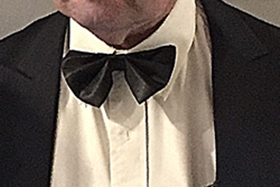
There are times
When a bow-tie is de rigueur
But I hate wearing it
de rigueur, meaning ‘ required by etiquette or current fashion’, despite its many vowels is pronounced ‘de rig-err’

There are times
When a bow-tie is de rigueur
But I hate wearing it
de rigueur, meaning ‘ required by etiquette or current fashion’, despite its many vowels is pronounced ‘de rig-err’

The prices of books varies greatly from one country to another. In India, many books cost far less than their equivalents sold, for example, in Europe. Readers in India buying books that have to be imported from ‘the West’ often face high charges due to delivery from afar. I have tried to address this problem with a couple of books, which I have written. My solution is outlined after the following introduction to one of my books about India:
My wife, who is a fluent Gujarati speaker, was born in Bombay. Her father’s family originated in Gujarat and her mother’s in the former Princely State of Kutch, which became part of the State of Gujarat after India became independent.
Both my wife and I have visited India regularly from our home in the UK, yet neither of us had ever been to Gujarat until early in 2018. We felt that it was high time that we visited the parts of India connected with her heritage. I have published a book that describes that first trip. We did not visit everywhere in Gujarat, but the places we saw, our experiences, and the people we met ranging from autorickshaw drivers to former royalty, and our experiences, are described my book. All of these have made us want to visit the region again and to explore it further.
I have long been fascinated with tiny enclaves. I have visited places such as Andorra, San Marino, Mahe (in Kerala), Pondicherry, and Llivia (a part of Spain surrounded by France). Gujarat contains two such places, the former Portuguese colonies of Daman and Diu, territories surrounded by Gujarat but separated from it by borders. We included them on our journey and discovered that though small in area, they are filled with interest.
Gujarat was the birthplace of many celebrated persons, including Narsinh Mehta (poet), Dayanand Saraswati (philosopher), Shyamji Krishnavarma (Sanskrit scholar and freedom fighter), and politicians such as: Mahatma Gandhi, Dadabhai Naoroji, Vallabhai Patel, Morarji Desai, and Narendra Modi. Yet, undeservedly, it is a part of India less frequented by tourists than many other places in India (e.g. Goa, Kerala, Rajasthan, and the ‘Golden Triangle’). I hope that what you will read in this travelogue will whet your appetite and encourage you to make plans to visit Gujarat.
The idea of my book is to unwrap the attractions of Gujarat to make them better known to those who have not yet visited this region of India.
What I have written above is to introduce you to a book I published in 2018 with the title “TRAVELS THROUGH GUJARAT, DAMAN, and DIU”. This book is available from on-line booksellers such as lulu.com, Amazon, and bookdepository.com. When you buy my books from these suppliers, they are produced in Europe or the USA and then shipped to the buyer. If they are bought by people living in India, their prices become very large (in comparison with average Indian book costs) because of additional postal charges. For example, TRAVELS THROUGH GUJARAT, DAMAN, and DIU can cost up to 1500 Indian Rupees (‘INR’) and another book, which I have recently published, “IDEAS, BOMBS, and BULLETS” can cost purchasers in India over 800 INR.
To make my books more affordable in India and priced at a rate closer to comparably sized books in the Indian market, I have re-published the two books mentioned above with an Indian print on demand outfit called pothi.com. The travel book has been revised and I hope improved. I have renamed it “GUJARAT UNWRAPPED”. My book about Indian patriots in early twentieth century London, “IDEAS, BOMBS, and BULLETS” retains its original name.
When ordered through pothi.com and delivered in India, GUJARAT UNWRAPPED is priced at 296 INR (plus minimal postage) and IDEAS, BOMBS, and BULLETS comes to 395 INR (plus minimal postage).
To order GUJARAT UNWRAPPED FROM POTHI.COM,
click: https://pothi.com/pothi/book/adam-yamey-gujarat-unwrapped
To order IDEAS, BOMBS, and BULLETS FROM POTHI.COM,
click: https://pothi.com/pothi/book/adam-yamey-ideas-bombs-and-bullets
IMPORTANT:
It is worth nothing that purchasers ordering the books from pothi.com BUT not having their books delivered in India, face huge postage charges.

Until I was 16 years old, I accompanied my parents on annual holidays in Florence (Italy). We always stayed at the Pensione Burchianti, which was run by two ageing sisters. Almost every evening, we ate dinner in a nearby restaurant (the Buca Mario). This excerpt from my book CHARLIE CHAPLIN WAVED TO ME describes how I began to acquire some limited skill in speaking Italia. Here is the excerpt:
” … After dinner we would walk back to the Burchianti. It might have been during one of these evening strolls that my father came up with a new version of the saying ‘a penny for your thoughts’, namely: ‘a penne for your sauce’. The traffic in the streets would have quietened down by the time that we had eaten, and all of the traffic signals, or ‘robots’ as my South African parents called them, had flashing amber lights instead of the usual sequence of three coloured lamps. The pedestrian signals, which alternated between the red ‘Alt’ and the green ‘Avanti’ during the day, simply flashed both messages at the same time at night.
When we arrived back at the Burchianti, the residents, who had been eating supper, were usually still lingering at their tables. Many of them almost lived in the Burchianti. There was an elderly commendatore, who took all his meals there but slept elsewhere. There were also a number of business people who spent the week working in Florence, but resided some distance away in the weekend. They lived in the pensione during the week. One of these was a lady pharmacist from Parma who spoke Italian with a curious accent, rolling her ‘r’s in an exaggerated way.
On entering the dining room, we would be greeted like old friends, which I suppose we were. We would be invited to sit at the sisters’ table, and then I had to perform. One of the sisters would ask me in Italian what I had eaten for dinner, and I had to reply in Italian. Everyone listened to my reply which usually went something like this:
“Primo piatto o mangiato spaghetti con pomodoro. Dopo o mangiato bistecca con patate fritte. E dopo, profiterole.”
It was not difficult to relate what I had eaten because every dinner I ordered the same thing or substituted lombatina di vitello (veal chop) for the bistecca. This nightly recitation gave me the confidence to try to speak in Italian, even if badly. When I did not know a word, I tried using a Latin word but pronounced it in a way that I believed made it sound Italian. Often, this worked! ...”
If you want to know whether Charlie Chaplin really did wave to me, grab a copy of my book from:
https://www.bookdepository.com/Charlie-Chaplin-Waved-Me-Adam-YAMEY/9781291845051
OR
http://www.lulu.com/shop/adam-yamey/charlie-chaplin-waved-to-me/paperback/product-21611544.html
OR Amazon or Kindle store

The observant eye
Spots the leaping brown fox
While walking in the park
This fox was seen next to the Serpentine lake in Kensington Gardens, London

In 1973, the economist EF Schumacher coined the phrase ‘small is beautiful‘. But, is small always beautiful?
The Mini, made by the British Motor Corporation, was first available for drivers to purchase in 1959. This compact, low-priced car, designed by Alec Issigonis, remained popular until 1986 when production ceased. I was not upset by this as the original Mini was extremely uncomfortable to sit in. Small the car was, but beautiful it was not.
In 1994, the German car manufacturer, BMW, bought the right to make cars bearing the trade name ‘Mini’. Models made from the year 2000 onwards faintly resemble the old-style Mini models, but contain many more up-to-date features. However, the BMW models look like bloated versions of the original versions. The new models look like Minis on steroids. They are not so small, and definitely not so beautiful.
The picture of the blue, old style Mini, was sourced from Flickr via Wikipedia

Centuries unchang’d
Hide with toes upward curl’d
Albanian footwear

Recently, I attended an event, a performance of Albanian polyphonic singing by the ‘Grupi Lab’ ensemble from Vlore (Albania), in a room in the Palace of Westminster in the heart of London. For those who are unfamiliar with the Palace of Westminster, this enormous building contains the two Houses of Parliament.
To enter the Palace, it was neccessary to weave around the barricades put up to limit the activities of the Extinction Rebellion climate change activists. The public entrance is in Cromwell green, close to a statue of Oliver Cromwell. After a series of security checks that resemble those at Heathrow Airport, we followed a path that leads into the huge Westminster Hall. Although restored in parts, this hall dates back to 1097 AD. Its marvellous hammer beam timber roof was built in the 14th century. Much of the timber is original, but some of it had to be replaced after a bomb struck in 1941.
After the concert, we decided to visit the public gallery of the House of Commons. After a short wait, we were issued with tickets and then escorted to another security check point. The examination here was very thorough.
The public gallery overlooks the chamber in which Members of Parliament debate and make speeches. When we arrived at about 5.30 pm on the 14th of October (2019), there were more people in the public gallery than in the chamber. A Labour MP was delivering a lengthy, dull speech. Nobody seemed to be paying him the slightest attention. After what seemed an eternity – actually, about ten minutes – he stopped. He was followed by a Conservative MP, who made an interesting speech, concisely and powerfully phrased. Again, this did not appear to interest anyone else in the chamber. During the couple of speeches we heard, we could see the few other MPs present sitting quietly, many of them fiddling with their mobile telephones or tablets. This, my first ever visit to a sitting of the House of Commons, was interesting but hardly scintillating.
What impressed me most about my visit to the Palace of Westminster was the staff. Everyone we encountered was not only helpful, but also kind and couteous. The ‘pomp and circumstance’ of the Palace did amaze me, but not nearly as much as the superb staff.

People enter keenly
The auditorium fills
Let the show begin
Auditorium of the Bridge Theatre, London

This true story in this recently published book covers three contintents:
* It concerns the adventures of an educated South African, who was captured by the British during the Boer war (1899-1902)
* The prisoner of war (POW) was held in prison camps in what was then British India.
*Whilst in Captivity, he visited Indian localities such as Madras, Trichinopoly, Kolar, Amritsar, and Bangalore. Being observant, he made notes on what he experienced. His observations form the centrepiece of this book, which is also rich in South African history.
* The POW’s descriptions of Bangalore in 1901 are particularly detailed, and will fascinate anyone who knows the city today
* This book will appeal to anyone interested in the histories of South Africa and/or India
“IMPRISONED IN INDIA” by Adam Yamey
is available as a paperback (ISBN: 9780244826161) at:
http://www.lulu.com/shop/adam-yamey/imprisoned-in-india/paperback/product-24280162.html
For readers in India: https://pothi.com/pothi/book/adam-yamey-imprisoned-india
and on Kindle

The popularity of vegetarianism and its relative veganism has greatly increased in the western world in recent years, and is still increasing. Popular reasons for abandoning the consumption of meat and/or products derived from animals (e.g. milk and eggs) include seemingly virtuous reasons such as love of animals and a desire to protect the world’s climate.
On the 23rd of July 1939, one world-famous vegetarian wrote a letter to another equally well-known vegetarian. Mahatma Gandhi wrote to Adolf Hitler. Here it is in a much abbreviated form (from: https://www.mkgandhi.org/letters/hitler_ltr1.htm):
“DEAR FRIEND,
That I address you as a friend is no formality. I own no foes.
… We have no doubt about your bravery or devotion to your fatherland, nor do we believe that you are the monster described by your opponents. But your own writings and pronouncements and those of your friends and admirers leave no room for doubt that many of your acts are monstrous and unbecoming of human dignity, especially in the estimation of men like me who believe in universal friendliness
… I, therefore, appeal to you in the name of humanity to stop the war. You will lose nothing by referring all the matters of dispute between you and Great Britain to an international tribunal of your joint choice
…You know that not long ago I made an appeal to every Briton to accept my method of non-violent resistance.
… During this season when the hearts of the peoples of Europe yearn for peace, we have suspended even our own peaceful struggle. Is it too much to ask you to make an effort for peace during a time which may mean nothing to you personally but which must mean much to the millions of Europeans whose dumb cry for peace I hear, for my ears are attended to hearing the dumb millions? …
I have no idea what the monster Adolf Hitler had to say about vegetarianism, but the saintly and peace-loving Gandhi wrote much about his abstinence from meat. For example, in 1932 he wrote:
“I do feel that spiritual progress does demand at some stage that we should cease to
kill our fellow creatures for the satisfaction of our bodily wants. The beautiful lines
of Goldsmith occurs to me as I tell you of my vegetarian fad:
‘No flocks that range the valley free
To slaughter I condemn;
Taught by the Power that pities me
I learn to pity them’ “
(see: https://www.mkgandhi.org/ebks/moralbasis_vegetarianism.pdf)
And at another time:
““It is very significant that some of the most thoughtful and cultured men are partisans of a pure vegetable diet.”“.
Maybe, he was thinking of the man of culture, Bernard Shaw, rather than Adolf Hitler!
Returning to the present day and the increasing appetite for meatless and dairy-free food, let us consider the current desire for vegetarian products to resemble meat products. Supermarket shelves are filling up with veggie burgers, meatless steaks, meatless meat balls, meatless shawarma, and many other products made to resemble meat without containing it. Recently, I was in a Chinese restaurant, which offered diners vegetarian chicken and vegetarian duck dishes. This yearning for vegetarian products to be named like and to look like meat products is absurd,
There are plenty of delicious vegetarian dishes that are not made to resemble foods that usually contain meat. Middle-Eastern and Turkish cuisine, for example, offer vegetarian eaters delights such as: humous, fattoush, Imam Bayildi, Mutabbel (an aubergine dish), falaffel, stuffed peppers,etc. Even the French, who until recently have not been overly attracted to vegetarianism, have a traditional dish perfect for vegetarians: ratatouille. As for Indian cuisine, there is a plethora of dishes that are vegetarian and do not try to appear like meat. In India, the land where Gandhi was born, vegetarianism is a way of life, rather than a changed lifestyle, for hundreds of millions of people. This has been the case in India for many millennia.
To conclude, what I am trying to say is that if you wish to abandon eating meat for whatever reason, then you might as well abandon the desire to eat things that look like meat, but are not. If you are adopting vegetarianism, then enjoy meatless dishes for their own sake, not because they remind you of meat! Bon apetit!
Picture source: tesco.com
 yamey
yamey 