Mini on steroids

MINIS


In 1973, the economist EF Schumacher coined the phrase ‘small is beautiful‘. But, is small always beautiful?

The Mini, made by the British Motor Corporation, was first available for drivers to purchase in 1959. This compact, low-priced car, designed by Alec Issigonis, remained popular until 1986 when production ceased. I was not upset by this as the original Mini was extremely uncomfortable to sit in. Small the car was, but beautiful it was not.

In 1994, the German car manufacturer, BMW, bought the right to make cars bearing the trade name ‘Mini’. Models made from the year 2000 onwards faintly resemble the old-style Mini models, but contain many more up-to-date features. However, the BMW models look like bloated versions of the original versions. The new models look like Minis on steroids. They are not so small, and definitely not so beautiful.


The picture of the blue, old style Mini, was sourced from Flickr via Wikipedia

Houses of Parliament

westmin


Recently, I attended an event, a performance of Albanian polyphonic singing by the ‘Grupi Lab’ ensemble from Vlore (Albania), in a room in the Palace of Westminster in the heart of London. For those who are unfamiliar with the Palace of Westminster, this enormous building contains the two Houses of Parliament.

To enter the Palace, it was neccessary to weave around the barricades put up to limit the activities of the Extinction Rebellion climate change activists. The public entrance is in Cromwell green, close to a statue of Oliver Cromwell. After a series of security checks that resemble those at Heathrow Airport, we followed a path that leads into the huge Westminster Hall. Although restored in parts, this hall dates back to 1097 AD. Its marvellous hammer beam timber roof  was built in the 14th century. Much of the timber is original, but some of it had to be replaced after a bomb struck in 1941.

After the concert, we decided to visit the public gallery of the House of Commons. After a short wait, we were issued with tickets and then escorted to another security check point. The examination here was very thorough. 

The public gallery overlooks the chamber in which Members of Parliament debate and make speeches. When we arrived at about 5.30 pm on the 14th of October (2019), there were more people in the public gallery than in the chamber. A Labour MP was delivering a lengthy, dull speech. Nobody seemed to be paying him the slightest attention.  After what seemed an eternity – actually, about ten minutes – he stopped. He was followed by a Conservative MP, who made an interesting speech, concisely and powerfully phrased. Again, this did not appear to interest anyone else in the chamber. During the couple of speeches we heard, we could see the few other MPs present sitting quietly, many of them fiddling with their mobile telephones or tablets. This, my first ever visit to a sitting of the House of Commons, was interesting but hardly scintillating.

What impressed me most about my visit to the Palace of Westminster was the staff. Everyone we encountered was not only helpful, but also kind and couteous. The ‘pomp and circumstance’ of the Palace did amaze me, but not nearly as much as the superb staff.

Captured by the British

COVER blog


This true story in this recently published book covers three contintents:

* It concerns the adventures of an educated South African, who was captured by the British during the Boer war (1899-1902)

* The prisoner of war (POW) was held in prison camps in what was then British India.

*Whilst in Captivity, he visited Indian localities such as Madras, Trichinopoly, Kolar, Amritsar, and Bangalore. Being observant, he made notes on what he experienced. His observations form the centrepiece of this book, which is also rich in South African history.

* The POW’s descriptions of Bangalore in 1901 are particularly detailed, and will fascinate anyone who knows the city today

* This book will appeal to anyone interested in the histories of South Africa and/or India 


IMPRISONED IN INDIA” by Adam Yamey

is available as a paperback (ISBN: 9780244826161) at:

http://www.lulu.com/shop/adam-yamey/imprisoned-in-india/paperback/product-24280162.html

For readers in India: https://pothi.com/pothi/book/adam-yamey-imprisoned-india

and on Kindle

Veggie burgers and other creatures

veggie

The popularity of vegetarianism and its relative veganism has greatly increased in the western world in recent years, and is still increasing. Popular reasons for abandoning the consumption of meat and/or products derived from animals (e.g. milk and eggs) include seemingly virtuous reasons such as love of animals and a desire to protect the world’s climate.

On the 23rd of July 1939, one world-famous vegetarian wrote a letter to another equally well-known vegetarian. Mahatma Gandhi wrote to Adolf Hitler. Here it is in a much abbreviated form (from: https://www.mkgandhi.org/letters/hitler_ltr1.htm):

DEAR FRIEND,
That I address you as a friend is no formality. I own no foes.

… We have no doubt about your bravery or devotion to your fatherland, nor do we believe that you are the monster described by your opponents. But your own writings and pronouncements and those of your friends and admirers leave no room for doubt that many of your acts are monstrous and unbecoming of human dignity, especially in the estimation of men like me who believe in universal friendliness

… I, therefore, appeal to you in the name of humanity to stop the war. You will lose nothing by referring all the matters of dispute between you and Great Britain to an international tribunal of your joint choice

You know that not long ago I made an appeal to every Briton to accept my method of non-violent resistance.

During this season when the hearts of the peoples of Europe yearn for peace, we have suspended even our own peaceful struggle. Is it too much to ask you to make an effort for peace during a time which may mean nothing to you personally but which must mean much to the millions of Europeans whose dumb cry for peace I hear, for my ears are attended to hearing the dumb millions? …

I am,
Your sincere friend,
M. K. GANDHI
The letter never reached Hitler; it was intercepted by the British in India.

I have no idea what the monster Adolf Hitler had to say about vegetarianism, but the saintly and peace-loving Gandhi wrote much about his abstinence from meat. For example, in 1932 he wrote:

I do feel that spiritual progress does demand at some stage that we should cease to
kill our fellow creatures for the satisfaction of our bodily wants. The beautiful lines
of Goldsmith occurs to me as I tell you of my vegetarian fad:

‘No flocks that range the valley free
To slaughter I condemn;
Taught by the Power that pities me
I learn to pity them’

(see: https://www.mkgandhi.org/ebks/moralbasis_vegetarianism.pdf)

And at another time:

“It is very significant that some of the most thoughtful and cultured men are partisans of a pure vegetable diet.”“.

Maybe, he was thinking of the man of culture, Bernard Shaw, rather than Adolf Hitler!

Returning to the present day and the increasing appetite for meatless and dairy-free food, let us consider the current desire for vegetarian products to resemble meat products. Supermarket shelves are filling up with veggie burgers, meatless steaks, meatless meat balls, meatless shawarma, and many other products made to resemble meat without containing it. Recently, I was in a Chinese restaurant, which offered diners vegetarian chicken and vegetarian duck dishes. This yearning for vegetarian products to be named like and to look like meat products is absurd,

There are plenty of delicious vegetarian dishes that are not made to resemble foods that usually contain meat. Middle-Eastern and Turkish cuisine, for example, offer vegetarian eaters delights such as: humous, fattoush, Imam Bayildi, Mutabbel (an aubergine dish), falaffel, stuffed peppers,etc. Even the French, who until recently have not been overly attracted to vegetarianism, have a traditional dish perfect for vegetarians: ratatouille. As for Indian cuisine, there is a plethora of dishes that are vegetarian and do not try to appear like meat. In India, the land where Gandhi was born, vegetarianism is a way of life, rather than a changed lifestyle, for hundreds of millions of people. This has been the case in India for many millennia.

To conclude, what I am trying to say is that if you wish to abandon eating meat for whatever reason, then you might as well abandon the desire to eat things that look like meat, but are not. If you are adopting vegetarianism, then enjoy meatless dishes for their own sake, not because they remind you of meat! Bon apetit!

Picture source: tesco.com

My artistic mother

HELsculpt2


My late mother died at the age of 60 in 1980. Her mother, who was born late in the 19th century in South Africa, held an old-fashioned opinion that girls should not attend university however bright they were. My mother would certainly have been able to cope with a university course of study, but, instead, she enrolled in the prestigious Michaelis  School of Fine Art in Cape Town. Founded in 1925, it is now ironically a department of the University of Cape Town.

Mom studied commercial art. Her first employment was hand painting posters, advertising cinema films. When I began visiting India in the 1990s, many film posters were still being painted by hand. Often, we saw workers perched on rickety bamboo scaffolding, painting the details of huge posters. Two years ago while visiting Bhuj in Kutch (part of Gujarat), we found a workshop where two men produced hand painted posters. They told us that the demand for these was dying out rapidly. It is interesting to note that, like my mother, the great Indian artist MF Hussain began his creative life as a painter of cinema posters.

Returning to my mother, she designed and painted advertising material for the Red Cross in Cape Town during WW2. In 1947, she followed her fiancé, my father, to the UK. She married in 1948, and I arrived a few years later. According to my father, Mom took painting classes with the the famous Sir Stanley Spencer (1891-1959).  Sometime after that, she began creating sculptures.

When I was born, I had a torticollis (twisting of muscles of the neck beyond their normal position) that caused my head to be bent to one side. At that time in the early 1950s, the doctors told my mother that there was nothing to be done about this, and we would just have to live with it. My feisty mother refused to believe this. Every day, she manipulated my head and neck and gradually corrected the situation. Whether it was this manipulation that caused my mother to become a sculptor, I cannot say. However, one of her first sculpures was a terracotta mother and child, which she reproduced much later as an alabaster carving (see photo above).

When I was a young child, my mother used to attend the sculture studios at the St Martin School of Art in London’s Tottenham Court Road. She was not a student; she used the facilities and received advice from other sculptors including Philip King and Antony Caro. At that time, she became a close friend of the sculptor Dame Elizabeth Frink, who visited our home regularly. At St Martins, Mom learnt how to weld and work with metal. She created several quite attractive abstract metal artworks. Being a perfectionist, she destroyed much of what she made, but not before having it photographed by a competent photographer. Sadly, these photos have gone missing.

By the time I was a teenager, my mother had ceased working at St Martins, possibly not of her own volition. She rented a large garage in Golders Green and used it as a studio, where she created huge abstract sculptures in timber. She found working on her own to be lonely. However, without the benefit of proper lifting equipment, she produced quite a few sculptures.

Around about 1970, Mom began complaining of back pains, which she thought were the result of the heavy work she was doing in her garage. She abandoned the garage and more or less stopped creating any artworks except for a very few abstract pen and ink drawings, which she considered good enough to be framed.

The back pains continued. My mother became disillusioned with the contemporary art scene. She was familiar with the great renaissance  works of art which she visited every year in Florence (Italy), and comparing these with what she and her contemporaries were producing added to her disinclination to produce any more art of her own. For the last ten years of her life, Mom continued to search (unsuccessfully) for an interest to replace the creation of art. Tragically, she died young because of a cancer, which might well have been contributing to her long-lasting back pain.

Whatever the reason, if an artist loses the urge to create, it must produce a huge hole in his or her life, something like losing a loved one.

Hard sell

clean mouth teeth dentist


An engraving of the Tower of Babel by Dolf Rieser (see: More about Dolf Rieser) used to hang overlooking the first landing of the staircase in our family home in north-west London.

In my thirties I worked as a dentist and lived in north Kent. Almost every weekend, I used to drive to visit my widowed father in our family home. On one of these visits I noticed a box lying on the landing beneath the Tower of Babel engraving. It was an unopened, sealed box containing a dental water pik. This is a device that can be used to pulse tiny jets of water between neighbouring teeth in order to dislodge deposits of dental plaque (bacterial debris). It has proved to be a far less effective method of removing plague than dental floss, which itself is less eggective than the use of  tiny interdental brushes. I was a bit surprised that my father had bought a water pik as he is not a lover of gadgets.

For several weeks after I first noticed the unopened package, I kept returning to my family home and seeing the unopened package, which was gradually becoming covered with dust. Eventually, I asked my father about it.

He told me that each time he visited his dentist, ‘D’, he was asked to purchase one of these water piks. After a series of visits, he paid out almost £100 to buy one. I asked him why he had wasted his money on something he was not going to use. He said:

“D kept on pestering me to buy one. He was getting on my nerves, so to shut him up I bought one. I have no intention of using it.”

No doubt profit was not the only motive for D wanting my father to own a water pik, and he might have been surprised by my father’s reason for buying one, namely to put an end to his ‘hard sell’.


To see the Tower of Babel engraving, click: HERE

Photo by Pixabay on Pexels.com


Urban animals

Romulus

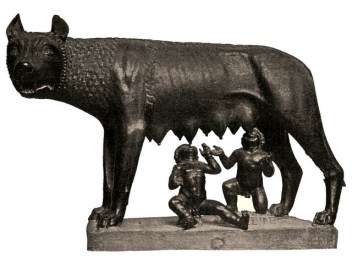
Exactly when great cities were founded is often unclear. However, sometimes there is a myth involving the animal world that is associated with the genesis of a great city. In the case of Rome (Italy), the story of Romulus and Remus and the wolf that suckled them is too well-known to be repeated here. If you do not know it, read about it HERE .

The great city of Ahmedabad in Gujarat (India) was founded in the 15th century AD by Ahmed Shah, who governed the Sultanate of Gujarat  from 1411 until  1442. According to the writers Achyut Yagnik and Suchitra Sheth in their book Ahmedabad: From Royal City to Megacity:

One popular myth says that Ahmed Shah went hunting one day on the banks of the Sabarmati and saw a hare chasing a dog. Amazed by the the unusual role reversal and interpreting it as an auspicious omen, Ahmed Shah decided to found a city at that spot by the river“.

This kind of myth in which a predator is chased by its prey is shared by several other cities including Malacca (now in Malaysia), Chandrapur (in Maharashtra), and the ancient city of Vijaynagara (in Karnataka). In the case of Malacca, a mouse deer being chased by a dog managed to push its pursuer into a river (see: https://en.wikipedia.org/wiki/Chandrapur) . As for Chandrapur, there was a hare chasing a dog. In each case, a city was founded on the spot where these unusual occurrences were reported.

Vijanagara on the banks of the River Tungabadra thrived from the 14th century until the 16th century and was during its heyday one of the largest and richest cities of its time.  Today, its extensive, impressive, and attractive ruins can be explored by visitors to Hampi (near the city of Hospet). According to Robert Sewell (1845-1925) in his A Forgotten Empire (first published 1900), a chieftain Deva Raya (aka ‘Deorao’) was:

“… one day hunting amongst the mountains south of the river when a hare, instead of fleeing from his dogs, flew at them and bit them…”

When Deva Raya told the sage Vidyaranya about this incident, the wise man told him to build a city on this spot. That was in 1336 AD, and the city became Vijaynagara. In another version of  this story, as related by Ratnakar Sadasyula in his recently published book City of Victory says that the hare attacking the dogs (at the place Vijaynagara was started) was seen by the brothers Harihara and Bukka, who were the first two rulers of the Empire of Vijaynagara (see: https://en.wikipedia.org/wiki/Harihara_I). It matters not who actually witnessed this extraordinary attack of the dogs by a hare. What is interesting  is that the locations of several cities has been ascribed to the siting of  prey pursuing its predator(s). 


Picture source: wikipedia