A Hebrew dictionary and a lost abbey

NOT MUCH REMAINS of Ramsey Abbey in a part of Cambridgeshire, which used to be in the former county of Huntingdonshire. Like most of the monastic institutions in England, Ramsey Abbey was ‘dissolved’ by Henry VIII. Ramsay was closed in 1539.

Founded in 969 by Bishop Oswald of Worcestershire (died 992), this abbey in the Fens achieved great importance, rivalling Ely and Peterborough. Three centuries before the first college (Peterhouse) was established at Cambridge in 1284, Ramsey was a renowned centre of scholarship. In addition to theological matters, the scholars at Ramsey studied a wide range of other subjects. One of the most eminent scholars, Abbo of Fleury (c945-1004), was brought to Ramsey by Oswald in 985. Abbo brought much knowledge from both the Classical world and the Arabic world to Ramsey, where he stayed for 18 months. Another leading scholar was Byrhtferth (c970-c1020), who was well-known for his studies of English history. He also wrote a scientific compendium in about 990. This included material about mathematics, properties of matter, astronomy, and medicine.

Geoffrey of Huntingdon, who lived in the 13th century, was Prior of Ramsey Abbey for about 38 years. He was a scholar, with great fluency in the languages of Latin, Greek, and Hebrew. When the Jewish people were expelled from Britain in 1290, he bought from them as many Hebrew texts as he was ablee to find, including from the synagogues at Huntingdon and Stamford. Under Gregory’s influence, Ramsey became a centre of Hebrew studies. From the books and texts collected at Ramsey, a priest, Laurence Holbeach (died c1420), compiled a Hebrew dictionary in about 1410.

When Ramsey was dissolved in 1536, the dictionary was amongst the many scholarly works taken (or stolen) from the monastery by Robert Wakefield (or ‘Wachefeld) of Oxford, where he taught Hebrew from 1530 until his death. Wakefield, who died a year later, was a renowned English orientalist and Hebraist who taught at famous universities including Cambridge, Oxford, Paris, Louvain, and Tübingen. What became of this dictionary, I have not yet been able to discover.  

Whether the dictionary remains in existence or not, I cannot say, but I do know that by visiting the small town of Ramsey, the visitor can see some remains of the former abbey. These include the remains of a gatehouse, which is now looked after by the National Trust and the Church of St Thomas à Becket, now a parish church. The latter was already constructed in the 12th century. It was probably originally built as a hospital or infirmary for the abbey, but by 1222, it had become a parish church. The aisles were rebuilt in the 16th century and the current west tower was built in 1672. The church contains some lovely stained-glass windows both behind the high altar and on the eastern part of the southern wall. These windows, created in the early part of the 20th century, were made by Morris & Co, a company founded by William Morris.

The former abbey has a connection with Oliver Cromwell (1599-1658), who was born in the nearby town of Huntingdon. In 1540, the estate of the former Ramsey Abbey was sold to Sir Richard Williams (1510-1544), also known as ‘Sir Richard Cromwell’. This man, who was Oliver Cromwell’s great grandfather, demolished most of the abbey, which was:

“… turned into a quarry, the lead from the roofs being melted down into fodders and ingots for sale to the highest bidder. Gonville and Caius college in Cambridge was built from the stone and Kings and Trinity were partly rebuilt. Stone from the Abbey also found its way into many local churches and other buildings” (https://ramseyabbey.co.uk/richard-cromwell/)

Richard’s son Henry built a Tudor house on the former abbey’s grounds. Henry’s son Oliver (born 1562), who was an ardent Royalist, much to the embarrassment of his nephew Oliver Cromwell, the famous Parliamentarian and ruler of England (the ‘Lord Protector’), lived in the house his father had built. This, the manor house, was sold to Coulson Fellowes in 1737 by the then owners, the Titus family. In 1804, the architect Sir John Soane enlarged the house. The building was further enlarged in 1839. Now the building houses Ramsey’s Abbey College. Currently the building looks far from being Tudor and by looking at its exterior, one cannot guess that it contains some remains of the early mediaeval abbey, on which it was built.

As a notice beside the remains of the gatehouse aptly states:

“After existing for nearly four centuries as the grounds of a private residence it is most fitting that a large part of the abbey site is now occupied by the Abbey College. The eighty or so monks in their black habits have been succeeded by a far greater number of students. Across the generations Ramsey has been the home of scholars who have sought to expand their knowledge of the world …”

I am certain that Bishop Oswald would be pleased to know although his scholarly establishment was closed by a King with dubious intentions, Ramsey continues to be a place of scholarship.

A marvellous modern mosque

KINGS COLLEGE CAMBRIDGE has a superb perpendicular gothic chapel, whose construction commenced in about 1446 and took almost 100 years to complete. Its fabulously intricate fan-vaulting makes it one of the finest buildings in Cambridge, if not in all of England. Until recently, it was the one and only building in Cambridge that visitors to the city needed to see, even if they did not have time to see anything else. Although this continues to be the case, there is another building, which visitors should make time to see in addition to the chapel. Unlike the college edifice, this is not in the historic academic part of the city but in Mill Road, not far from the main railway station. Near the eastern end of this thoroughfare, which is rapidly becoming a ‘trendy’ part of Cambridge, you will come across a wonderful modern building set back from the road and separated from it by a pleasant, small garden. This structure is The Cambridge Central Mosque.

The mosque was completed in 2019 and designed by Marks Barfield Architects (London) in conjunction with Professor Keith Critchlow (1933-2020), who was Professor of Islamic Art at London’s Royal College of Art, and the garden designer Emma Clark. The designers of the mosque aimed (in the words of Abdal Hakim Murad, chairman of the Cambridge Mosque Trust) to create:

“…a brand new sacred space … to bring together something that’s very ancient and timeless with the very latest technologies.” (https://cambridgecentralmosque.org/design/)

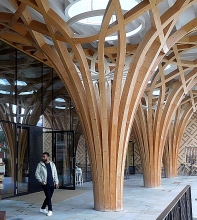
This has been achieved very successfully. The visually spectacular deep portico, reached after walking through a pleasant garden, is supported by clusters of curved timbers, which immediately bring to mind thoughts of the masonry fan-vaulting in Kings College Chapel. These clusters continue through the entire building, creating a sense of continuity of the exterior and interior spaces. The vaulting that reminds us of the mosque’s gothic relative at Kings College also evokes purely Islamic architecture such as one finds at the Alhambra in Spain. The outside of the building is covered with brickwork in two colours, the bricks being arranged to produce patterns which are contemporary versions of a traditional Islamic design. The centre of the mosque is topped by a single dome made in matt-gold coloured metal.

The glass walls that separate the portico from the interior of the mosque reflect the mundane houses opposite the mosque (across Mill Road). I do not know whether the designers intended it, but I felt that these reflections were a way of giving the impression that the garden and the world beyond the mosque is merging with the building itself, that the religious structure was merging with its secular surroundings. Whether or not this was the designers’ intention, this mosque deserves a place in the highest echelon of great British architecture alongside Kings College Chapel. The beauty of the chapel and the mosque, separated by many hundreds of years in age, both have the effect of taking one’s breath away in amazement.

A village, a school, and Jemima Puddleduck

LONG MELFORD IN Suffolk is a village that I have passed through several times. It was only during our most recent visit in August 2021, when we stopped there to see its church and Melford Hall that I realised that the place has a connection with Highgate School (in north London), which I attended between 1965 and 1970.

Melford Hall sits on land that was once owned by the abbots of St Edmundsbury. As with all monastic property, it passed into the hands of King Henry VIII when he ordered the dissolution of the monasteries in the 16th century. The king with an eye to profit rather than the prophets sold the properties he had confiscated to wealthy buyers (nobles, merchants, and lawyers). Melford Hall and its lands were sold to a local lawyer, William Cordell (1522-1581). His father was a personal assistant (‘steward’) to Sir William Clopton, a lawyer and owner of Kentwell Hall at Long Melford. Young Cordell was sent to study law at Lincolns Inn and was called to the Bar at the early age of 22. An active politician during the reigns of Queens Mary I and Elizabeth I and a founder of the Russia Company, William Cordell acquired great wealth. It was he that bought the estate at Long Melford along with its stately home, Melford Hall. In addition, he married Sir William Clopton’s granddaughter, heiress to estates in Lincolnshire and Yorkshire.

Cordell did not build Melford Hall, but he did modify it in various ways. However, he did build the nearby Hospital of the Holy and Blessed Trinity in 1573. Situated across from the cathedral-like parish church, this was an almshouse for 12 aged men and women. The Great Church of The Holy Trinity stands behind and above the almshouse. It is a superb example of 15th century gothic architecture and is distinguished by having a separate Lady Chapel, which cannot be entered from the church, at its east end. It is one of the only parish churches in the country, which was never part of an abbey, to have such a feature. Within this fine church, Sir William Cordell’s elaborate sculpted tomb can be found in the chancel to the right (south) of the high altar. He died childless.

Amongst other important roles, William Cordell became Recorder of London. He succeeded his acquaintance, another lawyer from Lincolns Inn, Sir Roger Cholmeley (c1485-1565). Sir Roger was the founder of Highgate School during the final months of his life. This is the school I attended many years later.

Thomas Hinde, author of “Highgate School. A History” wrote that after Cholmeley, William Cordell was the school’s greatest early benefactor. Connected with two other educational establishments, St Johns College in Cambridge and Merchants Taylors’ School, Cordell became a Governor of Highgate School in 1576.

When I was at Highgate, it only admitted boys. Some pupils, including me, were day boys, and others were boarders. The boarders lived in one of four houses: School House, The Lodge, Grindal House, and Cordell House. Grindal was named to commemorate Bishop Edmund Grindal (c1519-1583), who helped establish Highgate School and Cordell was named to honour William Cordell. Until We visited Long Melford, I had no idea about the reason for giving Cordell House its name.

Returning to Melford Hall, once the home of William Cordell, it has passed through many generations of the Hyde Parker family, who acquired the hall and its grounds in 1786 from a descendant of both William’s sister and his cousin, Thomas Cordell. In 1890. The Reverend Sir William Hyde Parker (1863-1931) married Ethel Leech (1861-1941) in 1890. Ethel had a cousin, who has become extremely well-known, the children’s author Beatrix Potter (1866-1943). She used to visit the Hyde Parkers at Melford Hall, where she stayed occasionally. She used to draw and sketch many features of the hall and its grounds. We were shown one of the bedrooms in which she used to sleep. Nearby in a glass-fronted display cabinet, you can see a toy duck, wearing the outfit that Beatrix had created for it. This duck was the inspiration for her book “The Tale of Jemima Puddleduck”, which was first published in July 1908.

I had seen photographs of Melford Hall, which made me want to visit it, and I was not disappointed. However, I had not expected to learn that the Hall and the village have connections with both Beatrix Potter and one of the earliest benefactors and governors of the secondary school I attended in Highgate. Our visit to Long Melford certainly broadened our minds, as the popular saying goes. I will leave you with how GK Chesterton, who attended St Paul’s School rather than Highgate, expressed this idea in his “The Shadow of the Shark”:

“They say travel broadens the mind, but you must have the mind.”

Shopping surprise in Suffolk

WE TRAVELLED TO HADLEIGH in Suffolk to see its church, its mediaeval guildhall, and its Deanery Tower. After viewing these buildings on a drizzly afternoon, we walked along the High Street, looking at some of the lovely old buildings along it. Several of them have coloured pargetting (decorative plasterwork).  Then, we spotted MW Partridge &Co on the corner of High Street and George Street. From the outside, there is nothing remarkable about this hardware store.

Stepping inside Partridges is like entering an enormous. well organised Aladdin’s cave. Apart from food and plants, there is almost nothing that cannot be found in the shop. One room leads to another, and then another, and yet another, each filled with everything that you might ever need to maintain your home and garden. Remarkable as this is, what is truly fascinating is that apart from one room built as an annexe in the 20th century, the rest of the shop is supported by old-fashioned timber beams and pillars.

According to the company’s history (www.partridgeshadleigh.co.uk/index.php?main_page=about_us), there has been an ironmongery business on the spot since 1823, if not before. In 1823, the ironmonger and iron founder Thomas Pritty acquired the business from a Charles Pretty (or ‘Pritty’). After passing through a couple of other owners, Maitland Walter Partridge and Daniel Partridge of Kersey bought the concern in 1929. This partnership did not last long, and in 1934 Maitland and his sister Edith registered the name M W Partridge & Co. Partridges have been in business ever since.

Two colourful churches

THE SUNDAY MORNING SERVICE at the parish church, St Mary the Virgin, in Haverhill in Suffolk had just ended when we entered the building. My wife chatted with a priest, who said he knew little about this church’s history. She asked him if there were any other churches in the district worth a visit. He mentioned two across the county border in Cambridgeshire, at the villages of Bartlow and at Hildersham. The two churches have something of interest in common: unusual colourful paintings.

Bartlow’s St Mary’s church has a distinctive round bell tower. But this is not the only thing that is remarkable about it. It was built in the 11th or 12th century and modified gradually during the following centuries. A real treat greets the visitor on entering the building: some colourful 15th century wall paintings, two on the south wall and one on the north. They depict St George’s dragon (north wall), and opposite this on the south wall: St Michael weighing the souls on The Day of Judgement, and east of it another shows a portrait of St Christopher carrying the Christ Child. The paintings existed long before the Civil War. On the 20th of March 1644, they were covered up with paint by Oliver Cromwell’s men under the command of William Dowsing (1596-1668), a fanatic iconoclast, also known as ‘Smasher Dowsing’. The frescos began to become uncovered in the 19th century, but it was only in 2014 that serious conservation work was undertaken on them.

St Christopher painting at Bartlow

The artists who created the wall paintings at Bartlow have been long forgotten, but this is not the case for the creators of the colourful chancel at Holy Trinity Church in nearby Hildersham. In 1806, the Reverend Charles Goodwin was appointed Rector of Hildersham. Ten years later, his son Robert was born. He studied at Clare College in Cambridge and whilst a student he joined The Cambridge Camden Society, whose aims were to promote the study of Gothic architecture and ‘ecclesiastical antiques’. This society grew to be a great influence on the design of Victorian churches.

In 1847, following the death of his father, Robert became Rector of Hildersham’s church. Soon, he began to consider how to ‘restore’ his church in accordance with gothic revival ideals. Amongst these ‘improvements’ was the painting of frescos on the walls of the chancel. These were executed using a novel technique known as ‘spirit fresco’, which made use of a complex mixture of beeswax, oil of spike lavender, spirits of turpentine, elemi resin, and copal varnish. This technique, invented by Thomas Gambier Parry (1816-1888), produced durable images that were easier to produce than the traditional fresco technique used, for example, in renaissance Italy. The chancel at Hildersham was painted using the new technique by Alfred Bell, John Clayton, and Stacy Marks. They and many assistants produced a magnificent display of saints and religious scenes, all from The New Testament. They were painted in 1890 and are in wonderful condition. The two churches are just under 4 miles apart and both are well worth visiting. And, when you do go to these buildings, you will find light switches near their entrance doors. We might never have seen them had it not been for my wife engaging in friendly conversation with the priest at Haverhill.

Eating securely at Baltic Amber

HAVERHILL IS IN SUFFOLK, close to where this county’s border meets those of Cambridgeshire and Essex. It is not a place that is near the top of Suffolk’s list of attractions. It does not rival, for example, Lavenham, Bury St Edmunds, Long Melford, and Southwold, to name but a few. However, we chose to spend a couple of nights there. When exploring the town’s dining opportunities, one place caught my attention. It is a restaurant/bar named Baltic Amber.

On the establishment’s website (www.balticamberrestaurant.com/), there is a pair of sample menus. One is in English and the other in Lithuanian. The restaurant was established by a Lithuanian family in March 2020. Despite this, there are only a few Lithuanian dishes on the menu. When we visited, of the five Lithuanian dishes, one must be ordered a day in advance, and, sadly, another was unavailable.

On arrival at this modern place next door to a large Travelodge hotel, we were met at the entrance by two burly but extremely friendly uniformed security guards. One of them checked our names on a list which was attached to a clip board. We asked them if they were expecting trouble. They answered, half jokingly, that they were there to “… keep out the riff-raff to allow diners to enjoy their meals peacefully.” Then, we were led inside and met by a waitress, to whom the security guard said: “table 24”. We were greeted by the lady, who turned out to be Lithuanian and she showed us to our table. I practised the three words of Lithuanian, which I know, on her and later on the owner. Both seemed pleased with my efforts.  The interior is modern and almost Scandinavian in design. The chairs at the tables were comfortable. Outside the restaurant, there are tables and chairs as well as a couple of fire-pits around which diners can be seated and kept warm.

Lithuanian potato pancakes with soured cream

We sampled Mead Vilnius, and aromatic spirit, rather like the Czech Becherovka. We also tried a Lithuanian beer. We ordered one of the Lithuanian dishes to share as a starter. Made of grated potatoes, which were fried and served with thick soured cream, they had a great resemblance to the Jewish dish, ‘latkes’. We followed that with Beef Stroganoff and Duck in an orange sauce. Both were above average both in quality and quantity.

The restaurant was full. The other diners, probably locals, were all having a good time, as did we. The place has good service and a pleasantly lively atmosphere. I am glad that I ‘discovered’ this place and would happily go again.

Slavery on the Brink

WISBECH IS A TOWN in northern Cambridgeshire, close to its border with Norfolk. It calls itself ‘The Capital of the Fens’. The River Nene runs through the town. One bank of the river, lined with many fine Georgian buildings is called the North Brink. The opposite bank is known as South Brink. At the eastern end of the Brinks, they are joined by the Town Bridge which crosses the Nene. Near the South Brink end of the bridge, there is a Victorian Gothic memorial.

The base of the memorial is square and contains three portraits in bas-relief. One is of William Wilberforce (1759-1833), who is best-known for his work in the abolition of the slave trade, another shows a kneeling African man in chains, and the third depicts Granville Sharp (1735-1813), who was an abolitionist and the founder of the first settlement of freed African slaves in Sierra Leone. A statue standing above the base under a gothic revival canopy is a portrait of Thomas Clarkson (1760-1846), who was born in Wisbech.

Clarkson, who deserves to be as well known as Wilberforce, studied at St John’s College Cambridge, where he wrote an essay in Latin, which asked the question whether it was lawful to make slaves of others against their will. This set him on the road to campaigning against slavery. He was active in this endeavour and helped Wilberforce to get the Slave Trade Act of 1807 passed by Parliament. This legislation did not abolish the slave trade outside the British Empire, but it did encourage British action to discourage other nations from practising it. It was Clarkson who encouraged Wilberforce, a Member of Parliament, to introduce the first Bill against the trade. Clarkson collected much evidence about the horrific nature of the slave trade and used it as evidence in his many publications and public speaking events. Clarkson live for 13 years after The Slavery Abolition Act of 1833. He focussed his later anti-slavery campaigns on, amongst other things, trying to put an end to slavery in the deep south of the USA.

The memorial to Clarkson in Wisbech was put up 1880-81. It was created to a design adapted from one originally proposed by Sir George Gilbert Scott (1811-1878). Though not nearly as grand nor as ornate, the memorial has a slight similarity to a slimmed down version of The Albert Memorial in London. I was pleased to see this statue of Clarkson because last year when visiting Wadesmill in Hertfordshire, we saw a monument to him that records the spot where, while walking from Cambridge to London, he had his revelation that his life should be dedicated to combatting slavery.

Mediaeval in a modern metropolis

A SHORT REMNANT OF the old Roman city wall, which used to surround London, runs just south of the church of St Giles Cripplegate, which itself is on the southern edge of the Barbican complex. The garden of Salter’s Hall lies where once a moat ran along the outer side of the wall. And on the other side of the wall, between it and the wide road called London Wall (the A1211), there are the remains of a mediaeval structure, which look as if they might have been the lower part of a gothic tower. These ruins can be examined close-up or a few feet away, seated at a table under the awnings of Barbie Green, an Australian-style, contemporary eatery, which serves good coffee. The restaurant is relatively new, but the ruins have been there far, far longer. Oddly, although we have passed this area often, it was only yesterday, 16th of August 2021, that we first noticed them.

A notice next to the ruins explains that they are all that remains of the tower of St Elsyng Spital, which was also known as ‘The Hospital of St Mary within Cripplegate’ (www.british-history.ac.uk/vch/london/vol1/pp535-537). This hospital was founded in 1330 by the merchant, a mercer, William Elsyng as a college for priests and to provide shelter and other assistance to London’s homeless blind people (https://ethos.bl.uk/OrderDetails.do?uin=uk.bl.ethos.538317). A victim of the Black Death, he died in 1349.  Following his instructions, after his death it became an Augustinian priory, which survived until it was dissolved in 1536 during the reign of King Henry VIII. After its dissolution, the parishioners of the nearby St Alphage Church, which had become derelict, purchased the church of Elsyng’s establishment. According to the architectural historian Nikolaus Pevsner, the 14th century tower, whose remains we saw, was incorporated into the structure of St Alphage. St Alphage was demolished at the end of the 16th century and its parishioners used what was left of Elsyng’s priory church, which was eventually replaced by a newly built church on a different site in 1777 (https://en.wikipedia.org/wiki/St_Alphege_London_Wall).

The well-maintained ruins consist of several tall gothic arches connected to each other by walls made of roughly hewn stones and mortar. Most of the arches are arranged around what was once the base of a tower. This mediaeval site is surrounded by modern buildings, lies beneath a sinuous elevated oxidised metal walkway. It is sandwiched between the fragment of London’s Roman Wall and the busy London Wall dual carriageway. Part of the joy of stumbling across this relic of pre-Reformation architecture is that unlike so many others we have seen on our travels, it is in the heart of a modern metropolis rather than a rustic environment.  

Small though it is in comparison with its modern surroundings, finding this reminder of London’s distant past, founded long ago by a philanthropic merchant, was a delightful surprise. Even today, so many centuries later, philanthropy thrives in the heart of the old City of London in the form of the descendants of the guilds, of which The Salters, whose hall I mentioned above, is just one example of many.

PS: The nearest Underground station is Moorgate

A lost landmark and a treasured map

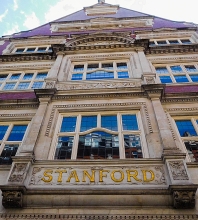
EVER SINCE I CAN REMEMBER, I have been fascinated by maps and collected them. I cannot say exactly why I enjoy them, but one reason is that I get satisfaction from aesthetic aspects of cartography. Another reason is that when I look at them, I try to imagine the reality that they represent, a form of virtual travelling. Whatever the underlying cause(s) of my fascination with maps might be, it is irrelevant to what follows because what I want to tell you is about a shop that I used to love to visit. It was Stanford in London’s Long Acre, a street not far from the old Covent Garden Market and Leicester Square.

Founded by Edward Stanford (1827-1904) in the early 1850s, his business was one of the best specialist suppliers of maps in the UK, if not the very best.  His company’s store on Long Acre opened in 1901, having moved there from Charing Cross. When I used to visit the shop to browse the lovely maps on display in the 1960s, there were two floors open to the public. The ground floor was the main showroom with maps of popular destinations that appealed to the majority of customers. The basement was less attractively arranged but far more interesting to serious travellers and map collectors such as me. There were no maps out on display down there. One had to ask a salesman to show you maps of areas that interested you. I believe it was there that I bought a nautical chart of the extremely remote French island of Kerguelen in the southern part of the Indian Ocean, a place that I had no intention of ever visiting.

In about 1966, my interest in Albania was born. I have tried to explain why this happened in my book “Albania on My Mind”, which I published in 2013, 101 years after Albania gained its independence.   In those days, not much was known in the UK about this small country in the western Balkans. Maps of Albania were not available in most shops, probably because few people visited the place, or were even remotely interested in it. So, I took the Underground from my local station, Golders Green, to Leicester Square. Stanford was a few yards from that station. At Stanford, I enquired about detailed maps of Albania, and was sent to the specialist map department in the basement.

The only detailed map of Albania available at Stanford was a 1:200,000 scale map with the information that it was made:

“Auf Grund der Oesterreichischer-Ungarische Kriegsaufnahmen und der im Auftrage der Albanische Regierung Von Dr Herbert Louis gemachten aufnahmen sowie mit Benützung italienischer und franzoesischer Karten” (i.e., ‘On the basis of the Austrian-Hungarian war recordings and the recordings made by Dr Herbert Louis on behalf of the Albanian government, as well as with the use of Italian and French maps’)

The map, which comes as two sheets, was up to date in 1925. A small map alongside the main map shows which parts of the large map were surveyed by whom and when.        Between 1916 and 1918, the surveyors were the armies of Austria-Hungary, France, and Italy. Some information collected by Baron Nopcsa between 1905 and 1909 is included in the map, as well as data collected by Dr H Louis between 1923 and 1924.

Baron Nopcsa was the Hungarian aristocrat and politician Franz Nopcsa von Felső-Szilvás (1877-1933; see: http://www.smithsonianmag.com/history/history-forgot-rogue-aristocrat-discovered-dinosaurs-died-penniless-180959504/), a founder of paleobiology and a specialist on Albanian studies. This one-time candidate for the throne of Albania created the first geological map of northern Albania. The German Dr Herbert Louis (1900-1985), whose name is prominent on the map, was no stranger to Albania. In 1923, he accompanied the Austrian geologist Ernst Nowack (1891-1946) during his research in the country, and in 1925, he was awarded a doctorate for his studies concerning Albania.

The map looked beautiful, I fell in love with it, and I knew I had to obtain a copy of it, but it was priced at 23/- (23 shillings: £1.15) for the set. That might not sound excessive today in 2021, barely the price of a small bar of chocolate or a cup of tea (in a scruffy café). But in about 1966, it was a huge sum of money for me, many times more than my weekly pocket money. I left Stanford, determined to save up for it and hoping that in the meantime the shop would not run out of copies of it. Eventually, I was able to purchase a set of these maps.

Delicately drawn, covered with contour lines, shaded representations of rocks and mountains, a variety of colours, the map shows how few roads there were in Albania in the 1920s. The tiny black dots, which represented buildings or small groups of them are often shown to be connected by tracks or footpaths, but many of them are a long way from any line of communication marked by the map makers. Most of the names on the map are in Albanian, but a few are also in Italian (e.g., Durazzo [Durres], Valona [Vlora], San Giovanni di Medua [Shengjin], and Santi Quaranta [Saranda]). Some words on the map are also in German.

I treasure this set of maps I bought at Stanford so many years ago and my memory of first being shown them in the basement of the shop. Yesterday, on the 15th of August 2021, first day of the 75th year of India’s independence, we walked along Long Acre, and discovered that although its name on the building is still there, the map shop is not. I had not realised that in 2019 this repository of records of landmarks and one of my favourite childhood haunts had moved from Long Acre to nearby Mercer Walk near The Seven Dials.