
The rent is only one red rose per year

THE PARISH CHURCH at Long Melford in Suffolk is both enormous and elegant: a fine example of mediaeval gothic architecture. I  have visited the church many times, and every visit, I spot something I had not noticed before.
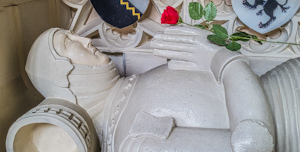
 

This May (2026), I saw the funerary monument commemorating Sir William Clopton (1383-1446). Within this memorial there is an effigy depicting Sir William lying on a pillow with his hands together as if he was praying.


A single red rose had been placed on the stone effigy.  In 1436, Sir William granted land for a market and a guildhall to the town of Hadleigh. The rent he charged for this land was one red rose per annum. And since then, the Mayor of Hadleigh places one red rose on the tomb of Sir William once every year. A notice by the tomb suggests that this is considered to be the oldest known rent anywhere in the UK.


Another interesting item in the church is a small carved stone bas-relief depicting the Adoration of the Magi. It is believed to have been carved in about 1350, roughly 150 years before the present church was constructed.  The carving might have been part of an alabaster altar that was destroyed during the Reformation.  The carved panel is remarkably similar to one that can be found in Paderborn Cathedral in Germany.


There are plenty of other fascinating artefacts to be seen in Long Melford’s Holy Trinity Church including stained glass windows that were not destroyed during the Reformation. However, I will end here by encouraging you to visit this marvellous church and discover things for yourself.

Where there was wool there was wealth

HADLEIGH IS A SMALL town in Suffolk (England). Like many towns in East Anglia, it was enriched by the wool trade in mediaeval times. Evidence of this included magnificent, cathedral-like churches and fine civic buildings. Hadleigh is no exception. Its fifteenth century half-timbered market hall (now a part of the town’s guildhall complex) is on one side of a graveyard that separates it from the south side of the large, fifteenth century parish church.

In one corner of graveyard there is a modern sculpture made of metal (mild steel). It depicts a sheep. Created by Benjamin Bramma, it was placed in the churchyard in 2015. That year, Hadleigh celebrated its rich heritage by holding a festival called “The Year of the Sheep”. As part of the festival, forty sheep were herded through the town.

The sculpture is a fitting tribute to the memory of the creatures that once brough wealth to Hadleigh.

Shopping surprise in Suffolk

WE TRAVELLED TO HADLEIGH in Suffolk to see its church, its mediaeval guildhall, and its Deanery Tower. After viewing these buildings on a drizzly afternoon, we walked along the High Street, looking at some of the lovely old buildings along it. Several of them have coloured pargetting (decorative plasterwork).  Then, we spotted MW Partridge &Co on the corner of High Street and George Street. From the outside, there is nothing remarkable about this hardware store.

Stepping inside Partridges is like entering an enormous. well organised Aladdin’s cave. Apart from food and plants, there is almost nothing that cannot be found in the shop. One room leads to another, and then another, and yet another, each filled with everything that you might ever need to maintain your home and garden. Remarkable as this is, what is truly fascinating is that apart from one room built as an annexe in the 20th century, the rest of the shop is supported by old-fashioned timber beams and pillars.

According to the company’s history (www.partridgeshadleigh.co.uk/index.php?main_page=about_us), there has been an ironmongery business on the spot since 1823, if not before. In 1823, the ironmonger and iron founder Thomas Pritty acquired the business from a Charles Pretty (or ‘Pritty’). After passing through a couple of other owners, Maitland Walter Partridge and Daniel Partridge of Kersey bought the concern in 1929. This partnership did not last long, and in 1934 Maitland and his sister Edith registered the name M W Partridge & Co. Partridges have been in business ever since.