Paris

Wallace ladies_500


The recent tragic conflagration of the cathedral of Notre Dame in Paris and its resultant degradation of one of the world’s best-known buildings evoked a sensation that I had not experienced since 1976. In that year, there was a devastating earthquake in the Friuli area of north-east Italy. 

We had good friends living in that area. They had taken us to see many  unique masterpieces of Longobard art and architecture that existed in the area. When we first heard the news, we were extremely worried about the fate of our friends, who, luckily, all survived. We were also concerned about the works of art and architecture we had grown to love.  Fortunately, most of these were restored eventually.

Ten years before the earthquake in Friuli, there was a terrible flood in Florence in November 1966. About 100 people were killed, and many, many valuable works of art perished in the oil-filled flood waters. Our family was extremely upset because we used to visit the Tuscan city every year to see old friends and to enjoy its rich artistic heritage.

We did not visit Florence the following year because of the damage, but recommenced our annual visits in 1968. For years after the flood, the height of the flood water levels was visible on the walls of buildings where central heating oil from the city’s boilers and tanks had mixed with the water and made indelible stains.

The fire in Paris brought back feelings of horror and disbelief that i had experienced in 1966 and ten years later. 

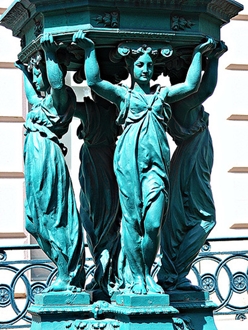
The picture illustrating this blog piece is a reminder of another tragedy that hit Paris: The Siege of Paris (1871) and the Commune. During those difficult times, there were great water supply problems. The English philanthropist Richard Wallace (1818-1890) built a number of drinking fountains for the people of Paris. Each was decorated with the four sculpted ladies shown in my illustration.

Already, many people are offering to donate money to help restore Notre Dame to its former glory. Had he been alive, i am sure Richard wallace would have been a willing contributor.

Going vegetarian in Gujarat

Gastronomic experiences of a carnivore in mainly vegetarian Gujarat

yamey's avatarGUJARAT, DAMAN, and DIU

veg

There are many vegetarians in India, particularly in Gujarat.

I am primarily an omnivore, who enjoys meat and fish.

In many of the places we visited on a seven week visit to Kutch and Saurashtra, it was difficult or even impossible to find restaurants serving non-vegetarian food. I spotted street stalls where omelettes were made to order – and they are very delicious – and barrows where un-refrigerated kebabs were on display in the hot weather, awaiting grilling.

In Kutch, I enjoyed the delicately prepared, tasty vegetarian thalis. In Saurashtra, thalis were less attractive to my taste because of their oily-ness and over use of sugar or other sweeeners. However, Gujarat is a paradise for snackers. All over Gujarat, you will find places selling a variety of delicious farsan (savoury snacks). My favourites include: dhokla, patra, ganthia, sev, bhel puri, chewda, dahi puri, khandvi, and pani puri.

Therefore when I…

View original post 165 more words

Climate change

Early morning flight_500

High above the clouds

A climate protester flies,

Changing the climate


This was inspired by an article in the Daily Mail newspaper (see: https://www.dailymail.co.uk/news/article-6938095/Dame-Emma-jets-5-400-miles-green-is.html), which reported:

“Emma Thompson arrived at Marble Arch yesterday afternoon to support climate change protesters and urged others to join their numbers.

What she might not have mentioned to them is that she had just flown back to Heathrow Airport from Los Angeles the day before.”


Train to Florence

Settebello_power_car


Until I was about 17 years old, my parents used to take my sister and I for long trips to Florence and Venice every year. Often, we would fly from London to Milan, and then take a train to Florence. Frequently, our reserved seats were occupied by other passengers, who would only shift elsewhere when we had got the carriage’s conductor to intervene on our behalf.

Here is an extract from my reminiscences of childhood travel in Italy from my book “Charlie Chaplin waved to me“:

“Once we were seated in our reserved seats, we began to enjoy the 3 hour journey to Florence. Within minutes of entering our carriage or compartment, my mother would begin to strike up a conversation with whoever was sitting nearby. My mother and two of her three brothers, one of whom lived in London and the other in Cape Town, were always happy to initiate conversations with complete strangers. Her only sister and other brother were less inclined to do this. Mostly, our fellow passengers were Italian, but once I recall sharing a compartment with an elderly American lady who was considerably older than my parents. After a few minutes of friendly conversation, she revealed that her son was none other but the world-famous violinist Isaac Stern (1920-2001), who was born 3 months before my mother.

Occasionally we were lucky enough to travel on a Settebello train. These high speed streamlined electric trains, which plied between Milan and Rome and stopped briefly in Florence, were the pride of Italian State Railways. At each end of the train there was an observation saloon. The driver’s cabins were located above these. When travelling in the front observation cabin, one experienced a driver’s view of the track ahead. As a child who loved trains, sitting in these was a great treat for me. I still gain great enjoyment sitting at the front of trams and trains. One of the attractions of London’s Docklands Light Railway, which weaves its way through London’s former docklands and other reclaimed parts of the East End, is that there are seats at the front of the train where a driver would normally be seated had the train not been automated.

About an hour away from Florence after passing through Bologna, the train entered a long tunnel. Even the fastest trains took almost half an hour to travel through this. Soon after we emerged from it we sped through the town of Prato, and then the suburbs of Florence (Firenze in Italian) began. I knew that after we had passed the marshalling yards at Firenze Rifredi, we would soon be entering the huge terminal, Florence’s Stazione di Santa Maria Novella.


Charlie Chaplin waved to me is available from:

Amazon, bookfinder.com, lulu.com, and on Kindle


Picture: Front of a Settebello train showing the observation lounge and the driver’s cabin above it. Source: it.wikipedia.org

Fishermen at Mandvi and entering Pakistan

Fishermen from Gujarat in India risk straying into the waters off Pakistan

yamey's avatarGUJARAT, DAMAN, and DIU

Mandvi

The picture shows dogs resting in the shade provided by a beached fishing vessel in the estuary of the River Rukmavati at the town of Mandvi in the former Kingdom of Kutch, now part of Gujarat.

Nearby, there were many similar fishing boats, all manned by Muslim seamen. These boats sail into the Gulf of Kutch, a piece of water that separates most of Kutch from another part of Gujarat, Saurashtra (or Kathiawad). 

The vessels are allowed to sail as far west as Okha, but no further as they would then stray into Pakistani water. We were told that there is quite a good deal of smuggling between the Indian and Pakistani fishermen. The Indians have to be careful because they might be arrested in Pakistani waters, as a recent newspaper report  reveals:

“A group of 100 Indian fishermen Monday crossed over to the Indian side through 

Attari-Wagah border after…

View original post 117 more words

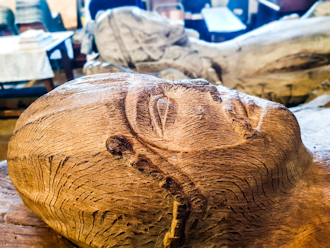
A carved Crusader

A life no longer,

Remember’d in timber:

Farewell, Crusader knight


14th century wooden effigy in church at Paulerspury in Northamptonshire, England


For more information about this rare mediaeval carving, see: History of Paulerspury

website from which this information was extracted:

Under the arcade between the chancel and the north chapel, on a freestone tomb panelled with cusped ogee blind tracery enclosing shields, are wooden effigies of a lady (c. 1340) and an armoured man (c. 1346-9), now placed side by side but not necessarily originally associated with each other. The male figure may represent Sir Robert de Paveley.  The monument was restored by Frederick H. Crossley of Chester in 1920, following a report on its condition by the S.P.A.B. in 1915

Green crime

plant


I am no gardener, but I enjoy garden, plants, and flowers. When I lived in Kent, I had an enormous garden, which I filled with shrubs because someone advised me that they needed little care and attention. This was good advice.

There was a strip of earth next to where I parked my car at night. I filled this with various shrubs that needed almost no care. One of these plants was a very slow growing conifer, which looked like a miniature Christmas tree. It grew close to where I entered the driver’s door of my car.

One day, I noticed that this tiny tree was no longer in its place. It had disappeared. I thought that maybe it had died and rotted away. After that, I thought little if anything about the missing plant. Where it grew was soon covered with foliage from the neighbouring fast-growing shrubs.

Many weeks later, a uniformed policeman visited my house and asked me if anything, such as garden tools or plants, had gone missing from my land. At first, I thought that this was an odd request. Then, I remembered the mysterious vanishing of my small conifer. I told the policeman about this. Then, he told me that there had been a garden thief operating in the area and the police were collecting evidence.

I told the policeman that I could not believe that my tiny plant could have been of any value for a thief. He explained to me that plants are valuable, and that the maturer they were, the greater their value. I was amazed that there was such a species of criminal as a plant thief.  But, since then, I have heard it is quite common, especially amongst respectable looking visitors to horticultural gardens such as Kew Gardens.

Well, as the saying goes: ‘you learn something new everyday’

Keeping fit

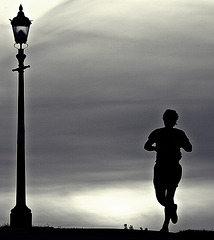
Evening jogger_240


While I was engaged to my wife, she suggested that I join her at her health club and try some of its facilities.

The first time I went, I decided to go swimming. After swimming two lengths very slowly, I managed to climb out of the pool, exhausted and breathless.

For the next visit, my wife-to-be suggested that I try a session in the sauna. She thought it would do me good and would  not be particularly exhausting. I removed most of my clothes and sat alone in the poorly-lit sauna room. After a few minutes I began feeling cold, and started shivering. Fed up with this miserable experience, I left the sauna, and got dressed. The sauna had not been switched on!

Undismayed by this, I decided to give the sauna another try a week later.  This time it was switched on, and steaming hot. Because my first visit had been so boring, I decided to take a magazine into the sauna to read to pass the time. I took my place on a bench alongside some very muscular men and opened my copy of a glossy BBC clasical music magazine. Within minutes, the glue holding my magazine together melted. Numerous pages covered with fascinating information about classical music floated gently downward on to the floor of the sauna, Sheepishly, I recovered some of them, and then hurried out of the sauna.

“Why not try the exercise cycles next time? ” my wife asked. “Good idea,” I replied reluctantly. So, a week later, I sat in the saddle of an exercise bike. My wife was seated on a neighbouring cycle pedalling away while reading a book resting on the handle bars. The third cycle in the room was being pedalled furiously by a man lstening to his Sony Walkman through a pair of headphones. Meanwhile, I was just trying to move my cycle’s pedal … completely unsucessfully. After a few minutes, I abandoned the cycle, and after that I have never bothered with health clubs again. 

“That’s a pity,” you might think.

But, maybe not, as I will explain.

When I was practising as a dentist, quite a few patients, often young men, used to limp when they walked into my surgery. Almost everyone of them had injured knees or tendons whilst playing football or running, or trying to keep ‘fit’. When I saw them, I thought how lucky I was that I did not become addicted to ‘keeping fit’.

Two heads, two cities


Ever since my interest in Albania began in the 1960s, I have had a fascination with the use of the double-headed eagle as a symbol. It appears in many places including the Albanian flag. Far less commonly used than single-headed eagle, the symbol has been found on ancient Babylonian archaeological remains dating from roughly 3000 to 2000 BC.

A few days ago, while I was visiting an exhibion (of works by Ruskin) in London, I spotted a man carrying a bag with the badge and letters in the photo above. I suspected that the letters above the double-headed eagle were Greek, but I did not know what they stood for. I asked the man, who turned out to be a Greek from Thessaloniki (Salonika). He told me that the badge and letters were the logo of a football team based in Thessaloniki.

PAOK stands for ‘Panthessaloníkios Athlitikós Ómilos Konstantinopolitón ‘, which means ‘Pan-Thessalonian  Athletic Club of Constantinopolitans’.   The club was founded  in 1926 by Greeks who had fled from Istanbul (Constaninople) following the tragic population exchange that began in 1923 after the Greco-Turkish War (1919-22). During this exchange, Turks living in Greece were deported to Turkey, and Greeks living in Turkey were deported to Greece. Over 160,000 ethnic Greeks from Turkey were resettled in Thessaloniki.

Some of the Greeks who had been evacuated from Istanbul established the PAOK in 1926. The team has two nicknames, translated as ‘The Black-Whites’ and ‘The double-headed eagle of the North’. Why did PAOK choose the double-headed eagle? The answer might lie in the fact that since the early Middle Ages this symbol was used occasionally by the Byzantine Empire, which had its headquarters in Constantinople, from where the founders of the team originated.