Glass in the garden


Once again, London’s Kew Gardens is hosting an exhibition of glass sculptures by Dale Chihuly (born 1941). The amazingly crafted glass artworks of often quite complex design have been placed both in the open-air and inside some of Kew’s lovely old glass-houses. 

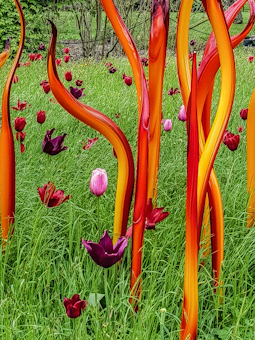
The curvy tubes with pointed ends shown in my photograph have been tastefully planted in a grassy field dotted with tulips. In the Temperate House, a large glass mobile has been suspended from the ceiling and smaller objects mingle with the plants. Wherever you look, you will find glass artefacts in  intimate contact with the plants growing around them. In the Water-Lily House, large glass sulptures evoking the flowers of water-lillies mingle with the real plants whose fronds float on the water.

As time passes and the plants grow more, some of Chihuly’s colourful glass objects will become harder to find.  The plant-like forms of many of the artworks mix with the plants to provide in some cases a stark contrast or in others they almost blend with the plants around them.

It is well worth visiting Kew whilst these sculptures are on display. However much I like the glass artworks, the stars of the show are for me the plants themselves (rather than the sculptures). This highlights how difficult it is for man to compete with nature on the aesthetic playing field.


The Chihuly works are on display at Kew Gardens until the 27th October 2019
Getting to grips in the kitchen


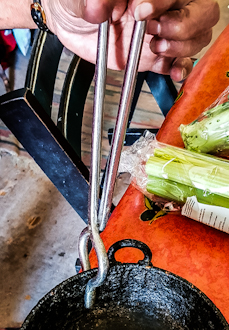
Just in case you have not got one in your kitchen, here is an implement that is extensively used in Indian kitchens and tea stalls.

The sandasi (pronounced roughly like ‘sun-er-see’ said fast), which is is also known as a pakad (from the verb ‘to hold’ in Hindustani) or a chimta (from the verb ‘to pinch’ in Hindustani), is essentially a pair of sturdy hinged metal (stainless steel) tongs. The handles of the implement are several times as long as the gripping elements. This means that quite heavy things may be lifted with the beaks of the tongs without any risk of them slipping out of their grip.

The sandasi’s long handles also mean that the user’s hands can be kept at a safe distance from the hot cooking vessels that are lifted with this pair of tongs. For example, the tea maker can lift and manipulate with ease the huge pots containing several litres of a bubbling, boiling mixture of milk, tea, and spices. 

I find the sandasi very useful for gripping the edges of large casseroles when I am stirring hot food like stews or curries.

Cooking tongs are, of course, available in countries other than India, but the sturdy construction and long handles of the sandasis have much to reccommend them.

The first fly

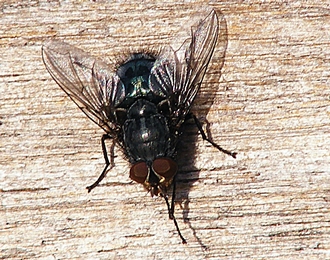
Fly on wood


The first fly of this year flew into my room just after the short warm spell we had in London over the Easter weekend. It was not the first fly that I have seen this year because the first couple of months of this year I spent in India. However, the fly in question, which arrived in late April, was the first fly that has tried to annoy me in London.

Although its buzzing and endless fly-passes can become annoying, there is another sensation that seeing and hearing the insect evokes in me. It reminds me of summer, a season I love. So, despite it annoying me, seeing this first plump fly also makes me joyful and gives me the feeling that warm, long bright days are not far off in London.

Tastes differ


food toast meal morning


When I was a child, I spent a great deal of time with my aunt and her children. They lived a few minute’s walk from our family home and I enjoyed spending time with them. Often, my sister and I used to spend a whole day at my aunt’s house, sometimes over night especially when my parents were away on a trip.

My aunt fed us. Sometimes she made us fried eggs. Then, I was a very fussy eater. In those far-off days, I only liked the white part of the fried egg, not the central yellow bit. One of my cousins only liked the central yellow part, but disliked the white surrounding it.  My aunt was an extremely down-to-earth individual, laden with more than a fair share of common sense. Her solution to the fried egg situation was that after making the fried egg, she used to carefully dissect the yoke portion of the finished product and serve it to my cousin. I was given the white portion of the egg with a neat hole in it where the yellow had been.

Today, many decades later, I am not keen on any part of a fried egg and do not eat eggs prepared in this way. I much prefer omelettes and hard-boiled eggs. However, I do enjoy making them for other people, The challenge is to avoid breaking the yoke. 


Photo by Pixabay on Pexels.com

A musical offering

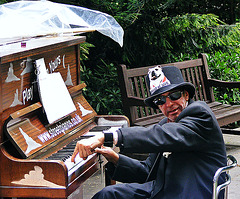
Maestro_240


This evening, I attended a performance of A Musical Offering by JS Bach (opus BWV 1079) at the Royal College of Music in Kensington. Each of the sections of this work was introduced by the conductor, Joe Parks, who explained what was musically interesting about them.

The whole piece is based on a theme composed by King Frederick II of Prussia. He gave it to Bach on the 7th of May 1747, and challenged the composer to do something interesting with it. A Musical Offering is what Bach did with the King’s theme. I am no musician, so can hardly explain the compositional procedures with which Bach exploited the King’s somewhat dull theme. For example, in one of the sections improvisations on the theme are played with musicians simultaneously playing the modified theme both forwards and in reverse. In another section, the theme is improvised in a range of different keys. In brief, this piece by Bach is both intriguing and challenging for musicians. Although this aspect of the music is lost on me, my enjoyment of the work was not impaired.

What fascinates me is that a piece of music so full of compositional twists and turns is a delight to hear. Bach has not only satisfied his desires to hone his compositinal technique in this piece, but also he has created a work that is highly satisfying to the listener.

Great music like great paintings reach into the the inner subconscious of the listener or viewer and thereby evoke an almost visceral sensation of joy. It does not matter that the music is full of compositional magic or the painting might be impressionistic or abstract because the great artist knows how to produce a work that reaches those hidden parts of the body that evoke feelings we call emotion. Without doubt, A Musical Offering did that for me.

The first time I ate rice

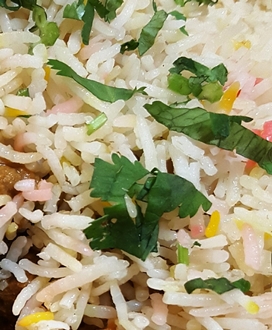
rice


I had a difficult birth. Both my mother and I nearly died when I was born. For the first few weeks of my life, I was not a healthy baby; my future was uncertain. Then, as I grew a little, I was a poor eater. My mother, who worried about me greatly, felt that it was best that I only ate what I liked. As a result, I became a fussy and unadventurous eater. My immediate reaction on being offered something that was outside the tiny range of foods that I was prepared to eat, was to refuse it.

Although at an early age, I was happy to eat tomato sauce either with pasta, which I still enjoy, or with baked beans, which I now dislike intensely. I recall eating a fresh (i.e. uncooked) tomato for the first time when I was about 13.

When I was 20, I joined some friends on a camping trip in France. We travelled around the country by car, camping at night. We would eat picnics for lunch and visit restaurants in the evening. One of our camping places was at Banyuls on the Mediterranean coast of France close to the Spanish border. One evening, we drove across the border to Port Bou in Spain. Naturally as we were in Spain, my friends ordered paella.

Paella, as many people know, is a rice based dish. I was a bit skeptical because I had managed to avoid eating rice (and rice pudding) prior to this brief trip to Spain. Something attracted me to the paella, maybe it was hunger or its delicious appearance, and I tried a portion. As for the rice, it was love at first bite. Since then, I have been a great fan of rice, which I had never tried during the first 20 years of my life. I still dislike rice pudding as it is made in the UK. In contrast, I really enjoy phirni, an Indian version of rice pudding.

Since that trip to Port Bou, my tastes have become quite adventurous. I rarely refuse trying something new, even if only once.

Looking back on my childhood, I now realise that my very conservative tastes deprived me of the delights of many of the gourmet meals, which my parents enjoyed while travelling with me and my sister. They would enjoy fine French or Italian food whilst I stuck to my ham or steak and chips. 

Well, as the French say À chacun son goût. I am glad that mygoût has become more exciting.


Where two countries kiss

KAZAN 90 The Danube narrows

Steep cliffs encroaching

The stream gathers speed

The Iron Gates loom ahead


The Iron Gates is a narrow defile or gorge through which the River Danube flows. One side of this attractively impressive canyon is formed by Romania and the other by Serbia. At one point, the two countries come so close to each other that they seem as though they are kissing. Where they come closest, there is a hydroelectric dam that was built during the Communist era.

My picture was taken from the Serbian shore in 1990, when Serbia was still part of Yugoslavia.

Facts and opinions

NEWS


The title of this brief blog article was inspired by the name of a Russian magazine  Аргументы и факты (‘Arguments and Facts’).

When I was a PhD student back in the 1970s, I did my experimental research in a laboratory.  For a while, the maintenance of this lab was supervised by a technician, ‘H’ by name. H was left-wing in his political views and made no attempt to keep his views to himself.

One day while I was working, H and I started talking about the newspapers we read. In my case, it was simple. I hardly ever read them. H said to me:

“I read two papers every day.”

“Which?” I asked.

“Oh,” he replied, ” I read the Times for the facts and the Morning Star for the opinion.”

For those who do not know, the Times used to be Britain’s most authoritative newspaper and the Morning Star is published by British Communists.

So, for H, the Times provided the facts which he coud use in arguments inspired by the Morning Star.


Breathless in Manhattan

NYC


When I was a child, I was told that a good way to stop hiccups was by holding one’s breath. Being of a nervous disposition as a child, I worried that dire consequences might follow if one forgot to stop holding one’s breath. My parents assured me that this was impossible; the body did not allow someone to do this.

A few months before President Kennedy was shot in the USA in 1963, we were staying in a borrowed flat (appartment) in Manhattan, New York City.  I was playing a game with my young sister. It caused us great hilarity and much laughter. This led to me plagued by an attack of hiccups. So, as I had been taught, I held my breath. I was standing up.

The next thing I knew was that I was lying on the floor. My mother had taken very little notice at first because she thought my fall was part of our game. Actually, it was not. Contrary to what I had been told, I had held my breath long enough to black out! Very fortunately, when I fell I narrowly missed hitting my face on the shart corner of a metal table.

Does my tale have a message? Well, I suppose it does. Holding your breath can bring hiccups to an end sometimes. If you try this method, make sure that you are sitting down!


By the way, a hiccup (noun) is what you do when you are hiccoughing (verb).