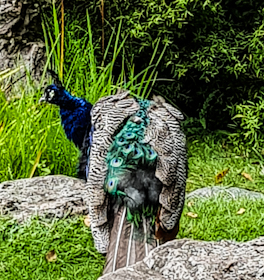
With full plumage,
An exotic creature:
The proud peacock in the park
In the Kyoto Garden, Holland Park, London

With full plumage,
An exotic creature:
The proud peacock in the park
In the Kyoto Garden, Holland Park, London

What sparks off an enduring interest in something? I do not know the answer, but let me describe how just one of my interests became ignited.
When I entered Highgate School in north London at the age of 13 years, we were obliged to study both physics and chemistry. The classes for these subjects were held in large laboratories whose walls were lined with locked glass-fronted cupboards filled with a wide variety of scientific equipment and, in the case of the chemistry labs, jars of chemicals in a variety of colours.
At the age of about 15, that was in the late 1960s, we had to make decisions about the nature of our future studies. If you wanted to study science, you kept on classes in chemistry and physics and dropped geography and history. For a course in the arts, you kept on classes in geography and history and dropped the two science subjects. I decided on science. You may wonder why.
It was only the desire to find out more about the stuff locked in the glass-fronted cupboards that made me choose the science course. It was as simple as that! I enjoyed studying scientific subjects and continued to do so until I had completed a doctorate in one of them (mammalian physiology).
Many decades later, I revisited Highgate School and was taken on a tour of its buildings including the Science Block. I noticed that the cupboards in the chemistry and physics laboratories had been replaced. Gone were the glass-fronted cabinets. They had been replaced by cupboards with opaque doors. The contents of these wall mounted cabinets could not be seen without opening their locked doors.
I wondered whether I would have chosen to study the science subjects had I been taught in the newer laboratories where everything was hidden from view.
Image source: ebay
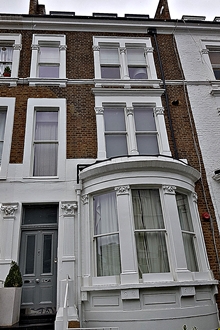
Number 140 Sinclair Road in west London, not far from Shepherds Bush Green, looks like an ordinary Victorian terraced house, which it is. However, in the first decade of the twentieth century it was home to a few Indian freedom fighters. When the seventeen year old David Garnett, the writer and a future member of the Bloomsbury Group, visited the house in 1909, he met Bipin Chandra Pal (1858-1932) the Bengali nationalist and a father of the Swadeshi movement, which promoted Indian economic independence. He shared the house with his son Niranjan Pal (1889-1959), a young Indian freedom fighter who was to become a founder of the Bombay Talkies film company. Sukhsagar Dutt (1890-1967), a young Indian revolutionary and brother of Ullaskar Dutt who was involved in the use of bombs in Bengal and Bihar and tried at Alipore (Calcutta), also lived at number 140.
In mid to late 1909, VD (‘Veer’) Savarkar (1883-1966) also lived at 140 Sinclair Road as a lodger of Bipin Chandra Pal. Savarkar, who was studying law at the time, was deeply involved in activities aimed at attempting to cause the British to leave India in order that the country became a sovereign nation. Savarkar is now best known for his contributions to the encouragement of Hindu nationalism. His book “Essentials of Hindutva”, published in 1923, is considered a seminal work by promoters of Hindu nationalism.
Savarkar moved from India House in Highgate, a centre of revolutionary Indian independence activists, to 140 Sinclair Road sometime in 1909 before the assassination in London’s Kensington of a senior Indian administrative figure, Sir WH Curzon Wyllie, in July 1909. The victim was shot at close range by Madan Lal Dhingra, a close associate of Savarkar. Savarkar was suspected of having some involvement in the plotting of Curzon Wyllie’s demise. Savarkar’s host in Sinclair Road, Bipin Chandra Pal, was firmly against what Dhingra had done, but accommodated Savarkar, who was pleased that the assassination had been successful until, as I wrote in my book “Ideas, Bombs, and Bullets”:
“… an angry crowd gathered outside, the house, Pal had to tell them that apart from being a paying guest, Veer had no other association with him. Another resident at this address, Pal’s son Niranjan, was a close friend of Veer’s and a regular visitor to India House. Niranjan’s association with India House worried Bipin greatly…”
Soon after this, Savarkar shifted his home in London to a flat above an Indian restaurant in a now non-existent alleyway in Holborn.
From what I have described, the seemingly ordinary terrace house at 140 Sinclair Road has played a small role in the history of India’s struggle for freedom from the British, which was eventually gained in August 1947.
For much more information about Indian patriots in Edwardian London, I invite you to read my recently published book, “Ideas, Bombs, and Bullets”, which focusses on the Indian patriots who congregated at India House in Highgate between 1905 and 1910.

This publication is available at:
http://www.lulu.com/shop/adam-yamey/ideas-bombs-and-bullets/paperback/product-24198568.html
or:
https://www.bookdepository.com/IDEAS-BOMBS-BULLETS-Adam-YAMEY/9780244203870
(paperback)
and
https://www.amazon.com/dp/B07W7CYKPG/
(Kindle)
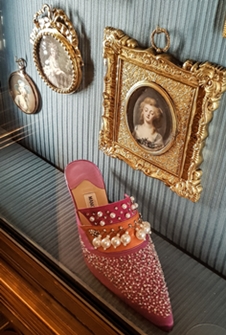
People who know me well, or even not so well, would be surprised to learn that I greatly enjoyed an exhibition of designer footwear.
The designer is Manolo Blahnik (born 1942 in Santa Cruz de la Palma, Spain), whose father was Czech and mother Spanish. His rapid rise to fame in the field of footwear design began in the early 1970s.
The exhibition called “An Enquiring Mind” is being held at the Wallace Collection in London until the 1st of September 2019 and should not be missed.
According to a leaflet about the exhibition, Blahnik has been long inspired by the collection of diverse fine artworks (paintings, sculpture, furniture, porcelain, armour, etc.) on display in the rooms of the Wallace Collection. The shoes he designs, especially those on display at the exhibition, reflect the artistic finesse and skillfulness of the Collection’s permanent works.
The footwear in the temporary exhibition is tastefully arranged amongst the Wallace Collection’s artworks. If one dd not know that the shoes were designed and made in the last 50 years or less, you would believe that they came from earlier eras when most of the Collection’s artworks were created. The shoes mingle harmoniously with creations made several hundreds of years earlier. Not only that, but also they are displayed very artistically, making the temporary exhibition a joy to the viewer.
So, even if you, like me, are put off by the idea of an exhibition of shoes, please try to make it to this superb exhibition.

I would never have thought that I would have enjoyed reading a book about rug-making cottage industry in Nova Scotia, but I have. Recently, a Canadian friend brought me a book that focusses on hooked rugs and their promotion by a lady called Lillian Burke (1879-1952), who was born in the USA.
Just in case you (like me before reading the book) have no idea what comprises a hooked rug, let me explain by quoting from Wikipedia: “Rug hooking is … where rugs are made by pulling loops of yarn or fabric through a stiff woven base such as burlap, linen, or rug warp. The loops are pulled through the backing material by using a crotchet-type hook mounted in a handle (usually wood) for leverage.”
Edward Langille’s book discusses in detail Lillian Burke’s significant involvement with the hooked rug manufacture carried out by housewives in small settlements in the remote Cape Breton district of Nova Scotia. Ms Burke, who was born in Washington DC, was highly acccomplished in teaching, music, and art. During both world wars, she helped pioneer what is now known as ‘occupational therapy’. She was a highly-regarded teacher. It was this skill that brought her into contact with the family of Alexander Graham Bell, the scientist and inventor of telephony. The Bells employed Lilian Burke as a tutor for their offspring. She developed a lasting friendship with the extended family, who owned a country retreat in the region of Nova Scotia where hooked rug making was a prevalent occupation of the local housewives.
Langille describes how Ms Burke helped to develop what had been a local craft into a viable money-making venture. Using her highly developed artistic skills, she helped the housewives produce rugs with artistically sophisticated designs that made them appealing to fashionable interior decorators in the USA (mainly).
Traditionally, the housewives of Cape Breton wove their rugs with scraps of coloured material. Ms Burke designed the patterns and the housewives did the ‘hooking’. She encouraged them to begin using locally-produced wool which they had dyed. One thing that particularly interested me was that Ms Burke showed the ladies how to use knots and paper masking to dye a skein of wool in varying colours, so that a single thread of wool would vary in colour along its length. This technique is used in Patan in Gujarat (Western India) to produce the silk threads with patterns of varying colour, which are used to produce the highly valuable woven Patola textiles. I would be curious to know whether Ms Burke had been aware of this century’s old method of dyeing.
Langille’s book is a remarkable, well-written, and readable biography of a remarkable woman, who is probably hardly known outside of Nova Scotia and beyond a few enthusiasts of hooked rug making. She deserves to be better known, especially in the light of what Langille’s book reveals about her dedication to the development of rehabilitation and occupational therapy. Professor Langille’s detailed and carefully researched book may well help give Lilian Burke the wider recognition she deserves.
REVIEW BY AUTHOR OF “IDEAS, BOMBS, and BULLETS”, about Indian patriots in London between 1905 and 1910
ISBN: 9781926448404

Some years ago, we were visiting relatives in the city of Buffalo in New York State (USA). We had never met them before, which was a pity since they turned aout to be a quite delightful couple. Apart from that, they were very interesting and interested in everything. Unfortunately, one of them has passed away.
We were travelling around New York State in a rented car when we visited my relatives in Buffalo. One day, they suggested that we went for an outing. Being much younger than them, I decided that we should all travel in our rented car. They were very mysterious about our destination. They gave me directions and i followed them. About 50 miles east of Buffalo we arrived at a neatly laid out small ‘one horse town’ and parked next to a pizzeria.
My relatives ordered one pizza. It was large enough for each of the five of us in our party to eat to our satisfaction. Of all the many pizzas I have eaten so far, this was one of the best that I can remember. I cannot rember the name of the pizzeria, but the town’s name is WARSAW.
A ring of dough
A colourful topping
It’s Italian, it’s pizza
PS after lunch at Warsaw, we continued to the nearby Letchworth State Park, which well deserves its nickname ‘The Grand Canyon of the East’
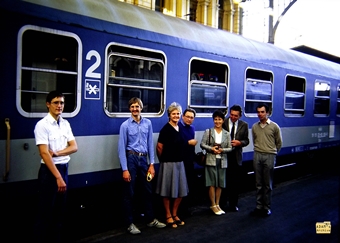
I used to visit Budapest in Hungary frequently in the 1980s during the Communist era. I had many good Hungarian friends there. They were very hospitable to me.
One day, I happened to visit the advanced booking office at Budapest’s grand Keleti (Eastern) Station. I have no recollection of where I was planning to go, but that is not relevant to the true story that follows. The smallish rectangular room was lined with about ten (or more) counters at each of which there was a booking office official.
A young Soviet Russian soldier entered the room. He was in an immaculately smart uniform and looked proud. He went up to the first counter and spoke to the person behind it. After about a minute, he was instructed to go to the next counter. Once again, he spoke to the official behind the window at the counter. And, after a few minutes, he was directed to the next counter. This went on until he had visited each counter in the room and reached the last one. At the last one, the official indicated that he should leave the room as he was in the wrong room for obtaining tickets for Soviet military personnel.
You might have thought that the official at the first counter he visited would have directed him to the correct place, but no. So great was the average Hungarian’s disdain for the Soviet soldiery that was keeping their country under the thumb of the Soviet Union that the officials in the booking office conspired together to waste the young Soviet soldier’s time and humiliate him. It was a beautiful example of passive resistance.
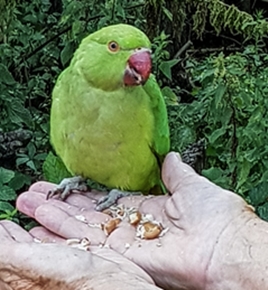
A bird in the hand
Is worth two in a bush
So wise folks say sometimes
Kensington Gardens, London

The first time I saw a performance of Shakespeare’s A MIDSUMMER NIGHTS DREAM was in the 1960s in north London (Big Wood in Hampstead Garden Suburb). It was performed by an amateur dramatic group in a clearing in a small wood. There were barely any props. The actors appeared and disappeared in and out of the trees growing around the clearing. It might not have been the very best of renderings of the play, but I found it highly enjoyable and magical. Whenever I think of the Dream, I remember that show in the woods, so long ago, with much fondness.
Since that magical summer evening in the wood, I have seen several more performances of the play, but none of them managed to recapture for me the magical experience that was created for me by my first viewing of the work.
A few days ago, I watched yet another performance of the Dream. This time it was at the lovely new Bridge Theatre next to the southern end of London’s Tower Bridge. The staging and acting was brilliant. The Director, Nicholas Hytner, had ‘tweaked’ the play slightly but successfully to make it more accessble to contemporary audiences. I hope that Shakespeare would have approved of this latest version. I feel that he might well have done. The ‘show’ was livened up with acrobats, who were not only superbly skilful but also great actors with clear diction, and much music. Despite these additions, the Bard’s original words were not sacrificed or edited in any noticeable way. It was not merely a play, but a spectacular extravaganza.
There was one aspect of the performance that I did not like. The play was performed ‘in the round’ on an arena where there would normally be stalls seating. Many people had bought tickets to stand on the stage in order to take part in an immersive performance. The actors mingled with the crowd of spectators standing on the ‘stage’. Assistants and the actors themselves shifted the crowds around to make spaces for props and passages through which the actors could move. It was a case of, to use the Bard’s words, “All the world’s a stage…”. This seemed to be very popular with both the audience members immersed in the drama as well as the rest of us sitting in seats. I was not keen on watching a play where the actors are surrounded by swarms of spectators. I felt that the latter diluted the action and were a bit of a distraction. The immersive theatre technique disturbed me, but most of the rest of the audience approved of it.
My picture shows the actors and audience mingling together at the end of the play
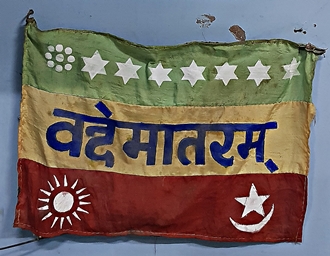
HAPPY INDIAN INDEPENDENCE DAY!


 yamey
yamey 