Kumihimo in Kensington

THE JAPAN HOUSE in London’s High Street Kensington first opened in 2018, and its aim is to increase people’s awareness and knowledge of Japan, the Japanese, and their culture. Until the 11th of June 2023, the Japan House is host to a superbly laid-out exhibition of Kumihimo – Japanese silk braiding. The braiding is a complex form of plaiting, using dyed silk threads. When, for example, hair is plaited or braided, three or more strands of hair are intertwined to form a plait. Practitioners of Kumihimo plait great numbers of often different coloured threads to create braids with beautiful repeating patterns. The most expert craftsmen and craftswomen can braid patterns using up to 140 different threads.

The exhibition shows how the threads are dyed, then spun into bobbins before finally being woven into braids. The braider uses a stand that holds the reels of thread. The threads are then plaited over each other in a repeating sequence to produce a patterned braid. Great concentration is required to maintain the sequence without making errors. A weight is hung onto the braid to hold it straight and taut whilst it is being created. In addition to examples of the various types of braiding stands, there are well-made videos illustrating braiders at work. There are many examples of finished products, including belts, fashion items, armour plating, and modern artworks. All of them are intricately patterned and incredibly beautiful.

The exhibition was set up by a Tokyo-based company, Domyo, which has been producing braided silk cords since 1652 AD. Kumihimo was a technique imported into Japan between 538 and 794 AD from the Asian mainland, and then refined and developed in Japan

When I learned that I was to visit an exhibition of braiding, I was not filled with enthusiasm. However, as soon as I entered the basement exhibition area, I realised that I was about to see a fine and most interesting display. Not only is there great beauty in the exquisitely detailed braiding, but this was also the case for the way the exhibits have been arranged. To summarise, see this exhibition if you can!

Lucie Rie, a potter in Cambridge

ONE OF MY UNCLES commissioned a ceramic work by the celebrated potter Lucie Rie (née Gomperz; 1902-1995). This used to be on display in my aunt and uncle’s house, which I used to visit often. Thus, I became familiar with the name Lucy Rie.

Lucie was born in Vienna (Austria), where she attended an avant-garde school of arts and crafts from 1922. After graduating, she set up her own studio in Vienna. Bring Jewish, she left Vienna in the late 1930s, and settled in London.

Encouraged by Bernard Leach, she established a studio in London. For a while she worked with the potter Hans Coper, but the artistic styles of the two artists differed considerably. Over the years, Lucie created objects in a variety of styles. She experimented with glazes and other techniques, creating pottery which was truly 20th century. Unlike Leach, whose works reference ancient Chinese and Japanese ceramics and mediaeval English, Lucie was innovative and inventive.

Until the 25th of June 2023, you can see a good exhibition of Lucie’s works, from her earliest to her later creations, at Kettles Yard in Cambridge. Undoubtedly, her works are of a high quality, both artistically and technically, but I was not particularly excited by the show. A video of David Attenborough interviewing Lucie in her studio interested me far more than her works on display.

By all means visit the exhibition, but in my opinion this is a show for Lucie Rie enthusiasts, rather than for the average exhibition goer.

The silent screen

HOBSON STREET IN the heart of Cambridge is one way and is used by traffic avoiding the pedestrianised section of Sidney Street. Hobson Street is lined with buildings of various ages. One of these, which has always attracted me, is a disused cinema whose facade has Art Deco features.

Built in about 1930 to replace an earlier cinema constructed in 1921, it was The Central Cinema. Its white tiled facade has Egyptian and Art Deco details.

In 1972, the cinema closed and was converted, as many other old cinemas have been, into a bingo hall. This establishment thrived until 2009 when the British government banned smoking in public places. Apart from three days when the building was occupied by squatters for 3 days, the old cinema has been boarded up and disused.

Various plans have been proposed for its future use, but none of them have been carried out. One of the problems is that because it is a protected edifice, any future plans have to preserve its original features. And as most of the new ideas for the old cinema involve adding windows, and adding them would infringe the protection order, all of the new plans have had to be abandoned. The protection order has saved the building but hindered its future development.

A penguin in the museum

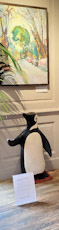
HAMPSTEAD’S BURGH HOUSE was constructed in 1704 and retains many of its original architectural features. Several of its rooms house a fascinating museum with exhibits relating to the history of Hampstead. I have visited the museum many times, but it was only today (the 9th of March 2023) that I noticed a model penguin on display. This used to stand inside High Hill Bookshop, which was located on Hampstead High Street. Founded by Ian Norrie in 1956, it remained in business until 1988.

During my childhood, in the 1950s and 1960s, I used to visit Hampstead almost every Saturday morning with my parents and my sister. We used to park the family car near to Jack Straws Castle, which is close to Whitestone Pond – one of the highest spots in London. Then, we would walk down Heath Street and along the High Street until we reached High Hill Bookshop. My parents were keen to encourage my sister and I to read. Therefore, every time we visited the bookshop, we had to choose one book each, which they purchased for us. I cannot recall all of the books I chose, many of them Puffin paperbacks, but I do remember that during these visits I gradually built up my collection of the adventures of Tintin by Hergé.

According to an article (https://jessicanorrie.wordpress.com/2017/08/04/the-best-independent-bookshop-in-london/) by Norrie’s daughter, Jessica Norrie, there was a party for Penguin Books held in the shop in 1960. The model penguin, which I saw in Burgh House today, was in attendance at that party back in 1960. I was eight in 1960, but I am afraid that I cannot remember seeing the penguin. It must have been in the shop during some of my visits, but then my interest in choosing a book was greater than looking for model penguins.

The penguin in the museum is black and white. On the white section of the bird’s belly, there are words, including “October 12th, 1960. High Hill Bookshop Silver Jubilee Party” and, also, some signatures. One of the signatures is that of Allen Lane, founder of Penguin Books. He died 10 years after the party. Another signature is that of the novelist Olivia Manning, There are several other signatures, but I found them too difficult to decipher.

Seeing the penguin at Burgh House brought back happy memories of my childhood and, at the same time, made me sad because High Hill Bookshop was irreplaceable. Waterstone’s, which followed in its wake, although well-stocked, lacks the charm of Ian Norrie’s wonderful creation.

You can read more about Hampstead past and present in my recently published book “Beneath a Wide Sky: Hampstead and its Environs”, which is available from Amazon: https://www.amazon.co.uk/BENEATH-WIDE-SKY-HAMPSTEAD-ENVIRONS/dp/B09R2WRK92/

The World under pressure

DURING A RECENT VISIT to the Wellcome Collection in London’s Euston Road, I saw some artworks that both captured my imagination and were aesthetically pleasing. It was an exhibit by the Moroccan artist Batoul S’Himi (born 1974). Her work in the Wellcome Collection, THE WORLD UNDER PRESSURE, consists of two gas cylinders like those that are used in kitchens around the world, and a commonly used cooking utensil – a pressure cooker. Each of the three objects is empty, and each of them have bits shaped like the map of the continents of the world carefully cut out of them.

According to the label beside the exhibit:
“Common yet dangerous objects in Moroccan kitchens, these gas cylinders and pressure cooker are carved with a map of the world. Here, global anxiety intrudes into the home. The artist’s use of domestic objects hints at the unequal burden of climate breakdown, hitting vulnerable people hardest, including women and children. But perhaps there is also hope, as families start to recognise their global impact.”
This is what the artist is portraying, but I believe that along with its title, the artwork, which uses containers designed to withstand high pressures, is a great visual metaphor for the myriad of pressures the world faces today. Simple though it is, Ms S’Himi’s work is highly effective and beautifully concise in its messaging.

A pavilion for Ramadan

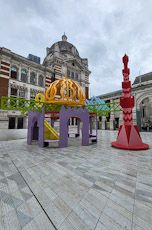
IN 2023 RAMADAN WILL occur between about the 22nd of March and the 21st of April. To celebrate this holy Islamic month, a colourful pavilion has been erected in the courtyard of the Exhibition Road entrance to the Victoria and Albert (‘V&A’) museum. It has been designed by Shahed Saleem and set up by The Ramadan Tent Project and the V&A. According to the museum’s webpage (www.vam.ac.uk/event/ok1kLZm29xJ/ramadan-pavilion-march-may-2023), the pavilion:
“…draws inspiration from the V&A’s Prints and Drawings collection to represent the history of the mosque and Muslims in Britain.”

Another webpage (https://www.vam.ac.uk/blog/museum-life/the-ramadan-pavilion-by-shahed-saleem) contains some interesting information about the history of Islamic edifices in the UK. The first mosque in Britain was built in 1889 in Liverpool by 20 British converts to Islam. It was housed in a Georgian terraced house. Since the arrival of many Muslim migrants in the UK im the 1950s and ‘60s, there is now a sizeable Muslim population in the country, and they worship in Britain’s approximately 1800 mosques. The earliest of these were in converted buildings, but now there are plenty of purpose-built mosques. Of these, one of the most beautiful and original is the mosque in Mill Road, Cambridge.

Shahed Saleem is an architect who specialises in designing mosques. Apparently, his pavilion at the V&A is the result of years spent studying mosques in Britain. With his Ramadan Pavilion, Saleem hopes that it will encourage people, who have never entered mosques, to explore mosque architecture and encourage them to enter these holy places to discover more about them. Well, that is an admirable aim, but from what I have seen of the pavilion, it is unlikely to fulfil that aim.

Undoubtedly, Saleem’s pavilion incorporates elements of mosque architecture and design. Sadly, it looks to me more like a children’s play area than a homage to Islamic architecture. I love Islamic architecture, but feel that the multi-coloured pavilion, which resembles something made with over-sized Lego bricks, does not respect the great beauty, delicacy, and intricateness that can be found in mosques both old and modern.

Ukrainians from Canada

LONDON IS RICH in memorials. Some of them commemorate well-known figures and events and others make the observer aware of lesser-known aspects of history. One of these obscurer memorials is on number 218 Sussex Gardens, next to St James Church and not far from Paddington Station. It was placed on the building, which was rented by the Ukrainian Canadian Servicemen’s Association (UCSA) [Союз Українських Канадійських Вояків] in 1943.

According to an informative website (www.ukrainiansintheuk.info/eng/03/ucsa-e.htm), the UCSA was:
“…formed on 7 January 1943 in Manchester, to cater for the social and cultural needs of Ukrainian Canadians serving overseas. Initially the association had 37 members. By the end of the war there were 1,500 active members and over 3,000 additional names on the association’s mailing list.”
That is clear enough, but I wondered about the story of the Ukrainian Canadians. In 2016, there were more than 1.4 million Canadians with Ukrainian ancestry. Canada has the third largest population of Ukrainians after Russia and Ukraine. Almost certainly, 1891 marked the start of the migration of significant numbers of Ukrainians to Canada. Back in those days, the territory, which is now the republic of Ukraine was divided between the Austro-Hungarian and Russian Empires. They were welcomed in Canada as the country needed workers to populate and cultivate the prairies.

The UCSA occupied the house in Sussex Gardens from late 1943 until early 1946. The website quoted above revealed that the UCSA:
“… organised social gatherings, or “get-togethers”, for its members, initially in Manchester and later also in London. A choir and a dance orchestra were organised at the London club, and a library and reading room were maintained there. The association’s activities also included visiting sick and wounded Ukrainian Canadians, compiling lists of those who had died or were taken prisoner, and looking after the graves of the dead (at various cemeteries in the UK, including Brookwood Military Cemetery near Woking, Surrey). From September 1943 the association published an UCSA Newsletter.”
As WW2 drew to a close, the UCSA also provided assistance to Ukrainian displaced persons and refugees from mainland Europe.

The memorial plaque on 218 Sussex Gardens was placed in September 1995, long before Russia began its current conflict with Ukraine. Unlike the statue of the Ukrainian Saint Volodmyr, which stands in Holland Park Avenue, the building near Paddington did not have any pro-Ukraine flags or other patriotic items affixed to it. The plaque is a discrete memorial to an aspect of the history of WW2, about which I knew nothing until today.

Hitler and India

MANY BOOKSHOPS IN INDIA carry copies of “Mein Kampf” by Adolf Hitler, translated into English. They are not hidden away from view but are displayed openly in bookshelves alongside books with less offensive texts. The books are not old and tatty, but look brand new, suggesting that they are bought frequently and replaced by new stock. Why this book should still be on the shelves in India so many decades after it was first published has always puzzled me. So, when I saw a book “Hitler and India” published by the historian Vaibhav Purandare in 2021, I bought a copy. I was hoping that it might help me understand the prevalence of “Mein Kampf” in Indian bookshops.

Purandare’s book is an easy read and quite interesting. He points out very effectively that Hitler had no love for Indians. Furthermore, he felt that it was right that the British rather the Indians than should rule India. And, in his opinion, he felt that should Germany ever rule India, the Indians would yearn for the return of what he considered to be the too lenient rule of the British. Hitler wrote that: “I would, despite everything, still far rather see India under English than under some other rule …”
Hitler had no desire to support those fighting for the freedom of India because, believe it or not, prior to WW2 he hoped that Britain and Germany might eventually become allies. Purandare also details how Indians in Germany suffered at the hands of the Nazis and their security forces. It was only after Britain and the Soviet Union became enemies of Germany that he entertained the idea of providing limited assistance to those, like Subhas Chandra Bose, who were fighting to free India from the British. Even then, the assistance he authorised was very limited. He did ship Bose out to Japan, but there was little more to his help than that. It must be remembered that he only did this as a way to undermine the British war effort; he did not believe that an independent India was either feasible or desirable. All of the foregoing is well described in the book.

Unfortunately, what the book failed to do is what I hoped when I purchased it. It brings me no closer to understanding why “Mein Kampf” appears in so many Indian bookshops, and evidently sells. What Purandare does make clear is that Hitler’s book contains passages that are insulting to Indians. As for its appeal to Indian bookshop browsers, his book has not brought me any closer to understanding it.