Unknown's avatar

About yamey

Active author and retired dentist. You can discover my books by visiting my website www.adamyamey.co.uk .

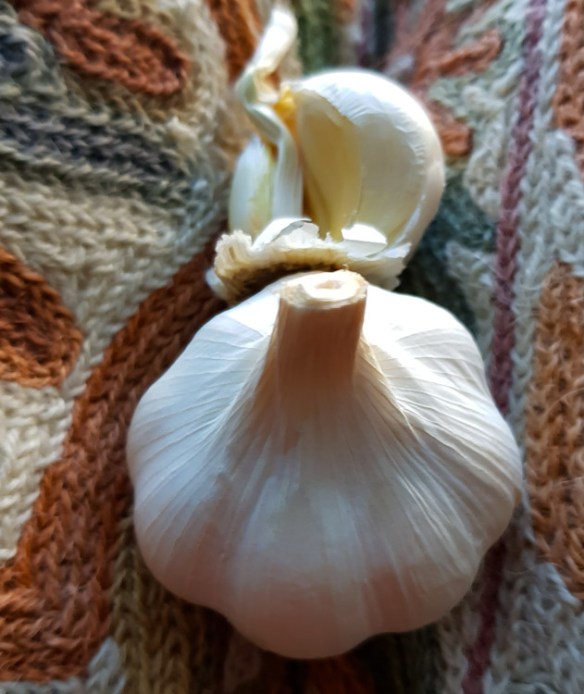
Garlic and parsley

PSX_20180917_175556.jpg


My late mother was a good cook. I know that you will think that often children praise their mother’s cooking however awful it is. In the case of my mother, her cooking was praised by many people, who still remember her skills in the kitchen many years after her demise at an early age. My mother was a keen disciple of the pioneering food writer Elizabeth David, who helped introduce Mediterranean cuisine to the British. Many recipes from the Mediterranean involve the use of garlic and parsley.

Although my mother did not permit my sister and me to cook in her kitchen, we were ordered to be in the kitchen with her either to keep her company and/or to do the washing-up. Our presence in the kitchen and proximity to a skilled cook engendered a life-long love of cooking in both my sister and me. When my mother died, I took over her kitchen and learned, by trial and error, how to cook. My sister did the same and ran a restaurant successfully for quite a few years.

Many of the dishes I cooked, and still make, contained copious amounts of garlic. This was not a problem until I qualified as a dentist, and moved to a practice in Kent, about 80 kilometres from London in distance, although it felt much further culturally and in many other ways.

Friends have often asked me whether the mouths that I treated emitted bad smells. The short answer is that although they might be malodorous occasionally, the dentist rarely smells them while treating the patient. However, the converse is true for the patient. In modern practice, the patient is often almost horizontal on the treatment chair. He or she can easily smell the dentist’s breath.

Soon after I began practising in Kent, I lived in local rented accommodation. I cooked for myself in the evenings, often preparing dishes with large amounts of delicious garlic.

One morning, Mrs G, a late middle-aged woman, attended my surgery. Soon after I had lowered the chair to a semi-reclined position, I commenced working on her teeth. In those days, the early 1980s, dentists did not routinely wear surgical gloves, nor did they wear facemasks. A paper facemask such as became ‘de rigueur’ after the beginning of the AIDs (HIV) epidemic, would not have prevented what was to occur after I began treating Mrs G.

After I had been at work for about a minute, Mrs G swept her hand in front of her mouth, and exclaimed: “Ooooh, Mr Yamey, you’ve been eating garlic.” I apologised, and from that day onwards I never ate garlic on a day before I was due to work.  

After I had been in practice for about twelve years, I began working in inner London instead of ‘extra-terrestrial’ Kent. My patients in London came from all over the world, and most of them ate at least as much garlic as I do. The garlic restriction that I exercised in Kent became unnecessary.

Parsley was another problem I faced when I first arrived in Kent. I used to buy my lunch at the local Tesco supermarket. Many of its employees were patients in the practice where I worked. In addition to sandwiches and potato crisps, I enjoyed eating something containing chocolate with my midday meal. Many was the time when the lady at the check-out till would hold my Mars bar or Crunchie up in the air, and then shout at the top of her voice: “Look what the dentist is eating.” I digress.

One summer’s day, I needed some parsley for something I wanted to cook. I entered the local Tesco and asked an assistant where this herb was kept in the shop. Surprised by my request, she answered: “Sorry, love, we only get that in at Christmas.” I was shocked. Only an hour and a half’s drive away in London, parsley was available throughout the year. The Medway Towns, where I worked, were trapped in a 1950’s time-warp when I first arrived there. By the early 1990s, when I shifted to London, the area was emerging gradually into the present.
Why I practised dentistry

UCL 1 University College London Portico

University College London Portico

I retired from dentistry exactly one year ago. This is how I got started 36 years ago…

I began studying dentistry after I had completed my PhD in physiology in 1976. My original intention was to obtain a clinical degree so that I would be able to widen the choice of post-doctoral opportunities beyond the field of specialisation relating to my doctoral thesis.

I entered the dental school at University College London (‘UCH’) ‘armed’ with a doctorate. There were two kinds of teaching staff at the school. The academic staff were attached to the University and the clinical ‘demonstrators’ were dentists who came into the hospital on a part-time basis to assist with teaching in the clinics where the students learned to treat patients. All the demonstrators used to address me as ‘Doctor Yamey’, but the academic staff, many of whom did not have PhDs, used to address me as ‘Mister Yamey’.

At the end of each course we studied, we would have to pass an examination. This consisted of a written paper along with a practical examination. All of the examinations included a face-to-face spoken test, a ‘viva-voce’ (or ‘viva’).

During my pharmacology viva, I was asked several questions by a pair of examiners. One of the examiners told me that I had answered one question incorrectly. I was sure that I had answered correctly, so I said: “I am certain that what I have said is right.” The two examiners looked at each other, and I began to worry. Then, the examiner who had not contradicted me said: “You know, he’s right.”

During another viva, the task was to look at a microscope slide, and then to comment on it to the examiners. When I had looked at the slide, I turned to examiners, and thought I heard one of them saying: “Where is it from?” Absentmindedly, I said: “It’s an unusual surname. It originates from Lithuania.” I had thought that I was being asked about my name, rather than the slide. Fortunately, I was able to give a satisfactory account of what I had seen under the microscope.

At the end of the first year, we were examined in general human anatomy. I entered the room where my viva was being held and sat down with the two examiners. One of them, an external examiner, said to me: Do you remember me?” I looked at him blankly before he said: “I used to meet you walking on Hampstead Heath with your parents. Please give them my regards.” At that moment, I knew that I had passed the examination.

The final year examinations, which determined whether you would or would not be awarded a degree in dental surgery were quite harrowing. Most people considered that the viva conducted by the dean of our dental school and a dean visiting from another dental school was the most frightening part of the finals. And, when I took the finals, we learnt that the visiting dean, the external examiner, had a fearsome reputation. So, I was somewhat nervous when I entered the room to face the deans. After answering a couple of questions evidently satisfactorily, the dean of our dental school said: “Well, of course we’re looking forward to you joining our staff when you qualify…” At that moment, I realised that I must have qualified.  I said that during the five-year dental course, I had discovered that I enjoyed treating patients, and that I would enter practice rather than academia.

One of the many things that appealed to me about practising dentistry is the constant contact with a huge variety of people. This is not the case in academic research. It can be a lonely business. The other appeal of practising dentistry is that often, but not always, a problem can be identified and solved. Someone loses a filling. The dentist replaces it: problem solved. In academic research, as each question begins to be solved, many others present themselves: it is never-ending.

A narrow escape

Ladbroke monument


My first job as a dentist was in a lovely practice in the Medway Towns. After having worked there for eleven years, I married and then lived in London. As it became tiring commuting by car between Kensington and north-east Kent, I changed practices. I worked for about nine months in north-west London in a practice where I was not happy. Then, I moved to another practice near Portobello Road. After about four years, the owner of that practice decided to open another branch in Maidenhead, Berkshire. I thought it would be interesting to work in a brand-new practice, and as Maidenhead was served by a good rail connection from Paddington, which is near my home, I decided to move to the new practice, where I treated its very first patient.

Usually, I boarded a local train that left Paddington a few minutes past eight in the morning. Just over half an hour later, I used to disembark at Maidenhead station, which was a couple of minutes’ stroll from the practice. Of the patients whom I treated there, the less said the better. My best memory of the place was that it was near a wonderful sandwich shop. The people who worked there had no idea about portion size control. So when I ordered my favourite sandwich, filled with prawn mayonnaise, it contained so much filling that I could hardly get my mouth around it.

One Monday evening, I returned to Paddington a little earlier than usual. Not being in a great hurry, I bought a ticket for the following Monday’s journey to Maidenhead.

On the following day, Tuesday the 5th of October 1999, I arrived at Paddington early as usual. Having already bought my ticket the evening before, I was able to take the train that left a few minutes earlier than the one I usually boarded. It left just before 8 am. The train I normally travelled on left a few minutes after 8 am.

I arrived at Maidenhead and began working. In those days, I used to have a radio running in my surgery. I heard a news bulletin that mentioned that there had been a terrible rail crash. I thought nothing of it until I returned to Maidenhead station that afternoon. I discovered, to my annoyance, that no trains were running as far as Paddington. They were all terminating west of Paddington at Ealing Broadway, where, fortunately, there is an Underground line which allowed me to continue my homeward bound journey.

It was only when I reached London that I learned more details about the crash. The train that I normally boarded every morning, the one which left a few minutes past 8 am, had collided head-on with a high-speed express train coming in the opposite direction on the same set of rails. Later, it was reported that 31 people had died and over 500 were injured. Most of the victims, killed and injured, were on board the train that I missed taking because I had bought my tickets on the night before.

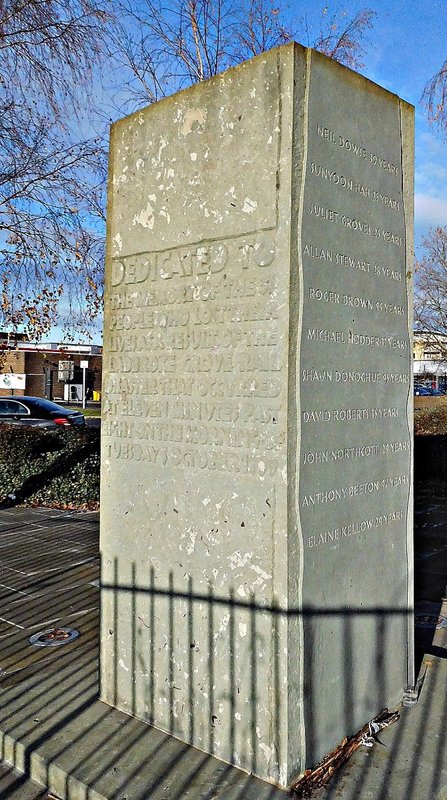
There is a monument to those who died in the crash. It is near the large Sainsbury supermarket on Ladbroke Grove. Whenever I see this simple stone monument or think about the incident, I shudder. One of the names on that memorial could have easily been mine.

Whisky for my teacher

teachers_scotch_whisky_70cl

During the last two years at dental school, we were assigned dental laboratory technicians to supervise us as we struggled to learn how to make acrylic dentures and gold crowns. Mr K was my crown technician. A friendly man, he used to listen to the problems that we encountered when trying to treat patients and, simultaneously, to deal with the often fussy and (necessarily) pedantic clinical tutors. Before any conversation could begin with with Mr K, the student would have to visit the canteen (two floors down) to fetch a cup of coffee for him and another for the student. Goodness knows how many litres of milky coffee entered Mr K during his working day.

When the number of days before qualifying began shortening rapidly, my fellow students and I began to look for practices where we could commence practising dentistry at last. One morning Mr K said to me that there was a dentist, Mr L, in the Medway Towns, who was looking for a newly-qualified associate. I had never visited the Medway Towns, which are about 80 kilometres south-east of London. A trip to the ‘country’ sounded attractive, and, who knows, I might have been offered a job. Actually, although surrounded by lovely countryside, the Medway Towns are far from rustic.

On the day before my interview, my father told me that Mr L had cancelled the appointment. I was saddened briefly, until my father told me that Mr L had said that Mr M, whose practice was in another part of the Medway Towns, was also looking for an associate. I rang Mr M, who asked me to visit him the next day.

Mr M turned out to be delightful. I knew that if he wanted me, I would enjoy working in his practice. He offered me the job instantly. I worked happily in his practice for eleven years until for practical reasons it became necessary for me to work in London.

Just after qualifying, one of my patients at Mr M’s practice asked me how long I had been a dentist. Not wanting to risk alarming the patient by revealing that it was less than a month since I had qualified, I answered: “I have been working in London for the last five years”. In dentistry, you need to think on your feet.

As I was leaving the practice to return to London after my interview, Mr M handed me a bottle of Scotch whisky. He said: “Give this to Mr K when you next see him.”

I did as I was instructed. When I spoke to a fellow student who had been directed to a practice by Mr K, I learned that a bottle of Scotch was Mr K’s fee or commission for finding associates for dentists who knew him.

I doubt that there are many employment agents or ‘head hunters’ that charge employers as little as the cost of a bottle of Scotch.