
Composing a haiku
Counting the syllables
Seventeen: it’s okay


Composing a haiku
Counting the syllables
Seventeen: it’s okay
At a post-office in India…
Snap a photo
in the sorting office:
make sure it don’t go viral

While we were visiting the city of BARODA (Vadodara):
“…we visited the main railway station because it has a post office. Visiting the station is like visiting an art gallery. The façade and staircases of the large relatively modern station (1954) are decorated with colourful modern paintings and bas-reliefs, including a trompe l’oeil fresco depicting a steam engine with a large ‘cowcatcher’ emerging from a tunnel. There are also several interesting sculptures on the raised pavement in front of the station entrances. One of them, which I liked most, shows a model train on railway tracks. The tracks with the carriages on them have been bent into a spiral with the old-fashioned engine in the centre of the spiral.

We drank tea in a café located along one of the station’s long platforms. Platforms in many…
View original post 231 more words

Photo by Pixabay on Pexels.com
I was a little intimidated by his appearance the first time he walked into my surgery. Tall, well-built, he clutched a half eaten sandwich in one hand and a bundle of papers in the other. When he had finished masticating the piece of sandwich in his mouth, he told me that the police had banned him from entering the area. Waving his collection of papers, he explained that his solicitor needed to get permission from the police when he needed to see a dentist at the practice.
P wanted a new set of dentures. Inwardly quaking, I took the primary impressions of his toothless gums, and then asked him to return a week later for the next stage of his treatment. By the end of the appointment, I felt that he was going to be a pleasant patient and that I need not fear him.
On the penultimate appointment, I tried the wax mock-up of his dentures to check that all was proceeding well. I let P look in the mirror. He was very pleased and wanted to take them away. I explained that the waxed version had to go back to the technician to be made into the final, usable plastic product. I told him that they would be ready in a week.
Looking crestfallen, P said :”really ? That might be awkward?”
I asked why.
“I am seeing the judge next week. If he puts me behind bars, I won’t be able to collect the teeth.”
I asked him if he could let me know if he was unable to return.
“Sure, doc,” he said, “I can phone you from prison.”
I said to him: “I see now. That’s what people mean by a ‘Cell phone'”
P gave me a huge toothless grin.
P did return for his teeth a week later, but I was not at work. I’d had to cancel my clinic to attend our daughter’s birth.
Wherever you look, up or down
On doors and walls
they can be spott-ed

All over the city of Cambridge, you will see depictions of creatures.
Here area few for you to enjoy:


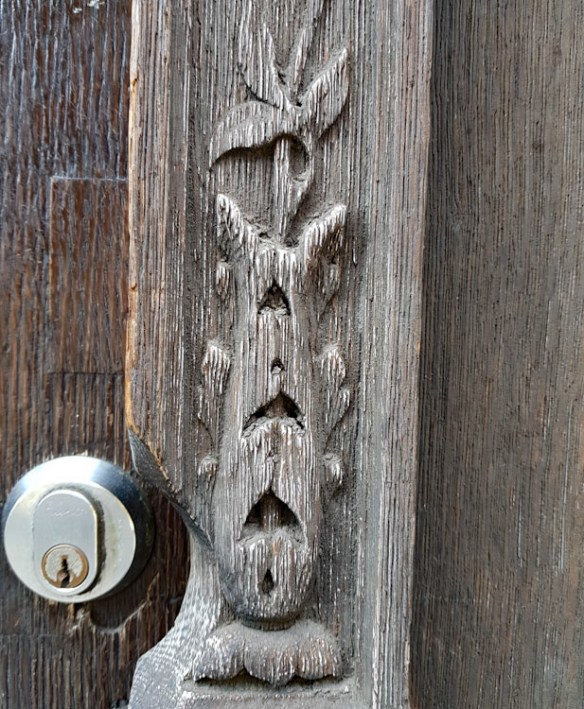
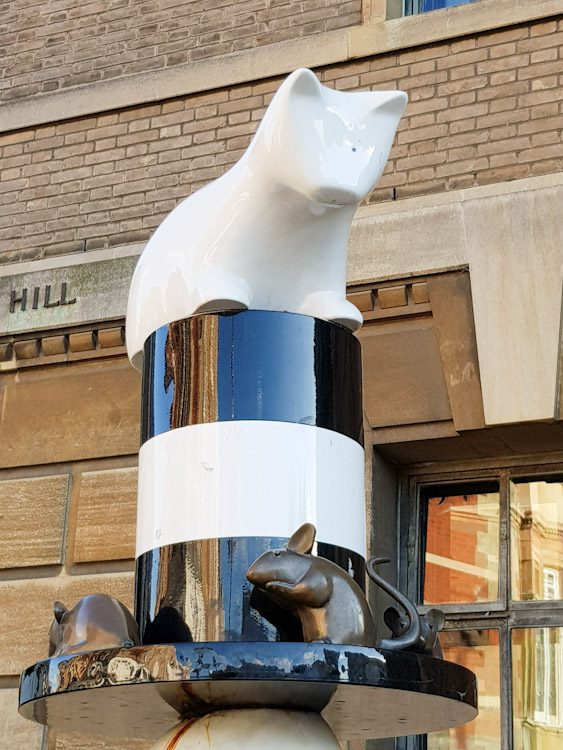
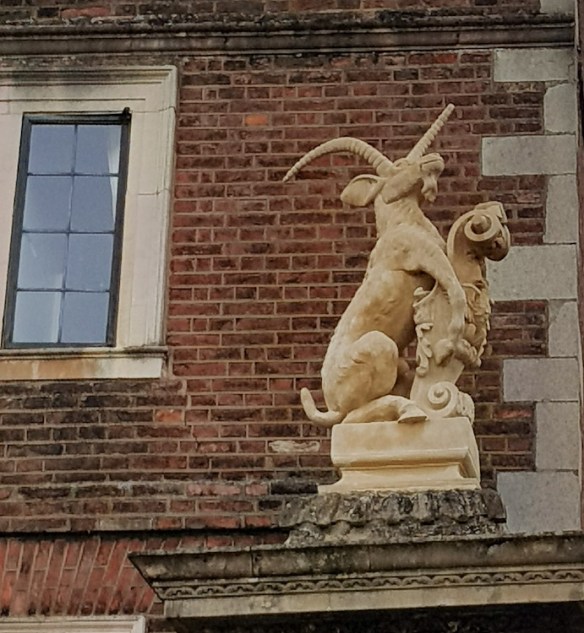
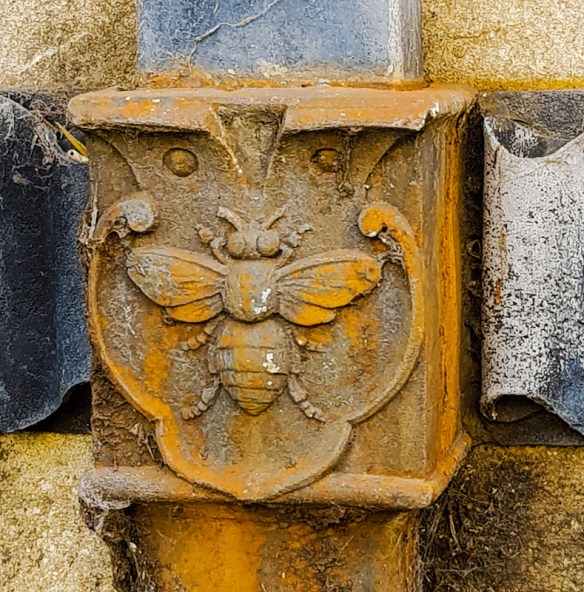
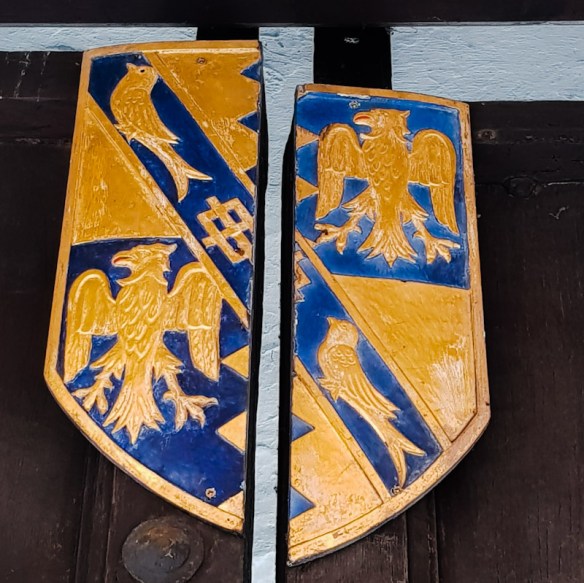
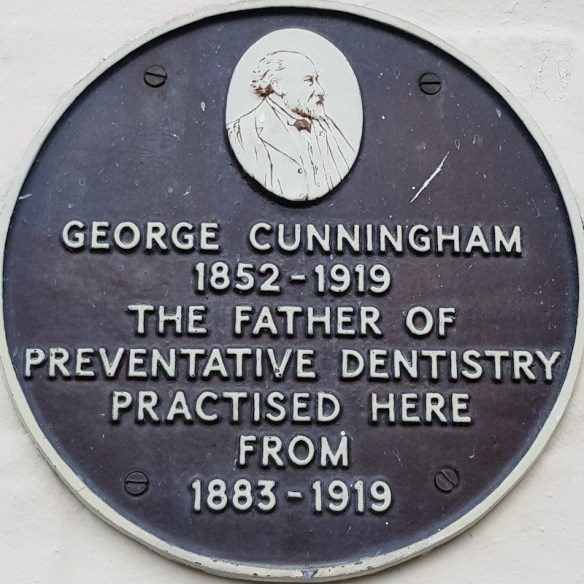
Mr T was a regular attender at my dental surgery. Bald, he had a high pitched voice. For some years he made appointments on Saturday mornings because he commuted during the weekdays. He retired and then began coming to see me on weekdays.
One Thursday just before Mr T was due to enter my surgery, our receptionist rushed in and said : “Don’t be surprised when you see Mr T.”
A few moments later, a woman in fairly dowdy, quite unfashionable clothes walked in and sat in my dental chair. When this person with a good crop of hair greeted me, I recognised Mr T’s voice and his familiar face was framed by his unfamiliar hair. I looked at my dental nurse, and she looked back at me, astonished.
As I always did, I asked the patient whether he/she had any medical problems lately, or had to see the doctor lately. The transformed Mr T said “not at all.”
Puzzled, I performed the dental check up, and discovered that there was a tooth that required extracting. T consented to this and we arranged for him to return a week later. He/she left the room.
In those days, early in my career, whenever I performed a tooth removal I asked the nurse to support the patient’s head gently during the procedure.
As soon as T left the room, my nurse said to me: “Don’t expect me to support his head next week. What if his wig were to come off in my hand?”
A week later, dressed as before in dowdy women’s clothing and with a full head if hair, the previously bald and previously male-attired T turned up for his extraction.
Before commencing, T asked me in his high-pitched voice which was now in complete harmony with his female appearance: “Will this take long?”
I said: “Only a few minutes. Are you in a hurry?”
“Slightly,” T replied, “I am going shopping with my wife in a quarter of an hour.”
I suspect that throughout his working life, T had yearned to appear female, but only in retirement was he able to make his fantasy into reality. His wife must have been a very understanding woman.

A pole, a person, some water,
A river in Cambridge:
That’s punting
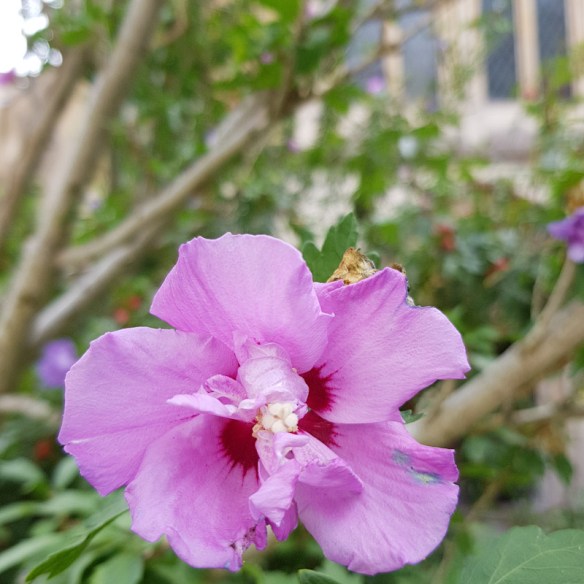
Seventeen syllables: haiku
Four lines a limerick
Poetry rules
This war written in mid-2016, following Adam Yamey’s visit to Albania
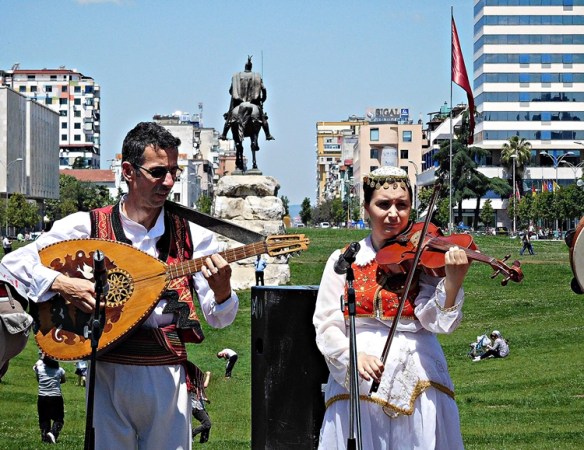
Tirana
Between 1944 and 1990, the tiny Balkan country Albania was governed by a Stalinist dictatorship. During that period, it was more isolated from the outside world than North Korea is today. My Indian wife, Lopa, and I visited the country in June 2016. We were open to surprises, but never imagined that we would discover what I am about to describe, namely some Indian connections.
The small town of Pukë is in the north of the country. Hardly visited by tourists, it is a pleasant place at a high altitude. During our visit there, we entered a small gift shop to buy a notebook. The shop-keeper looked at Lopa, and asked where she was from. When we said India, she pointed at a small television screen beneath the counter. We saw that she was watching something from Bollywood, but with Albanian sub-titles.
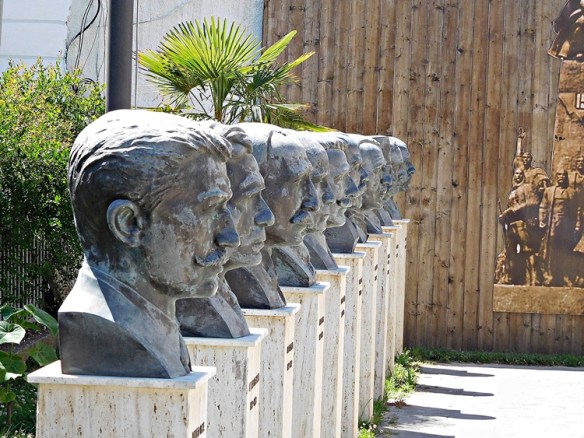
Vlore museu,
Some days later, we were in the coastal city of Vlorë, visiting the house where on the 28th November 1912, the independence of Albania (after about 500 years of Ottoman domination) was declared. We were shown around the building, which is now a museum, by a lady who spoke only Albanian. An Albanian friend translated. As we moved from room to room, we noticed that the lady was becoming more interested in Lopa than the Independence of Albania. She kept touching Lopa and even hugged her from time to time. At the end of the tour, she asked Lopa why she was not wearing something like a sari as the actors in the Bollywood films do on the television shows that she loved. A devotee of Bollywood soap operas, she was thrilled to have a real live Indian in her museum. She told us that Lopa was the first Indian women to visit her museum in the 11 years that she had been working there.
Later, we learnt that Bollywood television soap operas are extremely popular in Albania, especially amongst women viewers. The shows are usually broadcast in the afternoon, so a ‘savvy’ person knows better than to ring an Albanian woman during the hour that such shows are on-air.
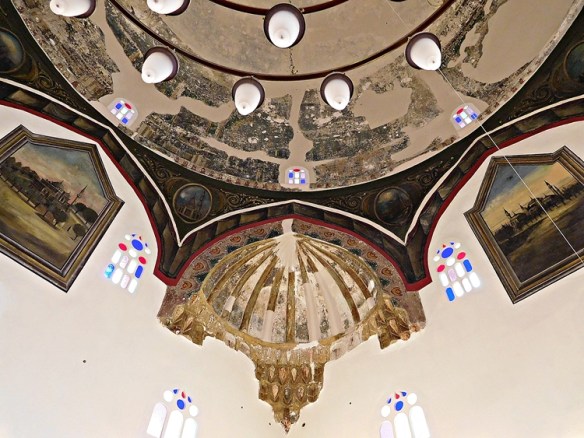
Mosque in Korce
Love of Bollywood is not confined to Albanian women. In the southern city of Korçë, we were visiting an old (15th century) mosque, when an elderly man, who was just about to enter to do ‘namaaz’, saw Lopa, and asked if she was Indian. On hearing the answer, he exclaimed: “Rye Kapur”, which was his way of pronouncing Raj Kapoor.
Judging from the excitement that Lopa evoked when meeting Albanians, we guessed that there were probably few or even no Indians in Albania. Our guesswork ended when we met Vijay in the foyer of the National Museum in Albania’s capital Tirana. Vijay, who hails from southern India, lives and works in Albania with his family. He was waiting for his son to return from cricket practice. We were surprised to hear that cricket is being played in a country which has not ‘enjoyed’ the effects of British colonial influence. Vijay told us that not only were ‘ex-pats’ involved in cricket in Tirana, but also Albanians. There is an Englishman who has been training members of Tirana’s rugby club to play cricket. In late June this year, the Albanian team beat the ex-pat’s team by one run.
On the next day, we met Vijay, who teaches computing to Albanians in Albanian, with his family at a café. His wife had specially prepared some Indian snacks for us: chicken tikka and some aloo bhajjis. While we were sitting chatting, another Indian, Vicki, wandered past and joined us. Vicki was working for an Indian mining company, but has recently returned to India having spent a few years in Albania. When we had spent time with our new Indian friends, we got up but before saying farewell, they invited us for lunch the next day.
Apart from having been very fortunate to have ‘bumped’ into Vijay and his family and friends, we were very lucky to have met any Indians at all in Albania. This is because there are currently only about 50 Indians in Albania, and some of them are Mother Teresa nuns.
The following day, we met Vijay and Vicky in the centre of Tirana. A car pulled up, and we all piled in. The car was driven by yet another Indian, Father Oscar who runs Tirana’s large Roman Catholic Don Bosco establishment. He drove us out to Vijay’s flat on the edge of the city. There, we were confronted with a superb warm buffet prepared by Vijay’s wife. As I served myself with chicken biryani, dal, chappatis, channa, and so on, I had to pinch myself to believe that I was not imagining eating home-cooked Indian food in Albania.
PS: Finally, for those with Indian passports who wish to visit Albania, the nearest Albanian embassy to India, we were told by an Albanian diplomat, is in Beijing (China).
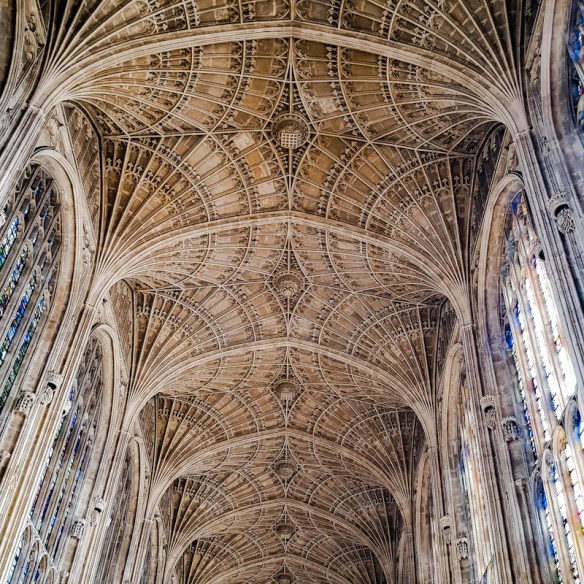
Ribbed vault-ed ceiling
Ethereal atmosphere
Kings College chapel

City of colleges
Towers lawns and bridg-es
That is Cambridge briefly

 yamey
yamey 