Unknown's avatar

About yamey

Active author and retired dentist. You can discover my books by visiting my website www.adamyamey.co.uk .

To Vienna and beyond

V Melk Abbey BLOG


IN 1971, I WAS AN UNDERGRADUATE STUDENT. That year, I made my first unaccompanied trip abroad. I was travelling by ferry and rail to Vienna and beyond. My late mother, who was very worried about how I would fare, wanted me to stay in a decent hotel for my first night on the Continent. That was to be in Cologne (Köln) in what was then West Germany. Back in 1971, there was no Internet to look up hotels in Cologne or anywhere else for that matter. The only guidebook to Germany in my possession was a pre-1914 Baedeker guide to The Rhine. Amongst the few hotels listed in the book in the entry for Cologne was a Dom Hotel. I rang the international telephone directory operator and asked if the place still existed. It did, and still does, and she supplied the number. I rang the Dom and booked a room for one night. My mother was happy about this, and said that as soon as I arrived, I was to ring her from the hotel.

I set off from London with my luggage in a metal framed canvas rucksack, kindly lent to me by my uncle Sven. I arrived in Cologne in the early evening and soon arrived at the very grand Dom Hotel, the ‘poshest’ in Cologne, in the late afternoon. It was a short distance from the Hauptbahnhof. I was greeted at the bottom of the steps leading up to its main entrance by a liveried doorman. He asked me for my luggage. So, I handed him my well-used rucksack. He held it gingerly as if it were a rat that had been dead for several days. At great expense, I telephoned my mother to assure her that I had survived the journey so far. From then on, she seemed to lose interest in my well-being during my adventure. I was not required to send progress reports back home.

After Cologne, I spent every night in a youth hostel or similar. From Cologne, I travelled by train to Würzburg, where I was planning to see the brilliant paintings by the Venetian painter Tiepolo inside the city’s Würzburger Residenz. Between Frankfurt and Würzburg, there was a middle-aged lady in my compartment. She wore what looked to me like very old-fashioned traditional German clothes including a hat with a feather stuck in its hat band. As the afternoon light began to fail, we began travelling through hilly country. I had just enough German to understand that the barely visible hills we were passing were the Spessart Hills. She told me that they were very beautiful. I have no idea why I remember her telling me about those hills. The next day, having spent a night in a comfortable youth hostel, I fulfilled my desire to view the Tiepolo wall and ceiling paintings.

At each of the German youth hostels in which I stayed, there was a different method employed to wake the guests in the morning. At Würzburg, A young man playing a flute wandered from dormitory to dormitory. At Munich, where I stayed one night, the morning call was someone shouting “Raus, Raus!”, which immediately conjured up thoughts about POW camps in Germany during WW2.

I decided to attend an opera performance on my first night in Munich. I bought the cheapest ticket for Berg’s “Wozzeck”. I note from the Internet that the opera was performed in Munich on March the 23rd 1971, which helps to date my trip. The ticket I bought allowed me to see the opera from the highest tier of the auditorium. When I arrived in my casual travelling clothes, I was the only man in the audience not dressed in formal evening wear. I enjoyed the opera from my eyrie near the ceiling of the theatre.

The following morning just after I had eaten a very modest breakfast, I met my friend, the late Michael Jacobs, at the famous Hofbrauhaus. We had arranged this sometime earlier when we were both in London. Each of us ordered a large stein of lager, probably a litre each. We chatted and drank in one of the establishment’s large noisy halls. Then, we went our own ways. I walked to the railway station with my rucksack on my back. It seemed to me that the hitherto flat pavements had become wavy. The alcohol had gone to my head.

My uncle Felix had recommended that I should make a stop at Linz in Austria in order to visit an interesting monastery nearby. I enjoyed the trip from Linz to Sankt Florian in what looked like an antique tram. The composer Anton Bruckner was associated musically with Sankt Florian.

From Linz, I travelled eastwards to another town with an important monastery. The monastery at Melk is perched on a hill overlooking the Rhine. I spent a night in the town’s youth hostel before continuing eastwards.

Deliberately, I overshot Vienna and continued from there by bus to the small town of Rust on Lake Neusiedl. The water of this shallow lake is shared between Austria and neighbouring Hungary. I was told that if the wind blows hard, the lake shifts position: more of it moves into Hungary or into Austria depending on the wind direction.  From Rust, little could be seen of the lake apart from endless beds of reeds. I was the only guest at the youth hostel because it was so early in the year. At night, I was left alone in the hostel. As I lay waiting to be overcome by sleep, I could hear an incessant croaking of a multitude of frogs coming from the direction of the lake. This strange sound did not help me fall asleep.

The next day, I took a bus to Mörbisch am See, a village on the lake, close to Austria’s border with the then communist Hungary. I asked a village shopkeeper if I could leave my heavy rucksack in his shop so that I could take a stroll. My aim, which was fulfilled, was to see for myself the notorious ‘Iron Curtain’. I walked south of the village and soon spotted the tall watch towers overlooking the no man’s land between the two countries. I only crossed the Iron Curtain for the first time about ten years later. Then, I hurried back to the village because I knew that there was a bus about to leave for Vienna at noon. The bus was waiting. I asked the driver to delay departure while I collected my rucksack. Unfortunately, the shop had closed for its lunch break. The forbearing bus driver helped me find someone to unlock the shop. We set off for Vienna.

My father had an American secretary called Nancy Berg. She and her husband had very kindly torn out and given me the pages about Vienna from their copy of “Europe on Five Dollars a Day”. From this useful source of information, I discovered that there was an extremely cheap, centrally located hostel near Mariahilfer Strasse in Vienna. This was no ordinary hostel. It was subterranean. It had been a bomb-proof underground shelter built by the Nazi Germans. The rooms were somewhat spartan, but each was served by an air-conditioning system that had been installed by the Nazis. The hostel required guest to leave the premises between 8 am and 4 pm. This was not a problem because there was so much for me to explore in and around Vienna.  The hostel was good value as was almost everything else in the city. In 1971, £1 Sterling was worth 80 Austrian Schilling. About ten years later, when I next passed through Austria, £1 only bought 20 Austrian Schilling.

I ate most meals at the popular Rathauskeller under the City Hall, which served good food at very reasonable prices. I particularly enjoyed ‘Gulaschsuppe’. One memorably enjoyable meal was at Grinzing at one of its Heurige, or wine taverns. I was not alone there. My friend Michael Jacobs had arrived in Vienna, where he was about to study German for a few months. He joined me and some other people, friends of my Uncle Felix. They were a couple in Vienna, whom my uncle had met. He was very keen that I should meet them. They invited me to afternoon at their residence in the city. It was a fine day and we sat on their terrace. I remember being given a cup of tea and a warm soft-boiled egg in its shell at the same moment. I had never been given this combination before. I hoped that it was not the local habit to break the egg into the tea. Had it been, I am sure that I would have not been able to even sip the strange mixture that would have resulted. Fortunately for me, the egg was designed to be consumed separately. I introduced Michael to this pleasant couple, and they became good friends.

By the time I travelled to Vienna, I had become a fan of the Dreigroschen Oper (Threepenny Opera) by Kurt Weill and Berthold Brecht. I had a gramophone record of the main songs in this work, which I never tired of hearing. Most people will be familiar with one of its opening songs, “Mack the Knife”. Many years later, I discovered a recording one of Ella Fitzgerald’s renderings of this song to a ‘live’ audience, during which she forgets the words following the first half of it. As luck would have it, there was a performance of the opera while I was in Vienna. I sat spellbound, listening to it at the city’s Volksoper.   

Amongst Vienna’s many attractions, there were several that I particularly enjoyed. One of these was the magnificent fairground at the Prater. This was on a scale I had never seen before. The Soviet War Memorial also sticks in my mind. I loved walking amongst the stalls in a street market that ran along the banks of a canal. Many of the stalls sold food from a part of Europe that I had not yet visited but wanted to: the Balkans and Communist Eastern Europe. Seeing road signs in Vienna pointing to places such as Bratislava and Budapest, both behind the Iron Curtain, thrilled me. I was also delighted by my visits to the Albertina art museum, Schönbrunn Palace on the edge of the city, and the Belvedere within the city.

It is curious that many details of my first ‘solo’ trip to mainland Europe remain in my mind but the return to London by train has left me no memories at all. I can only suppose that I travelled back without making any intermediate stops before reaching the English Channel. One thing that I regret is that I have mislaid the photographs, which I know that I took on this trip. I have an idea that they might be in a remote storage place that we rent on the outskirts of London. This is not accessible at present and even if it were, it might take hours or days sifting through what is being stored there to find them.


Photo: Melk Abbey from Wikimedia Commons


Carbon dating

I HAVE JUST DISCOVERED an unopened pack  of ten sheets of 13 x 8 inch carbon paper. Carbon paper is something younger readers might never have heard of or used. For those unused to this product, I will explain. More mature readers must bear with me, please.

CARBON

Carbon paper is a thin sheet of paper, one side of which is loosely coated with particles of ink. The other side of the paper is plain. If carbon paper is placed on plain paper (eg typing or writing paper) so that its inked face is in contact with  the plain paper, and then pressure (e.g. with a stylus or typewriter letter) is applied to a point on its un-inked side, the ink beneath the pressure point is transferred to the plain paper beneath the carbon paper, making a copy of the shape of the object (e.g. letter or shape) creating the pressure. 

Carbon paper was commonly used when typing on a typewriter. The letters that sharply hit  the paper to create a letter, number, or symbol, can be transmitted to a second or third piece of paper by carbon paper. The second and third pieces of typing paper are placed below the top sheet, but  each is separated from the  sheet above by layers of carbon paper with their inked surfaces facing down on them.  Thus, several copies of the same document can be created simultaneously.

This was a useful method of creating up to four reasonably distinct copies of a typed document in the era that preceded photocopiers, laser and inkjet printers, and word processors. For larger numbers of copies, one needed access to something like the now obsolete Gestetner machines. And, the copies they produced were not always easily legible.

The sealed pack of carbon paper that was lurking amongst unsorted stationery in our home  bears the name of the supplier, WH Smith  & Son. The company still exists. It has retail outlets in the UK  and abroad. I have seen branches of the company in the departure lounges of airports in the Gulf States.

The price of our pack is given as “3/-” (three shillings) or “15p”. The UK adopted decimalisation of its currency in 1971. Prior to this change, £1 was 20 shillings, each of which was 12 pennies. Thus £1 was 240 pennies (abbreviated as ‘d’, from the Latin word ‘denarius’).  After the decimalisation,  £1 was divided into 100p (‘pence’).

Given that our unused pack of carbon paper bears a price in both the old and the new currencies, I imagine that it was bought around the time that the British abandoned its old currency, when the new penny, 1p, became worth 2.4d (old pennies).

In 1982, I qualified as a dentist and began tackling the dental problems of the general public. After not having used carbon paper for several years, I found myself using a form of it daily. It came in short narrow rectangular strips of thin paper, sometimes with only one surface loosely coated with ink, but more often both sides. It was/and still is known as ‘articulating paper’. It is used to check how the teeth in the mandible (lower jaw) meet their opposite numbers in the maxilla. Determining this is very important for diagnostic purposes and for checking that crowns, bridges, dentures are in occlusal harmony with the rest of a patient’s dentition. If, for example, a crown (‘cap’) is high on the bite when it is being fitted, articulating paper can be used to detect which part of the cap has excess material that is preventing the patient’s teeth from meeting comfortably.

When I  came across my vintage pack of unused carbon paper, I thought that it was a reminder of times past, but it is not. A quick search on Google revealed that carbon paper is still widely available from stationery suppliers. Rymans now sells ten sheets of A4 carbon paper, not for 15p, but for £5.99. Carbon paper still has many uses apart from typing. For example, sheets of this paper are often used in pads of bills or invoices to make copies of the bills etc handed to customers.

I will not throw away our 3/- pack of carbon paper. It is a souvenir of a historic moment in British monetary evolution and a painful reminder of how much the purchasing power of £1 has diminished in almost 50 years

A road through my childhood

IT IS BECOMING AN ADDICTION: I must write something every day. It is probably a harmless compulsion, but it gives me great pleasure. Today, I will write about a road that did not exist until 1835. It runs northwards from the centre of London. It was built to bypass the hills on which Hampstead perches. The old route to Finchley and Hendon from central London passed across these hills before Finchley Road, originally a toll road, was constructed. Part of Finchley Road connects the suburb of Golders Green with Swiss Cottage. For five long years I travelled along this stretch.

HALL BLOG

Swiss Cottage is named after a pub, Ye Olde Swiss Cottage, which still resembles many people’s idea of what a Swiss chalet should look like. The pub is a descendant of the Swiss Tavern, built like a Swiss chalet. Opened in 1804, it stood on the same spot as its most recent avatar. It stood on the site near one of the toll booths built for collecting money from people using Finchley Road in earlier times.

There was another toll collecting place at Childs Hill, between Golders Green and Swiss Cottage. This toll gate was next to the now demolished Castle pub. For five years, I passed through Childs Hill on my way to the Hall School near Swiss Cottage.

I attended The Hall between 1960 and 1965. The Hall, founded in 1889 (the year the Eiffel Tower was built) was a private school for boys preparing boys for entry into private secondary schools, misleadingly called ‘public schools’.

During my time at the Hall, several bus routes plied between Golders Green and Swiss Cottage: 2, 2a, 2b, and 13. The fare was five pence (less than 2.5p) for children. I used to say to the conductor: “five-penny half, please”.

The bus journey to and from The Hall was tedious and slow. This was because Finchley Road was being widened. The roadworks began before I entered The Hall and continued after I left it five years later. To widen the road, which was lined by houses and shops all the way between Childs Hill and Swiss Cottage, every garden by the roadside had to be cut short. There was a garden centre in a long greenhouse near Finchley Road Underground station opposite the present O2 Centre.  More than three quarters of its length was demolished to permit road widening. All in all, the long section of road being ‘improved’ caused the rush hour traffic to move sluggishly. After 5 years of enduring this, I used to be able to recite from memory and in the correct geographical order the names of all the shops along Finchley Road. Today, hardly any of them exist. Even the large, still extant department store John Barnes has changed its name to John Lewis. Gone is the remains of the garden centre and the Edwardian Swiss Cottage public swimming pool. During my time at The Hall, this place closed when the then new Swiss Cottage Library and swimming pools opened close to the swiss style pub. Another of many disappearances is that of Cosmo, a restaurant that used to be popular with refugees from Central Europe and later with my wife, who loved the Hungarian cherry soup served there.

The Camden Arts Centre stands at the corner of Arkwright Road and Finchley Road.  The arts centre faces across the main road the start of Lymington Road, which soon runs along the side of a large grassy open space. This is where Hall School boys played football and cricket. We used to walk two by two with one of our teachers from the school to and from the field, a distance of at least a mile.

The Hall School was an ‘elite’ establishment. Almost all the pupils had parents who were listed in “Who’s Who”, or royalty, or were extremely wealthy. Several of my fellow pupils were sons of Greek shipping magnates. One of these used to be driven from the school to Lymington Road in his chauffeur driven Bentley, which he pronounced ‘bantly’. Occasionally, he used to offer teachers a lift in his luxurious vehicle.

The sports field in Lymington Road was opposite a small newsagent-cum-sweetshop. We were not supposed to enter this during school hours, which included time at the sports field. And, because we walked back to school after a sporting session, there was little chance to explore it, but somehow, we managed. The shop was amazingly well-stocked with cheap sweets. I discovered that if I walked from Swiss Cottage to Lymington Road, the fare from there to Golders Green was two pennies (there were 240 old pennies in one Pound) cheaper than from Swiss Cottage. This gave me two pennies on top of what I was given daily to buy snacks (in my case, read ‘sweets’) on the way home.

At Swiss Cottage, there was one sweet shop near my bus stop. It was a branch of Maynard’s inside the subterranean foyer of the Underground station. The sweets it sold were poor value: there was nothing for under three (old) pennies. In contrast, the shop on Lymington Road was full of sweets costing less than one (old) penny. For example, one penny bought four ‘blackjacks’ or a large chewy item called a ‘refresher’. And, for three pence, a ‘Sherbet Fountain’ (still available on the internet for 132 [old] pence or 55p). This used to consist of a paper cylinder containing a fizzy lemon flavoured white powder into which there was a black cylindrical straw made of liquorice (used to suck up the powder). The thing looked just like an unexploded firework. In short, It was worth walking about a mile to save on the bus fare and then to spend it in a place where my money had much better buying power.

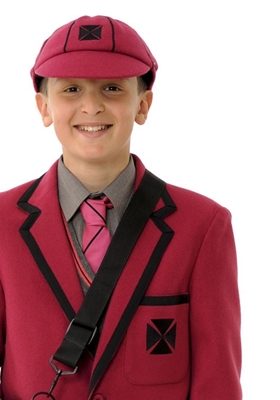
At the end of the day, I disembarked at Golders Green near the Underground Station. There used to be many children from other schools mingling there on their journeys home. One incident at this place remains in my mind, but before relating it, you need to know what we wore at The Hall. The colour that predominated in the school uniform was pink, which was considered rather strange for a boys’ school. Blazers and peaked school caps also contained black trimmings. One of these, which was prominently sewn on to our caps and the outer breast pocket of our pink blazers trimmed with black, was a black Maltese cross. The way that the school’s emblem was drawn was closer to the shape of the German Iron Cross than to the real Maltese cross. By the time I was attending The Hall, I had already become interested in the Holocaust (the Shoah). Golders Green had many Jewish people living there and several shelves of its public library were filled with books about the deeds of Hitler and his followers. I borrowed and read many of them. Therefore, I was horrified when I stepped off the bus at Golders Green one afternoon, and then some schoolboys from another school shouted at my friend and me:

“Look, the Nazis have arrived.”

Is it not strange what one cannot forget?


Picture from https://www.uniform4kids.com/ 

.

Eating out remembered

SEEING A PHOTO TAKEN  of La Cage Imaginaire, a restaurant in Hampstead has whet my appetite for writing about some memories of eating in this picturesque part of London long before the current restrictions on individuals’ movements and public gatherings.

COLIN BLOG

My parents used to like dining out at a ‘bistro’ in Church Row, a street lined with lovely old houses. The Cellier du Midi, as its name suggests was in a basement. Long before my mother died in 1980, they dined there often. My sister and I were never taken there. This made me curious about the place and for many years after they stopped going there, I thought it would be fun to try it out. It was only at the beginning of the 21st century that I did. My father’s teacher at the University of Cape Town, and later his colleague at the London School of Economics, Professor William Baxter (1906-2006) and his wife invited my wife and me to have dinner at the Cellier. It was Baxter, who in 1938 encouraged my father’s family to send him to England to continue his studies. I was excited about the prospect of eating in this restaurant at long last. Sadly, by the time we were invited there, the food was far from exceptional. It was far below the quality that would have been acceptable to my late mother, a discerning eater.

My parents ate Indian food occasionally. Their favourite Indian restaurant was the Shahbag in Rosslyn Hill, the continuation of Hampstead High Street. I ate enjoyably there once or twice with friends in the early 1970s but did not return for over 30 years. One evening, we drove up to Hampstead to attend a concert in a church on Rosslyn Hill. We arrived just before the performance was scheduled to start. I was driving. I dropped my wife and a friend at the venue, and then looked for somewhere to park. It took so long for me to find somewhere that I had to miss much of the concert. As the concert was near to the Shahbag and I was also hungry, I decided to miss the music and make a nostalgic trip to the Indian restaurant. I sat down and placed an order. Then, I waited and waited. While I was waiting, I looked at the food being delivered to customers on neighbouring tables. It did not look too appetising; by now, having visited India many times and eaten Indian food cooked in many Indians’ homes, I could distinguish between well and poorly prepared dishes. My appetite diminished. I looked at the time. It was nearly time to collect the rest of my party from the concert. I summoned the waiter and told him that as I was not prepared to wait any longer, he must cancel the order, which he did. I was disappointed that this experience had shattered my nostalgic illusions about this venerable establishment.

After my mother died, I began practising dentistry in a village near Gillingham in Kent. I lived down there during the week and visited my father most weekends. On Sundays, my father and I usually ate lunch out, often in Hampstead. One of our favoured places was the Cage Imaginaire, a tiny French restaurant at the end of Flask Walk furthest from Hampstead High Street. I always associate this restaurant’s name with that of a humorous film, “La Cage aux Folles”, which appeared in 1978. However, the restaurant was/still is a serious eating place. On one occasion when the waiter brought the cheese trolley to our table, I cheekily asked him to point out the cheese whose odour most resembled that of smelly socks. Without batting an eyelid or showing any disdain, he singled out a satisfyingly pungent French cheese.

Gradually, my father and I shifted our allegiance to an Italian restaurant, the Villa Bianca in Perrins Court. Although pricey, the food at this eatery never failed to satisfy. My father, whose mastery of the Italian language is good, enjoyed chatting with the Italian owner and his staff.

During my student days, all twelve years of them, I lived at my family home north of Hampstead, but visited it often. One place in which my parents would never have set foot but was popular with my friends and I was Maxwell’s on Heath Street.  This was Hampstead’s take on the American eating experience. Just up the street from the Pizza Express, Maxwell’s sold good hamburgers and milkshakes. Popular with more than one generation of northwest London’s younger set, this place opened in the 1970s and closed more than 40 years later. Incidentally, Maxwell’s pre-dated the arrival of McDonalds in London.

Almost across the road from Maxwell’s there was and still is a good Japanese restaurant, Jin Kichi, at which I ate several times more than 20 years ago. This was the first place I ever ate sukiyaki, a dish that involves cooking raw meat on a hot plate on the dining table.  Writing about this brings to mind another place, which was not strictly in Hampstead but close by in Swiss Cottage: Benihana.

I have only eaten at a Benihana restaurant once and that was long ago when the girl, who is now my wife, celebrated her birthday at the Swiss Cottage branch. We sat at counters surrounding an open space where our chef cooked, or rather performed, our meal. The chef would pick up a prawn, place it on a hot grill, and then toss it high up in the air, catch it, before placing it back on the grill. This performance of flinging food items up into the air and putting them on and off the grill was impressive in terms of juggling skills but disappointing as a gastronomic technique. By the time a much travelled, burnt, dead acrobatic prawn arrived on my plate, it had lost any appeal for me. However, a good time was had by all, except the prawns and other fragments of food we were served.

Returning to Hampstead proper, there is one restaurant that has been in existence since 1962. This is La Gaffe, which is on the same side of Heath Street as Jin Kichi, but higher up the hill. Although I have passed this place countless numbers of times, I have never entered it.

Heath Street leads down to Hampstead Underground Station and the start of Hampstead High Street. Despite vociferous objections from many of Hampstead’s ‘snobbish’ and ‘cultured’ residents, McDonalds managed to open a branch of their famous fast-food operation a few feet away from the station. It took the company twelve years to fight the objections to their opening.  Although I enjoy ‘haute cuisine’, I have the occasional yearning for a meal at Mcdonalds. The Hampstead branch was perfectly acceptable. However, after 20 years business in Hampstead, the company closed its branch there in 2013. It has been replaced by a branch of another chain, Le Pain Quotidien. I preferred its predecessor.

The Coffee Cup in Hampstead Heath Street is almost as old as I am. It first opened in 1954. Both externally and internally, this has not changed in appearance since my early childhood. When I was at school in the 1960s, this was the place to ‘hang out’. Oddly, I never did. In those days, the café had an exciting reputation. Maybe, I was not exciting enough to pay it a visit. Recently, I have ventured into this relic of the coffee bar era of Hampstead. I enjoyed a satisfactory, but not top class, espresso in its quaint interior, which looks as if it retains the original decor that it had when it first opened. I did not eat anything there, but I watched delicious looking pastries and English Breakfasts being served to other customers. Oozing with nostalgia, this place is as popular now as it was long ago.

Walk up either Perrins Court or Perrins Lane, and you will reach the southern part of Heath Street just before it continues to become Fitzjohns Avenue. On that short stretch of road, stands Louis Hungarian Patisserie. It was opened in 1963 by a Hungarian called Louis Permayer. Like the Coffee Cup, Louis has retained its original appearance. However, although it began as a place purveying Hungarian pastries and cakes, its current owners provide similar items, but not quite as tasty as what the former owner sold. That said, it is a quaint place to sit and chat over a hot beverage and a snack.

Louis has a special place in my memory. When I was an undergraduate in the early 1970s, I met one of my fellow students for a date one afternoon at Louis. My female friend liked the place and we have visited often since she became my wife some years after that afternoon. She recalls that in those long off days when we first met, Louis served coffee with a separate small bowl of whipped cream. Sadly, that tradition has disappeared and the charming Eastern European waitresses now working at the café look uncomprehendingly when you try to get a bowl of this with your coffee.

As soon as it is safe to roam around without risking one’s health excessively, we will head to Hampstead for a not brilliant but romantically nostalgic coffee at Louis, provided it has weathered the pandemic.


Photo of La Cage Imaginaire by Colin Hill


Memorable year endings

NEW YR Turned on palm_1024 BLOG


IN 2019, WE SPENT NEW YEAR’S EVE  in Ahmedabad. This beautiful city filled with history and remarkable monuments is in the Indian state of Gujarat, which is officially teetotal. Although we did consider smuggling some booze into our hotel room, we had an alcohol-free New Years Eve. After clinking glasses of chhaas (buttermilk), we sat in our bedroom listening to firecrackers being let off sporadically in the dark streets nearby. Other New Year’s Eves have been more memorable.

When we were young children, my sister and I used to spend New Year’s Eve with my cousins. Their parents, my uncle and aunt,  used to work hard to host our families and friends on Christmas Day. Their treat was to go out to celebrate the last day of the year. My sister, my cousins, and I were left at home to give company to my uncle’s ageing mother. My aunt and uncle used to get ready to leave and then came to say goodbye to all of us remaining behind. Invariably, my uncle’s mother used to try to guilt trip them by saying:

“How can you think of leaving us alone this  evening, of all evenings?”

This plaintive question was always unsuccessful in getting them to change their plans.

Sometime in the 1980s, I was staying over Christmas and New Year in a remote part of  Cornwall near to Bodmin. On that New Year’s Eve, I drove to Land’s End. That year’s end, Land’s End was enshrouded in thick mist. All I could experience of this famous landmark were, the icy cold air, the sounds of waves and a foghorn that blasted intermittently. I have yet to see Land’s End properly.

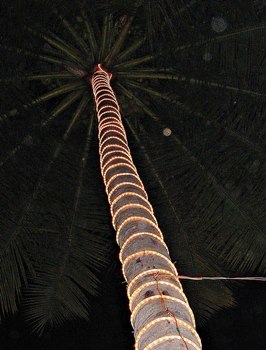
In 1994, I visited India for my first time. My wife and I were staying with my in-laws in Bangalore.  They were members of the Bangalore Club, one of the city’s prominent social clubs. Every year, they liked to attend the Club’s New Year’s Party. In the 1990s, these parties were fairly modest affairs. Tables were set up under the stars on a large lawn around an open-air  circular dance floor. The tall trunks of the palm trees surrounding the lawn, were entwined with strings of tiny light bulbs. One of the trees would have the current year displayed with numbers outlined with tiny light bulbs. At midnight, these used to be switched off as soon as the illuminated figures displaying the new year were switched on.

There was dancing on the circular dance floor. A competition was held to find the best dancers of the evening. In the past, my in-laws used to carry away the prize year after year. After some years, the committee asked them to forego the prize so that others could win them. Even as octogenarians, my in-laws were superb dancers.

In the 1990s, the ‘happening’ place for New Year’s Eve parties in Bangalore was the KGA (Karnataka Golf Association). Nowadays, the Bangalore Club is deemed to be the place to be as the year passes through its final hours. The party is now noisier and far more crowded than it used to be when I first experienced it – not my ‘cup of tea’.

One year after my father-in-law had passed away, my wife and I spent the 31st of December at home with my widowed mother-in-law. We ordered a pizza from a well-known chain. When it arrived, it tasted alright although it had a musty odour. We decided not to, or could not manage to, stay awake until midnight. We fell asleep. At three o’clock in the morning our mobile ‘phone woke us. It was our daughter ringing to wish us a happy new year. I must admit that this was the most relaxing New Year’s Eve I can remember.

Some years earlier, in the 1980s, I celebrated New Year’s Eve with my friend Raša in Belgrade,  the capital of the former Yugoslavia. To see the New Year in, we went across the River Sava to a party in a large flat in New Belgrade.

Before we set off in a taxi, Raša warned me to keep away from windows and  balconies. You might wonder why. Many retired military men lived in New Belgrade. A lot of them possessed firearms. At midnight, they celebrated by firing these guns. People outside on balconies or close to windows sometimes got injured by ricocheting bullets. We were not affected. At about 1 am, we left the party and visited some friends who lived on the edge of Belgrade. There, we drank a great deal of alcohol. The rest of that New Year’s Day was lost in an alcoholic haze.

I hope that the end of this tragically troubled year, 2020, will be memorable in a pleasant way. Will we be raising our glasses to digital devices,  or will we be clinking them with those held by our friends and family, maybe with fully extended arms?


Decorated palm tree at the Bangalore Club

Birthday in Kosovo

K1 PROHOR PC 90 Church ext BLOG

MY BIRTHDAY IS on VE Day (8th of May). In 1990, I celebrated it in the former Yugoslavia. I was driving around Serbia in a rented car with my friend from Belgrade, Raša R. His birthday was the day following mine.

Before I rented the car, Raša, a vey wise fellow, advised me to rent a car from one particular company because its cars carried Slovenian registration plates, rather than Serbian. This  proved to be sound advice.

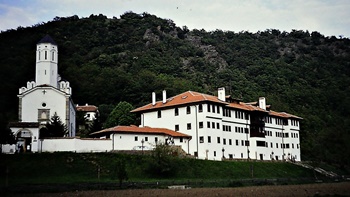
On the seventh of May, we booked into the comfortable accommodation provided at the beautiful Prohor Pčinjski monastery in the hills of southern Serbia. We decided to stay there two nights in order to celebrate our birthdays.

My birthday wish was to drive into the autonomous region of Kosovo and Metohija, which was populated by a high percentage of Albanians. And, then as now, I was greatly interested in all matters connected with Albania and the Albanian diaspora. Both Raša and I had separately visited the area in the 1970s. We were both keen to see it again.

Raša, a Serbian, had some reservations about driving into Kosovo, where there had been some unpleasant violent incidents between the Serbian and Albanian communities some months earlier. However, he decided that he would accompany me for two reasons. One was that our car bore Slovenian plates, not Serbian. The other related to his excellent command of the English language. He said he would only speak in English in Kosovo, not a word of Serbian.

We set off, driving through the relatively empty Serbian countryside. The boundary of Serbia and Kosovo was at the summit of a low mountain pass. As soon as we entered Kosovo,  we discovered that, unlike the part of Serbia we had just left, the countryside of Kosovo was relatively crowded with people, by the road side and in the fields. The landscape was liberally dotted with recently constructed homes and other buildings. This was quite different from what we recalled of our earlier visits.

We drove into Priština (Prishtinë), the capital city of the autonomous region. The main road was filled with a sea of people. We inched forward. The crowds parted slowly to allow us to proceed. Raša advised, nay forbade, me to sound the car’s horn. He did not want to upset anyone. I had never before driven through such crowds. Four years later, I did it again, but in the central market area of Bangalore in India. There, I and other motorists sound horns incessantly, but nobody pays the slightest notice to them.

We parked in the centre of the city in a car park that looked like it was the site of a large demolished building.

I was keen to buy recordings of Kosovan Albanian music for my ever growing collection of music from all over Yugoslavia.  The best supplier turned out to be a kiosk that sold cigarettes, magazines,  and newspapers. I bought about fifteen cassettes, the kiosk’s entire stock, but had no bag to carry my haul. The enterprising shop keeper saw my plight. He opened a couple of cartons that each contained twenty packs of cigarettes and emptied the packs onto his small counter. Then, he carefully packed my cassettes into the cartons.

After lunch in what seemed to be the grandest hotel in the city, we drove to see the beautiful Serbian Orthodox monastery at Gracanica.  Then we wended our way back towards Serbia, stopping for coffee at Gnjilane (Gjilan). There, I spotted a kebab shop that used a logo identical to the well-known McDonalds ‘M’. When I pointed this possible breach of ‘copyright’ to my friend, he shrugged his shoulders and said:

“This is Kosovo. Anything goes.”

We reached Prohor Pčinjski, where we ate a lavish and tasty dinner. The following day, Raša’s birthday trip was a drive through parts of Yugoslavian Macedonia. After passing some rice paddy fields, we were stopped by a policeman with a speed measuring device. He fined me the equivalent of £1 Sterling for speeding. My friend was fined half of that for not wearing a seatbelt. Otherwise, we had a good day, visiting an attractive small town, Kratovo, and the Roman ruins at Stobi on the River Vardar.

The following day, we drove back into Kosovo, stopping at the small town of Prizren. On both the 1990 and my 1975 visits, Prizren captured my heart more than any other place in Kosovo. Recently taken photographs I have seen show that it is still a delightful place.

From Prizren we drove to a dramatic pass that led from Kosovo into south eastern Montenegro.  We spent the night in Rozaje, a small Montenegrin market town. Thus ended a memorable double birthday celebration.

Soon after we visited Kosovo together, it was time for me to fly back to England. Raša accompanied me to Belgrade airport. Just before I entered the secure departure area, I waved to him and experienced a weird sensation. I felt that Raša knew that we would never meet again.

My sensation was not without basis. Soon after I left Yugoslavia,  the country began its painful dismemberment. Visiting my friends in Belgrade and elsewhere in Yugoslavia became inadvisable.  Sadly, by the time that uneasy peace began to reign again in what was once Yugoslavia, Raša had passed away.

VE Day marked the end of hostilities between the Axis and Allied powers in Europe on the day that was to become my birthday a few years later. The imposition of socialist regimes in Central and Eastern Europe that followed  did not put an end to festering sores that had been troubling the Balkans and elsewhere since the decline of the Ottoman and Austro Hungarian empires, which had already begun at the beginning of the twentieth century.  This was certainly the case in what was Yugoslavia. During the ‘reign’ of Marshal Tito, a semblance of unity was achieved in his country. However, after his death, as if recovering from a general anaesthetic, old unresolved conflicts reawakened. President Milošević did little to resolve these, but instead helped to exacerbate hem. Hailed by some Yugoslavs, mostly Serbs, as the new hero of Yugoslavia, this assessment was not shared by many, especially the Albanian folk in Kosovo.

For all the opprobrium that was heaped on Serbia during the 1990s, I cannot forget the warmth, hospitality, and friendship shown to me by ordinary people living in Yugoslavia, Serbians, Croatians, Bosnians, Albanians, and many others during the 1970s and 1980s. They did not deserve what befell them during the 1990s and much of the 20th century.

You can read more about travelling in the former Yugoslavia in “SCRABBLE WITH SLIVOVITZ” by Adam Yamey. This illustrated book is available from:

Amazon

Bookdepository.com

Lulu.com

Kindle

Photo shows Prohor Pčinjski monastery

New End new beginning

HAMPS 23 Former New End Hospital BLOG


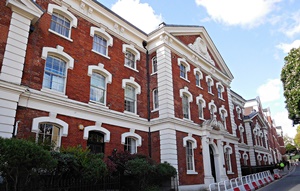
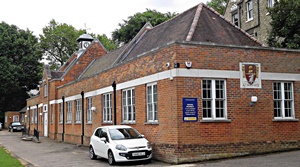
NEW END HOSPITAL in Hampstead village closed in 1986 and converted into luxury flats. It was opened in 1869 as a workhouse for impoverished folk and in 1931 it became a hospital specialising in endocrine diseases. In that year, a clinic devoted to treating thyroid disorders was established.

On Tuesday afternoons during the years 1968-1970, when I was preparing for university entrance examinations, I helped out in the thyroid department laboratories at New End Hospital.

The labs occupied the dank basement under the Victorian hospital. The outfit was directed by a formidably bright lady scientist. She was assisted by a small friendly team of scientists and technicians.

The first task assigned to me was to make the afternoon tea. I had never made tea before without using a tea bag and with the addition of milk (at home we drank tea without milk). What I served was universally abhorred. That first afternoon, I was given a lesson of how to prepare tea ‘properly’.

The lab I worked in was dedicated to diagnosing and treating thyroid patients with radioactive isotopes of Iodine. Patients were given radioactive iodine to ingest in the ward. Then, they were brought to what looked like a dental chair in our basement. A technician applied a Geiger counter probe to different parts of the patient’s body to determine the distribution of the iodine. From this, diagnostic information could be derived. Today, this manual technique has been replaced with automatic electronic body scanners.

After scanning, the by now radioactive patients were sent back to the ward. There, they waited for their radioactivity levels to drop to safe values or to await further administration of the isotope for therapeutic reasons. In both cases, these patients had to wait until they were no longer emitting harmful rays.

To assess the levels of radioactivity in the patients’ bodies, their urine was collected regularly and stored in brown glass Winchester bottles. These were brought down to be stored in the basement. Each bottle was regularly inserted into a lead covered cylindrical container containing Geiger counters. Apart from white lab coats, we wore no other protective garments.  Often, I helped with this activity. Thinking back, I doubt modern Health and Safety would have sanctioned our working practices in that basement.

At school, I was learning computer programming, and enjoying it. We learnt the principles of programming and how to use them in the recently designed Basic computer language. When the thyroid laboratory bought a programmable desktop Olivetti calculating/computing machine, I was the first person in the lab who knew how to make it work, to programme it.

The lab needed to communicate with the matron in charge of the thyroid ward, but everyone feared her. So, whenever possible if the lab needed to send something to her, they waited for me to arrive on Tuesday afternoons. By some kind of luck, the terrifying matron treated me kindly. I found her to be agreeable but realised that she needed to be treated with ‘kid gloves’.

My experiences at the laboratory under New End Hospital were both fascinating and enjoyable. They were also influential because they instilled in me an interest in physiology, and particularly endocrinology. I am certain that had it not been for those Tuesday afternoons at New End, I might not have gone on to making a new beginning at University College London, studying physiology.


Picture shows the former New End Hospital

Dig weed

GATE 3e Old Highgate School changing rooms BLOG

HIGHGATE SCHOOL IN north London, like many other public (i.e. private) schools in the UK and far fewer state schools, operated (and might still do so) a Combined Cadet Force (CCF). The CCF was designed to provide military training to teenage schoolboys. It provided military experience that would allow its members, if they joined the forces, to advance up the ranks faster than young people who were recruited without this training. It helped give public school boys an earlier chance of commanding their fellow soldiers than those who had not been privileged to attend expensive private schools.

Highgate School had a well equipped CCF. There was an armoury, a drill hall, an assault course, and at least one member of staff dedicated to running the CCF. During the period I attended the school,1965 to 1970, many of our teachers had served in the armed forces during WW2. Some of them were involved with the school’s CCF.

Fortunately for me, participation in the CCF became voluntary instead of compulsory when I reached the age for joining it. I would have hated the discipline, the polishing of belts and boots, the physical activities, and wearing the uniforms made of scratchy materials.

The CCF training took place on Tuesday afternoons. When it ceased to be compulsory, the school decided that those who did not volunteer should spend Tuesday afternoons doing some kind of useful social work

I was first assigned to gardening duty, known as ‘digweed’. Along with another boy, we spent Tuesday afternoons in the garden of one of the boarding houses. Our mission was to clear the weeds from flower beds. Neither my companion nor I could distinguish a weed from a flower. The sight of the house master’s wife bringing us cups of milky tea and biscuits always marked the end of a pointless afternoon, which left the garden in a worse condition that when we arrived.

After a while, I was transferred to visiting the inmates of a local old age home, what is now called a ‘care home’. My task was to chat and cheer up the inmates sitting in high backed padded chairs around the walls of the large sitting room.

In my teens, I was not the chattiest of people. And, all o the elderly inmates except one, were either incapable or uninterested in responding to my attempts to engage them in conversation. The exception was a feisty lady, who was very talkative. The only problem was that she was not there every week. She told me that whenever she was able, she escaped from the home and enjoyed herself until the police brought her back.

One afternoon, I rang the doorbell of the home. When the doors were opened, but only a little, I caught a glimpse of a coffin standing on a trolley in the dimly lit hallway. The matron told me that it would be best that I came back the following week. I had a free afternoon that day.

At some point the school decided that those who did not join the CCF should become members of the newly formed Basic Unit. Instead of wearing miltary uniforms we wore track suits. We spent time ‘square bashing’ or military style drill. I was hopeless at this, turning left when I was supposed to be turning the other way, and not moving in time with the other members of the unit.

One day during Basic Unit, we had to attempt the school’s military assault course. At one place on this, we had to scramble up two metal pipes to reach the flat roof of a seven foot high concrete block house and then to jump off it. I reached the roof, but refused to jump down. I remained up there until the other hundred or so boys had completed the course and were in position for some more drill before the afternoon ended. In desperation, the supervising teachers pleaded with me to jump down otherwise nobody else would be allowed to go home. I told them that did not bother me nor would I jump down. In the end, I was helped down so that the session could be brought to an end.

The best and most enjoyable Tuesday afternoon activity I did was during my last two years at Highgate. I worked as an assistant at the now long since closed New End Hospital in Hampstead. But, more about that another time!

Picture shows the concrete area where the Basic Unit trained

Saturday night feeder

BRUGES 65 BLOG

MY LATE MOTHER trained at the Michaelis Art School in Cape Town. She became a commercial artist. After she married my father in London in early 1948, she became a more creative artist, a painter and then a sculptor. Her interest in art was shared by my father, who became deeply interested in the history of art. Most of our family holidays were connected with my parents’ enthusiasm for art both old and new. I used to be quite envious of my friends whose parents took them to the seaside, but now that I am older I appreciate the special nature of our family holidays.

One of the places my parents enjoyed visiting was Bruges (Brugge) in Belgium.  We used to stay in the city’s Hotel Portinari. Once every visit, we did something that I found more enjoyable than visiting churches and museums. We took a boat ride along the city’s canals. These tours involved travelling in a small low boat powered by an outboard motor. The most exciting part of this voyage was when we passed beneath a particularly low road bridge. The tour guide would tell us all to duck our heads. My mother, who saw danger around every corner, always  emphasised how important it was to lower our heads as much as possible to avoid them being smashed to a pulp by the metal struts under which we were passing. In retrospect, considering the potential for experiencing this awful injury (possibly leading to death), I am amazed that my mother sanctioned these boat trips every time we visited Bruges.

My mother passed away, I married and in 1995 our daughter was born. Six weeks after her birth, we crossed the English Channel and we took our daughter with us. We were driving to Rotterdam in Holland to meet my wife’s parents, who were disembarking there after a cruise on the River Rhine.

We wanted to spend a night in Bruges on our way to Holland, but were unable to find accommodation in a hotel that we could afford. Instead, we booked a hotel at nearby Damme, which was said to be picturesque.

We arrived at our hotel in Damme on a Saturday afternoon. I remember that we had trouble getting hot water to flow in our shower. However much the hot tap was turned, the water remained icy cold. The problem was solved when a member of the hotel staff explained that the taps had been labelled wrongly: hot water flowed when the cold tap was opened.

 In the evening, the three of us went to a restaurant in Damme. The dining room was a long rectangle in plan. A long central ‘aisle’ ran between two lines of tables. Each table was occupied by late middle-aged couples sitting  with their backs to the walls and facing the diners seated opposite them across the aisle. Not one of these people looked as if they were enjoying their night out, or even being alive. They were a miserable looking bunch.

We were shown to the one remaining empty table. Within minutes of sitting down, our daughter decided that she needed a drink, not of Belgian beer but something that only wife could supply.

My wife asked the maitre d’hôtel whether there was somewhere that she could breastfeed our daughter discreetly. He pointed at a door. My wife stood up and walked towards it. Before she reached it, the hitherto seemingly moribund diners sprang to life. They told us that they did not mind if our daughter suckled in the dining room. They did not want mother and child to be exiled, or even self-exiled.

For the rest of the evening, our fellow diners remained animated, exclaiming how sweet our daughter was and offering much advice. Our arrival and our daughter, in particular, had made that Saturday evening a huge success for these ageing members of Damme’s  bourgeoisie.


Picture of the Minnewater in Bruges, taken in the early 1960s