A working men’s club with an unusual name

HASTINGS IN EAST SUSSEX has long had a thriving fishing fleet. It is the largest beach-launched fleet in Europe. Unlike many other fishing ports where the boats are moored in harbours, those at Hastings are moored along the town’s shingle beach when they are at rest. This is part of the beach where in 1066, William the Conqueror famously set foot on English soil.

In 1900, a group of Hastings fishermen met in the (now non-existent) Prince Albert pub – a popular meeting place for these men. The members of the group discussed the idea of raising money to give the poor children of the borough a happy time at Christmas. At that time, regulars of another Hastings pub, the Royal Oak, formed a charitable organisation called the Acorn Club. A website (https://winkleclub.org/early-times/) revealed:

“Apparently at that time in another Hastings pub, the Royal Oak, an Acorn Club had been formed. All members had always to carry acorns, failure to do so involving a fine, all such money being devoted to charity. The fishermen decided to organise an effort on the same lines but one of them … said: `Why an acorn? This is the Old Town; can’t we have something to do with fishing?’ Just then, so the story goes, Providence took a hand. Somebody appeared with a pail of winkles collected from the rocks. Inspiration! Let’s make it the Hastings Winkle Club.”

Thus, the Winkle Club of Hastings was ‘born’.

Members of the Winkle Club must carry a winkle shell at all times. When challenged by a member with the words “Winkle up”, the challenged member must produce his winkle shell and show it to the challenger. For, if they are discovered without their winkle, they are fined. Originally, the fine was one (old) penny, now it is £1. If the person who discovered a member without a winkle did not report him, he would also be fined. All the fines are donated to raise money to achieve the club’s objectives.

In the past, the Winkle Club raised money for poor children as already mentioned. Now, the club raises money for local good causes. Over the years, the Club has included some famous members, who were not fishermen. These include Winston Churchill, the Duke of Windsor, and Lord Montgomery of Alamein.

Close to The Stade, the part of Hastings where the fishing boats are moored, there is a traffic island known as Winkle Island. It is used for various local festivals and is the symbolic meeting place for members of the Winkle Club. A huge sculpture of a winkle shell (see photograph above) stands on Winkle Island. It serves as a public collecting box for the charity. Seeing this marine sculpture is what aroused my interest in this thoroughly worthy charitable organisation.

Mahatma on Madeira

UNTIL AIR TRAVEL really ‘took off’, travelling between South Africa and London involved a long sea voyage, either via the Suez Canal or via the Atlantic Ocean. Boats carrying passengers up and down the Atlantic often called in at Funchal in Madeira. Aged three, I travelled with my parents to South Africa by sea. I have seen a photograph of me dressed in a toga made from a sheet from our cabin. I was taking part in a fancy dress party to celebrate crossing the Equator.

Many years before that – in 1906 – a barrister, Mohandas Karamchand Gandhi, travelled by ship from London to South Africa. He was on his way back to South Africa, having petitioned young Winston Churchill, then Under Secretary of State for the Colonies, against the Black Act – a law promoting racial segregation. Apparently, when his ship docked in Funchal, the future Mahatma received news that his efforts had been successful, but this news turned out to be false.

On the 5th of September 2019, a bust of Gandhi was unveiled on the seafront in Funchal, close to the harbour where liners dock today. The bust, which unusually shows Gandhi without his characteristic round lens spectacles, was sculpted by Ram Vanaji Sutar (born 1925 in Gondur, Maharashtra). Sutar is also the sculptor of the massive Statue of Unity, depicting Sardar Vallabhai Patel in Gujarat. Beneath the bust there is a quotation incorrectly attributed to Gandhi; it was actually said or written by the Dutch American pacifist AJ Muste (1885-1967). The artwork was unveiled by HE Miguel Albuquerque, President of the Regional Government of Madeira and HE Nandini Singla, Ambassador of India to Portugal. It celebrates the 150th anniversary of Gandhi’s birth.

I am grateful to our friend Claus for telling us about the bust, which is not easily visible despite its position so near the waterfront: it is partially hidden by plants.

Over the years, I have visited Porbandar where the Mahatma was born; Rajkot where he went to school; Bhavnagar where he went to college; West Kensington where he lodged when studying for the Bar; Mumbai where he attempted to work as a lawyer; and the Gujarat Club in Ahmedabad where he first met Vallabhai Patel, and also set up his ashrams. So seeing him on Funchal has added to my attempts to follow in his footsteps.

In search of WC on Madeira

IN JANUARY 1950, the famous writer, painter, and politician, Winston Spencer Churchill (‘WC’) paid a short visit to the island of Madeira with his wife and his eldest daughter. They were accompanied by various British officials.

WC arrived on the island by sea, and stayed in the luxurious Reid’s Hotel in Funchal, which continues to flourish today. He left by seaplane a few days later to attend to affairs connected with an upcoming election in the UK.

While we were visiting the excellent photographic museum in central Funchal, we saw some photographs of Churchill, which were taken during his excursion to the picturesque fishing port of Camara de Lobos, which is a few miles west of Funchal. The photographs show WC painting a picture of the lovely bay surrounded by serried rows of houses. I have yet to see the picture, which I hope still exists.

We took a local bus to Camara de Lobos and disembarked close to a small bar named after WC. This is located close to a terrace overlooking the bay and its fishing boats. It was from here that he painted. A monument records this episode.

In 2019, a new hotel opened, the Churchill Bay. Outside its entrance, there is a sculpture depicting WC with cigar held between his lips. He is shown seated at an easel. Within the hotel’s lounge and bar, there is a fascinating collection of Churchilliana – photographs; letters signed by WC; a portrait by Felix Topolski; and contemporary artworks relating to WC.

Whether or not you are a fan of the Great WC, Camara de Lobos deserves a visit. Although there are plenty of tourists there, it manages to retain the feeling of a traditional fishing village.

Winston Churchill and a newspaper reading stand

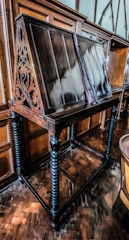
THERE IS A LOVELY old wooden newspaper reading stand is located in the formerly men only bar in the Bangalore Club. It bears the insignia “US” at one end, the S being back to front. Before about 1947, the club was the United Services Club.

Winston Churchill, who was never too fond of India, was briefly a member of the Club (in the late 1890s) , and incurred a small, but never paid debt there. I wonder whether the reading stand is old enough to have been used by Churchill.

Not my cup of tea

BEFORE REACHING MADEIRA, many people insisted that we should visit Reid’s Hotel in Funchal and to take afternoon tea there.

Pool at Reid’s Hotel in Madeira

Located in the western part of Funchal,  Reid’s was founded by William Reid, a Scotsman who arrived in Madeira in 1836. The hotel was his idea but he died before it was completed (in 1891). The massive seafront establishment was designed by George Somers Clarke and John Thomas Micklethwaite. It is not great architecture.

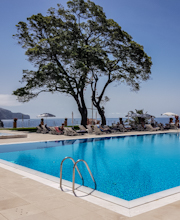
Since its opening, the hotel has hosted many famous guests including Winston Churchill,  Albert Schweitzer, George Bernard Shaw, and Rainer Maria Rilke. Apart from its celebrated guests, the establishment is famed for its afternoon teas. We decided against partaking of this treat because it contains far too many sugary confections. We had morning coffee and a pot of tea by the swimming pools on a terrace overlooking the ocean. By Funchal standards, it was costly (10 euros) but not outrageously so.

Undoubtedly, Reid’s is luxurious with good service. Its position overlooking a rocky cove is superb even though it is located in a part of Funchal, which resembles unexciting slightly upmarket seaside resorts on Italy’s Adriatic coast. However, the well-appointed hotel seemed somewhat sterile. If sun and sea is your top priority, then Reid’s is the place to go if you can afford it. However, it lacks the charm of other places in Funchal.

Well, we did visit Reid’s as people had suggested before we left London but I must say that it is not my ‘cup of tea’.

Up and down Molesworth Street

YOU CAN BYPASS the small town of Wadebridge in Cornwall by speeding along the A39 road, which extends from Bath in Somerset to Falmouth in Cornwall, but that would be a pity because it is a charming town. Wadebridge thrives because of its fine bridge across the River Camel. The great writer Daniel Defoe (c1660-1731) wrote about the town and nearby Padstow in his “A Tour Through the Whole Island of Great Britain”, published 1724-26, as follows:

“Padstow is a large town, and stands on a very good harbour for such shipping as use that coast, that is to say, for the Irish trade. The harbour is the mouth of the river Camel or Camal, which rising at Camelford, runs down by Bodmyn to Wodbridge or Wardbridge [sic], a large stone bridge of eight arches, or thereabouts, built by the general goodwill of the country gentlemen; the passage of the river there, before, being very dangerous, and having been the loss of some lives, as well as goods…”

Defoe noted that the passage from Wadebridge to Ireland via Padstow could be achieved in 24 hours. Thus, Wadebridge and its river crossing, now much widened since Defoe’s time, was an important stage for vehicles carrying passengers and goods between England and Ireland. The route for this transport would have been to first cross over the Camel on the bridge and then to proceed north westwards up the slope of Wadebridge’s then main thoroughfare, Molesworth Street. During daylight hours, most of this road is closed to motorised vehicles and provides a pleasant pedestrian precinct.

Molesworth Street is lined with shops, eateries, and some pubs. The Molesworth Arms, a former coaching inn, has existed since the 16th century. It was previously known by other names including The Fox, The King’s Arms and The Fountain. It got its present name in 1817. Nearer the bridge, there is The Swan Hotel near the old bridge, originally named ‘The Commercial’, is much newer than the Molesworth Arms. It was constructed the late 19th century.

I cannot explain why, but spending time on Molesworth Street always satisfies me. The recently opened (late 2021) Dollies café provides good coffee and exceptionally wonderful English breakfast items; everything is prepared freshly after ordering. Up the hill, stands Churchill Bars. Housed in the premises of the still functioning Wadebridge Conservative Club, it comprises a bar and a small restaurant named Winston’s. Popular with locals, this eatery serves generous helpings of lovingly prepared, tasty food. Its speciality, which is well worth trying, is roast belly pork served with roast potatoes, gravy, and vegetables (not overcooked). Unlike so many other places serving food in Cornwall, this place is good value and not pretentious.

Apart from several charity shops, a good newsagent, two butcher’s shops, a hardware store, banks, and so on, there is a small bookshop on Molesworth Street. This independent bookstore stocks a superb range of Cornwall-related books, both fiction and non-fiction. In a backroom, there is a large selection of second-hand books. Small booksellers such as this one on Molesworth Street make a welcome change from the countrywide bookshops such as Daunt’s, Waterstone’s, and WH Smiith’s.

Not as ‘trendy. as places such as Fowey, Falmouth, St Ives, and Padstow, Wadebridge seems a more ‘normal’ or ‘real’ kind of place, not wholly dependent on tourism. It is well placed to make excursions to places all over the county of Cornwall.

Churchill owned this village

YOU CAN NEVER PREDICT how much traffic you will encounter on the roads in and near London. So, we always allow extra time when making a trip, and often we arrive earlier than we had planned. Such was the case yesterday when we had arranged to meet some friends for a walk in Heartwood Forest, which is close to the village of Sandridge in Hertfordshire. We reached our destination about an hour too early and stopped in Sandridge to get a warm drink and to take a look around. What little remains of old Sandridge is attractive and is worth a visit despite its description in “Hertfordshire, a Shell Guide” by RM Healey:

“Subtopian clutter in a village that has ribboned out to join St Albans.”

We bought coffee in the well-stocked small village shop and heard its owner saying:

“I am still in business despite being surrounded by three Tesco Express supermarkets.”

Now, here is a strange coincidence. After dinner, when I had finally warmed up after our excessively chilled walk in Heartwood Forest, I settled down to continue reading the wonderful biography of John Churchill (1650-1722), the First Duke of Marlborough, by Richard Holmes, and read on page 110:

“On 14 May that year John Churchill was created Baron Churchill of Sandridge in Hertfordshire …”

The year was 1685. Well, I was staggered to read the name of the village, of whose existence I had not previously been aware and which we had just visited by chance earlier that day. I reached for my Shell Guide to Hertfordshire but found no mention of Churchill in the section about Sandridge. Somewhat surprised by this omission, I looked up ‘Sandridge’ in James Thorne’s “Handbook to The Environs of London”, published in 1876. Thorne revealed something about Churchill’s connection with Sandridge.

The manor of Sandridge was given to Sir Ralph Rowlett (before 1513-1571; see: http://www.historyofparliamentonline.org/volume/1509-1558/member/rowlett-sir-ralph-1513-71) of Holywell House (St Albans, Hertfordshire), Member of Parliament for Hertfordshire and Master of the Mint of England (in1543), by Henry VII in 1540.  When Sir Ralph, who had no heirs, died, it was passed on to his sister Elizabeth, the wife of Ralph Jennings (aka ‘Jenyns’; 1529-1572; http://www.wikitree.com/wiki/Jenyns-10). Sir Ralph died in Churchill, Somerset. The Jennings family kept the manor for several generations. When Richard Jennings (c1619-1668) died, he left the manor to his three daughters, Barbara, Frances, and Sarah (1660-1744; the youngest). Sarah was probably born in Water End House, which was built by her grandfather John Jennings (Jenyns) and which I have described elsewhere (https://adam-yamey-writes.com/2020/07/23/why-go-abroad/).

In 1677 or ’78, John Churchill, then a colonel, married Richard’s daughter Sarah Jennings. Then, he purchased the other sisters’ shares in the manor of Sandridge so that he owned the whole property. This permitted him to gain his first aristocratic title, that of ‘Baron Churchill of Sandridge’. As a baron, he was able to sit in the House of Lords. However, his attempt to become an MP for his borough, St Albans, met with failure:

“Churchill acquired one moiety of the Jennings estate by marriage … He thus enjoyed the principal interest at St. Albans, and in 1685 the mayor announced his candidature for the borough. In the event, however, his brother George was elected, perhaps because James II had made known his intention to give him an English peerage.” (https://www.historyofparliamentonline.org/volume/1660-1690/member/churchill-john-ii-1650-1722).

On reflection, it seems a bit strange that we did not notice any obvious indication in Sandridge of the connection of the celebrated John Churchill, ancestor of Sir Winston Churchill, with the village in the manor he acquired.  Some months earlier we had visited the village of East Knoyle (in Wiltshire), where the architect Christopher Wren was born in 1632. Despite the fact that Christopher left the village with his family when he was only three years old, visitors to East Knoyle are left in no doubt about its famous connection.

What remains of old Sandridge is attractive, even in the appalling weather conditions that we endured whilst walking around it. The village’s name is derived from ‘Saundruage’ meaning a place of sandy soil worked by bond tenants (i.e., feudal tenants completely subject to a lord or manor to whom they paid dues and services in return for land). The earliest written record of the place is in a document dated 796 AD.

The most fascinating building in the village is the Church of St Leonards. Although its exterior looks in great condition, it contains some structural elements that were put in place in the 10th century. These include Roman bricks found at sites near and in St Albans (Roman ‘Verulamium’). The church was consecrated as ‘St Leonards’ by 1119. Later, the church experienced modifications and enlargements.  Sadly, but predictably during this time of pandemic, the church was locked. So, we will have to make another visit to see this interesting building when things ease up. Likewise, the picturesque Queen’s Head pub next to the church was also closed, except for take-away meals.

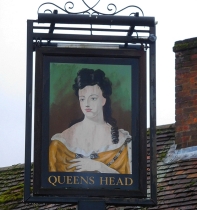
The Queens Head was built in the 17th century and, maybe, earlier, but has had much later work done to it (https://historicengland.org.uk/listing/the-list/list-entry/1102874).  The pub sign has the portrait of a woman’s head. The lady depicted has long black hair and is wearing a garment that exposes her neck and upper chest but not her cleavage. One long ringlet of her hair, which ends in a helical coil, is draped over the front of her left shoulder, and her face is looking slightly towards her right. The portrayal on the pub sign resembles that of Queen Anne (reigned 1702-1714) found in many better painted pictures.  This might not be accidental on a pub that existed long before Anne was on the throne. For, Lady Sarah Churchill, John’s wife, was a court favourite of Queen Anne. Incidentally, it is one of three pubs in this tiny village.

Once again, a short stop in a small English village has been most rewarding both from the aesthetic viewpoint and also because it has caused me to learn yet more detail about the fascinating history of the country where I live. I am grateful to our friends in Hatfield for giving us an excuse to discover Sandridge, a place so close to London but until yesterday, not on our ‘radar’.

Double vision and Blenheim Palace

WITHOUT DOUBT, Blenheim Palace (at Woodstock in Oxfordshire) is both impressive and grandiose. Built in the first decades of the 18th century, the Palace was designed by the dramatist and untrained architect John Vanbrugh (c1664-1726) in collaboration with Nicholas Hawksmoor (c1661-1736), who was a trained architect. The result, though magnificent in a monumental way, lacks the fine aesthetics and delicacy of, say, the Palais de Versailles or the Palazzo Pitti. The interiors of Blenheim Palace outshine the building’s rather charmless monumental exterior. That said, a visit to this palace is a must.

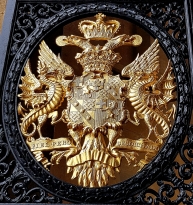
My interest in Blenheim Palace was immediately enhanced when, on arriving, I noticed the coats-of-arms adorning the gates to the visitors’ entrance. I was struck not only by their complexity but also by the presence of the two heads of a double-headed eagle (‘DHE’) prominently peering out of the coronet above the shield on the crest. Although over the years I have casually researched the distribution of the use of the DHE, I had not realised that it also appeared on the crest of the family of which the late Sir Winston Churchill (1874-1965) was a member, and whose life is greatly celebrated at Blenheim Palace and its gift shop. Sir Winston, who was born in Blenheim Palace, was also briefly a member of the Bangalore United Services Club, now the Bangalore Club, of which I am a member.

Getting back to the DHE, which, incidentally, is the symbol of the Indian state of Karnataka in which Bangalore is located, I was curious as to why the Churchill family has it incorporated into its coat-of-arms. Wherever you look on the inside or the outside of Blenheim Palace, you can spot the DHE. It is on external walls, internal furnishings, wall decorations, and even embossed on leather book covers. But why? I asked an official wearing a facemask and transparent plastic visor about it. She explained that it was because of one of the military exploits of John Churchill, 1st Duke of Marlborough (1650-1722), for whom the construction of Blenheim Palace was commissioned. John Churchill was a son of Sir Winston Churchill (1620-1688) and an ancestor of Sir Winston, the 20th century Prime Minister.

Without going into much detail, John Churchill was an important commander in the Battle of Blenheim (in Germany; 13th of August 1704), during which the armies of the Elector of Bavaria and of Marshal Tallard were defeated. This victory during The Spanish War of Succession helped to save the Holy Roman Empire (including Austria and Prussia) from defeat by the armies of Bavaria and France.  For this and other important military assistance, John Churchill was made a prince of The Holy Roman Empire by the Emperor Leopold I (1640-1705). It was because of this, that the DHE can now be found on the arms of the Churchill family.

Another DHE also found its way into the Churchill family by marriage. There is a portrait of Francis, 2nd Earl of Godolphin (1678-1766) by Sir Godfrey Kneller (1646-1723) hanging in Blenheim Palace. Son of Sidney Godolphin (1645-1712), the first Earl of Godolphin, Francis married Henrietta Churchill, 2nd Duchess of Marlborough (1681-1733), a daughter of John Churchill, the hero at the Battle of Blenheim. The Godolphin family were based in Cornwall. Their coat-of-arms contains the DHE. Unlike the Churchills’ use of the DHE, the Godolphin family had been using it heraldically (possibly, much) before the 18th century (www.british-history.ac.uk/magna-britannia/vol3/lxxviii-lxxxix). I do not know for sure but speculate that the DHE that appears in Cornish family crests, like those of the Godolphin and Killigrew families, might have some connection to the fact that for a while Duke Richard of Cornwall (1209-1272), second son of King John of England, was King of the Germans. He was holding that exalted position whilst he was a candidate for becoming the Holy Roman Emperor (he never did achieve that). So much for eagles with two heads and a total of four eyes. Now, I will remark on an exhibition held at Blenheim Palace that makes the viewer look at two disparate sets of images with only one set of eyes.

Blenheim Palace regularly hosts exhibitions of artworks by ‘modern’ or ‘contemporary’ artists. The curators juxtapose the recently created art with the fantastic collection of much older pieces that adorn the rooms of the palace. We had come to see the works of the British artist Cecily Brown, who was born in London in 1969. I must admit that I had never heard of her until our daughter, an accomplished young art historian, said that she was keen to see Brown’s works being exhibited in Blenheim Palace. Cecily Brown, so I have learned, specialises in producing paintings that both reinterpret older artworks and also remind the viewer of the appearances of the originals.

Having spent some time studying the palace and its artworks, Cecily Brown created several (about 25) paintings that in her mind echo what she experienced while looking at them. The paintings and some of her sketchbooks were then arranged amongst the paintings and other objects that decorate the rooms of the palace. Was this a successful idea? My answer is both ‘yes’ and slightly more ‘no’.

The placing of her sketchbooks amongst delicate Meissen and other precious works made of porcelain was highly effective. The placing of her paintings beside paintings of established great masters of European painting was less successful for several reasons. Her paintings are fine examples of semi-abstract modern art, pleasing to the eye and capable of intriguing the viewer. Seen against the plain white walls of a commercial gallery, they would be very impressive.

However, problems begin to arise when these works are placed in rooms full of paintings and other objects of great artistic value. For example, in the Red Drawing Room there is a large picture by Sir Joshua Reynolds (1723-1792) entitled “The 4th Duke of Marlborough and his family”, painted in 1777-78. This painting includes portraits of male and female family members. Cecily Brown has created her own interpretation of this, calling it “The Children of the Fourth Duke”. It is an impressionistic version of the original in which she has omitted the male figures that appear on the original painting by Reynolds. As a painting, Brown’s image is lovely and cannot be faulted. Placing her picture next to a work by the great Reynolds is both interesting and at the same time disappointing. It is interesting to see her interpretation but her painting pales into insignificance next to the original. That said, this is one of the most successful juxtapositions of Brown’s work in the whole exhibition; the others are less so.

There are two problems I have with the exhibition. First, I found that the placing of many, but not all, of Brown’s paintings distracted me and other visitors from seeing the older artworks that live permanently in the palace. Secondly, although it is brave of Brown to place her artistic creations besides those of long-established artists who have stood the test of time, I am not sure that is entirely wise because the average viewer, and that includes me, might find that her works pale in comparison with those of great masters.  Maybe, that is the case, but it has become popular to juxtapose contemporary art and far older works to stimulate the observer into new ways of looking and thinking. I cannot yet decide whether this is a good idea. To be fair, I can think of one successful exhibition where artworks of widely differing eras have been put together harmoniously, and that is in the Cartwright Gallery in Bradford (Yorkshire).

Just as the DHE can look in two directions, or maybe four, at the same time, the exhibition (and previous similar shows) at Blenheim Palace force us to look simultaneously at at least two eras of artistic endeavour separated by time – a kind of double vision, you might say. 

Clive in India

I AM NOW IN CALCUTTA. Last time I came here, for miles and miles along the railway lines and at stations, there were starving people. Now there is not a sign of famine – it has been organised with the ability of genius…” 

Thus, wrote Clive Branson (1907-1944) from Bengal on the 11th of November 1944. Later in the same letter, this British soldier in India added:

“… it is reported that in the week ending November 5th, 267 deaths occurred in Chandpur town and in the 53 unions (groups of villages), on an average more than 200 in each. The report states ‘Almost all the dead bodies were thrown into the ‘khal’ and paddy fields – to be devoured by dogs, jackals and vultures – as there was no man available to bury or burn those corpses.”

A few lines later, he adds:

The point is that out in the villages people can starve to death without anyone knowing about it, while on the basis of the falling mortality rate in Calcutta Amery will no doubt claim that the famine is over.”

‘Amery’ to whom Branson referred was Leo Amery (1873-1955), who was Secretary of State for India during WW2. The famine was that which decimated many Indians in Bengal and other parts of India.
clive

Writing on the 28th of August 1943, Branson suggested that the famine was to some large extent man-made rather than the result of natural disasters:

But the fact is there is enough food in India now …”

A major cause of the famine he suggested it was:

“… the hoarders, the big grain merchants, the landlords and the bureaucrats who have engineered the famine …”

And, on the 14th September 1943, Branson wrote:

The thing that stands out a mile is that the Government showed no signs of weakness when it came to the arrest of the Congress in glaring contrast  to its utter helplessness (??) (or should we call it co-operation, tie-up) in the face of the grain profiteers (and in a similar situation – the cloth merchants – the coalowners, re employment of women underground).”

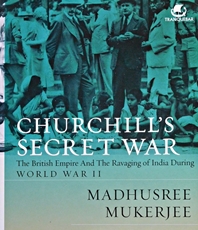
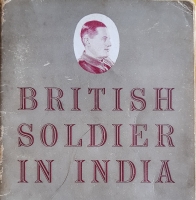
These quotes, damning indictments of the situation Clive Branson observed whilst serving in India come from a book, “British Soldier in India”. It contains the letters that Clive wrote from India to his wife in England and was published in 1944 by ‘The Communist Party, London’. The slender volume contains an introduction written by Harry Pollitt (1890-1960), who was General Secretary of The Communist Party of Great Britain from 1941 to 1956. I came across the book while reading an excellent book about the 1943 Bengal famine, “Churchill’s Secret War” by Madhusree Mukherjee, and ordered a copy.

Clive was born in Ahmednagar (India), son of an army officer. Ironically, most of his time in India during WW2 was spent in the town where he was born. He trained to be a painter at The Slade School of Art (part of University College London) and became a prolific and talented artist. Some of his works are housed in London’s Tate Gallery. From the age of 20, Clive became interested in Communism and joined the Communist Party in 1932. Pollitt wrote of him:

He was one of those who endear themselves to all who came in contact with them … he was able to inspire others to hate poverty and fight to remove it, to hate ugliness and see beauty … He was not only a brilliant speaker and organiser, but also did more than his share of what is sometimes called “the donkey work”. Nothing was too much for him …”

During the Spanish Civil War, Clive both recruited for, and from 1938 fought with, The International Brigade. In March 1938, he was taken prisoner by Franco’s Nationalist forces and interned in San Pedro de Cardeña concentration camp, where he painted and sketched the camp and many of its inmates. These artworks are currently stored in the Marx Memorial Library in London’s Clerkenwell Square. Pollitt reports that a fellow prisoner said of Clive:

In any difficult time, Clive was always cheery, putting forward what we should do … He was one of the most popular and most respected among the British prisoners.”

Clive, a true patriot and ardent anti-fascist, joined the Royal Armoured Corps during WW2 and was posted to India where he arrived in May 1942, the month that he sent his first letter published in the book. Pollitt accurately notes that Clive’s letters from India:

“… will make you angry and they will make you sad. They will make you see new colours and shades, an unimaginable suffering and a truly heroic grandeur, extraordinary nobility and equally extraordinary bestiality. It is a vivid and many-sided picture which Clive wanted to record in painting, and which we may be sure he would have executed with feeling and sincerity...”

Reading Clive’s letters today, 76 years after they were composed, still evoked a sense of anger because of the awful things he saw as well as a sense of wonder because of his very evident love and admiration of India and its people.

Whenever he was able, Clive mixed with Indians from all strata of society and delighted in their company.  While in Ahmednagar, Clive was introduced to an Indian artist. At this person’s house, he:

“… did a drawing for 1½ hours of his little niece aged 10. I did it in indelible pencil and ink – this is the medium I shall do most of my work in as it is more lasting – does not smudge – than ordinary pencil. But how difficult are Indian clothes – I shall have to do a lot of careful observation and drawing before I shall know what to do technically’ The Indian just sat and watched me working. He speaks English quite well, and knows a number of famous Indian painters – he himself went to the Bombay School of Art…”

This was noted in a letter dated 13th of April 1943. Several months later, in mid-September, Clive was invited to lunch with his artist friend. I loved his description of the occasion, which was new to him but typically Indian:

We sat on wooden seats about 2 ins. off the ground. The meal was in a room just off the kitchen. Of course we had taken off our boots etc. Each had a large silver plate with the various ingredients put around the edge. A small bowl of what they call butter-milk took the place of water. A pattern, done with vermilion and white powder had been drawn on the ground. In front of me was placed a little silver stand in which a stick of incense burned. Nana’s elder daughter also ate with us. The whole affair was very civilised and friendly.”

In general, Clive was enamoured of all of the Indians he encountered, both those from sophisticated and also humble backgrounds. He was horrified at the way that the British and their government treated them. This is a significant feature of what he conveyed in his letters. Also, the failure and apparent unwillingness of the British to address the terrible famine concerned and upset him greatly. He communicates this eloquently and powerfully in his writing.

One of Clive’s many observations struck a personal chord. It concerns the bookshops that Clive visited in India in search of reading material. In a letter written from Bombay in September 1942, he noted:

I have said a lot about going to bookshops, but I have never mentioned something which hits you in the face about the general trend of literature: 1. Hitler’s ‘Mein Kampf’ is on sale prominently at every bookstall …”

Seeing copies of “Mein Kampf” openly on sale in most bookshops in India is something that has always surprised me since my first visit to India in 1994.

As a Communist, Clive’s political views are not concealed in his letters. He showed little or no sympathy for the policies of Gandhi and the All India Congress. On the 10th of March 1943, he wrote:

How stupid Gandhi’s fast looks compared to the grandeur of a handful of Indian peasants and workers uniting to demand their human rights!  No wonder the Viceroy corresponds with Gandhi and sends the police after the people.”

As for the Muslim League in Bengal:

The net result of the League’s scheme is to launch the peasants against the little men and leave the big bastards to control the famine via the black market – such is the first practical application of the policy of Jinnah.” (letter dated 19th June 1943)

Also, as a staunch anti-fascist, he regarded Subhas Chandra Bose as contemptible because he had chosen to fight alongside the Japanese, who were allies of fascist Germany. During his stay in India, Clive met and discussed matters with members of the Indian Communist Party. This is described in the letters and was not removed by the censors. In addition, his harsh but justifiable criticism of Britain’s mishandling of the famine in India passed the censors’ scrutiny and reached his wife’s letter box intact.

Clive was constantly upset by seeing examples of British racism in India. He mentions this often in his letters. The most eloquent example appears in a letter written on the 29th of November 1943:

I am sitting on the grass outside a long army hut. Not far away is an African negro … reading a book. Five minutes ago a B.O.R. [British other rank] came up, stopped, and said to him, ‘Can you read?’ ‘Yes.’ ‘What’s the book? Miss Blandish?’ ‘No, Pygmalion.’ I had to record this – whole books could not present the present world situation better.”

(I imagine that the B.O.R. was referring to “ No Orchids for Miss Blandish”, a  raunchy thriller by James Hadley Chase)

In the same letter, Clive noted that the British Conservative MP, Ferris:

“… has made a study of Indian affairs, and has delivered himself of the profound judgement that India is not ready for self-government. I wonder how many whiskies and sodas it took to produce such an original conclusion.”

Sadly, Clive did not live long enough to see India becoming independent in 1947. He was killed in action early in 1944 “…commanding an M3 Lee tank of B Squadron, 25th Dragoons. He was hit a glancing but fatal blow on the back of the head by a Japanese anti-tank shell near Point 315 at the end of the Battle of the Admin Box.” (source: Wikipedia).

Clive’s letters provide a moving collection of well-described observations of India, a country in which many of its citizens were enduring a plight at least as bad as that of people suffering in Nazi occupied Europe. They were under the control of the British, who were fighting to defeat Nazi tyranny. The British were under the leadership of Winston Churchill, who is reported (by his close colleague Leo Amery) to have said:

I hate Indians. They are a beastly people with a beastly religion.”

Here are two short videos well worth watching in connection with what I have written:

https://youtu.be/QI6qg1ERmGE

(Pathé Newsreel with scenes of the famine. Commentary in Punjabi, but images are very powerful)

https://youtu.be/fUjtxHFGUrg

(An Indian historian/author/politician gives a fresh view of Churchill)



Facts, figures, and famine

blog churchill


THE BRITISH PRIME MINISTER, Mr Boris Johnson, appears to be strongly dependent on his chief adviser, Mr Dominic Cummings. Mr Johnson’s hero, the late Winston Churchill, was also very reliant on his chief advisor Professor Frederick Lindemann, First Viscount Cherwell (1886-1957), a scientist. Madushree Mukherjee, the author of “Churchill’s Secret War”, wrote:

“On most matters, Lindemann’s and Churchill’s opinions converged; and when they did not, the scientist worked ceaselessly to change his friend’s mind …”

Lindemann created the ‘S Branch’, a group of specialists whose role it was to report to Churchill after distilling “ …  thousands of sources of data into succinct charts and figures, so that the status of the nation’s food supplies (for example) could be instantly evaluated…” (Wikipedia).

Mukherjee noted:

“… the mission of the S branch was to provide rationales for whichever course the prime minister, as interpreted by the Prof, wished to follow.”

It would seem from this that Churchill pulled the strings, and even the great Lindemann was somewhat of a puppet. In contrast, it is difficult to say whether the puppet-master is our present prime minister or his chief adviser.

Two Commonwealth countries, Australia and New Zealand  erected large war memorials to their citizens near Hyde Park Corner and the gardens of Buckingham Palace. A more modest memorial complex, the Commonwealth Memorial Gates (inaugurated 2002), was put up to commemorate the great contribution that people from countries in the Indian subcontinent, the West Indies, and Africa made to defending the British Empire during the Second World War. An information panel informs the viewer that during the First World War, 1,440,500 men and women from the Indian subcontinent and Nepal “Volunteered for military service in the Indian Army”, and during WW2, “…over 2,500,00… “ men and women from the subcontinent fought for the forces of the British Empire. Between about 64,500 and 74,000 of the military personnel from the Indian subcontinent died in combat during WW1, and over 87,000 Indian (that is from pre-1947 ‘British India’) soldiers died during WW2. These figures are of necessity approximate and without doubt horrific. However, during WW2, the number of Indian citizens, who died of starvation in their own country during WW2 is far more difficult to know. The most reliable approximations give the number of Indians dying of starvation in Bengal during WW2 as being at least three million, that is about half the number of civilians who died because of Hitler’s demented racial theories.

The three million or most probably more Indians, who starved to death, lived mainly in Bengal. They did not perish by accident, as Madhusree Mukerjee explained in her book, which has been highly acclaimed. Unlike other famines in India caused by failures of harvest, what happened in Bengal in 1943 and ’44, the starvation of the Bengalis was probably largely man-made. And, as the book suggests using damning evidence that has come to light since WW2, two men who were most significant in its making were Churchill and his chief adviser Lindemann. 

Churchill was quite rightly focussed on winning the Second World War and at the same time preserving the integrity of the British Empire, which was being challenged by Indian nationalists throughout the two decades leading up to the outbreak of war and after the fighting began. For reasons I cannot explain Churchill did not like the Indian people. To give just one example, he is reported to have said of them in November 1942 that they were:

“… the beastliest people in the world next to the Germans.”

His adviser, the eugenicist Lindeman (Cherwell) was also no lover of the Indians. Mukerjee wrote in her book:

“Inferior as the British working class was in Cherwell’s view, he nonetheless ranked it far above the black and brown subjects in the colonies.”

Later, she wrote:

“All the evidence points to the prime minister and his closest adviser having believed that Indians were ordained to reside at the bottom of the social pyramid …”

Long after India had become independent, Lindemann described (according to Mukerjee who provides reference for this):

“… ‘the abdication of the white man’ as the worst calamity of the twentieth century – more deplorable than the two world wars and the Holocaust”.

The gist of Mukerjee’s book is that important amongst the reasons that the 1943 famine in Bengal was not relieved was that Churchill was not in favour of releiving it. The author wrote that although at times vital supplies and shipping were at critical levels, there were opportunities for famine relief supplies to be sent to Bengal. However, the British government under the leadership of Churchill came up with many excuses to avoid supplying famine relief.

I found the evidence provided in Mukerjee’s book to be reliably persuasive. However, there are many who would prefer not to hear anything but good of the man who helped Britain and its allies win WW2, Winston Churchill. For a defence of Churchill’s behaviour during the Bengal famine, I refer you to https://winstonchurchill.org/resources/in-the-media/churchill-in-the-news/bengali-famine/, an on-line article that tries to demolish an article by Gideon Polya with the title “Media Lying Over Churchill’s Crimes”, published in 2008 (see: https://sites.google.com/site/afghanistangenocideessays/media-lying-over-churchill-s-crimes). 

You can judge Churchill’s possible role in Bengal’s 1943 famine however you wis,  but see what Professor Amartya Sen, a former colleague of my father at the London School of Economics  said. Michael Portillo said to him in a BBC interview on the 14th of January 2008:

“What’s interesting about your description is that it doesn’t appear to rest upon a shortage of rice.”

Sen, who appears to be far more generous than Mukerjee about Churchill’s attitude to the famine, replied:

“No it wasn’t. I think I have to say the British Indian government was callous. I don’t think they were criminal but they were certainly extremely callous and didn’t really worry too much about it. And secondly they were badly misinformed. What had happened is that there was a considerable expansion of demand for food because of the war boom. And with the same supply they were having rising prices. So it wasn’t connected with food deficit at all.”

(https://sites.google.com/site/drgideonpolya/bengal-famine-broadcast).

Seeing the war memorials near Hyde Park Corner and a Holocaust memorial nearby in Hyde Park, and having recently finished reading Mukerjee’s book, inspired me to write this short piece in order to provoke interest in one of the horrible tragedies that happened during WW2, the Bengal Famine of 1943.

Mukerjee’s book presented me with one very superficial resemblance between Churchill and his admiring biographer Boris Johnson. Both had their devoted advisers. Although Churchill might not have done things to everybody’s satisfaction, he did play an extremely important role in suppressing the forces of evil that were threatening Britain and its allies during WW2. Let us hope that Boris will follow in Winston’s footsteps in our fight against another evil enemy, the Corona virus, and lead us to victory.