George Passmore (born 1942) and Gilbert Proesch (born 1943) – the artists Gilbert and George – are an item in more ways than one.
Gilbert and George met in 1967 while they were studying sculpture at London’s St Martins School of Art. A few years earlier, my mother made sculptures in the studios at that school, but as far as I know, never met the two men. They fell in love, live together, and later married officially. G and G create art together. The third thing that makes them an ‘item’ is that much of the art they create portrays themselves – always together. They are not only creators but also part of the art they create.
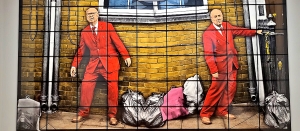
In much of this duo’s art, G and G depict themselves in various diverse situations. These colourful creations are simultaneously imaginative, weird, somewhat shocking, humorous, political, satirical, and mildly moralistic. Their art is the result of the duo’s reflections on contemporary life. In addition to large scale pictures in which they figure and describe as ‘sculptures’, G and G perform live acts which are effectively ‘live sculptures’. These performances that include acting and singing are usually recorded on film. Other works are videos in which the two men discuss their art and the nature of life and art in general.
On 1 April 2023, G and G opened their Gilbert & George Centre on Heneage Street – a small street leading off Brick Lane. This consists of a small outhouse in which visitors can view videos made by the duo. The main building contains three exhibition spaces, an office, and a gift shop. The Centre is dedicated to displaying works by Gilbert and George. The displays are changed every few months. The Centre has an informative website (https://gilbertandgeorgecentre.org/) , which summarised the work of G and G as follows:
“The inspiration and subject of the art of Gilbert & George is modern life. The life of Gilbert & George is art. Gilbert & George, with the viewer, explore and test their feelings in their art. Gilbert & George see the modern human condition. Acceleration, religion, politics, business, dullness, leisure, celebration, violence, money, history, poverty, age, sex, work, hope, newness, sickness, desire, intoxication, beauty, dereliction, love, despair; the radicalized world; the virtual world. They see the daily routines and feelings of their fellow citizens, from all backgrounds: the fast modern multi-cultural and multi- technological world. Office workers and junkies. They see the spectrum of human behaviour.
Gilbert & George observe the constantly changing life of our world the way one might observe the weather, or study the ceaseless current of a vast river.”
And this is a superb description of what G and G do. The results of their artistic endeavours might not be to everyone’s taste, but they are always interesting both visually and intellectually.
I always enjoy viewing this duo’s work, and visiting their centre in London’s Banglatown is a pleasure.


