Once a railway station in Kerala  but now a viewpoint for tourists

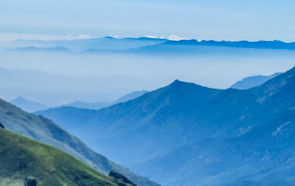
TOP STATION IS about 20 miles from Munnar (in Kerala) and 5500 feet above sea level.  Today, it is a popular tourist attraction, providing visitors with magnificent views of several ranges of hills. The place gets its name because it was the highest station on a railway that no longer exists.


View from Top Station

Between 1902 and 1908, a monorail system used for transporting locally harvested tea was built to connect Munnar with Top Station. In 1908, this was replaced by a narrow-gauge railway  the Kundala Valley Railway. Tea was transported to Top Station, where it was loaded onto a ropeway that carried it down 3 miles to a village, Kottagudi, in Tamil Nadu.  From there, it was transported to other parts of India. Sadly, the railway was washed away during a severe flood in 1924, and was never replaced.


Top Station was not only important as a railway Terminus, but also as a place on a road that was improved by the British  in 1942, when it was feared that Chennai, which had been bombed, might be invaded by the Japanese.


Following the bombing, which caused little damage, people fled from Chennai, the wealthy to hill station,  and the less well-known off to villages and towns far from the east coast. Meanwhile,  the British built what became known as the Escape Road, which ran across the high mountains between Kodaikanal and Munnar. This 50 mile road linked roads from Madras with roads from Munnar to Kochi (Cochin), from where troops could leave India if necessary.


The Escape Road, which reaches 8140 feet was the highest road in India South of the Himalayas.  The road remained in use until 1990. After this date, it fell into disused because neither Tamil Nadu nor Kerala were prepared to pay for its upkeep.


As a result of the closing of the former Escape Road,  travellers between Munnar and Kodaikanal have to travel on other roads. The present road route is 105 miles instead of  50 miles taken by the disused road.

  Top Station is well worth visiting. The views from over the precipice are amazing. To see them, one needs to elbow aside the numerous people posing for photographs or taking ‘selfies’. Unfortunately,  the viewpoint itself is covered with litter left by tourists.

A morning stroll in the town of Munnar in Kerala

JUST OVER FIVE thousand feet above sea level, the small town of Munnar, watered by three streams that meet in the town’s centre, is perched on the slopes of the hills that surround it. Unlike many places we have visited in India that are rich in historical monuments and artistic delights, the joy of Munnar is its situation and the beautiful views of the hills and tea gardens that surround it. Having said that, we did visit a couple of old buildings – old by Munnar’s standards (the town did not exist before the nineteenth century) – during our morning stroll on 14 January 2026.


Walking down the steep road from our hotel to the bazaar area near where three rivers meet, we passed sellers of long sticks of sugar cane topped with green leaves. The canes were stacked vertically creating what resembled a  curtain of bamboo stalks. Facing the canes was a long line of parked Mahindra jeeps, all waiting to be hired. As we passed their drivers, we were asked whether we needed a taxi.


The busy bazaar area of Munnar resembles that found in many small towns in India.  The streets that wound their way through this area have a never-ending stream of traffic: autorickshaws, trucks, cars, minibuses carrying visitors, large buses, and motorised two-wheelers. Bridges cross the river to join two equally bustling shopping areas.


Near the point where the three rivers meet, there is a bank where we got some cash: many businesses, including hotels and some restaurants require cash payments or electronic payments, which we cannot do. After dealing with the bank, we sampled a couple of types of locally grown tea: cardamom and masala milk teas.


After quenching our thirst, we headed away from town along the road that leads to Ernakulam. This leafy thoroughfare is lined on one side with market stalls, selling mainly ‘homemade’ Munnar chocolate and outdoor clothing (anoraks, hats, etc).


After walking up a gradual incline for about 300 yards,  we passed the Government Anglo Tamil Primary School (‘GATP’) and Model Pre-Primary. The GATP was founded in 1918, and its building with corrugated iron roofs and  Tamil style pillars looks quite old.


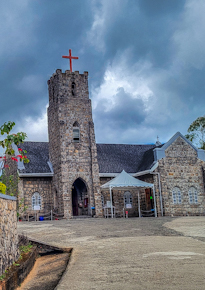
Christmas Church in Munnar

Not far from the school and high above it is an even older edifice. Completed and consecrated in 1911, this is the Church of South India’s Christ Church.  Built in a gothic style using local granite blocks, it is a grey coloured building, which, to my taste, is not particularly attractive.


Inside, this small church with its timber beamed roof has its own charm. Even though it was long after Twelfth Night  the church was gloriously colourful with its Christmas decorations still in place. A service was in progress. The number of people attending was under twenty. 


The church has a few stained glass windows and several plaques commemorating Brits who were associated with Munnar. One white marble memorial commemorates Archibald William Lunel Vernede who died in Munnar in 1917, aged 67. For many years, he had been:  “Superintendent and District Magistrate of the Cardamom Hills”. These Hills are the part of the Western Ghats that includes Munnar.


Another memorial recalls a more recent death. That of Cecil Philip Gouldsbury, who was a tea planter in the High Range (near Munnar), and died in 1971. I did a little research,  and found that Cecil was born in Calcutta in 1886, and died in Wiltshire (UK).


Although not a great beauty, Christ Church is a functioning Church, one of the oldest surviving buildings in Munnar, and a place that evokes the colonial era in the town.


After our pleasant stroll during which we enjoyed seeing the varying verdant vistas, we rode back to our hotel in an autorickshaw.


[And now a minor gripe. In India, the three-wheeler cabs used to be, and are still often called ‘autorickshaws’. However, their drivers, seeing a European face, will refer to them as ‘tuk tuks’, the name by which they are known further east ( e.g. in Thailand). I prefer to call these vehicles autorickshaws, as I have been doing over more than 30 years of visiting India.]

Two languages in the tea gardens of Kerala

LYING IN THE WESTERN Ghats at 5200 feet above sea level, Munnar, surrounded by tea gardens (plantations), is in the Indian state of Kerala, whose official language is Malayalam. The town’s name is derived from both the Malayalam and the Tamil words meaning ‘three rivers’. Indeed, three rivers meet in the heart of the town.


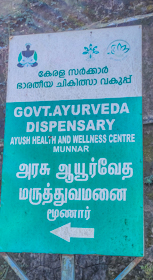
Top: Malayalam,  bottom: Tamil

Munnar is close to Kerala’s border with its neighbouring state Tamil Nadu. Since tea begun to be grown around Munnar in the 1880s, Tamils came to the district to work on the then British owned plantations. However, even before that there was a substantial number of Tamils living in the area that became Munnar in the early nineteenth century.


So, it is not surprising that there are plenty of Tamil speakers in the Munnar area. 44% of the population were Tamil speakers 2011; the rest were Malayalam speakers. During our first few hours after our arrival in Munnar, I noticed a large number of election posters. Many of these were either only in Tamil or, less frequently,  bilingual: Tamil a day Malayalam.


The man who drove us from Fort Kochi to Munnar, where he resides, told us that he is Tamil, not a Malayali. Also, he mentioned that in the flat coastal parts of Kerala, there are many Christians,  whereas in Munnar, people are mainly Hindu. This might well be the case, but in addition to a large mandir, I have seen several large churches and a large masjid in the town.


Within the state of Kerala,  Tamil speakers account for less than two percent of the population. Most of them live either around Munnar or around Palakkad.


As to whether the Tamils and Malayalis get on with one another in Munnar, I have no idea.

The warmth of a teamaker I’m a mosque garden in Istambul

THE KUCUK AYASOFIYA mosque in the European side of Istanbul was once a Byzantine church (construction commenced in 527 AD). It was converted to a mosque after the Ottomans took over Istanbul. In front of the mosque, there is a square garden with a pavilion in its centre. The garden is enclosed on three sides by cloister-like arcades, which contain small shops, a religious institution, craftsmen’s workshops, and a small café.

From the first day we arrived in Istanbul – a Monday, we visited the peaceful garden every evening to relax and enjoy glasses of Turkish tea. The tea was made by a man in his sixties, called Yavuz.

We kept returning to the garden every evening not only because of the tea, but to greet Yavuz. He was the sort of person you have to like. Despite not being able to speak Turkish, we felt the warmth of his personality. After a couple of days, he began greeting us as if we had known him forever. When he walked past our table, he would pat our shoulders in a friendly manner. He was a person, whom you could not help liking. He was warm and genuine.

On the Sunday following our arrival, Yavuz was not at the café. Someone else made our tea. We imagined that it was Yavuz’s day off. On the next day, he was not there. Someone else, whom we had met earlier at the café and spoke good English, was at the café that Monday. We asked him where Yavuz was. He told us quietly:
“He is no more. He died of a heart attack at the café late on Saturday night.”

We must have seen him only a few hours before he died. Although we had known him for less than a week, we were heartbroken. We felt as if we had lost a close friend or a much-loved relative.

Sadly, I never took a photograph of dear Yavuz. As we expected to see him during the rest of our trip, I had planned to ask him for his permission to take his picture later on. Even without a photograph, Yavuz will occupy an honoured place in our memories.

Tea makers and politicians in India

MY LATEST BOOK, “The Hitler Lock & Other Tales of India”, is mainly aboutmy very varied and fascinating experiences of travelling in India and only a little bit about Adolf Hitler. Here is a brief excerpt from the book:

Some say that when he was a young boy at school, India’s Prime Minister Narendra Modi helped in his family’s tea stall. Although he never became a chaiwallah, I have met one tea maker who became actively involved in politics. He was the owner of Chai Day Teahouse in Bangalore’s Johnson Market. I visited his establishment a couple of times in 2016, but when I looked for it four years later, it had disappeared.

Chai Day was more of a café than a tea stall. It had tables and chairs within its premises. What struck me immediately was that the walls of the seating area were covered with slogans, such as “Don’t promise when you are happy. Don’t reply when you are angry. Don’t decide when you are sad.”, and “We are not use less. We are used less”, and “Thanking you your faith for Syed Arif Bukhari.” The latter refers to the name of the owner, and the fact that he used to, and may still, put himself forward for election to positions, including MLA, in the Government of Karnataka. He told us that he is an independent and that his symbol is an electronic calculator. Just in case that is meaningless to you, I should explain that all political parties in India identify themselves with symbols as well as their names. For example, the Congress Party symbol is a raised right hand, and that of the BJP is a flowering lotus. This is done so that voters who have difficulty reading can find the party for which they want to vote. After chatting amiably with the charming Mr Bukhari, he said:

“If one chaiwallah can become a Prime Minister, maybe I can do the same.”

He might have been joking, but who can tell what the future will bring.

We are fond of drinking tiny cups of sweet, milky, often spiced, tea at the numerous tea stalls that can be found all over India.  During a visit to the Gujarati city of Baroda (Vadodara), we spoke to two tea makers one morning. One of them was a charming lady, who told us about the working life she led. She operates her stall from 630 am until 730 pm daily. She boils her tea with milk and spices on a gas ring, as do most other chaiwallahs. Each of her gas cylinders contain enough fuel (domestic LPG, which contains butane or propane or a mixture of them) to keep her stall going for 15 days.

The other chaiwallah we spoke with was Gopal. He has a tea stall near the entrance to one of the former pols (see below) of Vadodara. He works from 10 am to 6 pm. His stall was very busy when we visited it that morning. It faces a peepal tree with numerous Hindu offerings around the base of its trunk. One of the daily offerings to the gods is the first cup of tea that Gopal makes each morning. Like many other chaiwallahs we have visited in Gujarat, Gopal adds fresh herbs and spices to his tea. That morning, he had large sprigs of mint leaves and bunches of lemon grass and ginger. He pounds the latter in a pestle and mortar. He told us that pounding the ginger releases more flavour than grating it, which is what many other tea makers do. I asked Gopal whether I could take photographs of him and his stall. He allowed me to do so. As we were leaving him, he told his customers proudly (in Gujarati):

“Our Prime Minister must go to the UK and USA to have his picture taken. See, people from the UK have come all the way from London to Vadodara to photograph me.”

[Note: A pol is an ancient form of gated community, built for protection, found in the historic centres of Varodara and (more prevalently) in Ahmedabad].

You can buy a copy of the book either as a paperback or as a Kindle e-book from Amazon:

A masterful academic qualification

MANY INDIANS STRIVE to gain a Master of Business Administration (‘MBA’) degree. I can say little or nothing about the merits of this academic qualification, but know many friends who have been awarded it.

A long time ago, soon after we married in Bangalore, we attended an engagement party held for one of our friends. During the evening, the priest who would eventually officiate at the marriage gave a speech. He spoke in English with a strong South Indian accent. He introduced the couple as follows:
“These two dear people are well-matched. He has a yem bee yay. And she has a yem bee yay…”
Just in case you did not make sense of that, ‘yem bee yay’, it is the way that many Bangaloreans would pronounce ‘MBA ‘.

This distant memory of our friends’ engagement party was prompted by noticing a tea shop on Bangalore’s St Marks Road. It is named “MBA CHAI WALA”. Above the name are the words “India’s Most Iconic Chai Wala”. As we were in a hurry on our last day in Bangalore, we had neither the chance to sample a cup of tea nor to discover whether the place had anything to do with the MBA degree. On our next trip to Bangalore, I will investigate and get back to you.

Not my cup of tea

BEFORE REACHING MADEIRA, many people insisted that we should visit Reid’s Hotel in Funchal and to take afternoon tea there.

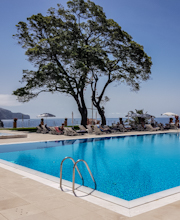
Pool at Reid’s Hotel in Madeira

Located in the western part of Funchal,  Reid’s was founded by William Reid, a Scotsman who arrived in Madeira in 1836. The hotel was his idea but he died before it was completed (in 1891). The massive seafront establishment was designed by George Somers Clarke and John Thomas Micklethwaite. It is not great architecture.

Since its opening, the hotel has hosted many famous guests including Winston Churchill,  Albert Schweitzer, George Bernard Shaw, and Rainer Maria Rilke. Apart from its celebrated guests, the establishment is famed for its afternoon teas. We decided against partaking of this treat because it contains far too many sugary confections. We had morning coffee and a pot of tea by the swimming pools on a terrace overlooking the ocean. By Funchal standards, it was costly (10 euros) but not outrageously so.

Undoubtedly, Reid’s is luxurious with good service. Its position overlooking a rocky cove is superb even though it is located in a part of Funchal, which resembles unexciting slightly upmarket seaside resorts on Italy’s Adriatic coast. However, the well-appointed hotel seemed somewhat sterile. If sun and sea is your top priority, then Reid’s is the place to go if you can afford it. However, it lacks the charm of other places in Funchal.

Well, we did visit Reid’s as people had suggested before we left London but I must say that it is not my ‘cup of tea’.

Honey for tea and death in Greece

THE SHORT-LIVED POET Rupert Brooke (1887-1915) lived outside Cambridge in the nearby village of Grantchester, where he rented a room in The Old Vicarage between 1909 and 1912. In May of 1912, Brooke was sitting in the Café des Westens in Berlin and feeling nostalgic about his life in Grantchester. He put pen to paper and composed his poem “The Old Vicarage, Grantchester.” Clearly fed up with Berlin, the poet begins the final verse of his poem with:

“God! I will pack, and take a train,        

And get me to England once again!       

For England’s the one land, I know,      

Where men with Splendid Hearts may go;                

And Cambridgeshire, of all England,     

The shire for Men who Understand;      

And of that district I prefer        

The lovely hamlet Grantchester…”

The final verse ends with the famous lines:

“The lies, and truths, and pain?… oh! yet          

Stands the Church clock at ten to three?     

And is there honey still for tea?”

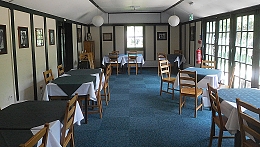
Inside the old pavilion at the Orchard in Grantchester

Having recently visited Grantchester, I can sympathise with Brooke’s desire to return to this charming village whose meadows run along the bank of the winding River Cam. The parish church of St Mary and St Andrew contains structures created as early as the 12th century, but most of the building dates from the 14th and 15th centuries. The west tower is mainly early 15th century. The clock on it no longer stands at ten to three, but it was stuck at that hour during the era when Brooke was in Grantchester.

The Orchard, which lies across the High Street from the church and between it and the meadows by the river, was planted in 1868. Before moving into the Old Vicarage, Brooke had lodged in a house in The Orchard. In 1897, a group of Cambridge University students asked Mrs Stevenson of Orchard House if they could enjoy tea under the blossoming trees. Thus began The Orchard Tea Gardens, now a popular haunt of students and tourists. Because of the unreliability of the English weather, a wooden pavilion was built at the end of the 19th century. In case of rain, tea drinkers could sit in the pavilion and enjoy their tea without getting soaked. Rupert Brooke was one of those, who used this place often. The Orchard’s website (www.theorchardteagarden.co.uk/history-new/) noted:

In taking tea at the Orchard, you are joining an impressive group of luminaries including Rupert Brooke (poet), Virginia Woolf (author), Maynard Keynes (economist), Bertrand Russell (philosopher), Ludwig Wittgenstein (philosopher), Alan Turing (inventor of the computer), Ernest Rutherford (split the atom), Crick and Watson (discovered DNA), Stephen Hawking (theoretical physicist, cosmologist and author), Jocelyn Bell (discovered the first pulsar) and HRH Prince Charles (future King of England). There is a list of some of the famous people who have visited in a separate page on our web site, and there are photographs of many of them on the walls of the Rupert Brooke Room.”

The Rupert Brooke Room was constructed later than the pavilion. The famous visitors included several noteworthy Indians including Jawaharlal Nehru, Salman Rushdie, and Manmohan Singh. There is a whole host of other well-known personalities who have taken tea at The Orchard including a group of Cambridge students, who achieved notoriety for their involvement in espionage for the Soviet Union: Anthony Blunt, Guy Burgess, John Cairncross, Donald Maclean, and Kim Philby.

As for Brooke’s question “And is there honey still for tea?”, I forgot to ask during our far too brief visit to The Orchard.  Brooke was commissioned into the Royal Naval Volunteer Reserve force at the outbreak of WWI. In early 1915, he set sail with the British Mediterranean Expeditionary Force. In late February, he developed a serious infection following an insect bite and despite the efforts of surgeons on a French hospital ship moored near the Greek island of Skyros, he died. He was buried in an olive grove on the island. In the churchyard of St Mary and St Andrew, Brooke’s name in carved on the church’s simple war memorial.

Dig weed

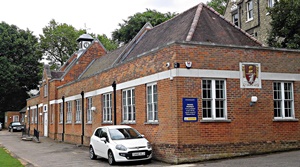
GATE 3e Old Highgate School changing rooms BLOG

HIGHGATE SCHOOL IN north London, like many other public (i.e. private) schools in the UK and far fewer state schools, operated (and might still do so) a Combined Cadet Force (CCF). The CCF was designed to provide military training to teenage schoolboys. It provided military experience that would allow its members, if they joined the forces, to advance up the ranks faster than young people who were recruited without this training. It helped give public school boys an earlier chance of commanding their fellow soldiers than those who had not been privileged to attend expensive private schools.

Highgate School had a well equipped CCF. There was an armoury, a drill hall, an assault course, and at least one member of staff dedicated to running the CCF. During the period I attended the school,1965 to 1970, many of our teachers had served in the armed forces during WW2. Some of them were involved with the school’s CCF.

Fortunately for me, participation in the CCF became voluntary instead of compulsory when I reached the age for joining it. I would have hated the discipline, the polishing of belts and boots, the physical activities, and wearing the uniforms made of scratchy materials.

The CCF training took place on Tuesday afternoons. When it ceased to be compulsory, the school decided that those who did not volunteer should spend Tuesday afternoons doing some kind of useful social work

I was first assigned to gardening duty, known as ‘digweed’. Along with another boy, we spent Tuesday afternoons in the garden of one of the boarding houses. Our mission was to clear the weeds from flower beds. Neither my companion nor I could distinguish a weed from a flower. The sight of the house master’s wife bringing us cups of milky tea and biscuits always marked the end of a pointless afternoon, which left the garden in a worse condition that when we arrived.

After a while, I was transferred to visiting the inmates of a local old age home, what is now called a ‘care home’. My task was to chat and cheer up the inmates sitting in high backed padded chairs around the walls of the large sitting room.

In my teens, I was not the chattiest of people. And, all o the elderly inmates except one, were either incapable or uninterested in responding to my attempts to engage them in conversation. The exception was a feisty lady, who was very talkative. The only problem was that she was not there every week. She told me that whenever she was able, she escaped from the home and enjoyed herself until the police brought her back.

One afternoon, I rang the doorbell of the home. When the doors were opened, but only a little, I caught a glimpse of a coffin standing on a trolley in the dimly lit hallway. The matron told me that it would be best that I came back the following week. I had a free afternoon that day.

At some point the school decided that those who did not join the CCF should become members of the newly formed Basic Unit. Instead of wearing miltary uniforms we wore track suits. We spent time ‘square bashing’ or military style drill. I was hopeless at this, turning left when I was supposed to be turning the other way, and not moving in time with the other members of the unit.

One day during Basic Unit, we had to attempt the school’s military assault course. At one place on this, we had to scramble up two metal pipes to reach the flat roof of a seven foot high concrete block house and then to jump off it. I reached the roof, but refused to jump down. I remained up there until the other hundred or so boys had completed the course and were in position for some more drill before the afternoon ended. In desperation, the supervising teachers pleaded with me to jump down otherwise nobody else would be allowed to go home. I told them that did not bother me nor would I jump down. In the end, I was helped down so that the session could be brought to an end.

The best and most enjoyable Tuesday afternoon activity I did was during my last two years at Highgate. I worked as an assistant at the now long since closed New End Hospital in Hampstead. But, more about that another time!

Picture shows the concrete area where the Basic Unit trained

In the footsteps of the ancients

OSTIA ANTICA, THE PORT of Ancient Rome is constructed mainly with baked clay bricks. When I visited it some years ago, I remember thinking that it looked like a recently built place because of the brickwork that looked so contemporary. Ostia dates back no further than the 4th century BC. The port at Lothal in Gujarat (western India) thrived long before Ostia, probably between 2500 and 1900 BC, but like the Roman port, the remains of Lothal are mainly (sun baked) clay bricks, giving them a far from ancient appearance. Lothal, excavated in the 1950s, was a port inhabited by people of the Bronze Age Harrapan (or Indus Valley) civilisation that thrived between about 3300 to 1300 BC.

We drove to Lothal from Ahmedabad along a good highway that runs through flat landscape with numerous tidy looking factories. We arrived after about 75 minutes of steady driving. The archaeological site, maintained by the Archaeological Survey of India (ASI), is in the middle of very flat fertile agricultural land far from the nearest village. Unlike most other ASI sites that charge an entrance fee, that at Lothal is the same for both foreigners, who are usually charged a high fee and Indians. Each ticket cost only 5 Rupees.

The ticket gives access to a small but well laid out museum, whose exhibitsand information panels demonstrate how Lothal fits into current understanding of Harappan civilisation and what life might have been like in the ancient port. A fairly simplistic video was shown. It concentrated mainly on Mohenjo-Daro, a large Harappan site now in Pakistan. The evidence dug up at Lothal and other Harappan sites shows that the civilisation was both technically and artistically sophisticated. On display, were systems of weights and ingeniously crafted fine jewellery, both examples of products that could only have been produced by people of great intellectual ability.

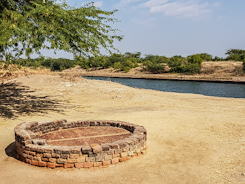
The ruins are, as already mentioned, mostly made of brick. A low mound, known as the ‘Acropolis’, is covered with structures that might have been warehouses or residences of the upper echelons of Lothal. The mound overlooks what looks like a huge rectangular brick lined swimming pool, now filled with rainwater. When Lothal was thriving, this dock was connected to the nearby sea (now the Gulf of Khambat) by a channel along which vessels could sail. Over the millennia, the coastline has shifted and what was once Lothal is separated from the sea, far away from it. The ASI keep the dock filled with rainwater to show what the dock must have looked like in its heyday.

Various other structures outlined by brickwork, including circular wellheads, can be visited. These include the former bead factory, a cemetery (where all the skeletons discovered were from people who died aged 30 or less; maybe older people were cremated), and a ‘lower town’. What little that has been excavated is well looked after, but without the explanations provided in the museum the casual visitor would have no idea of what he or she was seeing or how ancient these remains are. With a little background information it was thrilling to walk in the footsteps of townsfolk and traders who lived and thrived so many, many years before us.

We met only three other visitors while wandering around the ruins. They were all from Bangalore. They were touring Gujarat but lamented the fact that most signs are only in Gujarati script. In Karnataka, where they live and where we visit often, signs are often not only in the local script but also in English and/or Hindi.

There are no refreshments available at the Lothal site. An employee suggested that we might get tea in the modern village of Lothal, a few kilometres away. Our driver had his doubts about this and so did I when we drove along the winding dusty road through the small village. There were no shops or stalls to be found.

We parked outside a pair of wrought iron gates separating two houses. A lady appeared in the door of one of them, and my wife asked (in Gujarati) whether tea was available in the village. The lady said she would make some for us.

We followed her through the gates and into a long wide alley lined with houses. Two ladies were embroidering gold thread, jewels, and sequins onto long silk saris spread out along the incredibly clean concrete floor of the alley. Other ladies were sitting around.

Our hostess brought us each a plastic chair from her home. We sat chatting with the ladies while we awaited our tea. The alley was lined with houses that a farmer had built for his sons. Each of the ladies was one of his daughters in law.

Our hostess arrived with a large metal cup filled with tea and two china saucers. Each of us was handed a saucer, which she filled with hot tea. We slurped the tea from the saucers as is the custom when sharing tea in Gujarat (often one person drinks from a cup and the other who is sharing it drinks from the saucer: a system known as ‘cutting chai’).

The ladies doing the embroidery take about a day to decorate a whole sari with a complex design. The silk is sent to Lothal from Surat, where the decorated saris are later sold. An old lady with barely one tooth in her smile, the mother in law of the women we were talking with, joined us. This wizened relative asked if it was true that a man’s haircut would cost 1000 rupees in the USA, as she had seen on YouTube. We told her that it would cost at least that. She was then told to go back to rest on her charpoy in the nearby farmyard.

We asked where the menfolk were. They answered: “In the fields. What else could they be doing?”

Our hostess, who seemed to be the brightest of the very hospitable women, took us to see the cow whose milk had been used to make our tea. We thsnked her calf for sharing his mothers milk. She also proudly showed us the two fine horses the family owned.

Just before we left, my wife asked our hostess whether we could leave a small gift for her children. She said that they were at school and there was no need for a gift. She told us that she was very keen that they should do well at school, and hoped that they would be able to study in the USA, because she said: “There is no future for them, nothing here anymore.”

As we drove away from our new acquaintances through the village, people waved to us. We waved at three old men on a bench. They waved back. We felt that we had received a warm welcome at ground level in Gujarat.